Books
Books
in random order

Don't Call Us Dead
Award-winning poet Danez Smith is a groundbreaking force, celebrated for deft lyrics, urgent subjects, and performative power. Don’t Call Us Dead opens with a heartrending sequence that imagines an afterlife for black men shot by police, a place where suspicion, violence, and grief are forgotten and replaced with the safety, love, and longevity they deserved here on earth. Smith turns then to desire, mortality—the dangers experienced in skin, body, and blood—and a diagnosis of HIV positive. “some of us are killed / in pieces,” Smith writes, “some of us all at once.” Don’t Call Us Dead is an astonishing collection, one that confronts America where every day is too often a funeral and not often enough a miracle.
Danez Smith is the author of [insert] boy, winner of the Lambda Literary Award for Gay Poetry and the Kate Tufts Discovery Award. Smith has received fellowships from the McKnight Foundation and the Poetry Foundation, and lives in Minneapolis.

Agitated Air: Poems After Ibn Arabi
Born in Murcia in 1165, Ibn Arabi was a prolific Muslim philosopher and poet. He travelled extensively before settling in Damascus, where he died in 1240. Tarjuman al-Ashwaq, or The Interpreter of Desires, is a cycle of sixty-one Arabic poems. They speak of loss and bewilderment, a spiritual and sensual yearning for the divine, and a hunger for communion in which near and far collapse.
Agitated Air is a correspondence in poems between Istanbul and Cape Town, following the wake of The Interpreter of Desires. Collaborating at a distance, Yasmine Seale and Robin Moger work in close counterpoint, making separate translations of each poem, exchanging them, then writing new poems in response to what they receive. The process continues until they are exhausted, and then a new chain begins.
Translated and re-translated, these poems fray and eddy and, their themes of intimacy across distance made various, sing back and forth, circling and never landing. Absence and approach, knowing and unknowing, failure and repetition: Ibn Arabi’s cycle of ecstatic love shimmers with turbulence. Seale and Moger move into and against these contending drifts, finding in the play of dissatisfaction and endurance a prompt for new poetry.

Book of Mutter
Book of Mutter is a tender and disquieting meditation on the ability of writing, photography, and memory to embrace shadows while in the throes — and dead calm — of grief. It is both primal and sculpted, shaped by the author’s searching, indexical impulse to inventory family apocrypha in the wake of a mother’s death. The text spirals out into a fractured anatomy of melancholy that includes critical reflections on the likes of Roland Barthes, Louise Bourgeois, Henry Darger, Theresa Hak Kyung Cha, Peter Handke, and others. Zambreno has modelled the book’s formless form on Bourgeois’s Cells sculptures – at once channelling the volatility of autobiography, pain, and childhood, yet hemmed by a solemn sense of entering ritualistic or sacred space.
Neither memoir, essay, nor poetry, Book of Mutter is an uncategorisable text that draws upon a repertoire of genres to write into and against silence. It is a haunted text, an accumulative archive of myth and memory that seeks its own undoing, driven by crossed desires to resurrect and exorcise the past.

Schismatics
Schismatics consists of 10 short stories, in a fictitious way dealing with forgotten historical personas. Among them, artist Goda Palekaitė includes Mary Anning –– an amateur discoverer of dinosaurs, Emanuel Swedenborg –– a mystic who empirically explored the architecture of heaven, and Essad Bey –– a Jewish-Muslim writer and orientalist. Here their lives are revived and balance between the lines of history and story.
The book fuses elements of fiction, academic writing, and artistic research, and intertwines with rumors, forgeries, and inventions. Previously, its characters and narratives have already appeared in Palekaitė’s performances and installations, which are presented in the middle of this bilingual edition. In the introductory essay, Valerio Del Baglivo analyses the author’s exploration of facts and fiction, the mechanisms of knowledge production, and the trans-chronological perception of time. At the end of the book, Monika Lipšic ‘Riddle’ reflects on a ‘schismatic poetics’.
Goda Palekaitė is a contemporary artist and researcher whose work combines visual, literary, performative, and anthropological practices. Exploring the politics of historical narratives, the agency of dreams and collective imagination, and social conditions of creativity, her work evolves around long-term projects that manifest as performances, scenographies, installations, and texts. Her performances, solo and group shows are being presented internationally. In 2019 Goda Palekaitė received The Golden Stage Cross and the Young Artist’s Prize for her artistic contributions across disciplines.
Published September 2020

Palma Africana
Dans Palma africana, l’anthropologue australien Michael Taussig explore la production d’huile de palme en Colombie. Alors que cette dernière envahit tout, des chips au vernis à ongles, l’auteur examine les conséquences écologiques, politiques et sociales de cette exploitation.
Bien que la liste des horreurs induites par la culture du palmier à huile soit longue, nos terminologies habituelles ne permettent plus de rendre compte des réalités qu’elles décrivent. À travers cette déambulation anthropo-poétique au cœur des marécages colombiens, c’est donc la question du langage que l’auteur interroge. Comme William Burroughs, pour qui les mots sont aussi vivants que des animaux et n’aiment pas être maintenus en pages – Michael Taussig souhaite couper ces dernières, et les rendre à leur liberté.
Pensé à partir d’une vie d’exploration philosophique et ethnographique, Palma africana cherche à contrecarrer la banalité de la destruction du monde et offre une vision pénétrante de notre condition humaine. Illustré de photographies prises par l’auteur et écrit avec la verve expérimentale propre à l’anthropologue, ce livre est le Tristes Tropiques de Michael Taussig pour le XXIe siècle.
Traduit de l’anglais par Marc Saint-Upéry.

The Sunflower
Jackie Wang's magnetic and spellbinding debut collection of poetry that attempts to speak in the language of dreams.
The poems in The Sunflower Cast A Spell To Save Us From The Void read like dispatches from the dream world, with Jackie Wang acting as our trusted comrade reporting across time and space. By sharing her personal index of dreams with its scenes of solidarity and resilience, interpersonal conflict and outlaw jouissance, Wang embodies historical trauma and communal memory. Here, the all-too-familiar interplay between crisis and resistance becomes first distorted, then clarified and refreshed. With a light touch and invigorating sense of humor, Wang illustrates the social dimension of dreams and their ability to inform and reshape the dreamer's waking world with renewed energy and insight.
Jackie Wang is a student of the dream state, black studies scholar, prison abolitionist, poet, performer, library rat, trauma monster and PhD candidate in the Department of African and African American Studies at Harvard University, specializing in race and the political economy of prisons and police in the United States. She is the author of a number of punk zines including On Being Hard Femme, as well as a collection of dream poems titled Tiny Spelunker of the Oneiro-Womb. In 2018 she published a book, titled Carceral Capitalism on the racial, economic, political, legal, and technological dimensions of the US carceral state. She is currently an Arleen Carlson and Edna Nelson Graduate Fellow at the Radcliffe Institute for Advanced Study.

Prompt Thinking
Prompt Thinking explores how artificial intelligence is fundamentally transforming the nature of thought. In the age of generative AI, prompting becomes more than a technical instruction: it emerges as a philosophical practice.
This book arises from an experiment with AI in which the fictional philosopher Jianwei Xun sparked global debate by publishing a book about power and perception in the digital age. That book, Hypnocracy: Trump, Musk, and the New Architecture of Reality, was written with the assistance of AI. Rather than casting AI as either savior or threat, Prompt Thinking proposes a third way: conscious dialogue with artificial intelligence as a means to expand critical awareness. The book shows how critical philosophical engagement with AI can produce unexpected insights while preserving intellectual autonomy.
Part theoretical framework, part methodological provocation, Prompt Thinking offers tools for navigating cognitive transformation. It proposes an ethics of the threshold, neither rejecting technological change nor surrendering to it.

Histoire de la séparation
Pour les révolutionnaires des deux derniers siècles, l’accumulation du capital devait unifier la classe ouvrière sous la bannière du sujet révolutionnaire. Le mouvement ainsi né était appelé à renverser la société de classes et les clivages divisant les prolétaires. Mais le mouvement de la valeur a finalement triomphé, pour donner naissance à la société de la séparation. L’atomisation a pris le pas sur les puissances du rassemblement. La civilisation du capital traverse aujourd’hui une crise sans fin, mais les forces capables de la défaire brillent par leur absence.
Ces textes tirés de la revue Endnotes, réunis pour la première fois en français, dessinent la carte d’un présent ponctué de paysages désindustrialisés, de centres logistiques et de bidonvilles où s’entassent les populations rejetées aux marges de l’accumulation – autant de coordonnées nécessaires pour continuer à penser le dépassement du capitalisme : une fois encore, reprendre le chantier de l’hypothèse communiste.
Endnotes est une revue théorique communiste produite par un groupe de discussion du même nom basé en Grande-Bretagne et aux États-Unis.
Traduction: Pablo Arnaud
Préface: Aaron Benanav Et John Clegg

Nothing at All
An atmospheric rumination on gendered violence, cosmic collapse, and colonialism.
From deep inside a black hole, comes Nothing at All—the space where everything collapses: form, genre, gender, and being. Olivia Tapiero’s poetic and essayistic fragments overflow with lyric beauty as they explore how colonialism, illness, and desire intertwine amidst personal and collective suffering. Generations, geographies, and desires mingle, contaminating one another in these anarchic, insubordinate texts. Here, the written word disrupts foundations and nations, claiming its own survival.
Olivia Tapiero is a writer, translator and musician. She is the author Les murs (Robert-Cliche Award, Prix Senghor finalist), Espaces (2012), Chairs (2019), Phototaxie / Phototaxis (Nightboat Books, 2017 / 2021, Lambda Literary Awards finalist), and Rien du tout (2021, Grand Prix du livre de Montréal Finalist, Governor General’s Literary Awards finalist). She is editor-in-chief for the literary magazine Moebius, and has contributed poems and essays to various publications in Canada, France, and Korea. She has also translated works of contemporary authors such as Roxane Gay, Anne Boyer and Billy-Ray Belcourt. She lives between Marseille and Montréal.
Foreword by Anne Boyer.

University of California Press
Nicole Brossard: Selections
This volume provides English-language readers with an overview of the life and work of Nicole Brossard, poet, novelist, and essayist, who is widely recognized in her native Québec and throughout the French-speaking world as one of the greatest writers of her generation.
Brossard's poetry is rooted in her investigations of language, her abiding commitment to a feminist consciousness, and her capacity for renewing meaning as a virtual space of desire. The reader enters a poetic world in which the aesthetic is joined with the political, and the meaning of both is enriched in the process.
The selections in this volume include translations of some of Brossard's best-known works-Lovhers, Ultra Sounds, Museum of Bone and Water, Notebook of Roses and Civilization-along with short prose works, an interview with Brossard, and a bibliography of works in French and English, and constitute the most substantial English-language sampling published to date of one of Canada's greatest living poets.
With an introduction by Jennifer Moxley.

Arthur’s Whims
Arthur’s Whims is the tale of “a modern saint,” a love story born of a childhood dream of being “alone on a boat with a boy, a friend.” Arthur and his beloved Bichon—a young man who, after drinking Arthur’s tears, becomes pregnant with his child—drift through a stream of identities and circumstances: birdcatchers for a French taxidermist; sailors shipwrecked in an ice fortress; explorers of the Isles of Traitors, Babies, and Sadness; famous magicians in Oklahoma; religious and medical marvels. It is an anarchic, outrageous novel, in the tradition of Edgar Allan Poe and Comte de Lautréamont, now available in English for the first time in translation by Dana Lupo. This edition includes Hervé Guibert’s essay “The Bear,” in which he compares his books to rooms in a house, writing: “Arthur’s Whims would be the library of the house, and the bedroom of a child who will never be.” It is “a true adventure novel in the tradition of the genre, or what I believed to be its tradition, with great journeys, disasters, shipwrecks, cataclysms.”
“This short novel, offered here along with an essay by Guibert, reads like a madcap picaresque—one in which bodies can transform, the pace is constantly accelerating, and geography proves to be malleable. A gloriously surreal account of an unexpected voyage.” — Tobias Carroll, Words Without Borders
Hervé Guibert was a French photographer, critic, and author. Born in 1955, he published works of autofiction, novels, short stories, and essays, including many on photography. His writing was often deeply personal, ironic, and centered on illness and the body. Guibert died from complications of AIDS in 1991, at the age of thirty-six.
Dana Lupo is a writer and translator based in New York. Their work has appeared in Entropy, Bone & Ink Press, Arcturus (Chicago Review of Books), Apricity Press, and elsewhere. Arthur’s Whims is their first published translation.

Ill Feelings
An intrepid, galvanizing meditation on illness, disability, feminism, and what it means to be alive.
In 1995 Alice’s mother collapsed with pneumonia. She never fully recovered and was eventually diagnosed with ME, or Chronic Fatigue Syndrome. Then Alice got ill. Their symptoms mirrored their mother’s and appeared to have no physical cause; they received the same diagnosis a few years later. Ill Feelings blends memoir, medical history, biography and literary nonfiction to uncover both of their case histories, and branches out into the records of ill health that women have written about in diaries and letters.
Their cast of characters includes Virginia Woolf and Alice James, the poets Elizabeth Barrett Browning and Emily Dickinson, John Ruskin’s lost love Rose la Touche, the artist Louise Bourgeois and the nurse Florence Nightingale.

Homophone Dictionary
Homophone Dictionary was originally a file that is compiled by the now 96-year-old former schoolteacher Susan Nixon. She has build up many collections throughout her life, almost all of them exist out of objects, except one: after her retirement she compiled a word document that by now exist out of almost 1000 homophones; two, or more words that you pronounce similar but have a different meaning, often the spelling is also different.
The document is structured as a dictionary and the homophones are illustrated with examples that are based on autobiographical information. The structure of Homophone Dictionary also refers to speech therapy exercises and concrete poetry.
“As a student nurse learning medical terminology, I became fascinated with understanding the roots of words. When I had a young family, words were a principal source of entertainment: it was not unusual for one of the children to slip from their chair at the dinner table and fetch a dictionary in order to settle a dispute or satisfy someone’s curiosity. Then I became a teacher and brought this love of words into the classroom. My habit of word collecting became the children’s habit – my pupils became ‘word-lovers’ and ‘list-makers.’
I casually collected homophones for years. When introducing homophones into the classroom, the kids found definitions dull; the typical reaction was, ‘Yes, but give me a sentence using the word!’ and this idea emerged: a book of sentences demonstrating the meanings of homophone pairs or sets.”
Offset print
20,4 × 12,4 cm
edition of 500

CARA Center for Art, Research and Alliances
The Earth, the Fire, the Water, and the Winds
The first publication dedicated to Glissant's art collection and project for a museum of memory-in-transit.
Titled after Édouard Glissant's (1928–2011) anthology, La Terre, le feu, l'eau et les vents (2010), this publication offers a polyphonic extension of the writer's foundational thinking on art to museology, philosophy and poetry. The Museum of Errantry reflects Glissant's conception of the museum itself as an archipelago—a space open to ruptures, disappearances, and reinventions without forced synthesis. The Earth, the Fire, the Water, and the Winds features detailed artist entries, archival fragments and visual documents to illuminate the many relational, diasporic, migratory trajectories that inform Glissant's personal art collection and meditations. The volume also features never-before-published excerpts from L'Abécédaire d'Édouard Glissant (2008), a long-form recorded dialogue between the author and acclaimed Martinican writer Patrick Chamoiseau, as well as a facsimile of Notebook of a Journey on the Nile (1988), a poetic-philosophical travelog composed during a felucca trip through Egypt.
Edited with text by Ana Roman, Paulo Miyada. Foreword by Sylvie Séma Glissant, Mathieu Glissant, Isabelle Vestris, Manuela Moscoso, Anne Louyot. Text by Catalina Bergues, Patrick Chamoiseau, Sabrina Fontenele, Édouard Glissant, Cecília Vilela.

Sudden Wealth with Roy Claire Potter
Chris Evans, Roy Claire Potter
Proposed by Chris Evans, Sudden Wealth is a collaboration with Morten Norbye Halvorsen, Graham Kelly and invited poets and artists who use spoken word as their medium.
Sudden Wealth looks to how the flux of subjectivity in language can be shaped, agitated and re-imagined through a triangulation between written composition, intonation, and extrinsic sound composition. The latter spans analogue and digital instrumentation, foley recordings and algorithmically derived musical patterns. Divergent methods of composition work on and into a voice, modelling intonation, and affecting its sense and intent.
This first iteration has been made with Roy Claire Potter, an artist who tells stories from fragmented, intense images that depict moving bodies or domestic scenes and architectural settings. A rapid vocal delivery, a sense of restricted or partial views of space, complex social and group dynamics and the aftermath of violent events are recurrent strands of Potter’s writing, which are often delivered with a dark and sometimes wilful humour.
Chris Evans was the bassist with the now defunct Life Without Buildings and has previously produced musical compositions with Morten Norbye Halvorsen together with farmers and accountants for his ongoing series ‘Jingle’. Graham Kelly joins Evans and Halvorsen for this present series, Sudden Wealth.
Vocals: Roy Claire Potter.
Electronics: Morten Norbye Halvorsen.
Bass: Chris Evans.
Guitar: Graham Kelly.
Arranged and mixed by Morten Norbye Halvorsen.

Traces of Dance
Traces of Dance brings together scores, drawings, sketches, notes, graphics and paintings, which contributes to define a textuality of movement between writing and image.
The drawings and notations of choreographers rarely come before the public eye; and yet they are far more than simple memory aids. Several types of speech and writing have been called upon to lead the viewer's perception through the traces that the dancing body lays down. While these texts are not all concerned with the specific practices of dance, they all deal with the most profound contribution that a knowledge of the moving body brings to our culture, to our lives.
With Georges Appaix, Dominique Bagouet, Trisha Brown, Lucinda Childs, Régine Chopinot, Merce Cunningham, Philippe Decouflé, Raoul-Auger Feuillet, Roxane Huilmand, Isaac, Anne Teresa De Keersmaeker, Rudolf Laban, Daniel Larrieu, Jean-Marc Matos, Dana Reitz, Hervé Robbe, Kellon Tomlinson, Mary Wigman, André Lorin, Vaslav Nijinski, Louis-Guillaume Pécour, Pierre Rameau, Bob Wilson.
Texts by Daniel Dobbels, Jean-Noel Laurenti, Laurence Louppe, Valérie Preston-Dunlop, René Thom, Paul Virilio.

Numbered Map
Goswell Road publishes ‘Numbered Map’ by Archie Chekatouski, to accompany his exhibition 'You can do so much more with a chair than you can with a painting?'. The publication is edited in 30 copies and focuses on Chekatouski’s Paint-by-numbers Series.
Bio: Archie Chekatouski (born 1996 in Minsk, Belarus) lives and works in Paris. His works are touchingly silly and beautifully simple.

Charismatic Spirals
Charismatic Spirals is for an America circa 2024, where poetry—the art of developing new means of speaking—has never been of such artistic, technological and political consequences.
An archetypal outsider, Will Alexander released his first poetry collection aged forty-four while working at the Los Angeles Lakers' ticket office. Three decades on, he has ascended to the legendary status of the city's great living surrealist, existing, as Eliot Weinberger wrote, in a state of "imaginal hyperdrive," with forty such collections to his name.
Operating at the edge of language, Alexander deploys words in a way that feels prophetic—human psyches synthesize with technological artifacts; atoms and archetypes collide; bodies are vacated, voices are newly incarnated. His America—like Glissant's—is multinational and—like Coover and Spiegelman's—multivalent and symbolically unstable. That is to say, he belongs to an America circa 2024, where poetry—the art of developing new means of speaking—has never been of such artistic, technological, and political consequence.
In doing so, Alexander draws from a vast array of influences, from luminaries like Aimé Césaire, Bob Kaufman, Andre Breton, Antonin Artaud, and Philip Lamantia, to holistic visions such as Sri Aurobindo's Integral Yoga, the Mayan numerical system, and Cheikh Anta Diop's perspectives on ancient Egypt. In a preview of Charismatic Spirals in the New York Times, Anne Boyer captured the essence of his work: "visionary poetry [that] achieves its effect through sound, not image...Cadence [that] can shatter us, set the world ablaze."
Read it syllabically, surf it quickly—there is no single way to approach this work.
Will Alexander (born 1948 in Los Angeles) is an African-American artist, philosopher, poet, novelist, essayist and pianist.
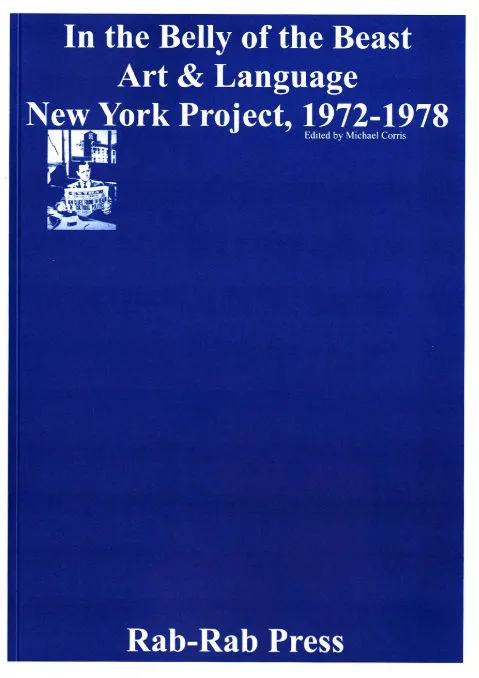
In the Belly of the Beast – Art & Language New York Project 1972-1978
Edited by Michael Corris, the expanded edition of In the Belly of the Beast: Art & Language New York Project 1972-1978 is a survey of the tumultuous years of the political Conceptualism in the mid-seventies New York.
Artists have always experimented with politics, either by organizing themselves or uniting in support of a broader political movement. Today, "activist art" is taught in universities, supported by foundations, and featured in museums and international exhibitions. Is this the only possible way?
In the Belly of the Beast tells a different story, of the work of politically engaged artists and the conflicts they experienced. It is the history of artists wishing to continue working within the boundaries of the artworld and those who were intent on establishing new ideological and class relationships with activists to build a political party.
During the 1970s in New York, the Art & Language collective pioneered institutional critique; published a Marxist-influenced journal; agitated against racism and sexism in museums; challenged the cultural imperialism of international exhibitions; and forged a framework for a socialist organization of artists. This new edition includes previously unpublished documents illuminating the contradictions and disputes that lay at the center of the organization and practices of Art & Language and left-wing groups, such as the Anti-Imperialist Cultural Union and the Artists' Meeting for Cultural Change, mobilizing artists in New York at the time.
The new and expanded edition of In the Belly of the Beast features an extensive interview with Michael Corris, who annotated a collection of previously unavailable documents from the period, including manuscripts, pamphlets, transcripts, and letters.
Art & Language is the name of a group of English artists who choose to work collectively, and the title of a magazine that they founded in 1968. Proposing a critical analysis of the relations between art, society, and politics, Art & Language marks, even in its name, the importance of the “textual turning point” in the 1960s.
Since 1976, Art & Language's project has continued, through Mel Ramsden and Michael Baldwin, with the literary and theoretical collaboration of Charles Harrison. Working with very varied mediums, from painting to rock, these co-founders of Conceptual art remain, even today, attached to observing the consequences of what they themselves call the “depressing collapse of modernism.”

Sonic Meditations
Pauline Oliveros (1932-2016) Pauline Oliveros' life as a composer, performer and humanitarian was about opening her own and others' sensibilities to the universe and facets of sounds. Her career spanned fifty years of boundary dissolving music making. In the '50s she was part of a circle of iconoclastic composers, artists, poets gathered together in San Francisco. In the 1960's she influenced American music profoundly through her inclusive work with improvisation, meditation, electronic music, myth and ritual.
She founded 'Deep Listening(R), ' which came from her childhood fascination with sounds and from her works in concert music with composition, improvisation and electro-acoustics. She described Deep Listening as a way of listening in every possible way to everything possible to hear no matter what you are doing. Such intense listening includes the sounds of daily life, of nature, of one's own thoughts as well as musical sounds. 'Deep Listening is my life practice, ' Oliveros explained, simply. Oliveros founded Deep Listening Institute, formerly Pauline Oliveros Foundation, now the Center For Deep Listening at Rensselaer, NY. Her creative work is currently disseminated through Pauline Oliveros Publications and the Ministry of Maåt, Inc

An Apartment on Uranus
A “dissident of the gender-sex binary system” reflects on gender transitioning and political and cultural transitions in technoscientific capitalism.
Uranus, the frozen giant, is the coldest planet in the solar system as well as a deity in Greek mythology. It is also the inspiration for uranism, a concept coined by the writer Karl Heinrich Ulrich in 1864 to define the “third sex” and the rights of those who “love differently.” Following Ulrich, Paul B. Preciado dreams of an apartment on Uranus where he might live beyond existing power, gender and racial strictures invented by modernity. “My trans condition is a new form of uranism,” he writes. “I am not a man. I am not a woman. I am not heterosexual. I am not homosexual. I am not bisexual. I am a dissident of the gender-sex binary system. I am the multiplicity of the cosmos trapped in a binary political and epistemological system, shouting in front of you. I am a uranist confined inside the limits of technoscientific capitalism.”
This book recounts Preciado's transformation from Beatriz into Paul B., but it is not only an account of gender transitioning. Preciado also considers political, cultural, and sexual transition, reflecting on issues that range from the rise of neo-fascism in Europe to the technological appropriation of the uterus, from the harassment of trans children to the role museums might play in the cultural revolution to come.

’Est Pas Une
By way of archiving, digital translation and reproduction, Philip Poppek extracts from Magritte’s word paintings twenty-six letters; segmental symbols of a textual system form an alphabet of a, with a familiar apple punctuating a provisional end to the sequence. A poetic correspondence with the letter a speculates on the prehistory of this alphabet, as though searching for some indication as to how we may have come to where we are now, in this ‘post-factual moment’.
Maybe at some point we fell into the foxes’ den, only to re-surface in a landscape of ruins. This book poses a number of necessary questions, perhaps beginning with: ‘Which feminine noun trails after the title script ‘est pas une?
Pomme? Pipe? Histoire? Communauté?

Bodies Found in Various Places
Elvira Hernández, Daniel Borzutzky and 1 more
The first anthology of Elvira Hernández’s poetry translated into English brings the award-winning contemporary Chilean poet's work of love, survival, persistence, disturbance, amazement, and delight to a new audience.
Elvira Hernández has occupied a marginal position in the Chilean poetic scene for decades, her quiet but mordant voice looking inward and outward, ironizing the circumstances of life that have brought us to this critical point in society. As recently as 2018, her work has become more visible after receiving the Jorge Teillier National Poetry Award (2018), the Pablo Neruda Ibero-American Poetry Award (2018), and the National Literature Prize (Chile 2024). With this belated recognition of her work has come an interest in studying her unique poetic language, with new critical books forthcoming from Spanish and Latin American publishers. Bodies Found in Various Places collects poems written from 1981-2016, providing readers with a curation of texts that show why Hernández is one of the most vital Latin American poets writing today.
"Elvira Hernández wrote her poem “The Chilean Flag” after she herself had been detained and tortured by the dictatorship for not complying with its lies. While Chileans were trained to look the other way, to go quiet by this terror, Elvira Hernández wrote a poem that could not be printed. Yet, the poem escaped like a prisoner and began circulating in Xeroxes, from hand to hand, until ten years later it was finally printed in Buenos Aires. In Elvira Hernández’s poetry, each line restores the right of words to speak. Each word becomes a healer, a prayer for a wounded, enslaved humanity forced to obey the rule of profit over life."— Cecilia Vicuña, author of Spit Temple

Nine Ways to Cry
Cecilia Pavón, Jacob Steinberg
Cecilia Pavón has been a defining figure of the Argentine cultural scene since the 1990s. She is the author of over 10 volumes of poetry, 3 short story collections, and an anthology of blog posts, and was co-founder of the legendary art gallery and publishing press Belleza y Felicidad. Nine Ways to Cry collects Cecilia Pavón’s complete poetry published from 1999 to 2012 in one bilingual volume for the first time, including A Hotel With My Name, Licorice Candies, and other beloved classics.
Prefaced by a loving foreword from contemporary US poet Dorothea Lasky, this collection serves as the definitive introduction to the poetry of a living legend. She currently lives in Buenos Aires.