Music & Sound
Music & Sound

Black Cine-Body Sonics: Racializing the Soundtrack
Black Cine-Body Sonics: Racializing the Soundtrack surveys how Black audiovisuality developed and thrives in films and television through importing and materializing the sonics of Black musical representation — from 'Blaxploitation' classics (Shaft and Truck Turner) to cine-auteurs (Melvin Van Peebles, Spike Lee and Jordan Peele) to music video performers (Michael Jackson, Beyoncé and Kendrick Lamar) to video artists (Arthur Jafa and Isaac Julien) to contemporary multi-genre explorations of race (Sinners, Lovecraft Country, Atlanta and Swarm). The book views Jazz Soul Funk Disco Hip Hop Techno and House not as 'source music' but as genetic origins in the transformation of movies and shows resulting in new cinematic and televisual formations — all of which foreground the body performance and musicality.
— Philip Brophy
This is the 4th publication in the Echoes of Dissent series, devoted to the politics of the soundtrack.

Slip-Syncs Collapse and Strange Unrealities in the films of Sogo/Gakuryu Ishii
You can talk about Ishii and music and you can talk about Ishii and sound. I want to talk about both. I want to talk about him as a node in a network of musicians and bands that starts with punk but spider webs out to ensnare post-punk industrial and ambient music with a brief free jazz cameo. I also want to talk about the way he uses sound rhythm and silence. This is not just about soundtrack. A soundtrack tends towards telling you something about what’s happening. Soundtracks tell you what to feel whether there is dread or romance or sadness in a scene. Not so for Ishii. For Ishii a soundtrack stands alone is a bed and is a moment but it doesn’t tell you how to feel. It is in Ishii's hands dislocation silencing or distortion of the cause-effect connection between the punch thrown and the punch landing between moving image and the sound that constructs the conceits of the cinema. "He attempted to find a visual equivalent to punk music," wrote critic Tom Mes. "A way to express the same philosophy and spirit with a camera instead of a guitar.”
— Jennifer Lucy Allan
This is the 3rd publication in the Echoes of Dissent series, devoted to the politics of the soundtrack.
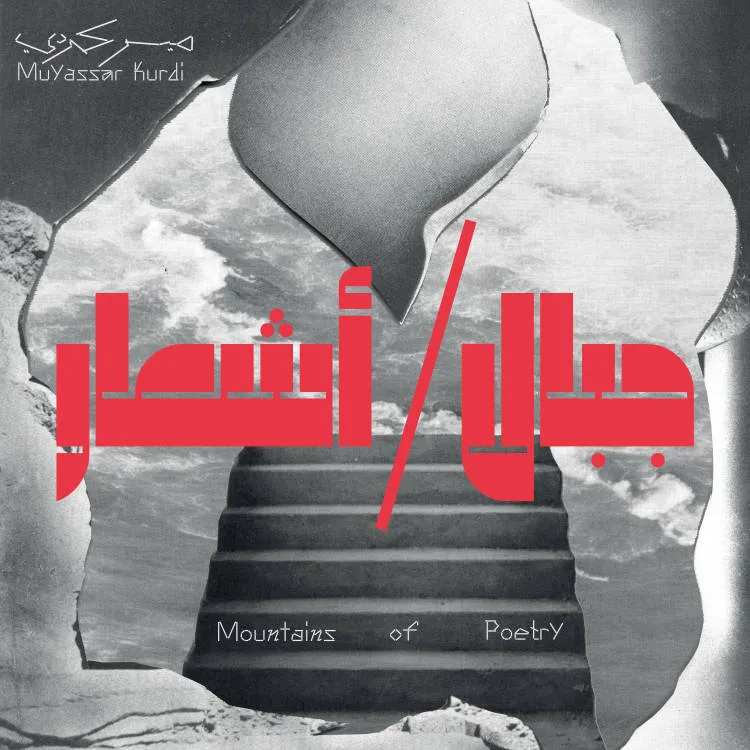
Mountains of Poetry (Limited Edition 12" Coloured)
Mountains of Poetry is a new 8-track studio album produced and developed by interdisciplinary artist Muyassar Kurdi. The album traces the entwined relations between one’s body and land, driven by a sense of urgency. Embedded in the earth, Kurdi imagines her body as a site for sonic excavation of memory and longing. The artist’s voice paired with electronic sound honors the ancient and the futuristic that together form a ritualistic reflection to navigate the tender space of remembering, forgetting and mourning. Departing from her usual emphasis on vocal abstraction, Kurdi turns to concrete words that punctuate the sonic landscape, gathering them into mountains of poetry.
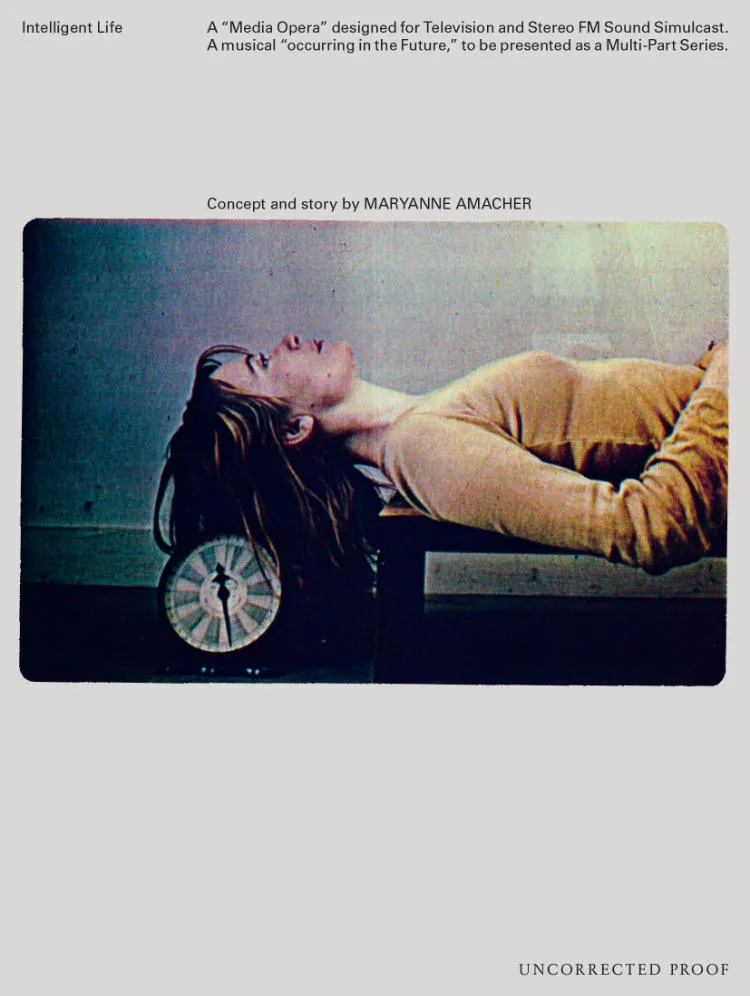
Intelligent Life
Comprehensive and previously unpublished documentation on the American composer's unproduced magnum opus.
Had it been produced, Maryanne Amacher's media opera Intelligent Life would have represented the summation of the composer's concept to date. As she wrote to John Cage in the autumn of 1983, following the untimely deaths of the opera's patrons—Wies Smals, founder of De Appel, and curator Josine van Droffelaar, in a plane crash in the Swiss Alps—she would have at last had the support to "communicate the finest of my thought to others." Amacher's serial, intended for broadcast, sought to transmit her evolving ideas about perception, listening, and composition to a broader public—shifting music away from "nod and tap recognition" toward a transformative practice that could awaken intelligence to "unrecognized and new perceptual modes."
Set in the year 2021, Intelligent Life follows the employees of Supreme Connections LLC, a music entertainment corporation navigating a future in which artificial intelligence generates music faster than composers can. Anticipating an industry-wide downturn, Supreme Connections president Aplisa Kandel seeks advanced technologies that will revolutionize the act of listening and the future of music, including a bio-music script that lets the user hear Bach from the aural perspective of a reindeer and a wearable device that goes beyond replicating the mechanical tympanic resonances of the listening subject to produce the "listening mind" or the "sophisticated perceiver"—capturing and reproducing all the emotional and psychological associations unique to each individual.
Though Amacher could not realize Intelligent Life in any of its intended forms—she theorized its publication as a serialized radio broadcast and television simulcast, among other configurations—she continued designing "treatments" for the opera for much of her career. This volume makes the most complete of these working documents—including episodic scripts, notes on the use of LaserDisc, and an illustrated storyboard for the pilot—available to the public for the first time.
Maryanne Amacher (1938-2009) was a composer of large-scale fixed-duration sound installations and a highly original thinker in the areas of perception, sound spatialization, creative intelligence, and aural architecture. She is frequently cited as a pioneer of what has come to be called “sound art,” although her thought and creative practice consistently challenges key assumptions about the capacities and limitations of that genre. Often considered to be a part of a post-Cagean lineage, her work anticipates some of the most important developments in network culture, media arts, acoustic ecology, and sound studies.
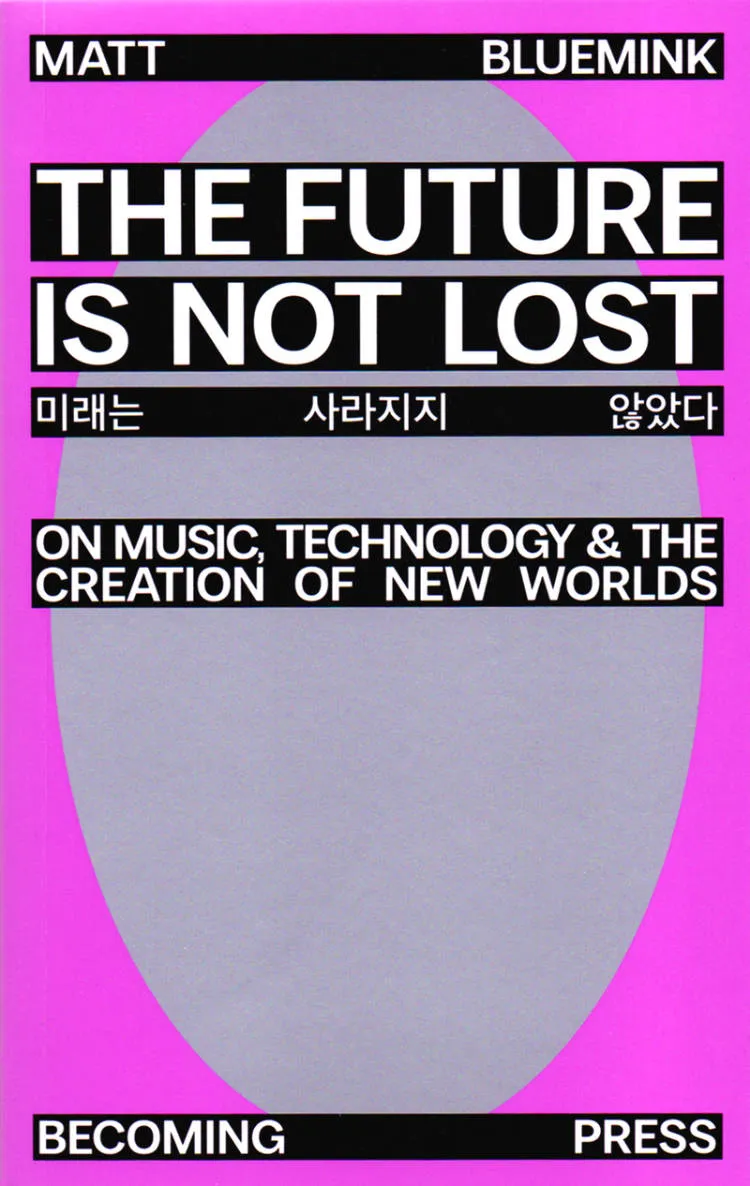
The Future is not Lost: On Music, Technology, and the Creation of New Worlds
Matt Bluemink, Alessandro Sbordoni
Mark Fisher taught a generation to hear the future's disappearance in contemporary music, as if the rhythm of the world was synchronised to the periodic flowering of new creative forms. His diagnosis was devastating: stagnation in music was akin to a venous insufficiency, or worse, some kind of nuclear winter that would ward off the spring for endless generations to come.
Drawing on musicians like SOPHIE, Arca and Iglooghost, Matt Bluemink declares that the future is not lost; it still speaks to us through music. If Fisher’s Hauntology — dwelling on ghosts of the past — is the logic of depression, then Bluemink’s Anti-Hauntology posits a logic of hope where voices from the future continue to guide the development of the present.
Island-hopping through Stiegler's philosophy of technics, Simondon's theory of individuation, and the spatial imaginaries of cyberpunk and solarpunk, Bluemink builds a theoretical framework equal to the times — one that takes seriously our capacity to, not only diagnose the world, but remake it. In order to create a new future we must re-imagine our relationship with music, with technology, and with culture. The world of tomorrow is a blank canvas; an open book. New beginnings are always possible.
Matt Bluemink is the founder and editor-in-chief of Blue Labyrinths online magazine. His research is focused on the relationship between the philosophy of technology, media theory and urbanism. He also writes on contemporary music, literature, and digital culture.
![Cover of أحمد [Ahmed] – Writing](https://rile.space/storage/4500/conversions/01KTRKW207R5ABRVS27RYCB9M1-webp.webp)
أحمد [Ahmed] – Writing
[Ahmed] is the quartet of Pat Thomas (piano), Joel Grip (double bass), Antonin Gerbal (drums) and Seymour Wright (alto saxophone). Since 2014, أحمد [Ahmed] have excavated and re-imagined the music of Ahmed Abdul-Malik, in an ever ongoing search for future music.
[Ahmed] – Writing (EXV01) gathers together the [Ahmed] ‘paper’ texts from the last decade: liner-notes; covers of the releases; and writing by the band members – Antonin and Joel have written two fresh ones for this book, Seymour’s have appeared alongside the records, and some of Pat’s come from a time (long) before [Ahmed]. “Together, the ideas-energy in these things gives a sense of what we have done, do, think together (and apart) in living music, how our different ways come together, and how, together, we learn through be-doing [Ahmed]… These texts are woven together (the etymology of text is from weave) through (and into) a rich fabric of enquiry. A collaborative weaving together of difference(s) to make a whole (thing).” (Seymour Wright)
Contributions by Pat Thomas, Seymour Wright, Antonin Gerbal, Joel Grip, Robert Levin, James G. Spady, John Chantler, Edward George, Fred Moten
Edited by [Ahmed]
Series Editors: Stoffel Debuysere, Jef Lambrechts, Will Holder
Initiated by Stoffel Debuysere
Produced and designed by Will Holder [lps’ original design: Maja Larsson]

The Twofold Commitment
At once an artist's book and an interview collection by Vietnamese filmmaker, writer and feminist and postcolonial theorist Trinh T. Minh-ha (born 1952), The Twofold Commitment centers on Trinh's 2015 feature film Forgetting Vietnam, which takes up one of the myths surrounding the creation of Vietnam: a fight between two dragons whose intertwined bodies fell into the South China Sea and formed Vietnam's curving, S-shaped coastline. Commemorating the 40th anniversary of the end of the war, the film draws inspiration from ancient legend to stage an ongoing contemporary conversation between land and water, creating a third space, another way, for historical and cultural re-memory.
This book features the film's lyrical, essayistic script, along with rhythmically distributed movie stills. Expanding on this central focus is a series of conversations between the filmmaker and critics and film and sound studies scholars dating from 2016 to 2022, amplified by an index identifying key concepts and ideas in the artist's work.

The Joy of Electronic Music
This book is for people who love electronic music, people who probably have a synthesizer or two at home. It’s for people who tell themselves that they should find some time for their passion, who blame themselves for not making enough music. This book is for them.
For decades, I thought that I could be a music producer. But over the years, I have discovered that my contribution to the electronic scene wasn’t exactly the music itself. Although I was lucky enough to produce a few successful tracks in Lithuania, back in the ‘90s, my actual achievement turned out to be raising interest in electronic music, for other young people. I’m still surprised when someone remembers my old tracks, but I’m very proud when someone tells me that listening to me speak on the radio about Berlin techno changed their dreams back in the day. Later, in the 2000s, I was part of the early SoundCloud team. The code we wrote has touched hundreds of millions people around the world. No track or song I would have ever produced would have had such an effect. There is a reason that Brian Eno says the evolution of music is moved by technology as much as it is by artists. The people who created Logic and Ableton, those who code SoundCloud and Spotify, design Korg and Roland synths, they influence the course of music on a massive scale. The development of music technology is the work of many people and I’m happy to call myself one of that gang.
This book is a natural extension of those ideas. It’s not based on scientific or journalistic research, but it’s not a biography, either. I imagine this book sitting on a studio desk, or in a gig bag. In the process, I hope that some young music creators will find answers here, and inspirations, to the questions they’ve been wrestling with for a long time.

The Secret History Of Kate Bush (And The Strange Art Of Pop)
The Secret History of Kate Bush, first published in 1982 as Kate was on the verge of superstardom, is a daring and unorthodox dive into the world of music, fame, and cultural obsession. Written by Fred Vermorel—a close associate of Malcolm McLaren and Vivienne Westwood, and renowned for his subversive "anti-biographies"—the book shatters the boundaries of traditional celebrity profiles. Told from the perspective of a die-hard fan, it unveils the mystique of one of pop’s most elusive icons while exposing the capitalist machinery driving the entertainment industry. Part biography, part cultural critique, and entirely provocative, this is not just a book about Kate Bush but a rebellious manifesto against the commodification of art.
Republished in 2022 by Le Gospel in France, this special edition goes even deeper with unpublished treasures from Vermorel’s personal archive. Featuring an exclusive interview with Kate’s father, Dr. Robert Bush, a razor-sharp foreword by novelist and musician Tony O’Neill (Digging the Vein), and Vermorel’s own afterword reflecting on his explosive work four decades later, this is a must-read for anyone fascinated by Kate Bush, the art of fandom, and the raw power of creative rebellion. Fred Vermorel is a pioneer of the in-depth study of celebrity and fan cultures, best known for his controversial "anti-biographies" of pop icons including the Sex Pistols, Kate Bush, Vivienne Westwood, and Kate Moss.

Basta Now (Expanded Edition)
Basta Now - Women, Trans & Non-binary in Experimental Music is a non-academic essay by French poet, novelist and music enthusiast Fanny Chiarello. It’s also the first book to be published by Permanent Draft, an all-female record label and micro-press founded by Chiarello & musician Valentina Magaletti, dedicated to promoting contemporary female, non-binary and transgender artists.
Basta Now is essentially a huge (yet admittedly not definitive) overview of 3867 womxn in the global experimental sound & music scene. It’s been written in playful and compelling prose and stylishly presented with photos, illustrations, and discographies.
Now in its expanded edition, the book includes 80 more pages and an additional 1496 names than the first edition, extended lists and discographies, and updated chapters – especially Wild Things, All-Stars and Madame Bricolage. “This book has nothing against men, it’s just not about them” (Fanny Chiarello)

Stalled Death Train
A dark-humored poet’s novel of cruising, contempt, and database crawling, Stalled Death Train rumbles through the death of David Bowie in 2016 to shake apart its narrator’s sense of self. Nick, a burned out office worker and late-Bowie fanatic, spends his days mourning his fallen star, left to decipher the legacy and lyrics of a singular pop icon whose excesses did not cease, even after his greatest moments had passed. Meanwhile, Nick must solve the mystery of why his boyfriend has begun to self-amputate as a form of autonomously upgrading his dimensions—or at least call tech support before he uploads himself to the cloud.

I Speak Radio
Anna Bromley, Achim Lengerer and 1 more
Publishing a selection of her radiophonic essays here for the first time, I Speak Radio reflects Anne Bromley's collaborative radio practice.
Since 2010, Anna Bromley has been inviting artists, activists and cultural researchers into the radio studio to explore language and voice together, in the context of sound, politics and everyday life. What began as an artists' radio research format has developed over the years into a series of exhibition pieces focusing on radio and its visible and invisible transmission bodies.
Publishing a selection of her radiophonic essays here for the first time, I Speak Radio reflects Bromley's collaborative radio practice. The publication also provides insight into the corresponding exhibition formats of these projects, including cooperations with a large number of artists, activists, radio makers and theorists. An index of images and texts on Bromley's other artistic works is inserted into the book.
I Speak Radio opens with Bromley's eponymous multimedia essay on the feminist appropriation of early radio technology in the 1920s. A Voice Exists in Voicing, the series of radio essays and sonic portraits with which Bromley opened the Manifesta Radio in Prishtina in the summer of 2022, comprises the core of the book. The accompanying visual element to this section is a series of drawings by Michael Fesca. Contextualizing texts by Catherine Nichols and Hedwig Fijen provide an introduction to A Voice Exists in Voicing. Finally, Bromley talks to media activist Diana McCarty about the politics of persistent radio voices and considers critical perspectives on radio as a medium within art exhibitions.
The reader series Scriptings: Political Scenarios publishes carefully selected scripts and texts by artists that refer neither to academic forms nor to purely literary forms of writing, but rather embed "text" as a fully integral part of contemporary political and visual art practice.
Contributions by Anna Bromley, Diana McCarty, Hedwig Fijen, Catherine Nichols, Tetsuo Kogawa, Alla Mitrofanova, JD Zazie.

Là
Laszlo Umbreit, Sirah Foighel Brutmann and 1 more
Là is an immersive, politically charged sound journey – a lament for the Al Naqab desert in Palestine. It is the result of a collaboration between Sirah Foighel Brutmann, Eitan Efrat, Laszlo Umbreit, and Ot Lemmens. The album combines acoustic instruments like flute and cymbals with processed electronics and mechanical sounds.
The track Ensemble is made from sound recordings of eleven 16mm film projectors, playing simultaneously and in intervals, creating a texture centered around a single pitch – La/A.
The tracks For Her, There, and No are recordings of live sessions played by Laszlo Umbreit and Eitan Efrat.
The album also features an extended text by Rose Higham-Stainton titled Strategies for Survival, spread across a 12-page booklet.
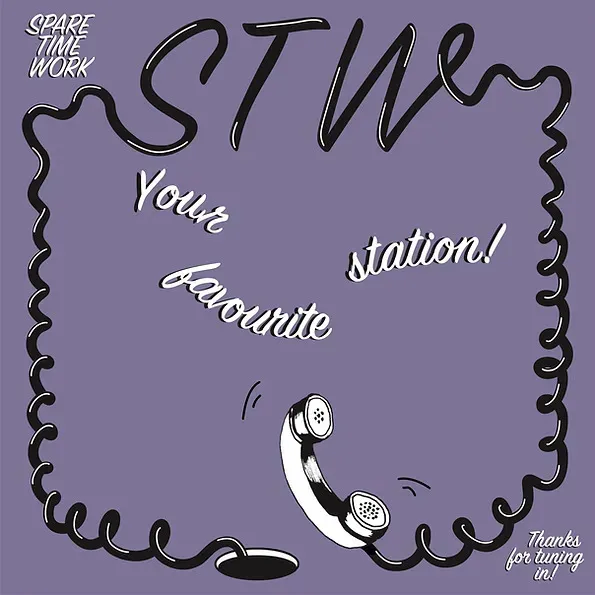
STW, your favourite station!
STW, your favourite station! functioneert als een radioprogramma. Een boek dat lyrisch proza uitzendt van We make stuff up for a living (een CV medley) tot COMPUTER_SONG, een ceremoniële quiz met Adult Hood & Young als protagonisten, een grillige anekdote van iemand die zich ergert aan een Call Service, en meer! Thanks for tuning in!

Clipping 2: Sum, Parts
Clipping 2: Sum, Parts brings together transcripts, commissioned texts, studies, and personal reflections that explore how transformation is central to building archives that remain alive through time. Clipping, in sonic terms, signals distortion—moments when excess pushes beyond clarity and opens new spaces of possibility.
The issue features contributions by Monique Todd, Andrea Zarza Canova, Cleo Tsw, Zahra Malkani, meLê yamomo, Melisa Cenik, Golnoosh Heshmati, Voice as Landscape (Alec Mateo and Lorenzo García-Andrade Llamas), Atiyyah Khan, Ibelisse Guardia Ferragutti, Femke Dekker, and Alice Twemlow. It is edited by Federica Notari and Cleo Tsw, designed by Catherine Hu and Cleo Tsw, and printed and bound by No Kiss.

Black Ark
The point of departure for the book «Black Ark» with Lee “Scratch” Perry (1936–2021), a Jamaican musical and visual artist who was based in Switzerland, is a detailed inventory of photographs and writings (Spring 2021) from the Black Ark Studios in Kingston, Jamaica, where Lee produced his music from 1973 on. He was a seminal pioneer of dub, an electronic subgenre of reggae that uses sampling, looping, remixing, reverb and echoes to create new songs as well as rework and appropriate pre-recorded songs and tracks.
Black Ark Studios was one of the cradles of dub. It’s also where Lee “Scratch” Perry’s musical approach found an enduring visual counterpart in the form of continuously evolving mural paintings and drawings as well as shape-shifting assemblages of records, instruments, found objects, posters, newspaper and magazine clippings, and appropriated books. The artworks form actual layers upon layers that are rhizomatically intertwined with the studio building itself as well as with the furniture inside—and with Perry’s biography and persona.
Perry created his very own, dense and eclectic world—a world that is documented in «Black Ark», before it disappears for good: the premises have recently been sold. The photographic documentation of the studio was supplemented by efforts to secure and preserve Perry’s cultural objects as part of a joint project with various cultural institutions.
«Black Ark» which reflects the rhythm and layering effects of collage both in its content and the materials used to craft the book. Perry was involved in the conception of the book in its early stages. It also interweaves various media and chronologies. The new photographs of the Black Ark Studios will be juxtaposed with stills from old documentaries and archival photos.
The idea of a “house” serves as both a working hypothesis and a metaphor. It will be the starting point and endpoint of various thematic strands, both visual and textual: for example, the book will explore the Black Ark as a “spiritual yard” in the context of African diaspora, as well as looking into archeomusicological aspects. Furthermore, extended captions by Perry’s biographer will provide the backdrop for a kaleidoscopic panorama of Perry’s eclectic and ingenious work.

Search & Destroy: The Complete Archive
V. Vale, Cecily Chen and 1 more
The collected run of the groundbreaking and iconoclastic zine.
From 1977 to 1979, Search & Destroy chronicled the birth of San Francisco's punk scene with an intensity and vision that transformed music journalism. Now, for the first time, every issue of this seminal publication has been collected and meticulously restored in one definitive volume.
Launched with a $100 loan from Allen Ginsberg and Lawrence Ferlinghetti, Search & Destroy was the nerve center of West Coast punk culture. V. Vale and his motley cast of contributors struck a new form of guerrilla journalism with an aesthetic and attitude that was as raw and uncompromising as the music itself.
Search & Destroy: The Complete Archive captures the texture and tension of a scene in flux through stark photography, radical design, and unfiltered interviews with legends such as William S. Burroughs, Throbbing Gristle, the Dead Kennedys, Suicide, and Negative Trend. This collected edition also features retrospective writing on the legacy of Search & Destroy, its influence on design and culture, and V. Vale's work as a publisher, researcher, and archivist.
V. Vale is an American editor, writer, interviewer, musician and SF Bay legend. He is the publisher and primary contributor to books and magazines published by his company, RE/Search Publications.
Cecily Chen is a writer and translator from Beijing, China. She is currently completing her PhD in English at the University of Chicago, where she writes about the “minor archive” of Asian American experimentalism, Marxist aesthetics, and gender and sexuality. You can find her writing at The Poetry Project, Entropy, and the tiny. She also edits poetry for Chicago Review.
Mitch Anzuoni is the founding editor of Inpatient Press and its translation imprint, Mercurial Editions. His writing has appeared in Harper's and Rhizome.

The Organ is the World's Greatest Synthesizer (vinyl LP)
Recorded live at Amsterdam's Oude Kerk during the 2024 Sonic Acts Festival, The Organ is the World's Greatest Synthesizer finds Charlemagne Palestine returning to the Staalplaat catalog after many years. Taking its title and cover from a drawing made by Palestine during the performance, the work expands his singular mythology of sound and spirit. Opening with resonating bells and falsetto overtones before surrendering to the vast sonic tides of the church organ, the 40-minute piece unfolds as an ecstatic continuum—tones intertwining, frequencies colliding, and space itself becoming an instrument. A testament to the living dialogue between artist, instrument, and place, this is Palestine at his most immersive and transcendent.
For over six decades, Charlemagne Palestine has been a pioneering composer, performer, and multimedia artist, celebrated for his ecstatic sonic explorations and ritualistic, metaphysical performances. Emerging from the cross-disciplinary New York art scene of the 1960s and '70s, he helped shape a heretical edge of minimalism alongside figures like Conrad, Riley, Niblock, and Glass. Trained as a Jewish cantor and later as the carillonneur at St. Thomas Church, Palestine cultivated a deep fascination with resonance and overtone—an obsession that evolved through his use of percussion, early synthesizers, and monumental piano works, influencing artists from John Cale to Nick Cave.

Staircase Mystery (LP)
An oral performance (concept, texts and voice by Karl Holmqvist).
Newspaper articles, snippets of conversation and pop lyrics form a textual mesh and merge into a variety of forms in dealing with text and its decoding and recoding. The text sometimes allows the quoted sources to stand out clearly and at other moments concentrates on the original qualities of the language.
Karl Holmqvist reads his poems in his distinctive lilting monotone way. He unterstands reading poetry as a form of visual art: as a form of invisible visual art, or as a form of Everyman's visual art. He is interested in poetry as a vehicle for communicating with and between people.
Recorded at Centre d'Art Contemporain Genève and in Karl Holmqvist's studio in Berlin.
Karl Holmqvist (born 1960 in Västerås, lives and works in Berlin and Stockholm) is a Swedish artist and poet whose work explores language as a sculptural and performative medium. Known for his text-based pieces, readings, and installations, he reconfigures language into rhythmic, often hypnotic compositions that unfold across performance, print, video, and object-based formats. Drawing on pop culture, protest, and poetry, Holmqvist transforms everyday language into visual and sonic material—blurring the boundaries between reading, speaking, and listening. His distinctive voice and approach invite audiences to encounter language not just as communication, but as energy, structure, and presence.

Two Intersecting Loops of Silence
Two Intersecting Loops of Silence is a 10-inch experimental vinyl that turns silence into rhythm and time into matter. Side A features two silent grooves that create a mechanical ticking when played, while Side B animates a clock-like etched drawing as the record spins. Numbered edition of 200 with hand-printed, unique etching covers. Each copy a one-of-a-kind artwork.

YouYou Group – A li'nuage
Handmade artist's book combining drawings, photographs, and archival materials. This publication reflects on the YouYou Group's ten-year journey and its evolving relationship with space. It marks a transitional moment from the group's long-term engagement with public space toward a growing understanding of spatiality and collective presence.
YouYou Group is a Belgian choir that specializes in what is known in Arabic as zaghareed. This trilling cry is used by women at weddings and festive occasions, but also at funerals. Youyou is the French name for zaghareed. Depending on the regional origin, it is also called kululu, tsahalulim, or irrintzi. It is a long, shrill tone that is modulated (by the throat, glottis, or rapid tongue movements) and can be heard from far away. Brussels artist Myriam Van Imschoot was one of the founders of this singing group.

Someone Who Isn't Me
Geoff Rickly’s debut novel Someone Who Isn’t Me is a feverish journey through the psyche of someone who no longer recognizes himself.
When Geoff hears that a drug called ibogaine might be able to save him from his heroin addiction, he goes to a clinic in Mexico to confront the darkest and most destructive versions of himself. In this modern reimagining of the Divine Comedy, survival lurks in the darkest corners of Geoff’s brain, asking, will he make it? Can anyone?

Viscose 08: SOUND
Jeppe Ugelvig, Bill Kouligas and 2 more
The eighth issue of Viscose examines the myriad of music and sound cultures of fashion. Entirely untethered from materiality and image, sound is the proof that fashion operates just as vividly in the purely atmospheric. From the artfully curated musical narratives of the runway to the ambient sonic environment of shops, fashion both emits sounds and seeks to associate itself with it for its own advancement.
Music in particular asserts fashion’s existential relationship to time: it aesthetically time-keeps fashion media and confirms sartorial novelty by mirroring it rhythmically. To a public consciousness, the intimate relationship between fashion and music is obvious and at times even understood as one and the same. Sound glues material such as clothes to wider zeitgeists and mediated lifestyles, and as such, to cultural memory itself. As Mary E. Davis has illuminated, the alliance is profoundly historic: as far back as 1672, fashion periodicals have covered clothes and music as equally essential components of an elegant, fashionable lifestyle.
Music, in fact, surrounds fashion: it enwraps makers, mediators, and consumers alike in ephemeral, yet intensely meaningful, signifiers of taste. Countless designers have come to fashion through musical subcultures, and labors in ateliers to particular playlists. Indeed, style most often has a soundtrack of its own, or dances to a specific tune. Fashion emits sounds before and after the musical. The clicking of heels, the rustling of a sweater, the hissing of a zipper. The ambient humming of a sewing machine; the conclusive “beep” from a store cashier.
For the 8th issue of Viscose, we set out to examine the sonic landscapes of fashion in a most expansive manner. In billing our issue “sound” we seek to gesture to more visually obscure and materially ephemeral interplays between fashion and the auditory—in wardrobes and shops, on the body and in the nightclub. With music culture at the center of our inquiry, we hope to seek beyond and towards the more ephemeral sounds the clothing and fashion emits, records, and appropriates. We are pursuing the possibility of rendering fashion in entirely sonic terms, and how this translates into written words, in a print magazine.

Clipping 1: Coming of Age
Federica Notari, Natasha Rijkhoff
For Clipping I: Coming of Age, editors Federica Notari and Natasha Rijkhoff compiled fragments from the events and gatherings held during the ongoing two-year collaboration between the Nieuwe Instituut’s Through Sounds project and the Rewire Festival. This co-curated, two-part programme explored the social and affective infrastructures of sound and music.
The theme of Coming of Age emerged from a desire to explore processes of becoming, not as a single transition, but as an ongoing iterative state. In this context, music acts as a connective tissue, bridging isolated experiences and communal infrastructures to form networks of shared meaning and distribution. Tracks become social objects: they carry stories, spark interactions and transform spaces.
The publication features written contributions by Emily Moore, Federica Notari, Katía Truijen and Natasha Rijkhoff. It is edited by Federica Notari and Natasha Rijkhoff, designed by Catherine Hu and Cleo Tsw, and printed and bound by No Kiss.