rile*books

Search books

Search books by title, author, publisher, keywords...

Cover of Basta Now (Expanded Edition)

Permanent Draft

Basta Now (Expanded Edition)

Fanny Chiarello

€29.00

Basta Now - Women, Trans & Non-binary in Experimental Music is a non-academic essay by French poet, novelist and music enthusiast Fanny Chiarello. It’s also the first book to be published by Permanent Draft, an all-female record label and micro-press founded by Chiarello & musician Valentina Magaletti, dedicated to promoting contemporary female, non-binary and transgender artists. 

Basta Now is essentially a huge (yet admittedly not definitive) overview of 3867 womxn in the global experimental sound & music scene. It’s been written in playful and compelling prose and stylishly presented with photos, illustrations, and discographies. 

Now in its expanded edition, the book includes 80 more pages and an additional 1496 names than the first edition, extended lists and discographies, and updated chapters – especially Wild Things, All-Stars and Madame Bricolage. “This book has nothing against men, it’s just not about them” (Fanny Chiarello)

Published in 2025 ┊ 482 pages ┊ Language: English

recommendations

Cover of Rab-Rab, Issue 5

Rab-Rab Press

Rab-Rab, Issue 5

Rab-Rab

Essays €27.00

The fifth issue of Rab-Rab: Journal of Political and Formal Inquiries in Art includes stories about nation traitors, fierce masses, socialist women struggles, love-forms, psychedelic counter-revolutionaries, workers unions, Brecht fiddlers, jazz surrealism, Soviet trains, and anti-fascism.

Among the contributors to the fifth issue are Anna Thew, Yehuda Safran, Peter Gidal, Cana Bilir-Meier, David Black, Marjo Liukkonen, Alejandro Pedregal, Peter Hallward, Minna Henriksson, and Jyrki Siukonen.

It has also two extensive dossiers. One dedicated to Franklin Rosemont is presented by Joe Feinberg and is introducing some unpublished and difficult to find texts parallel with writings of T-Bone Slim and Joe Hill. The other dossier on Robert Linhart is presented by Tevfik Rada, and it includes a translation of a chapter from Linhart's book on productivism, an article against Western bourgeois dissidents, and an interview with him.

Cover of Tar Hollow Trans: Essays

University Press of Kentucky

Tar Hollow Trans: Essays

Stacy Jane Grover

Essays €22.00

"I've lived a completely ordinary life, so much that I don't know how to write a transgender or queer or Appalachian story, because I don't feel like I've lived one.... Though, in searching for ways to write myself in my stories, maybe I can find power in this ordinariness."

Raised in southeast Ohio, Stacy Jane Grover would not describe her upbringing as "Appalachian." Appalachia existed farther afield—more rural, more country than the landscape of her hometown.

Grover returned to the places of her childhood to reconcile her identity and experience with the culture and the people who had raised her. She began to reflect on her memories and discovered that group identities like Appalachian and transgender are linked by more than just the stinging brand of social otherness.

In Tar Hollow Trans, Grover explores her transgender experience through common Appalachian cultural traditions. In "Dead Furrows," a death vigil and funeral leads to an investigation of Appalachian funerary rituals and their failure to help Grover cope with the grief of being denied her transness. "Homeplace" threads family interactions with farm animals and Grover's coming out journey, illuminating the disturbing parallels between the American Veterinary Association's guidelines for ethical euthanasia and the World Professional Association for Transgender Health's guidelines for transgender care.

Together, her essays write transgender experience into broader cultural narratives beyond transition and interrogate the failures of concepts such as memory, metaphor, heritage, and tradition. Tar Hollow Trans investigates the ways the labels of transgender and Appalachian have been created and understood and reckons with the ways the ever-becoming transgender self, like a stigmatized region, can find new spaces of growth.

Cover of Clipping 1: Coming of Age

Nieuwe Instituut

Clipping 1: Coming of Age

Federica Notari, Natasha Rijkhoff

For Clipping I: Coming of Age, editors Federica Notari and Natasha Rijkhoff compiled fragments from the events and gatherings held during the ongoing two-year collaboration between the Nieuwe Instituut’s Through Sounds project and the Rewire Festival. This co-curated, two-part programme explored the social and affective infrastructures of sound and music.

The theme of Coming of Age emerged from a desire to explore processes of becoming, not as a single transition, but as an ongoing iterative state. In this context, music acts as a connective tissue, bridging isolated experiences and communal infrastructures to form networks of shared meaning and distribution. Tracks become social objects: they carry stories, spark interactions and transform spaces.

The publication features written contributions by Emily Moore, Federica Notari, Katía Truijen and Natasha Rijkhoff. It is edited by Federica Notari and Natasha Rijkhoff, designed by Catherine Hu and Cleo Tsw, and printed and bound by No Kiss.

Cover of Blank Forms #07 – The Cowboy's Dreams of Home

Blank Forms

Blank Forms #07 – The Cowboy's Dreams of Home

Joe Bucciero, Lawrence Kumpf

The seventh entry in an ongoing series of anthologies, this book features rare poems alongside new essays and interviews that engage the artists and themes explored elsewhere in Blank Forms' public programming.

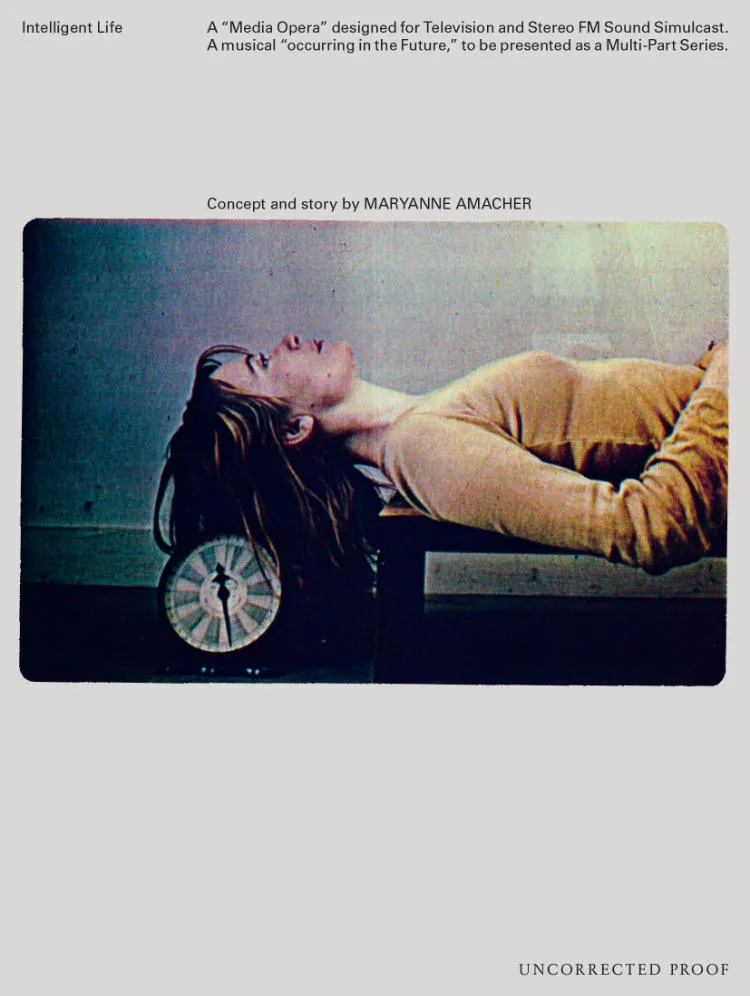
Where most of prior entries, including Aspirations of Madness (2020), Intelligent Life (2019), and Music From The World Tomorrow (2018), have foregrounded little-seen or newly translated archival materials, this iteration privileges new texts produced specifically for the publication. These include an in-depth retrospective interview with the idiosyncratic Texan singer-songwriter and visual artist Terry Allen conducted by ICA Philadelphia chief curator Anthony Elms; a conversation between multidisciplinary writers—and longtime friends—Thulani Davis and Jessica Hagedorn on the occasion of Davis's latest poetry collection, Nothing but the Music, recently published by Blank Forms Editions; a recent discussion between composer Sarah Hennies and cellist Judith Hamann about their recent collaboration, which is included on Hamann's Music for Cello and Humming; and a conversation with composer-performers Tashi Wada and Charles Curtis, on the heels of a recent compilation of Curtis's work, Performances & Recordings 1998– 2018, produced by Wada. Each of these interviews shed light on the particularities of the artists' careers and methods in terms both formal and casual, practical and theoretical. 

In addition to these dialogues, this book features new critical reflections on three artists whose work Blank Forms has presented: the legendary jazz percussionist and healer Milford Graves, by Ciarán Finlayson; English multimedia artist Graham Lambkin and his beguiling 2011 album Amateur Doubles, by Alan Licht; and the UK-based experimental music trio Still House Plants, by Joe Bucciero. These articles mine historical, social, and theoretical contexts, filling gaps in the existing literature on the given artist-subjects. New and archival poems and writing about poetry complement these interviews and essays, including rare texts by Davis, Hagedorn, and René Daumal—the latter translated by Louise Landes Levi—and a suite of Auto-Mythological writings commissioned from Chicago-based composer and musician Angel Bat Dawid.

Cover of Black Case Volume I and II – Return From Exile

Blank Forms

Black Case Volume I and II – Return From Exile

Joseph Jarman

Poetry €20.00

The republication in print form of the poems of Art Ensemble of Chicago's founding member breathes new life into a forgotten document of the Black Arts Movement.

In 1977, Art Ensemble of Chicago Publishing Co. published Jarman's Black Case Volume I and II: Return From Exile, a collection of writing conceived across America and Europe between 1960 and 1975. Comprised largely of Jarman's flowing, fiery free verse—influenced by Amus Mor, Henry Dumas, Thulani Davis, and Amiri Baraka—the book also features a manifesto for “GREAT BLACK MUSIC,” notated songs, concert program notes, Jarman's photos, and impressions of a play by Muhal Richard Abrams, the founder of the Association for the Advancement of Creative Musicians of which Jarman was also an original member.

Jarman writes poetry of personal revolutionary intent, aimed at routing his audience's consciousness towards growth and communication. He speaks with compassionate urgency of the struggles of growing up on Chicago's South Side, of racist police brutality and profound urban alienation, and of the responsibility he feels as a creative artist to nurture beauty and community through the heliocentric music that he considers the healing force of the universe. A practicing Buddhist and proponent of Aikido since a 1958 awakening saved him from the traumatic mental isolation of his time dropped by the US army into southeast Asia, Jarman sings praise for the self-awareness realization possible through the martial arts.

With cosmic breath as its leitmotif, his poetry both encourages and embodies a complete relinquishing of ego. While some of the poems contained within Black Case have already been immortalized via performances on classic records by Jarman and Art Ensemble of Chicago, its republication in print form breathes new life into a forgotten document of the Black Arts Movement.