Archive Books
Archive Books
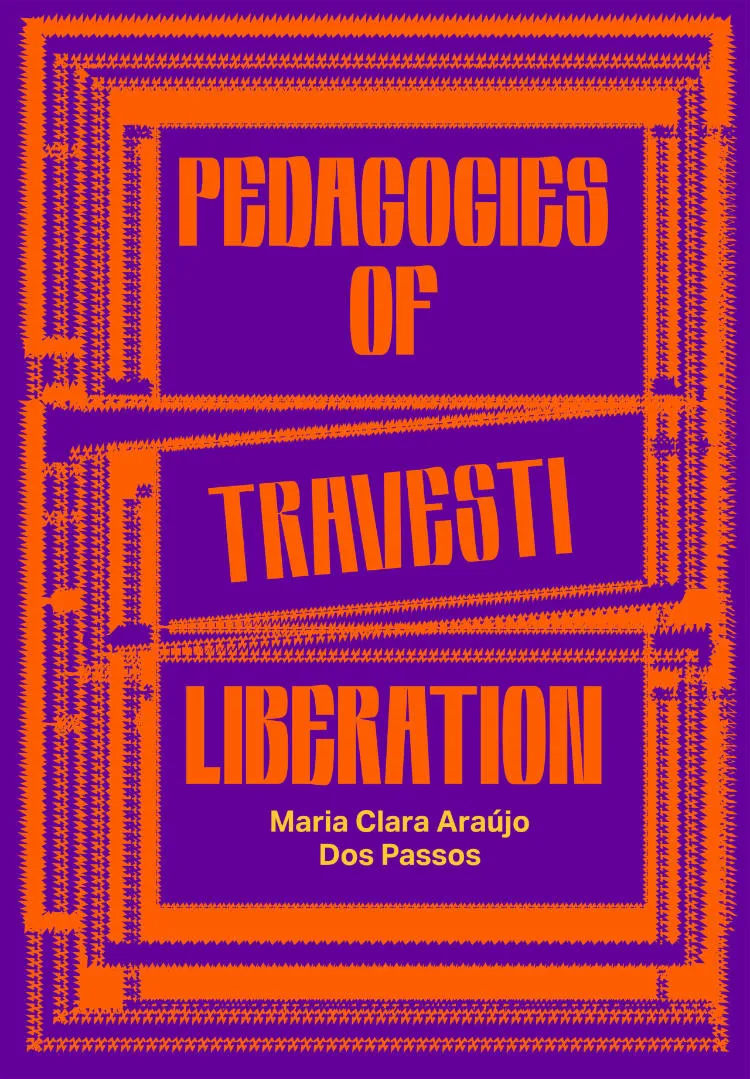
Pedagogies of Travesti Liberation
Maria Clara Araújo dos Passos, Natália Affonso
Maria Clara Araújo dos Passos examines the interplay of education, identity, and liberation in Brazil's travesti community.
In Pedagogies of Travesti Liberation, Maria Clara Araújo dos Passos critiques traditional pedagogical frameworks that marginalize gender nonconforming narratives and highlights the effects of systemic discrimination on travestis' psychosocial well-being. The book advocates for inclusive educational practices and emphasizes the need for affirmative curricula.
Newly translated from Portuguese, this work contributes towards connecting political struggles globally and navigating the complexities of translation—particularly of the term "travesti"—across various geographical and political contexts, featuring a conversation between Araújo dos Passos and translator Natália Affonso.
Maria Clara Araújo dos Passos (born 1996 in Recife) is a Brazilian Afro-transfeminist educator and sociologist, and an activist for LGBT rights.

Mud … and the Earth System
Mud … and the Earth System explores groundbreaking research in Earth system sciences and highlights the challenges of communicating these findings to the public.
As once-stable “mudscapes” transform, they become both symptoms and symbols of a rapidly warming planet. This book delves into humanity’s connection to these changes through the study of ancient organic and inorganic compounds that have come alive after millennia. It poses essential questions about what these evolving ‘mud’ compounds reveal about Earth’s deep past and our imminent future.
Born from collaborative research led by artist Rikke Luther at the Interdisciplinary Research of Ocean, Climate and Society (ROCS) at the University of Copenhagen in collaboration with Earth scientist, Professor Katherine Richardson, this publication showcases how artistic practices – such as image-making, conceptual mapping, and filmmaking – enhance scientific representation.
Mud… and the Earth System features commissioned essays from experts in Earth Science, Political Aesthetics, and Molecular Geobiology. The book pairs their insights with compelling artwork, including large-scale maps of emerging ‘mudscapes’ in Svalbard, Iceland, Greenland, and Gotland.
The essays give perspectives on the DNA that is collected and stored in mud, which connects life across timescales as an evolutionary resource framing the interactions of human societies with the extreme complexities of the Earth system. Esther Leslie’s “Mud Crystal and Polar Thinking” sets the scene, followed by Karina K. Sand’s “Death and Life: in Mud: Two Million Years in a Split Second,” and Earth scientist Katherine Richardson’s contribution “A Muddy Diary.”
As Richardson sums up, “Mud is an important medium for storing the archives that describe the history of both life and climate on Earth, and we are only just beginning to understand the fantastic stories that mud can tell.”
Contributions by Esther Leslie, Rikke Luther, Katherine Richardson, Karina Sand

Scores for Political Desires
The publication of the winners of the Villa Romana Prize has taken the shape of four distinct yet interrelated booklets – an editorial series continuing the tradition of the institution to offer a space for the dissemination and reverberation of the research and work of the Villa Romana Fellows after their ten-months residency in Florence.
Each year, four selected artists are invited to live and work in the same house that, since 1905, generations of artists have continuously inhabited. They always come as a group – a constellation of four people – but all as singular artists. The opportunity of yearly publishing their work in a bundle of four separate books and within an open series allows for a larger combination of echoes across the generations of Villa Romana Fellows. A further occasion for “being singular plural.”
Contributions by Elena Agudio

Art Law, and Artists' Rights: for Creators, Authors and Artists
Art Law draws on forty years of practice to empower and encourage creators, authors, and artists to understand, protect, and exercise their rights. It illustrates key aspects of art law by expanding on specific legal cases. Whenever an artist brings a case to court, that case has the potential to clarify and expand the rights of all artists. Each legal decision not only educates the public and the judiciary about the challenges faced by artists but also highlights the importance of applying the law to safeguard their rights.
In examining the role of justice in artistic activities, we must acknowledge that justice is achieved through legislation and individual case rulings. These are the mechanisms that artists can activate. Favorable judicial decisions can have a wide-reaching impact on both artists and society. However, the court remains a passive entity until an artist brings a case to stimulate a decision. Thus, litigation can serve as a form of activism that prompts a ruling. Although it can be difficult and expensive, it is an effective tool that is accessible and potentially beneficial to all. This compendium provides the knowledge necessary for creatives to work freely and securely, understand their rights, and avoid self-censorship and exploitation.
Contributors: Jenna Jordan, Esq., Bara Diokhane, Esq., Timothy Caron, Esq., and Kevia McComb

Things Bigger Than What Can Be Seen
Things Bigger Than What Can Be Seen is a collection of Oraib Toukan’s essays, translated to Arabic for the first time. In close dialogue with Palestinian pedagogue Munir Fasheh on the topic of turbeh (local soil in Arabic), Toukan crafts a haptic perspective on images from what she terms their ‘soil grain’.

Praise House
Building on the notion of ‘praise,’ Adama Delphine Fawundu frames this book as a celebration of life. She honors the stories whispered to her by her mother; she adorns her body in her grandmother’s textile work; she elevates the memory of various named and unnamed Black women of the diaspora and documents the iconic small Civil War era styled white wooded praise house on a patch of land off the side of a road in South Carolina not far from Beaufort creating an intimate body of work of color photography of an interconnected history.
This book about female figures—grandmothers, mothers, daughters, artists, caregivers, storytellers, and cooks—explores a range of emotions that consume us about family life and history. It is both an art book
and a memoir. Viewing it brings us face to face with known and unknown cultures and introduces us to various art practices shared, taught, and learned through the African diasporic traditions. Fawundu connects to the self through history, joy, and beauty and offers the reader ways to navigate fear based on migration and loss. It is a gift, too, as it allows us to imagine alongside the artist.
Adama Delphine Fawundu is an artist based in Brooklyn, NY of Mende, Bubi, and Krim descent.
Through photography, video, textile-based sculptural forms, and performance, she creates embodied entities inspired by Indigenous knowledge systems and spiritual retentions across time and space. She co-authored the book MFON: Women Photographers of the African Diaspora. She is an Assistant Professor of Visual Arts at Columbia University.
Edited by Chiara Figone
Contributions by Mistura Allison, Berette S Macaulay, Niama Sandy, Bonaventure Soh Bejeng Ndikung, Deborah Willis

Sustaining the Otherwise
Sustaining the Otherwise is a collaborative research and artistic project about restitution, reparation and transformation taking place in multiple locations over several years. Initiated and conceptualized by researchers and curators Amal Alhaag & Selene Wendt, it offers a space for artists, activists, scholars and writers to be in dialogue and to explore the topic of restitution in relation to both material and immaterial culture, through a program that frames restitution within the context of contemporary art practice.
Edited by Amal Alhaag & Selene Wendt
Featuring an introduction by Amal Alhaag & Selene Wendt as well as provocations, reflections, and essays by Barby Asante, Michael Barrett, Quinsy Gario, Sana Ginwalla, Aude Christel Mgba, Lennon Mhsishi, Ogutu Muraya, in addition to a sonic contribution by Robert Machiri.

Global Fascisms – Reader
A critical examination of the aesthetic, social, and political dynamics of fascism, questioning its appeal and ideological mechanisms.
Around the world, there is a glaring turn towards a sinister form of politics. One is reluctant to name it for what all its recognizable signs point to, for fear of accepting the reality that fascism is here and it is everywhere. Amid a raging discussion about where authoritarianism ends and fascism begins, the Global Fascisms—Reader critically examines the aesthetic, social, and political dynamics of fascism, questioning its appeal and ideological mechanisms, and looking at how current authoritarian conjunctures are being condoned, contested, and resisted across the globe. The longform essays, poetry, and conversations with experts collected here accompany the eponymous exhibition at Haus der Kulturen der Welt (HKW), engaging with a quintessentially modern and eerily contemporary political mo(ve)ment.
Contributions by Stefan Baghiu, Thomas Biebricher, Cosmin Costinaș, Kwame Dawes, Jakob Grüner, June Jordan, Jeremy Knowles, Canberk Köktürk, Henrieke Kohpeiß, Daniel Loick, Clara E. Mattei, Bonaventure Soh Bejeng Ndikung, M. NourbeSe Philip, Vanessa Rocco, Arundhati Roy, Aaron Skabelund, Quinn Slobodian, Eric Otieno Sumba, Terese Svoboda, Julia Adeney Thomas, Vanessa E. Thompson, Alberto Toscano, Maxi Wallenhorst.

I Speak Radio
Anna Bromley, Achim Lengerer and 1 more
Publishing a selection of her radiophonic essays here for the first time, I Speak Radio reflects Anne Bromley's collaborative radio practice.
Since 2010, Anna Bromley has been inviting artists, activists and cultural researchers into the radio studio to explore language and voice together, in the context of sound, politics and everyday life. What began as an artists' radio research format has developed over the years into a series of exhibition pieces focusing on radio and its visible and invisible transmission bodies.
Publishing a selection of her radiophonic essays here for the first time, I Speak Radio reflects Bromley's collaborative radio practice. The publication also provides insight into the corresponding exhibition formats of these projects, including cooperations with a large number of artists, activists, radio makers and theorists. An index of images and texts on Bromley's other artistic works is inserted into the book.
I Speak Radio opens with Bromley's eponymous multimedia essay on the feminist appropriation of early radio technology in the 1920s. A Voice Exists in Voicing, the series of radio essays and sonic portraits with which Bromley opened the Manifesta Radio in Prishtina in the summer of 2022, comprises the core of the book. The accompanying visual element to this section is a series of drawings by Michael Fesca. Contextualizing texts by Catherine Nichols and Hedwig Fijen provide an introduction to A Voice Exists in Voicing. Finally, Bromley talks to media activist Diana McCarty about the politics of persistent radio voices and considers critical perspectives on radio as a medium within art exhibitions.
The reader series Scriptings: Political Scenarios publishes carefully selected scripts and texts by artists that refer neither to academic forms nor to purely literary forms of writing, but rather embed "text" as a fully integral part of contemporary political and visual art practice.
Contributions by Anna Bromley, Diana McCarty, Hedwig Fijen, Catherine Nichols, Tetsuo Kogawa, Alla Mitrofanova, JD Zazie.

Territoires / Territories / Territorien – Filmtranskripte
Brigitta Kuster, Achim Lengerer
A monographic publication featuring multilingual text-film transcripts engaging with the legacy of the German colonial project in Cameroon and Germany, as well as broader questions of border crossings, asylum, and exclusion.
The works collected for this publication span installation, video art, and ciné-poems, emerging from anti-racist movements and debates around disidentification, representation, and institutional critique—through the medium of moving images.
A key part of the publication comprises films created in French and German as part of the research project Choix d'un passé, in collaboration with Moïse Merlin Mabouna. These films are accompanied by textual and visual sequences from the video works S. – Je suis, je lis à haute voix and Erase them! – The image as it is falling apart into looks. The eBook also includes a playable film file and elements from the film performance Der erste Blick #1, created in collaboration with Angela Melitopoulos and Vassilis S. Tsianos.
The reader series Scriptings: Political Scenarios, edited by Achim Lengerer, publishes carefully selected scripts and texts by artists that refer neither to academic forms nor to purely literary forms of writing, but rather embed "text" as a fully integral part of contemporary political and visual art practice.
Texts by Brigitta Kuster and Moïse Merlin Mabouna.

The Interpreter Dis/Appears
Virginie Bobin, Achim Lengerer
An artistic exploration of the political and emotional stakes of translation in the context of asylum law, through the lens of rarely heard testimonies: those of interpreters.
The Interpreter Dis/appears stems from an investigation conducted between 2019 and 2023 by curator, editor, and translator Virginie Bobin, focusing on both professional and volunteer interpreters and translators, as well as representatives from the state and organizations working with exiled individuals navigating asylum application procedures in France. By redirecting attention to the voices of interpreters—rarely visible figures in this ecosystem—the project delves into the ambiguous role of translation at the intersection of those who govern and those governed by asylum law. Within such a controlled environment, can the act of translation, with all its complexities, still express fleeting gestures of solidarity or even resistance? Through the exchanges prompted by these questions, the book seeks to reframe the prevailing public and political discourse on asylum, harnessing the embodied experiences of a small group of interpreters as an alternative lens to reveal the underlying power dynamics at play. It also probes the ethical and political potential of translation. The Interpreter Dis/appears unfolds across a variety of theatrical, artistic, and theoretical writing, alongside insightful contributions from artists and researchers who open up different perspectives for understanding and activating these issues.
The reader series Scriptings: Political Scenarios, edited by Achim Lengerer, publishes carefully selected scripts and texts by artists that refer neither to academic forms nor to purely literary forms of writing, but rather embed "text" as a fully integral part of contemporary political and visual art practice.
Contributions by Alix Eynaudi, Vir Andres Hera, Mihret Kebede, Franck Leibovici, Serena Lee, Marianne Mispelaëre, Eliana Otta, Rester. Étranger, Olia Sosnovskaya, Myriam Suchet, TOGETHER UNTIL _ __ (what)* ?

THE DELUSION
Coinciding with Danielle Brathwaite-Shirley’s exhibition, Serpentine and Archive Books have released the artist’s first monograph, THE DELUSION. It imagines a ‘new bible for emotional processing’ and offers intimate insight into the project and the artist’s wider practice, in a gamified, interactive style.
Danielle Brathwaite-Shirley (b. 1995, London) is a Berlin/London-based artist who graduated from the Slade School of Fine Art, London in 2019. Working predominantly in animation, sound, performance, and video game development, their practice intertwines lived experience with fiction to imaginatively retell the stories of Black Trans people. Encouraging the active participation of the visitor-player in their installations, the artist highlights the role of individual choices in shaping narratives and histories.
Contributions by Mckenzie Wark, Helen Starr, Legacy Russell x Mindy Seu, Tamar Clarke-Brown, Danielle Brathwaite-Shirley, Kay Watson, Rebecca Allen, Hans Ulrich Obrist, Shenece Oretha, Rosa-Johan Uddoh, Barby Asante, Ebun Sodipo

Destination: Tashkent – Experiences of Cinematic Internationalism
The legacy and posterity of the Tashkent Festival for Asian, African and Latin American Cinema, which was held between 1968 and 1988 in Uzbekistan.
Between 1968 and 1988, the Tashkent Festival of Asian, African, and — from 1976 onwards — Latin American Cinema was held in Tashkent, Uzbekistan. As an exercise in soft power and a response to anti-colonial movements and the socio-political upheaval of the late 1960s, the festival grew into a unique gathering for film professionals and became an important platform for South-South solidarity that went beyond the cinema halls of Tashkent. In essays and conversations by researchers, film-makers, and organizers of contemporary film festivals, the Destination: Tashkent Reader reappraises the original festival's programming, while also looking critically at its legacy. From the vantage point of Berlin-based diasporas of Asia, Africa, and Latin America, the reader also investigates how such practices of encounters and collaboration resonate within the film scenes of these three continents today.
Contributions by Cana Bilir-Meier, Souleymane Cissé, Pascale Fakhry, Zach Ramon Fitzpatrick, Sophie Genske, Timur Karpov, Ali Khamraev, Valeriya Kim, Carlos Kong, Bonaventure Soh Bejeng Ndikung, Maren Niemeyer Jacqueline Nsiah, Furqat Palvan-Zade, Marie Helene Pereira, Elena Razlogova, Aykan Safoğlu, Masha Salazkina, Alex Moussa Sawadogo, Can Sungu, Echo Xuedan Tang, Sarnt Utamachote.

we as water
“Water has the power to connect us, reflects the relationship between past and present and provides space for narratives that have previously been overlooked."
In her book we as water, Leila Orth explores water as a site of memory, weaving together the stories of eight people who tell of oceans, rivers, and lakes and their own memories. Building on her many years of artistic engagement with memorials, Leila Orth uses the book to search for places, far removed from national memorials, that lead to a possible transnational form of remembrance. Water becomes a transnational site of memory, where layered stories and perspectives intertwine. It holds the traces of travellers and the drowned, the sand at the bottom of the seas, the history of the islands and coastlines where we grew up. It recalls our families, our longings, the past, the fighters, the dead, and the living.

Afghanistan
Afghanistan is my father’s homeland. He was born in Kabul in 1945 and later moved first to France, then to Switzerland in the 1970s. In my mind, Afghanistan exists as a geography with blurred edges, something I feel the need to reconcile with. It’s a place I’ve only ever known through stories, a source of memories that, over time, have shifted and become distorted.
Contributors: Luca Cerizza, Farid Rahimi, Said Rahimi, Susanna Ravelli, Francesca Recchia, Zafar Sayan, and Dawood Tawana

Metropolitan Voids Agency
Margherita Moscardini, Zasha Colah and 1 more
Metropolitan Voids Agency is the first monographic publication dedicated to the collected works of artist Margherita Moscardini. The book recounts the work carried out by Moscardini spanning seventeen years, between 2008 and 2024, inviting a reading of her practice in its entirety as an investigation into ‘urban voids’: those which Moscardini has recognized and designated as voids, or those she has herself invented in the urban fabric.

Studies on Squats
Studies on Squats is an evocative exploration of embodied resistance and political movement that uses the multifaceted posture of the “Asian Squat” as a lens through which broader concepts of migration, illness, and resilience are examined. In Studies on Squats, the body—in its most vulnerable and potent states—becomes a speculative site for reclaiming agency by crafting new forms of protest that draw from ancestral strength, humor and eroticism. This posture, rich with cultural resonance, offers as an entry point to imagine ways in which the body can engage in acts of defiance against systems of oppression. Studies on Squats invites the audience to consider how dance and choreographic thinking can serve as tools for envisioning alternative futures, where artistry empowers those enduring systemic social injustices to transform their realities.

My Mother My Home
Who claims abstraction? What are the limits of abstraction? Are statelessness, dislocation and feelings of (un) belonging embodiments of an abstracted self that is in itself a work in progress? How could performance art—an artistic practice that places significant importance on presence and legibility of form—transgress into the realm of the abstract and the illegible in an effort to protect the artist’s likeness while shedding light on what it means to be in their body in relation to this world?
Chipo Chipaziwa’s My Mother My Home establishes itself as a query on the aspects of belonging and the artist’s own personhood that acts as the foundation of her practice. The question of where one’s personhood begins and ends within an artwork has appeared to be ever prevalent within the realm of visual art and is more relevant within the canon of performance art.
Writers: Chipo Chipaziwa, Denise Ferreira da Silva, Olumoroti George
Contributing artists: Margaret Joba-Woodruff, Sophia Lapres, and David Ezra Wang
Edited by Katrina Geotjen

Entangled – Texts On Textiles
What does it mean to be a curator who writes, and, more specifically, how can curators write about textiles? This publication steps outside the framework of the typical exhibition catalogue to occupy "the space between literature and criticism".
The Community of writers was set up to create time and space to retreat from these outside opinions and demands and to let curiosity and the joy of writing be the driving forces of the writing process. This book has been realised under the auspice of Interweaving Structures: Fabric as Material, Method, and Message, and specifically through collaboration between the Faculty of Fine Art, Music and Design at the University of Bergen and the Central Museum of Textiles in Łódź. The two partners have strong positions of specialisation—the museum acts as a caretaker of material textile traditions and art in Poland, and the faculty has a strong textile art tradition and offers the only education programme for curators in Norway.
Edited by Anne Szefer Karlsen.
Contributions by Andreas Hoffmann, Heather Jones, Martina Petrelli, Anne Szefer Karlsen, Lea Vene, Johanna Zanon.

Majnoon Field Guide
I went to the field; I became many.
Majnoon is an oil field in the global south. Majnoon is also the violence, and the state of mind that survives the violence. How can this be a field guide in any customary sense? Latitudes have been taken. Words are written in disrupted or troubled syntax. Rather, this book proceeds alongside a search for what many call emancipatory practice; to been acted in the field, where we feel most alive. The volume is divided into five parts, preceded by maps and legends. First in the sequence is a colour-coded soil map,“Majnoon and Hir Environs”, adapted from material originally published in 1960 by the Iraqi Ministry of Agriculture. It was the product—relic, really—of a brief era that saw fields and farmlands redistributed among labourers and peasants. Since then, the map has changed with the shifting substance of our earthly constitution; it pivots on the example of Majnoon. Any map is appended by its legends, and I rewrite them from the perspective of dismantling. A longish colour key unfolds with the likeness of a poem pursuing return, inspite of scorch and ruin. It should be mentioned that ‘hir’ recurs multiple times throughout the book as gender-nonconforming pronoun—suggestive, ambiguous, and, in my opinion, sufficiently sound for the moment. It is essential to keep needling the problem of language.
A second, simpler map charts water flow as casualty of upstream accumulation. Dams are borders, after all, and we are lousy with them; downstream is sentenced to the whims of an architecture whose gates are mostly closed. On the map, a symbol resembling a small, numbered page locates Majnoon as point of interest. A subsequent diagram also contains this motif—not for navigation through the field, butt hrough the book itself.

But how does it change the price of tomatoes in the market?
In 2021, seven Fellows of the postgraduate program of the Berlin University of the Arts (UdK) gathered in despair over the institution’s failings. This publication explores what happens next. It emerges from an experimental process of dialogue and documentation, and tackles questions regarding globalized art production and the dissemination of knowledge. A dense collage of both critique and transformative artistic practices, the book is a unique contribution to the debate on socially engaged art. Just as importantly, it provides a point of reference for artists in comparable situations: those who pursue their work in the face of deadlocked institutions which uphold the status quo despite claiming to do the opposite. It strives to be a helpful pointer for artists who insist nonetheless on their ethical and political prerogatives. Vulnerability and conflict will accompany any such process, inevitably, and our publication does not dissimulate any of these things—even as it charts possible paths beyond them.
With: Adnan Softić, Amelie Jakubek, Ami Lien, Enzo Camacho, Nina Softić, Okhiogbe Omonblanks Omonhinmin, Shehzil Malik and Sonia Hamad

Film Undone – Elements of a Latent Cinema
Film Undone presents contributions introducing unmade and unfinished film projects, film ideas realised in non-filmic media, as well as films that remained unseen in their intended form and at their intended time.
These tentative and careful probes dedicated to singular projects reflect the importance of primary materials before and beyond the film. Bringing them together as Elements of a Latent Cinema opens a space to consider cases from various political geographies and historical moments in relation. Latency prompts to think differently about what has remained invisible in cinema than under deficit-centred categories such as failure, loss, or incompletion. It marks a sustained potentiality for things to change their condition, to affect us and set us in motion.
Contributions by Alejandro Alvarado, Carmen Amengual, Annabelle Aventurin, Alia Ayman, Concha Barquero, Petra Belc, Uliana Bychenkova, George Clark, Greg de Cuir Jr, Shai Heredia, Tobias Hering, Tom Holert, Katie Kirkland, Olexii Kuchanskyi, Brigitta Kuster, Dhianita Kusuma Pertiwi, Léa Morin, Tara Najd Ahmadi, Ojoboca, Uriel Orlow, Volker Pantenburg, Lisabona Rahman, Mathilde Rouxel, Bunga Siagian, Oleksandr Teliuk, Elena Vogman, Akbar Yumni

Two years Vacation
This book, Deux Ans de Vacances, Dos Años de Vacaciones, Dwa Lata Wakacji, Two years Vacation, Due Anni di Vacanza, documents the production of Céline Condorelli's process-based, cumulative artwork titled 'Tools for Imagination'. The title of the book raises the question of labour and working time, starting from a non-equivalence with its inverse: free time. We can read the various iterations of the title which appear on the cover as an expression of the impossibility of thinking about time outside of work in a univocal dimension.

Fraitaxtsēs sores tsîn ge ra≠gâ – Ondjembo yo Null Vier
A complete documentation on a multimedia exhibition by Berlin-based artist Ixmucané Aguila, giving voice to voiceless descendants of victims of genocide in Namibia.
Genocide in Namibia is an especially sensitive matter—its history has at times been ignored, underestimated, or even denied outright. In the artistic documentary Fraitaxtsēs sores tsîn ge ra≠gâ – Ondjembo yo Null Vier, Ixmucané Aguilar has worked in close collaboration with Nama and OvaHerero people who vividly evoke memories and rituals of mourning caused by human loss and land dispossession under Imperial Germany's violent occupation.
From these personal encounters emerge portraits, visuals and narratives as documental fragments, consisting of living voices which insist on defending memory as an invocation to witness and never to remain passive in the face of social injustice. Rather than a linear collection of data referring to distant places and its distant past, this work engages with stories as chronicles calling to be recognised as pieces of humanity and time.
Alongside Aguilar's portraits, this publication also contains contributions by human rights attorney Wolfgang Kaleck and the curator of the work Tristan Pranyko, along with poetry by Namibian artists Nesindano Namises, Fritz Isak Dirkse and Prince Kamaazegi, and narratives, testimonies, chants and mourning rituals shared by OvaHerero and Nama people in present-day Namiba.
Published on the occasion of the eponymous exhibition at National Art Gallery of Namibia, Windhoek, in 2023
Ixmucané Aguilar (born 1983) is a Guatemalan Berlin-based visual artist/designer who, through multi-layered documentary photography, engages in extensive field research to put out installations and art publications to relay her work in an artistic language.