Artistic Research
Artistic Research

How To Do Things With Groups
STARTING POINT: ALL GROUPS HAVE AN UNCONSCIOUS
This project developed from a shared experience: groups we believe should exist and succeed, from mutual aid collectives to communist cadres, struggle with difficult and often unexamined inter-psychic group dynamics. We take it as a starting point that groups, by their very nature, elicit and enact painful and confusing states, like over-dependence on a leader or fear of contamination. We believe that these dynamics play out beneath the surface and alongside whatever the group is trying to do together. In other words, any group, like any individual, has an unconscious.
OUR BIG QUESTION: WHAT DOES THIS MEAN FOR GROUPS DOING POLITICAL WORK?
Groups break down for all kinds of reasons; political organizing is often brutal, exhausting, disappointing work. Feelings of heartbreak and betrayal, resentment and shame, are common. These can be painful, difficult aspects of group life to discuss. They are also often dismissed as ancillary to the real work of political struggle, especially in times of unabating crisis, genocide, and war.
Although interpersonal drama can be taken up in excess–and distract from our work–group dynamics are not mere distraction, and our hesitations about discussing them do not make them disappear. Ironically, in fact, when groups treat relational dynamics as merely superficial or deleterious, they often wind up mired in confusion about what any given internal conflict is “really” about. Often the confusion is posed as not being able to discern what is interpersonal strife and what is political disagreement—an aggravating situation that, we’ve observed, comes up constantly in groups’ narration of their own breakdown. There are no easy formulas for working through these dimensions of group life, but we believe that being undisciplined about them makes it harder for groups to work together productively—or, for that matter, to separate “well.” This pamphlet offers concepts and questions that you can bring to your own group to perform a group inquiry, to think about what might be happening below the surface.
Groups Group is a collective of clinicians, organizers, writers, artists, and scholars interested in group dynamics in the everyday life of all forms of left social movements. We also do internal process work, popular education, and consult with groups.

TRANSMISSIONS: Radio Essays on Edges, Crossings and Narrowcasting Borderlands
Transmissions: Radio Essays on Edges, Crossings and Narrowcasting Borderlands gathers radio essays—created as part of Robida Collective’s project Radio drugega/The Other Radio—which reveal that to speak of “the border” is never to speak of a single line. There are political borders, conceptual borders, bodily borders; carnivalesque borders, where order collapses into play; linguistic and cultural borders, where words slip between languages and where accents become geographies; archival borders, separating memory from forgetting; borders of abandonment, where life and death enter into a dialectical ballet; economic borders, drawn by property, ownership, enclosure; borders of matter, space and time; acoustic borders, where the voice meets noise and incomprehensibility; cosmic borders, where meteors cross the thin edge of air; ecological borders, porous and breathing, where one species touches another. These are some of the borders this book speaks of – lines that do not divide but resonate, that hold together separation and proximity, distance and relation. Together, these essays form a cartography of friction but also affinity, reminding us that to erase all borders is to erase the very conditions of encounter – and that meaning often emerges not at the centre, but at the edges where worlds meet.
With texts by:
Agnes Cameron, Ajda Bračič, Aljaž Škrlep, Antônio Frederico Lasalvia, Giorgia Maurovich, Jack Bardwell, Kate Donovan, Kat Macdonald, Lijuan Klassen, Luca Vettori, Michael Marder, Moritz Gansen, Olya Korsun, Petra Filagrana, Urška Savič.

How to see rivers in cracks
How to See Rivers in Cracks, an invitation to read through softness rather than certainty. It begins where attention loosens, where listening lingers, and where small cracks let the world in.
Written as a shifting sequence of notes, exercises, and reflections, the publication moves through Moerwijk, The Hague, Antwerp, and in-between spaces, tracing how soil, sound, and urban surfaces remain porous and in constant transformation. Cracks are not treated as damage but as openings where relation becomes visible~ where matter, bodies, and environments co-compose one another.
The text resists a fixed interpretation. Instead, it unfolds as an instruction that can be followed, misread, or left open. In this sense, it does not hold itself steady. Without the reader, it does not fully take place, remaining dependent on attention, proximity, and the act of reading itself.

Toxicité coloniale: Documenter le Paysage Radioactif
Toxicité coloniale revient sur les programmes nucléaires français menés entre 1960 et 1966 dans le Sahara algérien. Ce programme secret, qui s’est déroulé pendant et après la guerre d’indépendance algérienne (1954-1962), a permis au régime colonial français de mettre à feu quatre bombes atomiques atmosphériques, treize souterraines et de mener d’autres expériences nucléaires dans le désert. Alors que la grande majorité des documents d’archives sont toujours classés secret aujourd’hui, Toxicité coloniale rassemble une variété de sources permettant de documenter l’histoire violente des activités de la France en Algérie. Le livre constitue un corpus de choix à l’intersection de la justice spatiale, sociale et environnementale pour ceux et celles qui s’intéressent à l’architecture, au paysage et aux pratiques d’archivage dans une démarche décoloniale.
Alors que ces bombes ont eu des conséquences durables pour les populations et les environnements locaux ainsi que pour les vétérans français, le manque de contrôle des explosions, les lacunes de sécurité et l’utilisation des Algériens comme main- d’œuvre sur des chantiers particulièrement dangereux apparaissent comme des faits coloniaux d’une importance majeure.

Movement Research Performance Journal
Issue #62 - We Exist in the Ambivalence of Those Motherfuckers
Anh Vo, maura nguyen-donohue and 1 more
What began as a project responding to the fiftieth anniversary of the ‘end’ of the Vietnam War became a project of inhabiting the Movement Research Performance Journal (MRPJ) from within the landscape of contemporary Vietnamese performance art. The result, Issue #62, is a window onto a community of insiders who reflect a set of concerns, questions, historical trajectories, and aesthetic legacies that differ from what has more often been foregrounded in our U.S./New York City-centric publication. Like other documents of this kind, which endeavor to portray a performance scene that will be foreign to many readers, the texts from this group of intergenerational, contemporary artists demonstrate a careful navigation of the dialectics of inside and outside, self and other, performer and audience, seeing and being seen, that informs every exchange across cultural difference.
The texts are also not monolithic, suggesting a range of relations to the Vietnam of the past and present, from within Vietnam’s national borders and among the diaspora. Especially for contributors living and working in Vietnam, writing has also been a practice of choreographing words within a political landscape where to speak publicly, in itself, is a performance of negotiated risk. Embracing the complexities of these differing positions has been the focus of our editorial process—one that has asked the editorial team to embrace the limits of our own knowledge, to recognize we will not be able to recognize all valences others may discover in these texts, and not to edit these layers out of the works that follows.
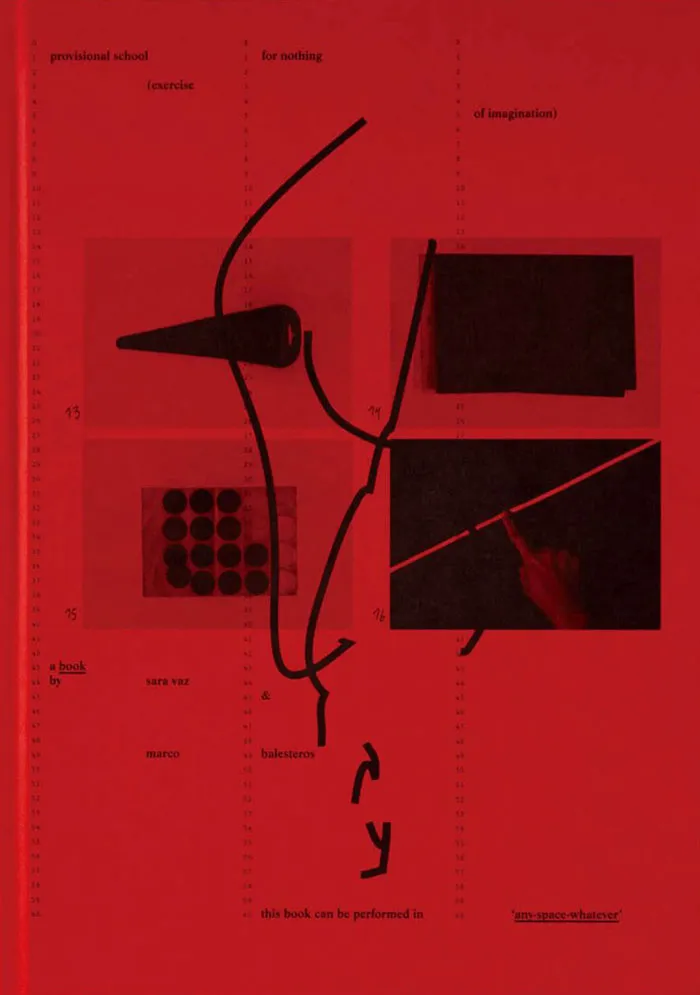
provisional school for nothing—exercise of imagination
‘Provisional School for Nothing—exercise of imagination’ aims to explore forms of parallel education such as self-learning, self-organized schools, unschooling, inner schools, and more. This book is a choir of around 30 invited guests (artists, choreographers, dancers, graphic designers, writers, thinkers and so on). We use the word ‘choir’ since we decided to explore the concept of authorship. The book functions like a language score —comprising words, fragments, and loose ideas that develop throughout a series of conversations we’ve had with our guests via Zoom during the pandemic.
with Marco Balesteros Sara Vaz Alexandru Balgiu Ana Jotta Bráulio Amado Cracked Bolos Igor Dobricic Isabel Carvalho Ivan Martinez João Fiadeiro João dos Santos Martins] Karel Martens Maki Suzuki & Lppl Marco Bene Maria Duarte Marion Cachon Miguel Bonneville Nelson Guerreiro Olivier Lebrun Olga Mesa Francisco Ruiz de Infante Paul Elliman Paul Faure Pedro Barateiro Pedro Rogado Ricardo Nicolau Sara & André Sara Graça T.I.M.E. Tomás Cunha Ferreira Von Calhau! the missing person a man in silence
designed by Sara Vaz Marco Balesteros
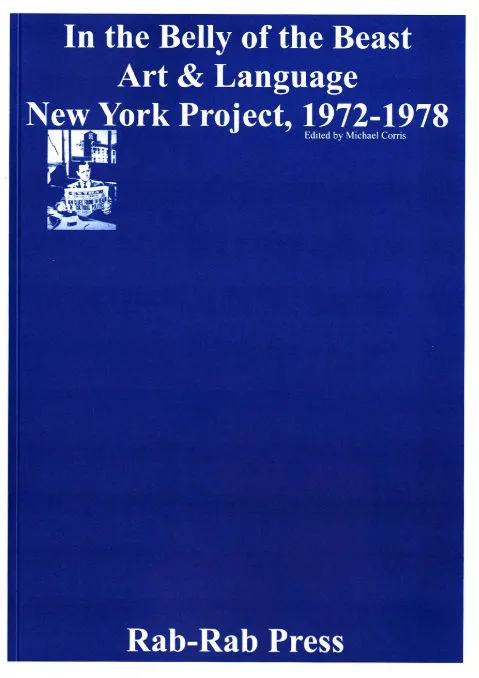
In the Belly of the Beast – Art & Language New York Project 1972-1978
Edited by Michael Corris, the expanded edition of In the Belly of the Beast: Art & Language New York Project 1972-1978 is a survey of the tumultuous years of the political Conceptualism in the mid-seventies New York.
Artists have always experimented with politics, either by organizing themselves or uniting in support of a broader political movement. Today, "activist art" is taught in universities, supported by foundations, and featured in museums and international exhibitions. Is this the only possible way?
In the Belly of the Beast tells a different story, of the work of politically engaged artists and the conflicts they experienced. It is the history of artists wishing to continue working within the boundaries of the artworld and those who were intent on establishing new ideological and class relationships with activists to build a political party.
During the 1970s in New York, the Art & Language collective pioneered institutional critique; published a Marxist-influenced journal; agitated against racism and sexism in museums; challenged the cultural imperialism of international exhibitions; and forged a framework for a socialist organization of artists. This new edition includes previously unpublished documents illuminating the contradictions and disputes that lay at the center of the organization and practices of Art & Language and left-wing groups, such as the Anti-Imperialist Cultural Union and the Artists' Meeting for Cultural Change, mobilizing artists in New York at the time.
The new and expanded edition of In the Belly of the Beast features an extensive interview with Michael Corris, who annotated a collection of previously unavailable documents from the period, including manuscripts, pamphlets, transcripts, and letters.
Art & Language is the name of a group of English artists who choose to work collectively, and the title of a magazine that they founded in 1968. Proposing a critical analysis of the relations between art, society, and politics, Art & Language marks, even in its name, the importance of the “textual turning point” in the 1960s.
Since 1976, Art & Language's project has continued, through Mel Ramsden and Michael Baldwin, with the literary and theoretical collaboration of Charles Harrison. Working with very varied mediums, from painting to rock, these co-founders of Conceptual art remain, even today, attached to observing the consequences of what they themselves call the “depressing collapse of modernism.”

Trophy Logic
We stand at the edge of the world’s mercy, as subjects destined to fall. Instead, we posit: what might unfurl when we discard the uniform of the individual, and instead orient towards tinkering with the fluctuating dynamics of desire, value, infrastructure, touch, and language. Don’t be fooled, for the dynamics are brittle. Unrestricted interplay has a limit, and method is to be found at its rim. That a tangible or decorative item may serve as recognition or evidence of merit might somehow become a logic of itself. This publication presents a collection of explorations of excess, limitation, dehydrated thought, proclivity, sublimation, debauchery, and the narrowly-defined. Indeed, the subject is destined to fall, but ultimately does not! As we reckon with the illegibility of merit, we are beckoned to reconsider our relationship to one another, the unseen settings of nostalgia, the monolithic, and the stifling hold that comes not from the absence of violence, but the sheer overabundance of it. The winner just might take it all,but we’re all destined to some sort of trophy.
with Brandon Chow, Jody Aikman, Kessy Paller-Bain, Maximilian Pellizzari, Milda Valiulytė, António Manso, Preto Macarena, Magaña Villar, Sara Vallis, Cecilie Jensen, Iris Verge Ferrer, Mia You, Mehmet Süzgün, Emma Adjari, gervaise alexis savvias, Emanuella Cunt, Greta þorkelsdóttir. Designed by Miglė Lukoševičiūtė

Crassiers, une chronologie des luttes stéphanoises
"Ces deux collines jumelles sont pour moi des contre-monuments : un héritage industriel délaissé, en friche, conservant une puissance symbolique et politique. Les messages et les crassiers sont indissociables."
La première partie de cette édition est une collecte d'images intégrant des messages sur les crassiers (1948-2024). Ces images ont été récupérées principalement sur internet, complétées par un appel à collecte public sur les réseaux sociaux, ainsi que par la distribution de flyers et le collage d'affiches. Les images sont rassemblées chronologiquement et chaque message est recontextualisé dans son événement politique. La seconde partie présente les crassiers jumeaux en croisant plusieurs perspectives ; historique, géologique, urbaine, écologique et politique. Enfin je définis les crassiers en tant qu'outils et supports tactiques d'affichage public. Ce travail a abouti à cette première impression en janvier 2025.
Cette édition continuera à se développer au fil du temps grâce à des rééditions régulières, intégrant des messages découverts ou récemment apparus.

Bulletin B – Issue 2
Contributions by Jerry Ahn, Han Ok-hee, Han Soon-ae, Lilian Gonzalez, Kim Jeon-seon, Miss Lee, Lee Jeong-hee, Hansen Oh, Yun Park, Seonha Park, Sun Hyejeong, Wang Gyu-won.
Bulletin B is a bilingual editorial project gathering artistic and cultural productions from Korea and its diasporas, with a focus on queer and womxn voices. Borrowing the spirit of an unofficial newsletter, it surfaces when it needs to; assembling poetry, prose, and cultural fragments across time.
Rooted in translation as a practice attentive to power, history, and silenced voices, Bulletin B reconstructs fragmented lineages and constellations of reference through irregular acts of dissemination and exchange, tracing how narratives move between languages, contexts, and material forms.

Scores for Political Desires
The publication of the winners of the Villa Romana Prize has taken the shape of four distinct yet interrelated booklets – an editorial series continuing the tradition of the institution to offer a space for the dissemination and reverberation of the research and work of the Villa Romana Fellows after their ten-months residency in Florence.
Each year, four selected artists are invited to live and work in the same house that, since 1905, generations of artists have continuously inhabited. They always come as a group – a constellation of four people – but all as singular artists. The opportunity of yearly publishing their work in a bundle of four separate books and within an open series allows for a larger combination of echoes across the generations of Villa Romana Fellows. A further occasion for “being singular plural.”
Contributions by Elena Agudio

Sustaining the Otherwise
Sustaining the Otherwise is a collaborative research and artistic project about restitution, reparation and transformation taking place in multiple locations over several years. Initiated and conceptualized by researchers and curators Amal Alhaag & Selene Wendt, it offers a space for artists, activists, scholars and writers to be in dialogue and to explore the topic of restitution in relation to both material and immaterial culture, through a program that frames restitution within the context of contemporary art practice.
Edited by Amal Alhaag & Selene Wendt
Featuring an introduction by Amal Alhaag & Selene Wendt as well as provocations, reflections, and essays by Barby Asante, Michael Barrett, Quinsy Gario, Sana Ginwalla, Aude Christel Mgba, Lennon Mhsishi, Ogutu Muraya, in addition to a sonic contribution by Robert Machiri.

Verlag der Buchhandlung Walther König
Movement Notation
Eshkol and Wachmann focused dance on its basic element: the movement of the human body. They treated the different parts of the body as separate instruments, similar to the musical instruments of an orchestra–each with its own rules for the movements to be performed. This new edition of the 1958 publication is supplemented by contributions from Eshkol’s companions and further archive material, which contextualizes and supplements the history of the 'EWMN’s‘ origins and embeds it in contemporary discourses on dance and movement.
The publication is published in the context of the performance 'Pause: The Noa Eshkol Chamber Dance Group‘ at KW Institute for Contemporary Art (August 2023), as well as the exhibition 'Noa Eshkol: No Time to Dance‘ at the Georg Kolbe Museum (15 March–25 August 2024). The new edition was developed together with the 'Noa Eshkol Foundation for Movement Notation‘.

An Orobic Journey – On Migratory Restlessness, Community, and Multispecies Geographies
Valentina Gervasoni, Lorenzo Giusti
A layered and polyphonic investigation that, setting out from the Orobic Alpine territory in Northern Italy, explores the mountainside not merely as a natural backdrop but as an epistemological lens through which to understand and rethink the contemporary world.
The book originated as an online magazine and an expansion of the biennial program Thinking Like a Mountain (2024–25), a project inspired by Aldo Leopold's exhortation to abandon an anthropocentric gaze in favor of a geological outlook on the peaks, thereby acknowledging the intrinsic value of every natural element. An Orobic Journey developed independently from the exhibition program and is not limited to mere documentation; instead, it functions as a parallel research tool articulated through essays, conversations, and visual documentation, featuring contributions from artists, scientists, researchers, anthropologists, ornithologists, curators, academics, architects, writers, and other experts.
Embracing Ursula K. Le Guin's "carrier bag theory," An Orobic Journey brings together non-heroic tales of resistance, adaptation, and cohabitation. The book opens with a reflection on species migration and "migratory restlessness": a condition that does not only concern the spontaneous return of wolves to the Alps or the transit of birdlife, but becomes a metaphor for a shared condition of continuous movement and searching. The future of the mountain—amid tourist monocultures and acts of transformative care—is investigated by conceiving the Alpine landscape as a political space shaped by power relations, images, and collective memories, and inhabited by multispecies communities that dwell in a place, weaving intergenerational relationships. With both a poetic and political approach, An Orobic Journey attempts to rethink ways of looking at the mountain landscape while imagining new collective rituals.
![Cover of Visit [country]](https://rile.space/storage/4263/conversions/01KNPFVPPA9VBM18HD24YCC4XJ-webp.webp)
Visit [country]
Visit [country] is an artist’s book that brings together texts taken word for word from official government tourism websites and state-produced promotional videos from every UN-recognized country in the world. Stripped of the usual accompanying imagery and inspirational music, what becomes clear is how tourism feeds on — and is fuelled by — nationalism, chauvinism, and the invention of identity.
Much like a “choose your own adventure” book, the reader is guided by a series of questions that connect one country to another through recurring ideas and clichés, and must decide whether to visit the destination with “the best food”, “the most beautiful women”, “the friendliest people”, or “the most authentic history”. The book also includes an extensive concept index that maps the thematic and linguistic patterns linking the nations’ self-descriptions. It is a journey where every country is the best.
The project grows out of The Complete National Anthems of the World, a durational performance first presented in 2023, and stands as a parallel, autonomous, yet complementary work.

Inhabiting the 0.6%: The reality of Seoul's Black Hole
Cette édition documente la surpopulation de Séoul et les statistiques tragiques qui s'y rapportent. Elle rassemble les voix de ceux qui y vivent, de ceux qui y ont vécu, de ceux qui doivent s'y rendre et de ceux qui l'ont quittée. La production suit les principes écologiques énoncés par la graphiste, Sara de Bondt en 2014. Pour éviter le gaspillage, des formats standard (A4) et du papier 100% recyclé ont été choisis, avec une impression en risographie. Pourquoi cet exode massif vers Séoul ? Comment Séoul est-elle devenue un trou noir ?
This edition documents Seoul’s overpopulation and the tragic statistics associated with it. It gathers the voices of those who live there, those who have lived there, those who must travel there, and those who have left. The production follows the ecological principles set forth by the graphic designer Sara de Bondt in 2014. To avoid waste, standard formats (A4) and 100% recycled paper were chosen, with an impression in risography. Why this massive exodus toward Seoul? How has Seoul become a black hole?
[KO] 이 책은 서울의 인구 과밀화와 이와 관련된 비극적인 통계들을 기록한다. 서울 거주자, 과거의 거주자, 가야만 하는 자, 그리고 이방인까지. 이들의 목소리를 인터뷰로 담았다. 2014년 그래픽 디자이너 사라 드 본트가 제시한 생태적 원칙을 따라 A4 규격 사이즈의 100% 재생용지 위에 리소그래피로 인쇄되었다. 왜 모두가 이토록 서울로 몰려드는 것일까? 서울은 어쩌다 블랙홀이 되었을까?

sae-kki-eo by AFSAR Si詩Salon(Poetry Salon)
“sae-kki-eo” is AFSAR’s (Asian Feminist Studio for Art and Research) debut publication documenting activities from April-August 2024. The project brought together AFSAR Si詩Salon(Poetry Salon) members globally on Discord to share poetry and explore feminist/queer writing approaches. The publication features members’ personal poetry, workshop documentation, and research discussions about women’s poetry and queer poetic expression. The Korean title “sae-kki-eo” allows for multiple interpretations, including meanings related to derivatives, interruption, and plant propagation, suggesting ideas of growth and creative intervention. Since it was primarily written in Korean, it naturally intersects with the necessity of poetry translation, though this was not the original intention.

Subjective Atlas of Brussels
Brussels is an amalgam of juxtapositions: a place that inspires you to dream away on sultry summer nights before hitting you with its rough reality the next day. It is a city that you slowly fall in love with until you can no longer imagine wanting to live anywhere else. However, it’s a special kind of love, a kind of love that keeps you critical, a kind of love that keeps you questioning the space that you inhabit as you wonder how we as a community can do better.
This Subjective Atlas of Brussels showcases the work of designers, artists and other creative minds who all share this kind of love for Brussels, depicting the diverging narratives and histories of different spaces, allowing us to dwell on the fascinating snapshots that make up this great metropolis. Discover how more than 80 Brusseleirs have mapped what this capital means for them at this moment in time.
EDITORIAL TEAM: Petra van Brabandt, Margrit Coppé, Lisemarie van Loon (intern), Erika Sprey, Kurt Vanbelleghem
INTRODUCTION: Melat Gebeyaw Nigussie

Subjective Atlas of Palestine
Sublime landscapes, tranquil urban scenes, frolicking children; who would associate these images with Palestine? All too often the Western media show the country’s gloomy side, and Palestinians as aggressors. It is this that makes identifying with them virtually impossible. If we are to relate to the Palestinians other images are needed, images seen from a cultural and more human vantage point.
Palestinian artists, photographers and designers have mapped their country as they see it. Given their closeness to the subject, this has resulted in unconventional, very human impressions of the landscape and the architecture, the cuisine, the music and the poetry of thought and expression. The drawings, maps and photographs reveal individual life experiences. The contributions give an entirely different angle on a nation in occupied territory. In this subjective atlas it is the Palestinians themselves who show the disarming reverse side of the black-and-white image generally resorted to by the media.
CURATOR: Khaled Hourani (International Academy of Arts Palestine)
CONTRIBUTORS: Sameh Abboushi, Majd Abdel Hamid, Senan Abdelqader, Mohammed Amous, Tayseer Barakat, Sami Bandak, Baha Boukhari, Mahmoud Darwish (poem), Reem Fadda, Shadi Habib Allah, Majdi Hadid, Shuruq Harb, Dima Hourani, Khaled Hourani Munther Jaber, Khaled Jarrar, Abed Al Jubeh, Hassan Khader (foreword), Yazan Khalili, Suleiman Mansour, Basel Al Maqousi, Sani P. Meo, Inas Moussa, Hafez Omar, Hosni Radwan, Awatef Rumiyah, Ahmad Saleem, Shareef Sarhan, Majed Shala, Sami Shana’ah, Maissoon Sharkawi, Mamoun Shrietch, Lena Sobeh, Mohanad Yaqubi, Inass Yassin

Afghanistan
Afghanistan is my father’s homeland. He was born in Kabul in 1945 and later moved first to France, then to Switzerland in the 1970s. In my mind, Afghanistan exists as a geography with blurred edges, something I feel the need to reconcile with. It’s a place I’ve only ever known through stories, a source of memories that, over time, have shifted and become distorted.
Contributors: Luca Cerizza, Farid Rahimi, Said Rahimi, Susanna Ravelli, Francesca Recchia, Zafar Sayan, and Dawood Tawana

Correspondences de Appel 1975–2025
This volume brings together 50 years of correspondence from the archive of de Appel contemporary arts centre in Amsterdam. In tracing a relational and affective history of the institution, each piece offers a glimpse into the artistic projects and programmes de Appel has commissioned and championed; the cultural shifts and careers it has nurtured; the celebrations and struggles it has weathered; and the collaborations and friendships sparked along the way. The book gathers materials from more than 100 voices, with paper and digital exchanges covering an intricate web of people, places, and events, ultimately coalescing into what can be perceived as the unified work of an institution.
Includes a light-blue satin Ribbon by Alison Knowles.

A small book of Ojika Recipes
This is not a cook book, but a collection of recipes that Olya Oleinic gathered during her residency on Ojika Island (Nagasaki, Japan). Sometimes a bit lost in translation, it represents her attempts to connect to her new environment.
This book is part of a catalog series for the Ojika Artist in Island Program, which is supported by Ojika Town and Nagasaki Prefecture, as well as The Netherlands Embassy in Tokyo.

Mahraganat Dance in Egypt: Between Acceptance & Rejection
In 2021, Hend Elbalouty started researching the relation between art and social class in Egypt and created a performance inspired by the local street dance and music in Egypt (Mahraganat). In her artistic work, Hend strives to produce and participate in socially aware dance pieces, constantly exploring the role of Art as a tool to empower the individual and bring out those neglected modes of expression. With her recent publication "Mahraganat Dance in Egypt: Between Acceptance & Rejection", she now continues this exploration within the form of an artist's book.
Hend Elbalouty (EGP/DE) is a choreographer, performer and author, based in Cologne. She holds a MA in Performing Arts from Academy of Media Arts Cologne, a BA in production design from institute of cinema studies in Egypt and 3 years degree in contemporary dance from Cairo Contemporary Dance Center. In recent years, Hend was interested in the challenge of using Arabic language – in Germany – as an artistic tool. This approach often challenged the perception of Arabic language in the western art world, and was the core of many projects in the last three years such as for the video exhibition “FrauenGold'in Hamburg, the dance performance “The Kitchen” in Cologne, or “Absence”, a group exhibition at Coculture Art space, Berlin, as well as the video installation “hell vol.1” in Cologne.
In 2022 Hend was awarded the “Kunstpreis der FREUNDE der KHM 2021”, which honors outstanding artistic achievements by KHM diploma students and graduates.

Maisa in Webland
What does ‘user-friendly’ website mean if, on it, online behaviors like stalking, teasing, and ghosting — once considered peripheral — are now central to survival, care, and belonging? How to thrive without becoming an “Interdisciplinary Unicorn”: the state’s most beloved user-citizen fluent in multiple registers of production, optimization, and self-branding? How in this beautiful world is one supposed to log off, when surveillance and privacy erosion have been normalized? And how, oh how, could users possibly think of building the alternatives, when cool and cringe online acts, all activate the platform’s reward system: the unleashing of emoji-filled praise? How to resist the platform’s toxic seduction?
Haunted by screenshots of early cyberfeminist websites and in dialogue with digital sages, web scripts, and business interests, media artist, web developer, and author Maisa Imamović embarks on a philosophical and practice-based crusade through the internet’s surface and its shadows. To expose the various ways of thriving online without surrendering to optimization, the book explores imperfect uses of perfect software, preservation of precarious web infrastructures, tactical content strategies, and experiments with autonomous financial systems — all wrapped in educational efforts to sustain criticality amid automation. Through these traversals beneath the scroll, Maisa finds her Webland: speculative, broken, and oftentimes, poetic infrastructure where logic destabilizes, binaries dissolve, and meaning evades monetization. But can a non-extractive internet exist beyond metaphor? Can poetry rewire protocol? Or will her sanctuary be absorbed into the very architectures it resists?
"In Maisa in Webland, Maisa Imamovic evokes the multidimensional, spontaneous human elements of the early web, using interviews, case studies, critical theory and fiction as her organic materials. She peeks behind the screen and through time to trace the subtle erosion of the web’s early utopian ideals to its cold and extractive present. Imamovic bravely wades through the swampy digital muck that mediates our everyday reality, examining its invisible psychic scaffolding with academic rigor, and a big dose of humor and heart. Was it an inevitable entropy, or an aberration? How and when did we get so off-course? Can we return? Do we want to? In Maisa’s Webland, we might very well be doomed, and maybe that’s a good thing. When the center of this tangled web no longer holds, something new can take shape.” - Nada Alic, author of Bad Thoughts