Art & Language
Art & Language
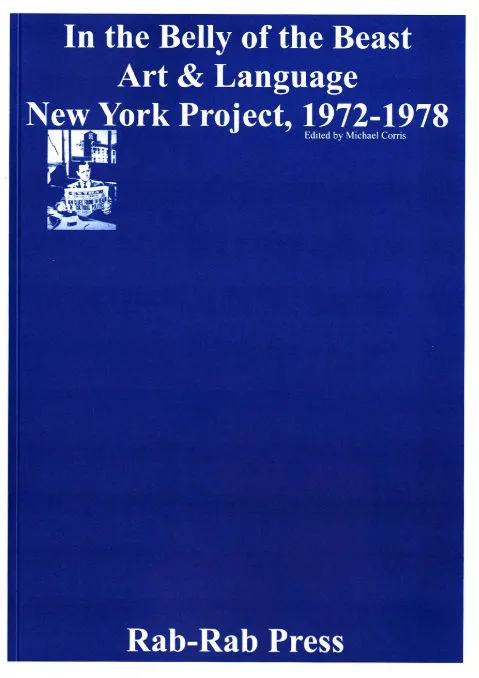
In the Belly of the Beast – Art & Language New York Project 1972-1978
Edited by Michael Corris, the expanded edition of In the Belly of the Beast: Art & Language New York Project 1972-1978 is a survey of the tumultuous years of the political Conceptualism in the mid-seventies New York.
Artists have always experimented with politics, either by organizing themselves or uniting in support of a broader political movement. Today, "activist art" is taught in universities, supported by foundations, and featured in museums and international exhibitions. Is this the only possible way?
In the Belly of the Beast tells a different story, of the work of politically engaged artists and the conflicts they experienced. It is the history of artists wishing to continue working within the boundaries of the artworld and those who were intent on establishing new ideological and class relationships with activists to build a political party.
During the 1970s in New York, the Art & Language collective pioneered institutional critique; published a Marxist-influenced journal; agitated against racism and sexism in museums; challenged the cultural imperialism of international exhibitions; and forged a framework for a socialist organization of artists. This new edition includes previously unpublished documents illuminating the contradictions and disputes that lay at the center of the organization and practices of Art & Language and left-wing groups, such as the Anti-Imperialist Cultural Union and the Artists' Meeting for Cultural Change, mobilizing artists in New York at the time.
The new and expanded edition of In the Belly of the Beast features an extensive interview with Michael Corris, who annotated a collection of previously unavailable documents from the period, including manuscripts, pamphlets, transcripts, and letters.
Art & Language is the name of a group of English artists who choose to work collectively, and the title of a magazine that they founded in 1968. Proposing a critical analysis of the relations between art, society, and politics, Art & Language marks, even in its name, the importance of the “textual turning point” in the 1960s.
Since 1976, Art & Language's project has continued, through Mel Ramsden and Michael Baldwin, with the literary and theoretical collaboration of Charles Harrison. Working with very varied mediums, from painting to rock, these co-founders of Conceptual art remain, even today, attached to observing the consequences of what they themselves call the “depressing collapse of modernism.”

Reality (Dark) Fragments (Light)
This monograph covers more than fifty years of creation by Art & Language, whose artists are at the origin of conceptual art. Through unpublished texts by Matthew Jesse Jackson and Art & Language, a transcript of their opera libretto Victorine, and an interview with the artist collective, this publication questions their journey, and more broadly, the relationship between contemporary art and conceptual art.
The permanent collection of the Château de Montsoreau – Museum of Contemporary Art has grown to include 800 works from Art & Language. To celebrate this event, the museum produced a major exhibition and a publication titled Reality (Dark) Fragments (Light). The monograph and exhibition look back at 50 years of creation by these critical, provocative, subversive, punk art collective. They question the main issues involved in Art & Language's work: conversation as an artwork, description, transdiciplinarity, crisis in the relationship between the artist, the museum and the art gallery.
Edited by Marie-Caroline Chaudruc.
Foreword by Marie-Caroline Chaudruc.
Text by Matthew Jesse Jackson, interview with Art & Language by Victorine Meurent.