rile*books

Search books

Search books by title, author, publisher, keywords...

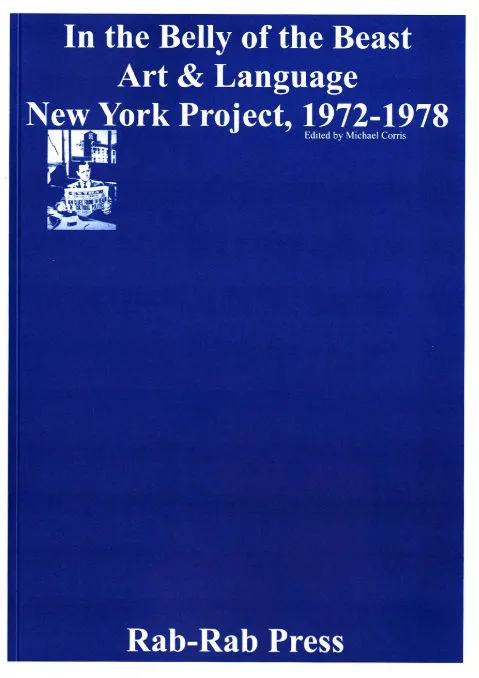
Cover of In the Belly of the Beast – Art & Language New York Project 1972-1978

Rab-Rab Press

In the Belly of the Beast – Art & Language New York Project 1972-1978

Art & Language

€16.00

Edited by Michael Corris, the expanded edition of In the Belly of the Beast: Art & Language New York Project 1972-1978 is a survey of the tumultuous years of the political Conceptualism in the mid-seventies New York.

Artists have always experimented with politics, either by organizing themselves or uniting in support of a broader political movement. Today, "activist art" is taught in universities, supported by foundations, and featured in museums and international exhibitions. Is this the only possible way?

In the Belly of the Beast tells a different story, of the work of politically engaged artists and the conflicts they experienced. It is the history of artists wishing to continue working within the boundaries of the artworld and those who were intent on establishing new ideological and class relationships with activists to build a political party.

During the 1970s in New York, the Art & Language collective pioneered institutional critique; published a Marxist-influenced journal; agitated against racism and sexism in museums; challenged the cultural imperialism of international exhibitions; and forged a framework for a socialist organization of artists. This new edition includes previously unpublished documents illuminating the contradictions and disputes that lay at the center of the organization and practices of Art & Language and left-wing groups, such as the Anti-Imperialist Cultural Union and the Artists' Meeting for Cultural Change, mobilizing artists in New York at the time.

The new and expanded edition of In the Belly of the Beast features an extensive interview with Michael Corris, who annotated a collection of previously unavailable documents from the period, including manuscripts, pamphlets, transcripts, and letters.

Art & Language is the name of a group of English artists who choose to work collectively, and the title of a magazine that they founded in 1968. Proposing a critical analysis of the relations between art, society, and politics, Art & Language marks, even in its name, the importance of the “textual turning point” in the 1960s.

Since 1976, Art & Language's project has continued, through Mel Ramsden and Michael Baldwin, with the literary and theoretical collaboration of Charles Harrison. Working with very varied mediums, from painting to rock, these co-founders of Conceptual art remain, even today, attached to observing the consequences of what they themselves call the “depressing collapse of modernism.”

Published in 2026 ┊ 196 pages ┊ Language: English

recommendations

Cover of Iliazda at the Birthday Party – Autobiographical Lecture, 1922

Rab-Rab Press

Iliazda at the Birthday Party – Autobiographical Lecture, 1922

Iliazda

The English translation of Zdanevich's Dadaist autobiographical lecture in Paris in 1922, where he adopts the name Iliazda. In this entertaining lecture, the achievements of the avant-garde is presented as a combination of zaum, polymorphous sexuality, aleatory forms and scatological interpretation of culture.

The second volume of the bie bao series presents a eulogy entitled Iliazda at the Birthday Party, a pseudo-autobiographical lecture delivered by Ilya Zdanevich in Paris in 1922. It reports on Zdanevich's artistic and political adventures up until then. Along with an autobiography full of self-admiration, in this lecture Zdanevich gives an interpretation of his zaum dramas inspired by Freudianism, and humorously describes a colourful image of the Russian microcosm in Montparnasse. 

Additionally, this second volume also includes Iliazd's letter to Ardengo Soffici from 1964, where one can read, in the most unambiguous terms, about Zdanevich's positions against war, imperialism, and all forms of nationalism. Subtitled 50 Years of Russian Futurism, the letter to Soffici presents us with an altogether new Zdanevich—a "fellow traveller" in both leftist and avant-garde circles. As well as the extended introduction and extensive annotations, the texts are further contextualised with Johanna Drucker's visual presentation of the birth of the Iliazd cult.

The bie bao series will include eight publications, covering many layers of Zdanevich's rich theoretical and artistic output. Each volume consists of a bio-bibliographical introduction, a commentary, a translation with annotations, and artistic intervention.

Iliazd (Ilya Zdanevich, 1894-1975) was a Russian poet, designer, typographer, theoretician, art critic, and publisher, close to the avant-garde circles and one of the promoters of Futurism in Russia, author of a poetic work, drama written in zaum abstract poetic trans-sense or "transrational" language, and novels.

Cover of Rab-Rab, Issue 5

Rab-Rab Press

Rab-Rab, Issue 5

Rab-Rab

Periodicals €27.00

The fifth issue of Rab-Rab: Journal of Political and Formal Inquiries in Art includes stories about nation traitors, fierce masses, socialist women struggles, love-forms, psychedelic counter-revolutionaries, workers unions, Brecht fiddlers, jazz surrealism, Soviet trains, and anti-fascism.

Among the contributors to the fifth issue are Anna Thew, Yehuda Safran, Peter Gidal, Cana Bilir-Meier, David Black, Marjo Liukkonen, Alejandro Pedregal, Peter Hallward, Minna Henriksson, and Jyrki Siukonen.

It has also two extensive dossiers. One dedicated to Franklin Rosemont is presented by Joe Feinberg and is introducing some unpublished and difficult to find texts parallel with writings of T-Bone Slim and Joe Hill. The other dossier on Robert Linhart is presented by Tevfik Rada, and it includes a translation of a chapter from Linhart's book on productivism, an article against Western bourgeois dissidents, and an interview with him.

Cover of Wanting Something Completely Different – 111 Vignettes of Left-Wing Figures, Themes, Films, and Writers

Rab-Rab Press

Wanting Something Completely Different – 111 Vignettes of Left-Wing Figures, Themes, Films, and Writers

Jairus Banaji

Non-fiction €20.00

A collection (montage) of biographies and themes written by Jairus Banaji.
Wanting Something Completely Different discusses a range of political figures, themes, directors and writers in a series of brief, evocative descriptions ('vignettes') aimed at laying out a vision of a modern, cosmopolitan left that can think creatively about the world we live in. The political figures include both thinkers and activists from a wide range of backgrounds—from Frantz Fanon and the Palestinian novelist Ghassan Kanafani to the theologian Dietrich Bonhoeffer and the murdered Russian journalist Anna Politkovskaya. The themes range equally widely from the death of Walter Benjamin (reconstructed here from a remarkable documentary on the same theme) and the slaying of Pasolini to the work of British Marxist Perry Anderson, or the corrupt nature of India's leading corporate groups, or the outstanding contributions of Italian and U.S. Black feminists to feminist theory. And under the rubrics which discuss film and literature, there is the same striving for diversity and depth.

The vignettes collected in this Rab-Rab book first circulated on Facebook over some seven years or more and are reproduced here with a new introduction and extensive bibliographical references and notes.

Jairus Banaji is a historian and revolutionary Marxist activist. He received the Isaac and Tamara Deutscher Memorial Prize in 2011. His academic work has ranged widely across sources and languages, with major books on Late Antiquity and commercial capitalism as well as numerous papers and articles.

Cover of About Narration – Materials, Comments, Interventions

Rab-Rab Press

About Narration – Materials, Comments, Interventions

Ingemo Engström, Harun Farocki

Published in collaboration with Harun Farocki Institut, this book unpacks About Narration [Erzählen], a 1975 essay film directed by Ingemo Engström and Harun Farocki.

Edited and introduced by Sezgin Boynik and Tom Holert, this book focuses on About Narration [Erzählen] directed by Ingemo Engström and Harun Farocki.
It includes the film's script alongside the historical documents related to its making and Farocki's previously unpublished theoretical and programmatic essay on the film. The publication also includes a retrospective essay by Ingemo Engström on the film's political and artistic background.

Volker Pantenburg's detailed elaboration of the conditions of its making, alongside Boynik and Holert's concluding remarks, further contextualizes the film. The interview with Cathy Porter on Larisa Reisner, a heroine of About Narration, gives an overview of the life of a militant writer who inspired Engström and Farocki.

Edited and introduced by Sezgin Boynik and Tom Holert.

Cover of Biting the Hand – Traces of Resistance in the Art & Language diaspora

Rab-Rab Press

Biting the Hand – Traces of Resistance in the Art & Language diaspora

Paul Wood

€30.00

Extensive survey of the politically outward-looking Conceptualism emerging from Art & Language in the UK. Especially considering its critique of the norms of Modernist art practices in contemporary art, particularly practices of art education.

Edited, compiled and introduced by Paul Wood, Biting the Hand: Traces of Resistance in the Art & Language diaspora is about a dissident formation of artists active in the UK in the 1970s and 80s.

The book tells the story of artists engaging with a critique of then-contemporary modernist art education, who have embarked on a series of theoretical investigations which became increasingly politicised under the pressures of an evolving social crisis. Increased racism, unemployment and attacks on the organised working class all raised questions about how a critical art might respond.

By the late 1970s, these radical artists, mostly in the orbit of the Art & Language group, were producing posters and leaflets for a wide range of left-wing causes, as well as analyses of the politics of art and design education and the role of cultural ideology in maintaining consensus. In the 1980s, as Thatcherism tightened its grip, those involved went their separate ways into areas as diverse as media work, trade unionism, health and education.

Biting the Hand has three parts: a retrospective introduction setting the formation in its historical context, and two annotated documentary sections presenting examples of the work as both text and image, written and edited by Paul Wood.

It also includes a foreword by Sezgin Boynik, publisher, and an afterword by Ann Stephen, curator and art historian, further expanding on the book's subject.

For many years Paul Wood worked for the Art History Department of the Open University. His publications from that period include Conceptual Art (2000), Western Art and the Wider World (2013), and the four-volume anthology Art in Theory (1990-2020), co-edited with Charles Harrison and others.

Edited, compiled and introduced by Paul Wood.
Foreword by Sezgin Boynik; afterword by Ann Stephen.

Cover of Reality (Dark) Fragments (Light)

Château de Montsoreau

Reality (Dark) Fragments (Light)

Art & Language

This monograph covers more than fifty years of creation by Art & Language, whose artists are at the origin of conceptual art. Through unpublished texts by Matthew Jesse Jackson and Art & Language, a transcript of their opera libretto Victorine, and an interview with the artist collective, this publication questions their journey, and more broadly, the relationship between contemporary art and conceptual art.

The permanent collection of the Château de Montsoreau – Museum of Contemporary Art has grown to include 800 works from Art & Language. To celebrate this event, the museum produced a major exhibition and a publication titled Reality (Dark) Fragments (Light). The monograph and exhibition look back at 50 years of creation by these critical, provocative, subversive, punk art collective. They question the main issues involved in Art & Language's work: conversation as an artwork, description, transdiciplinarity, crisis in the relationship between the artist, the museum and the art gallery.

Edited by Marie-Caroline Chaudruc.
Foreword by Marie-Caroline Chaudruc.
Text by Matthew Jesse Jackson, interview with Art & Language by Victorine Meurent.

Cover of Spiritual World Tour

Tabloid Publications

Spiritual World Tour

Nat Marcus

Spiritual World Tour by Nat Marcus.
Cover of Épopées Célestes / Epopee celesti

Éditions Empire

Épopées Célestes / Epopee celesti

Gustavo Giacosa, Barbara Safarova

A veritable panorama of Art Brut at an international level, through 180 works selected from Bruno Decharme's collection.

Art brut has never ceased to shake up the history of art and nourish minds resistant to norms as it questions classic notions of art and creation as well as those relating to the normal and the pathological. But who are they, these artists of a special kind, witnesses to another world, strangers to stylistic trends and influences? They stay—or are kept—away from the culture of fine art as well as the codes and places that constitute it such as schools, academies, museums, art fairs, etc.

Featuring A.C.M., Noviadi Angkasapura, Anselme Boix-Vives, Marie Bodson, Giovanni Bosco, Gustavo Enrique Buongermini, Aloïse Corbaz, Fleury-Joseph Crépin, Egidio Cuniberti, Henry Darger, Fernand Desmoulin, Janko Domsic, Dong-Hyun Kim, Jaime Fernandes, Eugen Gabritschevsky, Pietro Ghizzardi, Madge Gill, Paul Goesch, Jorge Alberto Hernández Cadi, Paul Humphrey, Zdeněk Košek, Joseph Lambert, Gustave Pierre Marie Le Goarant de Tromelin, Augustin Lesage, Pascal Leyder, Alexander Pavlovitch Lobanov, Ramon Losa, Dwight Mackintosh, Lázaro Antonio Martínez Durán, Mettraux, Edmund Monsiel, John Bunion Murray, Iwona Mysera, Koji Nishioka, Masao Obata, Jean Perdrizet, M. Pierron, Photographies Spirites, Miloslava Ratzingerová, Marco Raugel, Achilles G. Rizzoli, Leopold Strobl, Harald Stoffers, Mose Tolliver, Melvin Way, Scottie Wilson, Adolf Wölfli, Anna Zemánková, Carlo Zinelli, Unica Zürn.