rile*books

Search books

Search books by title, author, publisher, keywords...

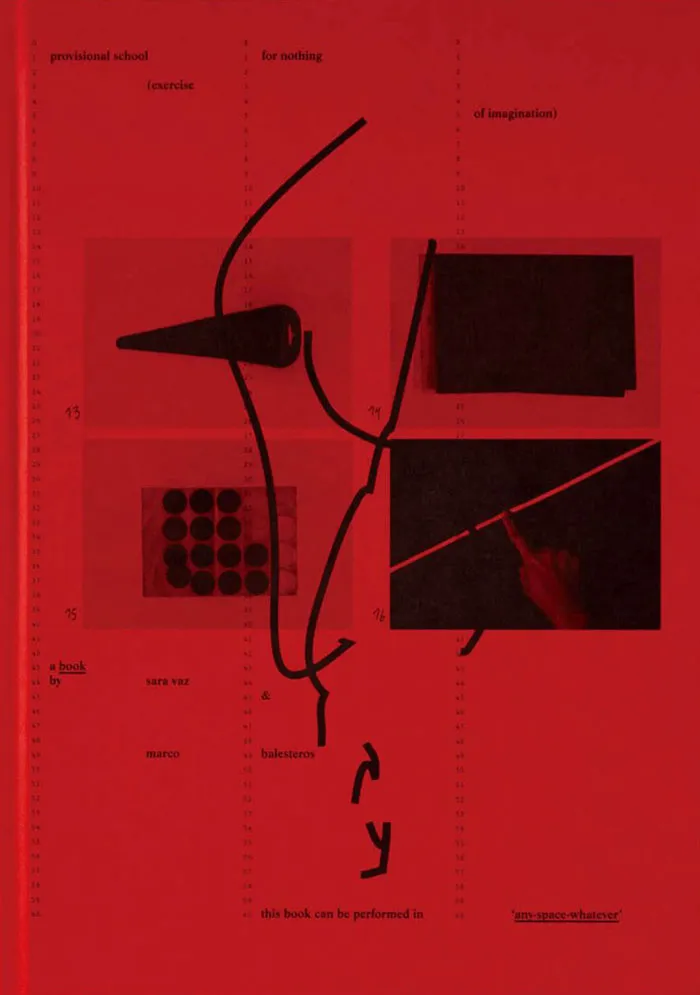
Cover of provisional school for nothing—exercise of imagination

Edições Provisórias

provisional school for nothing—exercise of imagination

€35.00

‘Provisional School for Nothing—exercise of imagination’ aims to explore forms of parallel education such as self-learning, self-organized schools, unschooling, inner schools, and more. This book is a choir of around 30 invited guests (artists, choreographers, dancers, graphic designers, writers, thinkers and so on). We use the word ‘choir’ since we decided to explore the concept of authorship. The book functions like a language score —comprising words, fragments, and loose ideas that develop throughout a series of conversations we’ve had with our guests via Zoom during the pandemic.

with Marco Balesteros Sara Vaz Alexandru Balgiu Ana Jotta Bráulio Amado Cracked Bolos Igor Dobricic Isabel Carvalho Ivan Martinez João Fiadeiro João dos Santos Martins] Karel Martens Maki Suzuki & Lppl Marco Bene Maria Duarte Marion Cachon Miguel Bonneville Nelson Guerreiro Olivier Lebrun Olga Mesa Francisco Ruiz de Infante Paul Elliman Paul Faure Pedro Barateiro Pedro Rogado Ricardo Nicolau Sara & André Sara Graça T.I.M.E. Tomás Cunha Ferreira Von Calhau! the missing person a man in silence

designed by Sara Vaz Marco Balesteros 

Published in 2025 ┊ 320 pages ┊ Hardcover ┊ Language: English

recommendations

Cover of Énergies

Même pas l'hiver

Énergies

Judith Hopf

Les sculptures et les films de Judith Hopf sont alimentés par des réflexions sur les relations que les êtres humains entretiennent avec la production et la technologie. Pour Énergies, sa première exposition monographique en France qui eut lieu conjointement à Paris à Bétonsalon et au Plateau, Frac Ile-de-France, l’artiste s’est concentrée sur cet élément invisible dont la quête accompagne notre quotidien et nos activités, produit par la conversion de ressources naturelles en puissance. Ce catalogue réunit des reproductions de dessins inédits, un entretien avec l’artiste et un texte critique de Tom Holert qui fait retour sur vingt années de travail.

Judith Hopf's sculptures and films are fuelled by reflections on the relationship human beings have with production and technology. For Énergies, her first solo exhibition in France, held jointly in Paris, at Bétonsalon and Plateau, Frac Ile-de-France, the artist focused on this invisible element whose quest accompanies our daily lives and activities, produced by converting natural resources into power. This catalog features reproductions of previously unpublished drawings, an interview with the artist and a critical text by Tom Holert, looking back over twenty years of work.

Textes / Texts
- François Aubart, Xavier Franceschi et Émilie Renard, "À propos d’énergie, d’amour et de chansons : conversation avec Judith Hopf"
- Tom Holert, "Changements de rythme : La méthodologie énergétique de Judith Hopf"

- François Aubart, Xavier Franceschi et Émilie Renard, "On Energy, Love, and Songs: Conversation with Judith Hopf"
- Tom Holert, "Changing Pace: Judith Hopf’s Energetic Methodology"

Traduction / Translation
Jean-François Caro
Louise Ledour

Typesetting : Olivier Lebrun

Cover of Peau d’Ana

Daisy Editions

Peau d’Ana

Ana Jotta, Alice Dusapin and 2 more

Monograph €22.00

A long conversation about the work and life of Portuguese artist Ana Jotta, accompanied by 60 previously unpublished photographs of her homes (in Brazil, Morocco, and Zanzibar) and her years in theater in the late 1970s.

“Peau d’Ana” is a conversation with the Portuguese artist Ana Jotta (1946), conducted in January 2024 by Alice Dusapin, Martin Laborde, and Baptiste Pinteaux in the Lisbon apartment that Ana has occupied for over forty years. Through the history of both this unique place and the various other homes in which she has lived — Tangier, Madeira, Brazil, and the Portuguese countryside — Ana Jotta mischievously and playfully invites us to revisit fragments of her life. She discusses her childhood, her work as an actress and set designer, her first exhibitions in the mid-1980s, and her life in the studio. She talks about the importance of pleasure and frustration, her love of painting and literature, and the role of the irrational in her work. She shares her dislike of families, her friendships with artists and other animals, and the detours necessary for finding, and preserving, the energy essential for work… and for sleep. She disarms with the precision of her words, which describe a solitary, demanding, and profoundly vivid existence where mediocrity has no place. The interview, published in French and English, is accompanied by some sixty previously unpublished photographs and documents.

Cover of Jennifer Lacey & Nadia Lauro – Dispositifs chorégraphiques

Les Presses du Reel

Jennifer Lacey & Nadia Lauro – Dispositifs chorégraphiques

Alexandra Baudelot

Monograph €25.00

Un essai consacré au travail de la chorégraphe et danseuse Jennifer Lacey et de la plasticienne et scénographe Nadia Lauro, qui rend compte de l'univers visuel des deux artistes au travers de nombreuses illustrations.

Dans cet essai, Alexandra Baudelot s'attache à saisir l'ensemble des œuvres co-écrites par la chorégraphe Jennifer Lacey et la plasticienne et scénographe Nadia Lauro, en observant de quelle manière elles s'architecturent les unes aux autres pour constituer des extensions inédites d'une forme artistique vers une autre.

Elle les observe à la manière de parcours envisagés comme des supports d'expériences cherchant à déborder constamment ses propres cadres de représentation. Ceci afin de saisir les politiques mises en jeu pour penser le corps, sa place dans un environnement fictif ou quotidien, son impact dans les enjeux chorégraphiques contemporains et ses liens avec notre époque.

L'espace de cet essai se prête également à l'univers visuel des deux artistes qui se livrent ici à un jeu de construction entre l'exploration d'images d'archive, de déclinaisons de projets inédits et périphériques aux pièces publiques, d'illustrations, et d'exposition d'un portfolio de dessins.

Originaire de New York, la chorégraphe et danseuse Jennifer Lacey est établie à Paris. Depuis 1991, elle a développé son propre travail chorégraphique qui a été présenté aux États-Unis (P.S. 122, The Kitchen) et en Europe (Klapstuk Festival, Vienna Festival, Danças na Cidade, Biennale d'art contemporain de Lyon, Big Torino). Depuis qu'elle réside en France, elle a créé et présenté plusieurs œuvres : $Shot (Lacey / Lauro / Parkins / Cornell), Châteaux of France no. 2 et no. 3, un projet conçu en collaboration avec Nadia Lauro, et Prodwhee!, une série de courts modules. En 2002, elle a été accueillie en résidence aux Laboratoires d'Aubervilliers. Jennifer Lacey a collaboré à différents projets avec de nombreux artistes : Loïc Touzé, Boris Charmatz, Emmanuelle Huynh, Benoît Lachambre, Catherine Contour et Latifa Laâbissi. Elle développe actuellement ses créations au sein de l'association Megagloss.

Nadia Lauro est artiste visuelle et scénographe basée à Paris. Elle développe son travail dans divers contextes et conçoit des environnements, des installations visuelles et des costumes pour différents projets chorégraphiques. Outre Jennifer Lacey, elle collabore notamment avec les chorégraphes Ami Garmon, Vera Montero, Benoît Lachambre, Frans Poelstra, Barbara Kraus, figures de la danse contemporaine en Europe. En 1998, elle fonde avec l'architecte paysagiste Laurence Crémel l'association Squash Cake Bureau – scénographie et paysage au sein de laquelle elle conçoit des installations paysagères et du mobilier urbain. Elle a également créé la scénographie de plusieurs défilés de mode.

Cover of Initiales #05 — Andrea Fraser

École nationale supérieure des beaux-arts de Lyon

Initiales #05 — Andrea Fraser

Claire Moulène, Emmanuel Tibloux

Periodicals €15.00

Le cinquième numéro de la revue d'art et de recherche « rétro-prospective » est consacré à l'artiste et performeuse Andrea Fraser, figure clé de l'art des années 1990 et 2000 et du courant de la « critique institutionnelle » (une monographie complétée par une grande enquête sur l'espace critique réalisée auprès d'une cinquantaine d'artistes, critiques et philosophes internationaux).

Avec contributions de Kader Attia, Eva Barto, Sophie Bonnet-Pourpet, Marie de Brugerolle, Gregory Buchert, Daniel Buren, Marie Canet, Gregory Castéra, Inès Champey, Thierry Chancogne, Claire Fontaine, François Cusset, Judith Deschamps, Paul Devautour, Philippe Durand, Joao Enxuto & Erica Love, Andrea Fraser, Nicolas Frespech, Dora García, Romain Grateau, Emmanuel Guez, Thomas Hirschhorn, Aliocha Imhoff & Kantuta Quirós, Béatrice Josse, Franck Larcade, Ju Huyn Lee, Sven Lütticken, Fabrice Mabime, Bartomeu Mari, Chus Martínez, Gwenael Morin, Claire Moulène, Jean-Luc Moulène, Yan Moulier Boutang, Vincent Normand, François Pain, Gerald Petit, Anne Querrien, Thierry Raspail, Sinziana Ravini, Delphine Reist & Laurent Faulon, Christophe de Rohan Chabot, Phillippe Roux, Jean-Baptiste Sauvage, Thomas Schlesser, Ida Soulard, Fabien Steichen, Michel Surya, Emmanuel Tibloux, Vier 5, Ulf Wuggenig, Italo Zuffi.

Cover of Pina #2

Pina Magazine

Pina #2

Forensic Architecture, Edgar Calel

Periodicals €25.00

Exhibitions by Edgar Calel and Forensic Architecture, conversations with Lisette Lagnado and between Eyal Weizman, Agata Nguyen Chuong, Zoé Samudzi and Irmgard Emmelhainz, and short stories by Portia Subran and Rémy Ngamije.

Forensic Architecture presents ‘A Counter-Archive of the Ovaherero and Nama Genocide’, a powerful investigation into the early 20th-century genocide committed by German colonial powers in today’s Namibia. Drawing on years of archival research and spatial analysis, the exhibition traces the lasting impact of colonial violence in three parts: from the ideological roots of racialised imperialism, to the design of the concentration camp, to the ongoing environmental degradation and dispossession affecting Indigenous communities today.

Edgar Calel’s ‘Dreams and memories dazzle through the flickering of fireflies’ is an exploration of dreams, memory and everyday life within his multi-generational family home in Comalapa, Guatemala. Each morning, dreams are shared among family members, as a practical and poetical way to sense the energy of the day ahead. Concrete business plans and reminders to cook certain dishes emerge from these retellings: a ritual so entwined in the architecture of their every day, that, even when apart, they recount their visions through shared voice notes.

Pina is a printed, portable exhibition space. We function as a commissioning platform, collaborating with artists to create exhibitions existing solely within the pages of a magazine.

Cover of Archives on Show – Revoicing, Shapeshifting, Displacing – A Curatorial Glossary

Archive Books

Archives on Show – Revoicing, Shapeshifting, Displacing – A Curatorial Glossary

Beatrice von Bismarck

Archives on Show brings the potential of reformulating the social and political relevance of archives by curatorial means into focus.

Based on the specific properties, faculties and methods of curation, the volume highlights those techniques and strategies that deal with archives not only to make their genesis and history apparent but also to open them up for the future. The 22 different ways of dealing with archives testify to the curatorial participation in (re)shaping the archival logic, structures and conditions. As process-oriented, collective and relational modes of producing meaning, these curatorial practices allow for the alteration, reconfiguration and mobilization of the laws, norms and narratives that the archive preserves as preconditions of its power.

The contributions to this volume by artists, curators and theorists demonstrate approaches that curatorially insist on building other relations between human and non-human archival participants. Each is using the book to create a curatorial constellation that generates and forms new connections between different times and spaces, narratives, disciplines and discourses. Configured as a glossary, the positions assembled in this volume exemplify curatorial methods with which to treat the archive as site and tool of collective, ongoing negotiations over its potential societal role and function.

Contributions by Heba Y. Amin, Talal Afifi, Eiman Hussein, Tamer El Said, Stefanie Schulte, Strathaus, Haytham El Wardany, Julie Ault, Kader Attia, Roger M. Buergel, Sophia Prinz, Yael Bartana, Rosi Braidotti, Kirsten Cooke, Ann Harezlak, Alice Creischer, Andreas Siekmann, Octavian Esanu, Megan Hoetger, Carlos Kong, Iman Issa, Kayfa ta, Kapwani Kiwanga, Doreen Mende, Stefan Nowotny, Marion von Osten, pad.ma, Abdias Nascimento, Eran Schaerf, Magdalena Tyżlik-Carver, Françoise Vergès.

Cover of Vampyroteuthis Infernalis

Les Presses du Reel

Vampyroteuthis Infernalis

Vilem Flusser

Philosophy €17.00

L'édition inédite et définitive (établie à partir des tapuscrits originaux en français) du traité fabuleux du philosophe tchéco-brésilien Vilém Flusser (1920-1991), une fiction philosophique et poétique qui, par des chemins détournés, nous confronte à la violence et à l'impasse des sociétés contemporaines.

Un monstre venu des profondeurs de l'océan, un poulpe vampire. Sa violence rappelle les nazis, ses mœurs sont libertaires et libidineuses. C'est une créature infernale, cannibale et brutale, pouvant changer de couleur à volonté, et dotée de trois pénis.
Et c'est notre cousin.

Dans cette fable fantastique, Vampyroteuthis infernalis émerge, non des abysses de l'océan, mais du plus profond de nous-mêmes pour nous tendre un miroir, nous montrer à quel point nous, les hommes, sommes ses proches parents et que nos histoires, nos sociétés, nos modes de vie ne sont, au fond, pas si différents.
Ce texte délibérément provocateur du philosophe tchéco-brésilien Vilém Flusser (1920-1991) n'est ni scientifique, ni objectif : c'est une fiction philosophique et poétique qui, par des chemins détournés, nous confronte à la violence et à l'impasse des sociétés contemporaines.

Flusser avait écrit ce texte en français (outre des versions en allemand et en portugais), et ce livre est la première édition du texte original en français. Il est accompagné des fantastiques dessins de son ami l'artiste et « zoosystémicien » français Louis Bec (1936-2018), co-auteur du livre, traduisant en images pseudo-scientifiques les chimères vampyroteuthiques.

Des essais de Marc Lenot, Élise Rigot et Florent Barrère éclairent la démarche de Flusser et de Bec.