Alessandro Sbordoni
Alessandro Sbordoni
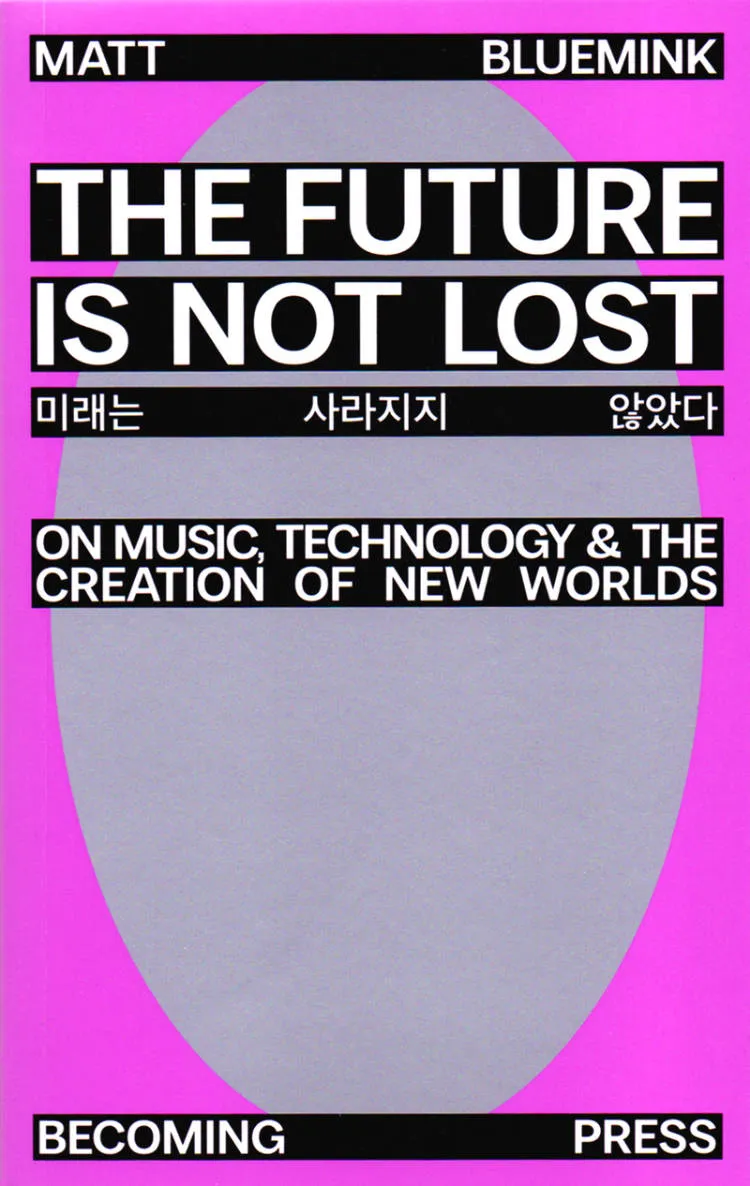
The Future is not Lost: On Music, Technology, and the Creation of New Worlds
Matt Bluemink, Alessandro Sbordoni
Mark Fisher taught a generation to hear the future's disappearance in contemporary music, as if the rhythm of the world was synchronised to the periodic flowering of new creative forms. His diagnosis was devastating: stagnation in music was akin to a venous insufficiency, or worse, some kind of nuclear winter that would ward off the spring for endless generations to come.
Drawing on musicians like SOPHIE, Arca and Iglooghost, Matt Bluemink declares that the future is not lost; it still speaks to us through music. If Fisher’s Hauntology — dwelling on ghosts of the past — is the logic of depression, then Bluemink’s Anti-Hauntology posits a logic of hope where voices from the future continue to guide the development of the present.
Island-hopping through Stiegler's philosophy of technics, Simondon's theory of individuation, and the spatial imaginaries of cyberpunk and solarpunk, Bluemink builds a theoretical framework equal to the times — one that takes seriously our capacity to, not only diagnose the world, but remake it. In order to create a new future we must re-imagine our relationship with music, with technology, and with culture. The world of tomorrow is a blank canvas; an open book. New beginnings are always possible.
Matt Bluemink is the founder and editor-in-chief of Blue Labyrinths online magazine. His research is focused on the relationship between the philosophy of technology, media theory and urbanism. He also writes on contemporary music, literature, and digital culture.

Semiotics of the End: Essays on Capitalism and the Apocalypse
The apocalypse as such will not take place, as it is already finished. Today, there is no longer any difference between the end of the world and capitalism itself: from Britney Spears’ Till the World Ends to The Caretaker’s Everywhere at the End of Time, from Avenger’s Endgame to Donnie Darko, and all the way down to the internet’s Backrooms, the world never ends but is reproduced again and again according to the semio-logic of capital.
In contrast with Mark Fisher’s Capitalist Realism, Semiotics of the End is a manifesto for the imagination of another relationship with the end. If it is easier to imagine the end of the world than the end of capitalism, as Slavoj Žižek, Fredric Jameson, and Mark Fisher put it, it is only because we have not imagined anything yet. The end is just the beginning.
With an Afterword by Matt Bluemink
Mentioned in

In the Delirium of the Simulation: Baudrillard Revisited
Third edition featuring afterword by Alessandro Sbordoni & several appendices, including a new translation & edit of “Taylor Swift Does Not Exist”.
This is a monumental and extensive work from someone who is arguably the most well-versed scholar of Baudrillard, Deleuze & Laruelle in the German-speaking world, Achim Szepanski, the original founder of Mille Plateaux, Force Inc Music Works and NON. This book is dedicated to Jean Baudrillard, who would be described by Achim as the most radical and advanced stimmung in Philosophy. Through this comprehensive and devouring analysis of Baudrillard’s work, the author presents a gripping account of their own philosophy; alongside his magnum opus Die Ekstasie der Spekulation, this book, In the Delirium of the Simulation, provides the strongest case for what might be called, in light of his passing, Szepanskism or Szepanskian Economics.
From Finance, to non-philosophy and radical experimental music, Szepanski is an anomalous and unique theoretician with one hell of a history.
CONTENTS:
- Metabox of Terms: Simulation, Code, Hyperreality, Fractal, Seduction and Implosion
- Baudrillard's Maximisation Hypothesis: the System and the Other
- Baudrillard & Marxism: Signs, Production and Money
- Distinguishing the Consumer System (or Shopping Mall) from the Landfill
- Baudrillard & the Financial Simulacrum
- Excursus on Jonathan Beller's World Computer
- Hyperreality & Artificial Intelligence
- Baudrillard & Quantum Theory
- Afterword: Hyperculture by Alessandro Sbordoni
- Appendix 1: Taylor Swift Does Not Exist
- Appendix 2: Baudrillard: After the Orgy
- Appendix 3: Imagination & Reality: Psychoanalysis vs Baudrillard