rile*books

Search books

Search books by title, author, publisher, keywords...

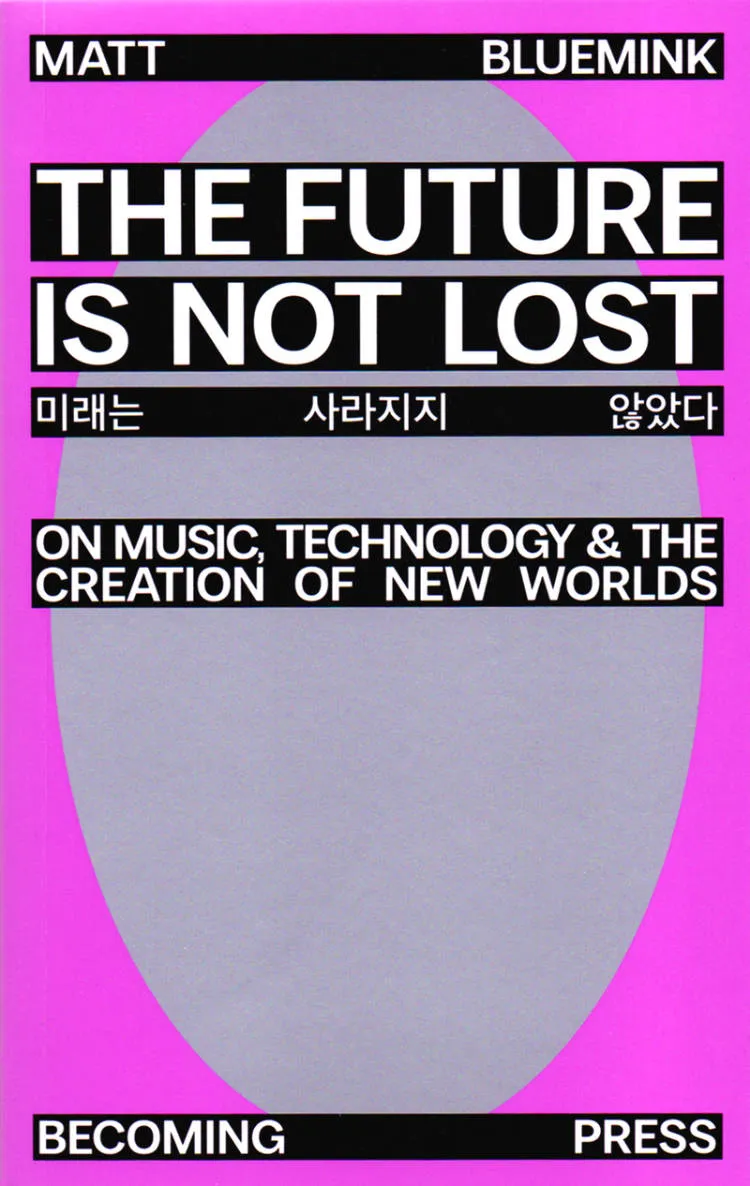
Cover of The Future is not Lost: On Music, Technology, and the Creation of New Worlds

becoming press

The Future is not Lost: On Music, Technology, and the Creation of New Worlds

Matt Bluemink, Alessandro Sbordoni ed.

€16.00

Mark Fisher taught a generation to hear the future's disappearance in contemporary music, as if the rhythm of the world was synchronised to the periodic flowering of new creative forms. His diagnosis was devastating: stagnation in music was akin to a venous insufficiency, or worse, some kind of nuclear winter that would ward off the spring for endless generations to come. 

Drawing on musicians like SOPHIE, Arca and Iglooghost, Matt Bluemink declares that the future is not lost; it still speaks to us through music. If Fisher’s Hauntology — dwelling on ghosts of the past — is the logic of depression, then Bluemink’s Anti-Hauntology posits a logic of hope where voices from the future continue to guide the development of the present. 

Island-hopping through Stiegler's philosophy of technics, Simondon's theory of individuation, and the spatial imaginaries of cyberpunk and solarpunk, Bluemink builds a theoretical framework equal to the times — one that takes seriously our capacity to, not only diagnose the world, but remake it. In order to create a new future we must re-imagine our relationship with music, with technology, and with culture. The world of tomorrow is a blank canvas; an open book. New beginnings are always possible. 

Matt Bluemink is the founder and editor-in-chief of Blue Labyrinths online magazine. His research is focused on the relationship between the philosophy of technology, media theory and urbanism. He also writes on contemporary music, literature, and digital culture. 

Published in 2026 ┊ 192 pages ┊ Language: English

recommendations

Cover of Exocapitalism – Economies with absolutely no limits

becoming press

Exocapitalism – Economies with absolutely no limits

Roberto Alonso Trillo, Marek Poliks

Essays €16.00

A rigorous and mind-blowing account of the dynamics of capitalism today through an in-depth exposition of software, speculative finance, and the highest scales of arbitrage.

At the centre of Marek Poliks and Roberto Alonso Trillo's argument is the idea that capital does not belong to humans, it belongs to—and is governed by—itself. Traditional economic theory struggles to keep up with the rapid rate of acceleration, and this book steps in to address this:

"The critical orthodoxy is slowing; it's tired, it's not especially good at the internet, it's probably never manned a Starbucks counter or an anonymous cubicle. Its younger adepts—though digitally native—are chronically underemployed, unavailable, drowning in the student debt (or student opportunity cost) required for entry into the critical apparatus. Few have any patience for the numbing slop-speak of the LinkedIn economy, the libertarian enclave of forex and HFT and memecoins, the quarter-zip depravity of employment at the charnel houses of McKinsey or Deloitte or Accenture, the blazingly random mood-swings of venture capital that lubricate all of the above. This impatience is—in the parlance of the above—a blocker: it means that the critical apparatus underestimates the power of the software economy, struggles to articulate the morphological density of digitally-realized capitalism, comprehensively ignores the functional death of labor, and doesn't understand scale."

Introduction by Charles Mudede.
Afterword by Alex Quicho.

"A masterpiece... Nick Land for adults."
— 0nty

Cover of Unconscious/Television

becoming press

Unconscious/Television

Lucas Ferraço Nassif

Essays €18.00


This book stems from the author’s discontents with Lacanian Psychoanalysis, by drawing from psychoanalysts like Félix Guattari and Sándor Ferenczi, as well as authors like Viveiro DeCastro, and Thomas Lamarre, to whom the book is dedicated. 

As Lucas Ferraço Nassif elaborates on the possibility of a multiplicitous Unconscious, or rather, a mass of many Unconscious(es), he attempts here to fold the book itself into the text, to make the organisation of the physical book itself a part of the elaboration. 

This 2nd Edition comes with a few editorial changes, and a slightly different design approach. It is being presented now with a suite of endorsements from a group of exciting writers and researchers, including Persis Bekkering, Thomas Lamarre, and Yuchen Li. Much of the first edition is preserved, and an extra text has been added, written by the editor as a part of the lecture at Ifilnova. There has been a focus on making this book more accessible, so we have reworked the design of this edition in Black & White. 

The Unconscious is Semiotic, not Linguistic, and it only jumps out when you read between the lines. Do you remember, back in 1997, when 600 kids had epileptic shocks whilst watching Television—the Pokémon Shock? This might sound strange at first, but Lucas Ferraço Nassif theorises that, contrary to the claim that this was caused by oscillations of blue and red light alone, it could have been caused by microperceptions and intensities within narrative. As Porygon takes Ash and friends into the digital world, the immanence of unconscious assemblages drags viewers in, too. 

Such is the haptic and imagetic nature of this book. Using several design and editorial strategies, and a particular mode of writing, the author attempts to elaborate on their work on the Unconscious by recreating a similar possibility—where book, language and reader collapse into a composition, an assemblage or a haecceity. Unconsciousness operates as the multiplanar compositions of Japanese Anime do, so this book has been organized accordingly—different texts, different temporalities, different voices—and like the Japanese concept of Ma (negative space), or even like CoreCore, something jumps out of the breaks, the gaps in between the layers, and therein lies, for this book, a departure point for elaborating on not just one, but many, Unconscious(es). 

Cover of Empires Over Skin: How we Fashioned our World

becoming press

Empires Over Skin: How we Fashioned our World

MYB

Philosophy €15.00

Meltdown Your Books, the author of Where Does A Body Begin? (2023), returns to Becoming Press for their second book, focusing not, this time, on the body itself, but what comes next. Whether in the sense of Dress, Clothing or Fashion, there is not much beyond the body itself that better signifies humanity than the act of adorning a body with garments, because we have no fur, or because of social codes, whether religious or class-oriented, because of beauty, or because of industrial capital; because, because, because. 

“The mounds of clothing that adorn my floor and the foot of my bed sometimes grow too large, and suddenly I am sinking into the matted mess of fabrics. On days like these I can’t help but feel that clothing, not just my clothing, but the very idea of clothing, is swallowing me up. Clothing is this immensity looming over me, yet somehow a microscopic itch in my brain, prodding me and twisting itself into knots–an irritation I accept for the temporary bliss of scratching it.”

To be human is to wake up, every morning, and to don the costume that completes your identity, for better or worse, by choice or by coercion. 

The task this book undertakes requires a particular kind of author, one who can recognise and sort through the contradictions on a theoretical level, but also someone who does not abstract the topic from their position as a subject—a critical book of fashion must be written by someone who lives it, someone who is passionate enough to write in good faith, because fashion isn’t just Gucci and Sweatshops—which themselves are rightly condemned for all kinds of reasons—because fashion itself is merely the tip of what may be one of the biggest, deepest ice bergs of all—Fashion is a philosophical black hole, one which drags everything into its infinite stomach, from semiotics to psychoanalysis, to art, design and craftsmanship, to economics and production chains, to speculation and historicising, to algebra, journalism and so on. 

Yet, this isn’t a philosophy book because it is simply too down-to-earth and relatable; it is just as celebratory and excited as it is critical. M.Y.B. begins by simply looking down, and beginning to describe the shoes upon their feet—it unravels dialectically and uncovers long chains of connections that stretch back through time.  

Meltdown Your Books (M.Y.B.), the pen name, was made as a portmanteau of the seminal essay Meltdown by Nick Land, and the landmark film Throw Away Your Books, Rally in the Streets by Shuji Terayama. I chose the name, almost 3 years ago now, to reflect the political and digital black hole I saw hovering at the edge of contemporary media experience, and to present my work without the muddy veneer of personal identity. It has remained, since its inception, an anonymous project in only the loosest terms. The dedicated could always find my real identity, and some have, and so its anonymous character existed primarily as an element of presentation. Its anonymity existed to emphasize its deindividuated character. The things I discuss and emphasize under the M.Y.B. label are not items with definitive characteristics, they are collective experiences. M.Y.B. is something I cherish beyond self.

Cover of Christian Eschatology of Artificial Intelligence: Pastoral Technologies of Cybernetic Flesh

becoming press

Christian Eschatology of Artificial Intelligence: Pastoral Technologies of Cybernetic Flesh

Giorgi Vachnadze

Non-human €12.00

The book tracks the overlap of various “regimes of truth” from the Greco- Roman period through to the AI and cybernetic period, in order to present a continuity that ties together Christian Pastoralism and Neoliberal Self-Governance. The result is a fascinating and detailed examination of western hegemonial doctrines and signs, such as the Logos, the Flesh, and the Fall. 

Vachnadze leaves us with no conclusion besides a certain feeling in our stomachs, a feeling that often comes when someone makes you aware of something fascinating, but deeply unnerving. The author weaves scripture and theory together in a way which can be as exciting as conspiratorial fictions, but it is executed without compromising the respectable position he has established at the point where non meets sense.

Cover of Of Enemies & Venison: First Materials for an Aztec Cosmotechnic

becoming press

Of Enemies & Venison: First Materials for an Aztec Cosmotechnic

Lou Manuel Arsenault

Philosophy €15.00

A new future for Mexico depends upon unearthing what colonialism has buried below the ground.

Situated deep within the ontological turn, this book brings together the philosophical anthropology of Descola and Viveiros de Castro, with the discourse that runs, through Heidegger, towards the world-building technics of Yuk Hui. Through a detailed study of the sacrificial and symbolic practices of Warfare & Hunting, Lou Manuel Arsenault uses these philosophies as tools to uncover a Cosmotechnic of the Aztecs.

In the cosmology and way of life of Nahuatl-speaking populations of the Valley of Mexico and the surrounding regions during the post-classical period, Warfare & Hunting were inseparable ritual practices within which the distinction between beings—Human, Jaguar, and Deer, or Aztec, Mimixcoa, or Mother and Enemy—became blurred. Articulated here as an Aztec Cosmo-Technique of identification, it is argued that these ritual practices enacted a world with its own destiny, one which was trampled by colonial violence. Yet this destiny—Batalla’s “Deep Mexico”—lies dormant, buried underground, buried in the literature, and in the archaeological record; this book works to unearth it.

Cover of Death by Landscape

Soft Skull Press

Death by Landscape

Elvia Wilk

Essays €17.00

From the acclaimed author of the novel Oval comes a book of "fan nonfiction" about living and writing in the age of extinction.

In this constellation of essays, Elvia Wilk asks what kinds of narratives will help us rethink our human perspective toward Earth. The book begins as an exploration of the role of fiction today and becomes a deep interrogation of the writing process and the self.  

Wilk examines creative works across time and genre in order to break down binaries between dystopia and utopia, real and imagined, self and world. She makes connections between works by such wide-ranging writers as Mark Fisher, Karen Russell, Han Kang, Doris Lessing, Anne Carson, Octavia E. Butler, Michelle Tea, Helen Phillips, Kathe Koja, Jeff and Ann VanderMeer, and Hildegard von Bingen.  

What happens when research becomes personal, when the observer breaks through the glass? Through the eye of the fan, this collection delves into literal and literary world-building projects—medieval monasteries, solarpunk futures, vampire role plays, environments devoid of humans—bridging the micro and the macro and revealing how our relationship to narrative shapes our relationships to the natural world and to one another.

Cover of If UR Reading This It's 2 Late

Argos Arts

If UR Reading This It's 2 Late

Tony Cokes

The first monograph on the work of artist Tony Cokes, creating a visual cartography of a body of moving image work that spans twenty years.

Tony Cokes's video works are eviscerating critiques and affective art works, bringing together color theory, sound, music, and texts, and quoting a polyphony of voices including Aretha Franklin, Mark Fisher, David Bowie, Public Enemy, and Donald Trump. Combining political and social commentary with cultural theory and a critique of capitalism, Cokes's works viscerally confront the social condition, particularly the prejudices and threats suffered by black subjects. This book is the first monograph on his practice, creating a visual cartography of a body of work that spans twenty years.

It features four critical pathways into Cokes's decades-long practice, with essays contributed by notable academics, and conversations between Cokes and artist Kerry Tribe. Cokes's work deals with mediation and distribution, and the book itself becomes another conduit for the dissemination of theory, critique, and counter-narrative—a process that Cokes so powerfully engages in as an artist.

This book accompanies Cokes's solo exhibition, If UR Reading This It's 2 Late: Vol. 1–3, across three international art institutions: Goldsmiths Centre for Contemporary Art, London; Carpenter Center for the Visual Arts, Harvard University; and ARGOS centre for audiovisual arts, Brussels.

Cover of Semiotics of the End: Essays on Capitalism and the Apocalypse

becoming press

Semiotics of the End: Essays on Capitalism and the Apocalypse

Alessandro Sbordoni

Philosophy €12.00

The apocalypse as such will not take place, as it is already finished. Today, there is no longer any difference between the end of the world and capitalism itself: from Britney Spears’ Till the World Ends to The Caretaker’s Everywhere at the End of Time, from Avenger’s Endgame to Donnie Darko, and all the way down to the internet’s Backrooms, the world never ends but is reproduced again and again according to the semio-logic of capital. 

In contrast with Mark Fisher’s Capitalist Realism, Semiotics of the End is a manifesto for the imagination of another relationship with the end. If it is easier to imagine the end of the world than the end of capitalism, as Slavoj Žižek, Fredric Jameson, and Mark Fisher put it, it is only because we have not imagined anything yet. The end is just the beginning.

With an Afterword by Matt Bluemink