rile*books

Search books

Search books by title, author, publisher, keywords...

Cover of Intelligent Life

Blank Forms

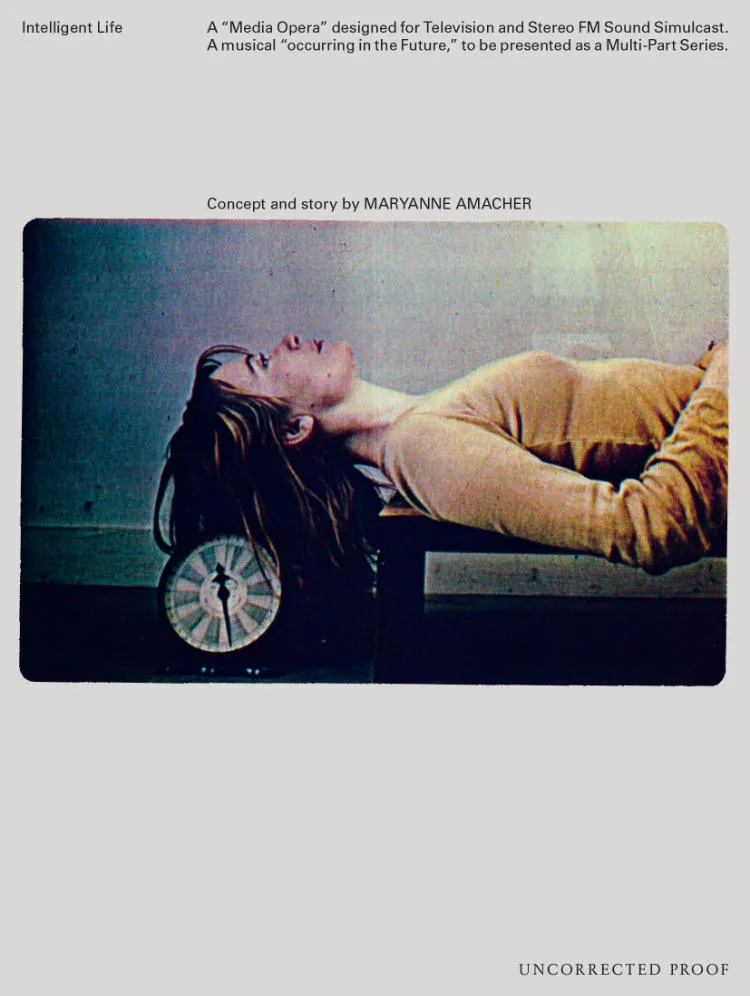
Intelligent Life

Maryanne Amacher

€60.00

Comprehensive and previously unpublished documentation on the American composer's unproduced magnum opus.

Had it been produced, Maryanne Amacher's media opera Intelligent Life would have represented the summation of the composer's concept to date. As she wrote to John Cage in the autumn of 1983, following the untimely deaths of the opera's patrons—Wies Smals, founder of De Appel, and curator Josine van Droffelaar, in a plane crash in the Swiss Alps—she would have at last had the support to "communicate the finest of my thought to others." Amacher's serial, intended for broadcast, sought to transmit her evolving ideas about perception, listening, and composition to a broader public—shifting music away from "nod and tap recognition" toward a transformative practice that could awaken intelligence to "unrecognized and new perceptual modes."

Set in the year 2021, Intelligent Life follows the employees of Supreme Connections LLC, a music entertainment corporation navigating a future in which artificial intelligence generates music faster than composers can. Anticipating an industry-wide downturn, Supreme Connections president Aplisa Kandel seeks advanced technologies that will revolutionize the act of listening and the future of music, including a bio-music script that lets the user hear Bach from the aural perspective of a reindeer and a wearable device that goes beyond replicating the mechanical tympanic resonances of the listening subject to produce the "listening mind" or the "sophisticated perceiver"—capturing and reproducing all the emotional and psychological associations unique to each individual.
Though Amacher could not realize Intelligent Life in any of its intended forms—she theorized its publication as a serialized radio broadcast and television simulcast, among other configurations—she continued designing "treatments" for the opera for much of her career. This volume makes the most complete of these working documents—including episodic scripts, notes on the use of LaserDisc, and an illustrated storyboard for the pilot—available to the public for the first time.

Maryanne Amacher (1938-2009) was a composer of large-scale fixed-duration sound installations and a highly original thinker in the areas of perception, sound spatialization, creative intelligence, and aural architecture. She is frequently cited as a pioneer of what has come to be called “sound art,” although her thought and creative practice consistently challenges key assumptions about the capacities and limitations of that genre. Often considered to be a part of a post-Cagean lineage, her work anticipates some of the most important developments in network culture, media arts, acoustic ecology, and sound studies.

Published in 2026 ┊ 456 pages ┊ Language: English

recommendations

Cover of Black Case Volume I and II – Return From Exile

Blank Forms

Black Case Volume I and II – Return From Exile

Joseph Jarman

Poetry €20.00

The republication in print form of the poems of Art Ensemble of Chicago's founding member breathes new life into a forgotten document of the Black Arts Movement.

In 1977, Art Ensemble of Chicago Publishing Co. published Jarman's Black Case Volume I and II: Return From Exile, a collection of writing conceived across America and Europe between 1960 and 1975. Comprised largely of Jarman's flowing, fiery free verse—influenced by Amus Mor, Henry Dumas, Thulani Davis, and Amiri Baraka—the book also features a manifesto for “GREAT BLACK MUSIC,” notated songs, concert program notes, Jarman's photos, and impressions of a play by Muhal Richard Abrams, the founder of the Association for the Advancement of Creative Musicians of which Jarman was also an original member.

Jarman writes poetry of personal revolutionary intent, aimed at routing his audience's consciousness towards growth and communication. He speaks with compassionate urgency of the struggles of growing up on Chicago's South Side, of racist police brutality and profound urban alienation, and of the responsibility he feels as a creative artist to nurture beauty and community through the heliocentric music that he considers the healing force of the universe. A practicing Buddhist and proponent of Aikido since a 1958 awakening saved him from the traumatic mental isolation of his time dropped by the US army into southeast Asia, Jarman sings praise for the self-awareness realization possible through the martial arts.

With cosmic breath as its leitmotif, his poetry both encourages and embodies a complete relinquishing of ego. While some of the poems contained within Black Case have already been immortalized via performances on classic records by Jarman and Art Ensemble of Chicago, its republication in print form breathes new life into a forgotten document of the Black Arts Movement.

Cover of Better Do It Now before You Die Later: Sonny Simmons with Marc Chaloin

Blank Forms

Better Do It Now before You Die Later: Sonny Simmons with Marc Chaloin

Sonny Simmons, Marc Chaloin

Though his years in the New York free-jazz scene of the sixties cemented his reputation as "one of the most forceful and convincing composers and soloists in his field," saxophonist Sonny Simmons (1933–2021) was nearly forgotten by the '80s, which found him broke, heavily dependent on drugs and alcohol, and separated from his wife and kids. "I played on the streets from 1980 to 1994, 365 days a year," Simmons tells jazz historian and biographer Marc Chaloin. "I would go to North Beach, and I'd sleep in the park. The word got around town that Sonny is a junkie, really strung out."

The resurrection of Simmons' career―upon the release of his critically acclaimed Ancient Ritual (Qwest Records) in 1994―has become a modern legend of the genre. In the last two decades of his musical career, Simmons broke through to a new echelon of recognition, joining the pantheon of great innovators and masters of the music. But to this day he remains an undersung figure. Here, in the first ever book dedicated to his life, Simmons recounts his childhood in the backwoods of Louisiana, his adolescence in the burgeoning Bay Area jazz scene and his star-studded life in New York playing alongside the greats.

Cover of Spectres #02 – Resonances

Shelter Press

Spectres #02 – Resonances

Bartolomé Sanson, François Bonnet

The second issue of Spectres is devoted to the concept of resonances, with contributions by Maryanne Amacher, Chris Corsano, Ellen Fullman, Christina Kubisch, Okkyung Lee, Pali Meursault, Jean-Luc Nancy, David Rosenboom, Tomoko Sauvage, The Caretaker, David Toop, and Christian Zanési.

To resonate: re-sonare. To sound again—with the immediate implication of a doubling. Sound and its double: sent back to us, reflected by surfaces, diffracted by edges and corners. Sound amplified, swathed in an acoustics that transforms it. Sound enhanced by its passing through a certain site, a certain milieu. Sound propagated, reaching out into the distance. But to resonate is also to vibrate with sound, in unison, in synchronous oscillation. To marry with its shape, amplifying a common destiny. To join forces with it. And then again, to resonate is to remember, to evoke the past and to bring it back. Or to plunge into the spectrum of sound, to shape it around a certain frequency, to bring out sonic or electric peaks from the becoming of signals.

Cover of Silence: Lectures and Writings

Wesleyan

Silence: Lectures and Writings

John Cage

Essays €27.00

Silence: Lectures and Writings is a book by American experimental composer John Cage (1912–1992), first published in 1961 by Wesleyan University Press. Silence is a collection of essays and lectures Cage wrote during the period from 1939 to 1961.

Most of the works are preceded by a short commentary on their origins, some have an afterword provided. Several works feature unorthodox methods of presentation and/or composition. "The Future of Music: Credo" juxtaposes paragraphs of two different texts. The text of the first part of "Composition as Process" is presented in four columns, the text of "Erik Satie" in two. "45' for a Speaker" is similar to Cage's "time length" compositions: it provides detailed instructions for the speaker as to exactly when a particular sentence or a phrase should be said. "Where Are We Going? and What Are We Doing?" is presented in several types of typeface to better reflect the concept of the lecture, which was originally presented as four tapes running simultaneously. "Indeterminacy" is a collection of various anecdotes and short stories taken from life or books Cage read: the concept is to tell one story per minute, and to achieve the speaker has to either speed up or slow down, depending on the length of the story.

Cover of Wistlin is did

Cordite Books

Wistlin is did

Chris Mann

Poetry €19.00

Chris Mann is an Australian-American composer, poet and performer specializing in compositional linguistics. Mann studied Chinese and linguistics at the University of Melbourne, and his interest in language, systems, and philosophy is evident in his work. Mann founded the New Music Centre in 1972 and taught at the State College of Victoria in the mid-1970s. Mann moved to New York in the 1980s and was an associate of American composers John Cage and Kenneth Gaburo. Mann has recorded with the ensemble Machine For Making Sense with Amanda Stewart and others, Chris Mann and the Impediments, and Chris Mann and The Use. Mann currently teaches in the Media Studies Graduate program at The New School.

Cover of Schizo-Culture: The Event, The Book

Semiotext(e)

Schizo-Culture: The Event, The Book

Sylvère Lotringer, David Morris

Philosophy €42.00

The legendary 1975 "Schizo-Culture" conference, conceived by the early Semiotext(e) collective, began as an attempt to introduce the then-unknown radical philosophies of post-'68 France to the American avant-garde. The event featured a series of seminal papers, from Deleuze's first presentation of the concept of the "rhizome" to Foucault's introduction of his History of Sexuality project. The conference was equally important on a political level, and brought together a diverse group of activists, thinkers, patients, and ex-cons in order to address the challenge of penal and psychiatric institutions. The combination proved to be explosive, but amid the fighting and confusion "Schizo-Culture" revealed deep ruptures in left politics, French thought, and American culture.

The "Schizo-Culture" issue of the Semiotext(e) journal came three years later. Designed by a group of artists and filmmakers including Kathryn Bigelow and Denise Green, it documented the chaotic creativity of an emerging downtown New York scene, and offered interviews with artists, theorists, writers, and No Wave and pre-punk musicians together with new texts from Deleuze, Foucault, R. D. Laing, and other conference participants.

This slip-cased edition includes The Book: 1978, a facsimile reproduction of the original Schizo-Culture publication; and The Event: 1975, a previously unpublished and comprehensive record of the conference that set it all off. It assembles many previously unpublished texts, including a detailed selection of interviews reconstructing the events, and features Félix Guattari, William Burroughs, Kathy Acker, Michel Foucault, Sylvère Lotringer, Guy Hocquenghem, Gilles Deleuze, John Rajchman, Robert Wilson, Joel Kovel, Jack Smith, Jean-François Lyotard, Ti-Grace Atkinson, François Peraldi, and John Cage.

Cover of Livre d'images sans images (LP)

Varamo Press

Livre d'images sans images (LP)

Mette Edvardsen, Iben Edvardsen

Performance €23.00

Livre d’images sans images by Mette Edvardsen & Iben Edvardsen borrows its title from a book by H.C. Andersen, also referred to as The Moon Chronicler. The book follows a conversation between a painter and the Moon, where the Moon describes to the painter what she sees on her journey around the world every evening, telling the painter to paint what she describes. “This conversation, as in the now obsolete meaning of the word (‘a place where one lives or dwells’), was the starting point for our work. Using the weather report as dramaturgy, (‘the moon did not show up every evening, sometimes a cloud came in between’), we have created and collected materials from our conversations in the form of recordings, text, voice, drawings, references, found images, loose connections, inspirations and imaginations, in the order they came to us. They are at the same time sources and traces, material and support for new imaginations or events to come.” The work consists of three different media: vinyl, paper and live performance. 

Mette Edvardsen is a choreographer and performer eager to explore the performing arts as a practice and situation, also in relation to other media such as books and writing. This work is in collaboration with her daughter, Iben Edvardsen.

Published by Xing & Varamo Press
XONG collection – artist records XX10 (2023)
First edition, September 2023
Recorded and edited by Mette Edvardsen & Iben Edvardsen
Format white 12’ vinyl LP in cardboard sleeve
Released in a numbered edition of 300 copies, including collector’s edition of 25 copies, each accompanied by a unique poster hand drawn with black marker by Mette Edvardsen & Iben Edvardsen, 59,4 x 84 cm, folded, signed by the artists

Cover of Sonic Faction: Audio Essay as Medium and Method

Urbanomic

Sonic Faction: Audio Essay as Medium and Method

Maya B. Kronic, Steve Goodman and 1 more

Essays €20.00

Explorations of the audio essay as medium and method.

With contributors including Justin Barton, Angus Carlyle, Kodwo Eshun, Steve Goodman, Robin Mackay, Paul Nataraj, and Iain Sinclair, Sonic Faction presents extended lines of thought prompted by two Urbanomic events which explored the ways in which sound and voice can produce new sensory terrains and provoke speculative thought.

Three recent pieces provide the catalyst for a discussion of the potential of the "audio essay" as medium and method, a machine for intensifying listening and unsettling the boundaries between existing forms: documentary, music, ambient sound, audiobook, field recording, radio play….

Kode9's Astro-Darien (2022) is a sonic fiction about simulation, presenting an alternative history of the Scottish Space Programme, haunted by the ghosts of the British Empire. Justin Barton and Mark Fisher's On Vanishing Land (2006) is a dreamlike account of a coastal walk that expands into questions of modernity, capitalism, fiction, and the micropolitics of escape. Robin Mackay's By the North Sea (2021) is a meditation on time, disappearance, and loss as heard through the fictions of Lovecraft, Ccru, and the spectre of Dunwich, the city that vanished beneath the waves.

Alongside photographic documentation of the events and edited transcripts of the artists' discussions, Sonic Faction brings together contributors with diverse perspectives to address the question of the audio essay and to imagine its future.

Contributors
Lawrence Abu Hamdan, Lendl Barcelos, Justin Barton, Ben Borthwick, Angus Carlyle, Matt Colquhoun, Jessica Edwards, Kodwo Eshun, Steve Goodman, Ayesha Hameed, Eleni Ikoniadou, Lawrence Lek, Robin Mackay, Paul Nataraj, Emily Pethick, Iain Sinclair, Shelley Trower

Cover of Spectres #05 – Diffusion

Shelter Press

Spectres #05 – Diffusion

François J. Bonnet, Bartolomé Sanson

The fifth issue of the annual publication dedicated to sound and music experimentation, co-published by Shelter Press and Ina GRM – Groupe de Recherches Musicales, on the theme of diffusion and dissemination.

In a 1955 pamphlet entitled Seven Years of Musique Concrète, Jacques Poullin wrote:
"[...] sound projection in a concert hall is a logical extension of the concerns of the Groupe de Recherches de Musique Concrète and requires its technicians to properly study multiple aspects of the problems of sonorisation that are often neglected and to date have been almost exclusively the preserve of 'public address' technicians".

From the very beginning, fixed media electroacoustic music in its various guises faced a significant challenge: that of how it could be shared with the public. Even before it was distributed in the form of records, musique concrète, having first been transmitted on radio, soon turned to the concert stage. From the time of its birth, a twofold question was posed: What strategy of diffusion could be used for this music which involves no live performers? But also, how could it make use of existing systems of sound amplification without losing its singular nature, making sure to preserve its own particularities? Identified very early on, these questions have lost none of their pertinence some seventy years later.

Under pressure from the cultural industries and faced with a largely commercially-driven standardisation of formats, it is important today to reaffirm both the singular nature of experimental electroacoustic practices, and the possibilities these practices open up beyond standards and rules.

This calls for an exploration of the vast domain of sound creation in which, here and there, ideas, concepts, and sometimes new works appear that fully embrace the question of the deployment of sound, its dissemination and its expansion. An exploration focussed on the listening experience—a fundamentally musical experience—but adopting a critical approach which may sometimes call into question traditional ways of sharing and listening to sound, the status of listener and creator, and which may even challenge the acoustic integrity of venues and the legitimacy of diffusion systems.

Such are the questions to be addressed here. Sketching out the contours of what is quite obviously a huge subject, this volume, drawing upon a wide variety of points of view, experiences, and ideas, hints at an entire critical apparatus that remains to be developed and consolidated, but is crucial given the primordial importance of the theme of dissemination. For dissemination is the transitional stage par excellence, the uncertain stage that sits between creation and reception while at the same time determining both. It is a critical stage, yet one that is often neglected or, as Poullin says, left to a technical intermediary who may impose conditions entirely exogenous to questions of music and listening.

For these reasons, it seems more necessary than ever to return to the experience of sounds, to once again listen attentively to their trajectories, their diffraction in space, their emergence and their disappearance. To get to grips with the mysteries of their deployment so as to reaffirm that this deployment is essential to them.

Edited by François J. Bonnet and Bartolomé Sanson.
Contributions by Marja Ahti, Scott Arford, Nicolas Debade, Michael Gatt, Tim Ingold, Rolf Julius, Jules Négrier, John Richards, Marina Rosenfeld, Hildegard Westerkamp, Randy Yau.

Spectres is an annual publication dedicated to sound and music experimentation, co-published by Shelter Press and Ina GRM – Groupe de Recherches Musicales.

Cover of Stalled Death Train

Spunk Editions

Stalled Death Train

Evan Kennedy

Fiction €20.00

A dark-humored poet’s novel of cruising, contempt, and database crawling, Stalled Death Train rumbles through the death of David Bowie in 2016 to shake apart its narrator’s sense of self. Nick, a burned out office worker and late-Bowie fanatic, spends his days mourning his fallen star, left to decipher the legacy and lyrics of a singular pop icon whose excesses did not cease, even after his greatest moments had passed. Meanwhile, Nick must solve the mystery of why his boyfriend has begun to self-amputate as a form of autonomously upgrading his dimensions—or at least call tech support before he uploads himself to the cloud.

Cover of The Organ is the World's Greatest Synthesizer (vinyl LP)

Staalplaat

The Organ is the World's Greatest Synthesizer (vinyl LP)

Charlemagne Palestine

Recorded live at Amsterdam's Oude Kerk during the 2024 Sonic Acts Festival, The Organ is the World's Greatest Synthesizer finds Charlemagne Palestine returning to the Staalplaat catalog after many years. Taking its title and cover from a drawing made by Palestine during the performance, the work expands his singular mythology of sound and spirit. Opening with resonating bells and falsetto overtones before surrendering to the vast sonic tides of the church organ, the 40-minute piece unfolds as an ecstatic continuum—tones intertwining, frequencies colliding, and space itself becoming an instrument. A testament to the living dialogue between artist, instrument, and place, this is Palestine at his most immersive and transcendent.

For over six decades, Charlemagne Palestine has been a pioneering composer, performer, and multimedia artist, celebrated for his ecstatic sonic explorations and ritualistic, metaphysical performances. Emerging from the cross-disciplinary New York art scene of the 1960s and '70s, he helped shape a heretical edge of minimalism alongside figures like Conrad, Riley, Niblock, and Glass. Trained as a Jewish cantor and later as the carillonneur at St. Thomas Church, Palestine cultivated a deep fascination with resonance and overtone—an obsession that evolved through his use of percussion, early synthesizers, and monumental piano works, influencing artists from John Cale to Nick Cave.