Maryanne Amacher
Maryanne Amacher
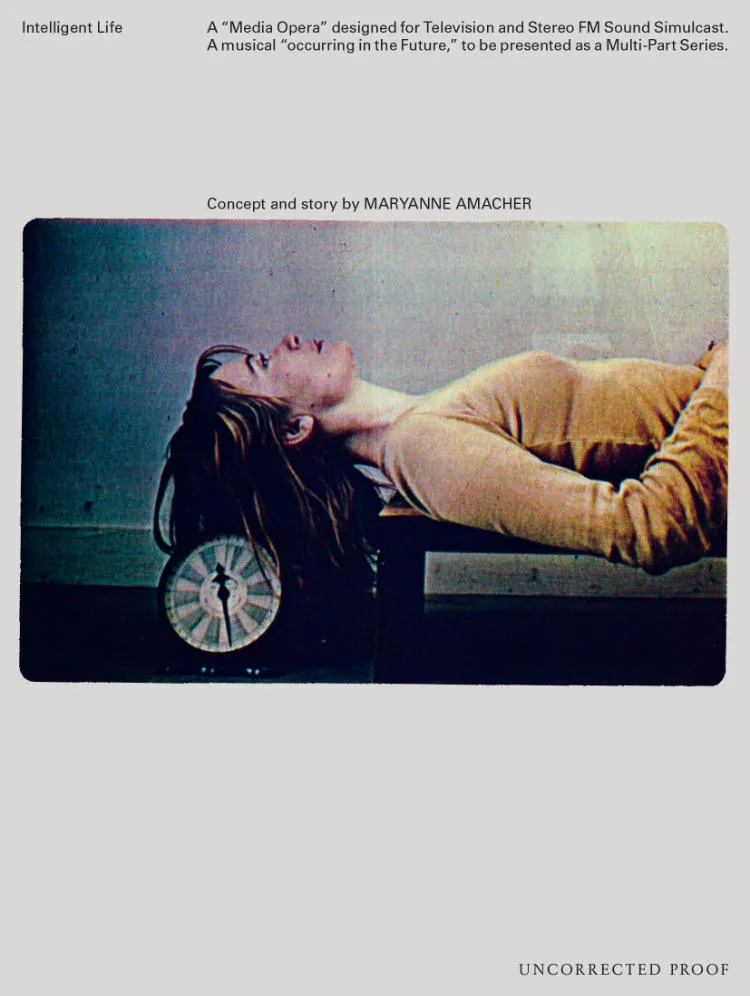
Intelligent Life
Comprehensive and previously unpublished documentation on the American composer's unproduced magnum opus.
Had it been produced, Maryanne Amacher's media opera Intelligent Life would have represented the summation of the composer's concept to date. As she wrote to John Cage in the autumn of 1983, following the untimely deaths of the opera's patrons—Wies Smals, founder of De Appel, and curator Josine van Droffelaar, in a plane crash in the Swiss Alps—she would have at last had the support to "communicate the finest of my thought to others." Amacher's serial, intended for broadcast, sought to transmit her evolving ideas about perception, listening, and composition to a broader public—shifting music away from "nod and tap recognition" toward a transformative practice that could awaken intelligence to "unrecognized and new perceptual modes."
Set in the year 2021, Intelligent Life follows the employees of Supreme Connections LLC, a music entertainment corporation navigating a future in which artificial intelligence generates music faster than composers can. Anticipating an industry-wide downturn, Supreme Connections president Aplisa Kandel seeks advanced technologies that will revolutionize the act of listening and the future of music, including a bio-music script that lets the user hear Bach from the aural perspective of a reindeer and a wearable device that goes beyond replicating the mechanical tympanic resonances of the listening subject to produce the "listening mind" or the "sophisticated perceiver"—capturing and reproducing all the emotional and psychological associations unique to each individual.
Though Amacher could not realize Intelligent Life in any of its intended forms—she theorized its publication as a serialized radio broadcast and television simulcast, among other configurations—she continued designing "treatments" for the opera for much of her career. This volume makes the most complete of these working documents—including episodic scripts, notes on the use of LaserDisc, and an illustrated storyboard for the pilot—available to the public for the first time.
Maryanne Amacher (1938-2009) was a composer of large-scale fixed-duration sound installations and a highly original thinker in the areas of perception, sound spatialization, creative intelligence, and aural architecture. She is frequently cited as a pioneer of what has come to be called “sound art,” although her thought and creative practice consistently challenges key assumptions about the capacities and limitations of that genre. Often considered to be a part of a post-Cagean lineage, her work anticipates some of the most important developments in network culture, media arts, acoustic ecology, and sound studies.
Mentioned in

Spectres #02 – Resonances
Bartolomé Sanson, François Bonnet
The second issue of Spectres is devoted to the concept of resonances, with contributions by Maryanne Amacher, Chris Corsano, Ellen Fullman, Christina Kubisch, Okkyung Lee, Pali Meursault, Jean-Luc Nancy, David Rosenboom, Tomoko Sauvage, The Caretaker, David Toop, and Christian Zanési.
To resonate: re-sonare. To sound again—with the immediate implication of a doubling. Sound and its double: sent back to us, reflected by surfaces, diffracted by edges and corners. Sound amplified, swathed in an acoustics that transforms it. Sound enhanced by its passing through a certain site, a certain milieu. Sound propagated, reaching out into the distance. But to resonate is also to vibrate with sound, in unison, in synchronous oscillation. To marry with its shape, amplifying a common destiny. To join forces with it. And then again, to resonate is to remember, to evoke the past and to bring it back. Or to plunge into the spectrum of sound, to shape it around a certain frequency, to bring out sonic or electric peaks from the becoming of signals.