Artistic Research
Artistic Research

YouYou Group – A li'nuage
Handmade artist's book combining drawings, photographs, and archival materials. This publication reflects on the YouYou Group's ten-year journey and its evolving relationship with space. It marks a transitional moment from the group's long-term engagement with public space toward a growing understanding of spatiality and collective presence.
YouYou Group is a Belgian choir that specializes in what is known in Arabic as zaghareed. This trilling cry is used by women at weddings and festive occasions, but also at funerals. Youyou is the French name for zaghareed. Depending on the regional origin, it is also called kululu, tsahalulim, or irrintzi. It is a long, shrill tone that is modulated (by the throat, glottis, or rapid tongue movements) and can be heard from far away. Brussels artist Myriam Van Imschoot was one of the founders of this singing group.

Self-Institution A Terminology Audit
A survey of and reflection on artists using/ hijacking institutional formats.
Self-Institution/Terminology Audit is a collection of profiles and lexicons documenting artistic practices that operate as self-declared institutions. It examines the act of self-institution as both a conceptual and operational approach, focusing on how these practices structure themselves and engage with their contexts.
Initiated by the Office for Joint Administrative Intelligence (O.J.A.I.), this publication investigates artist offices, bureaus, departments, ministries, societies, centres, and other explicitly institutional invocations. The Terminology Audit reveals language and jargon unique to each practice. The case studies, currently active in the field, represent a broad range of approaches, including research-based, performance-driven, pragmatic, materially motivated, counter-institutional, esoteric, and absurd facsimiles of institutionhood.
The publication was conceptualized and introduced by Chris Dreier and Gary Farrelly (O.J.A.I.), featuring an essay by Gary Farrelly, due diligence text by Andrea Knezović, and a responsorial note by Alicja Melzacka. Included self-instituted entities are: The Bureau of Melodramatic Research (BMR), The Office for Joint Administrative Intelligence (O.J.A.I.), Self Luminous Society, Gesellschaft zur Emanzipation des Samples G.E.S, Department of Ultimology, Minister of Cosmic People, Tac.ka Association, KOLXOZ, Pls, I’m Trying to Think Institute (PITTI), This Institute, Aurora-Rhoman Institute of Archaeology and Cultural Relics, AARS (Antwerp Artist Run School), The Letter Space Department (TLSD), Temporary Information Center (T.I.C.).

Tongue Touching The Other
Tongue Touching the Other / Dil Ötekine Değince is a result of a research project on the Turkish language and its exchanges mainly with Arabic, Farsi and Kurdish. Through language, it aims to follow a common, transnational history and how modern national identities affected our knowledge of that history, and sense of belonging. However, as much as commons, varied forms and dimensions of marginalization are also deeply embedded in our history, culture, language, and as a result, in our everyday lives and in our collective unconsciousness. This book is an attempt to rethink the social, economic & cultural contexts of identity and the concept of “othering” and reflect on inherited motives of imperial and colonial structures, racism, colourism, classism & gender roles.
The book was created through a multi-layered process involving research, conversations, and design. The research phase explored academic texts, etymology, and visual culture to uncover narratives of commons and division. Conversations with 18 people across 9 countries—based on trust and anonymity—provided personal, subjective insights, recorded between July 2022 and January 2025. These dialogues were transcribed and, rather than presented chronologically, were edited into a montage alongside archival visuals and texts, shaping the book's four-chapter narrative:
Yabancı / Stranger / یابان
Misafir / Guest / مسافر
Eğitim / Education
Temsil / Representation / تمثيل

The (Incomplete) Cosmic Catalogue
Mapping constellations between five specific pre-colonial cosmological examples extending from the Sahel to the Horn of Africa, this work reframes cosmology as a multi-dimensional and scalable practice of situated technologies and embodied cartographies. The resulting publication which was produced during the Jan van Eyck residency is a culmination of several years of research and exploration into precolonial cosmologies and spatial orders rooted in the African Sahel extending to the Horn of Africa.
The (Incomplete) Cosmic Catalogue is an output of a research project that was initially commissioned by the Canadian Centre for Architecture as part of the multi-disciplinary research fellowship, The Digita Now: Architecture and Intersectionality in 2022.

The Circle: Chronologie pour une constellation
A visual and text based investigation led by Moroccan artist Bouchra Khalili during many years following the traces left by the Mouvement des travailleurs arabes, a group fighting for the rights of the Arab workers in France at the turn of the 1970s.
Khalili focused her attention on the theatre groups Al Assifa and Al Halaka who were created in this political environment. The publication unfolds from The Circle (2023), a video installation shown for the first time at the 15th Sharjah Biennale (2023), at Macba (2023) and at the Luma Foundation (in Arles in 2023-2024 and Zurich in 2025).
The book is published in conjunction with Bouchra Khalili's exhibitions as guest visual artist of the Festival d'Automne in Paris in 2025.
Texts by KJ Abudu, Bouchra Khalili, Mohamed Amer Meziane, Abdellali Hajjat ; interviews with Saïd Bouziri, Hedi Akkari, Smaïne Idri, Mustapha Mohammadi, Philippe Tancelin, Mia Radford, Lucas Yahiaoui.

MAKAN #2 / Manufacturing Narratives
In its second issue, Manufacturing Narratives, Makan focuses on how interrogating narrativity can provoke fundamental questions about how societies define or choose to accept societal or historical truths in today’s world. Spanning across [and beyond] the Mashreq and Maghreb, the various contributions reflect a shared space of inquiry that bridges geographies and fosters emergent dialogues across shifting territorialities. This issue invited contributors to right (as much as write) narratives: to question authorship and its social collectivities, to retell alternative public histories, to explore gender roles, and to unsettle the exoticism, folklorization, and political textures of fiction as a practice of indiscipline. Together, these contributions re-articulate the genealogies of our present through the pluralities of the past, offering tools to imagine and manufacture alternative futures, and realities otherwise.
With contributions by Ala Younis, Bari Abbassi, George Bajalia, Karim Kattan, Karima Kadaoui, Tamkeen, Kenza Sefrioui, Lahbib El Moumi, Laila Hida, Maureen Mougin, Mohamed Amer Meziane, Monica Basbous, Nadia Tazi, Sénamé Koffi Agbodjinou, Salma Barmani, Sonia Terrab, Soufiane Hennani, Yto Barrada.

Forensic Architecture: Violence at the Threshold of Detectability
In Forensic Architecture, Eyal Weizman, the group’s founder, provides, for the first time, an in-depth introduction to the history, practice, assumptions, potentials, and double binds of this practice. The book includes an extensive array of images, maps, and detailed documentation that records the intricate work the group has performed.
Included in this volume are case studies that traverse multiple scales and durations, ranging from the analysis of the shrapnel fragments in a room struck by drones in Pakistan, the reconstruction of a contested shooting in the West Bank, the architectural recreation of a secret Syrian detention center from the memory of its survivors, a blow-by-blow account of a day-long battle in Gaza, and an investigation of environmental violence and climate change in the Guatemalan highlands and elsewhere.
Weizman’s Forensic Architecture, stunning and shocking in its critical narrative, powerful images, and daring investigations, presents a new form of public truth, technologically, architecturally, and aesthetically produced. Their practice calls for a transformative politics in which architecture as a field of knowledge and a mode of interpretation exposes and confronts ever-new forms of state violence and secrecy.

Chile Chico et le quartier Versailles
Chile Chico et le quartier Versailles, c'est une exploration qui inventorie, interroge et révèle les mémoires invisibles en listes et en collections. Une mémoire qui ne soffre pas en bloc, qui résiste, se fragmente, se transforme. A travers cette archive collaborative, nous avons voulu capter ces va-et-vient ď'un passé qui dialogue avec le présent, des images qui oscillent entre Vintime et le collectif.
Le point de départ de cette fabrique visuelle, c'est lexil des Chilien.nes, débarqué.es dans les années 70, qui se tissent une nouvelle vie sur le sol de Neder-Over-Heembeek, dans le quartier Versailles à Bruxelles. Ces trajectoires, arrachées à un ailleurs, s'ancrent dans des espaces rêvés comme de transit pour devenir des lieux d 'appartenance, où lexil se mue et les racines finissent par se déployer. A ces récits se greffent d'autres histoires, d'autres trajectoires. Un quartier comme un carrefour, ou les individualités se rencontrent, où les vies se croisent et s'allient.

The Contemporary Condition - Contemporaneity in Embodied Data Practices
Cornelia Sollfrank, Felix Stalder
What parallels are there between a human pranayama practitioner and a migratory bird in heavily datafied environments? In Contemporaneity in Embodied Data Practices, two artistic field studies provide the starting point for a dialogical reflection on the entangling of diverse temporalities in body-related, datafied, and experiential practices. Shifting through biological, historical, and technological rhythms, Cornelia Sollfrank and Felix Stalder unfold their respective more-than-human frames of reference and arrive at specific forms of agency in the contemporary moment. Published in partnership with the Centre for Research in Artistic Practice under Contemporary Conditions at Aarhus University.

When Fact Is Fiction
What is the value of fiction at a time when fake news, alternative facts, and infotainment undermine the integrity of politics and media? This question is the common thread of When Fact Is Fiction. It brings together contributions by and about artists who probe the boundaries between fact and fiction. The ambiguous relationship between the documentary and the imaginary has been investigated and questioned within the arts for decades. The artists discussed in this volume deliberately blur the boundaries between what is generally known as ‘fiction’ and as ‘reality’. They share a fascination with the same problem: the impossible challenge of representing reality. Their artistic re-interpretation of oral and archival sources often has an explicit critical potential to rewrite history, rethink our present time or imagine possible futures.

Blended Fibers
Blended Fibers is a visual research book exploring cotton, wool, flax, silk, viscose, and acrylic—six key textile fibers. Bridging analog and digital processes, each chapter begins with a fiber’s microscopic cross-section, which is translated into graphic patterns, basic weave structures, and 3D forms modeled using 3D software. The book moves fluidly between scientific reference and visual experimentation, revealing the geometry and materiality hidden within textiles. Through digital tools and archival sources, Blended Fibers uncovers how the smallest elements of fabric shape its surface, offering a layered, visual understanding of fiber structure and its role in textile design.

Weaving Language I
Weaving Language I: Lexicon is the first book in the Weaving Language series, which examines the poetics of weaving traditions through historical research as well as contemporary practices. Attempting to dismantle and rebuild commonplace understandings of the history of writing, Weaving Language focuses on fiber-based forms as a longstanding but often overlooked medium for record-keeping, storytelling, and poetry.
In Weaving Language I: Lexicon, weaving processes are mapped onto English grammar to suggest a method for reading woven works. Offering visual vocabularies as both discrete concrete poems as well as a collection of translatable terms, this book invites readers, writers, and weavers to participate by considering weaving as a system that can be decoded. Textile forms are broken into the basic building blocks of language, presented as a visual/textual lexicon.
Weaving Language I: Lexicon was initially self-published by Capone in 2012 and in 2015 re-issued in an edition of five as an artists’ book, which was awarded the Frances Mason Harris ’26 Prize from Brown University.
Essay Press’s edition makes this important work available for the first time in a trade edition. The edition has also been newly edited and significantly expanded into a multivocal work that represents the contributions of a small collective of artists including Martha Tuttle, Allison Parrish, Sarah Zapata, Adjua Gargi Nzinga Greaves, Amaranth Borsuk, and Imani Elizabeth Jackson, thanks to funding from the Oregon Arts Commission and the Ford Family Foundation. The book also includes an afterword by Kit Schluter and diagrams by Anni Albers (with permissions from the Josef and Anni Albers Foundation).
Plans are underway to similarly expand and reissue the two additional books in the series both previously published in limited editions currently out of print: Weaving Language II: Language is Image, Paper, Code, & Cloth (information as material, York, UK, 2018) and Weaving Language III: Writing in Threads (Center of Craft, Asheville, NC, 2017). The Weaving Language project has been accompanied by numerous gallery shows, including “Material Memory,” a show running from October 7 through November 9, 2022, at Nationale in Portland, Oregon, to accompany the release of the Essay Press edition of Weaving Language I.
Artists’ books from the Weaving Language series are held by the collections of the Museum of Modern Art Library in New York, NY; the Thomas J. Watson Library at the Metropolitan Museum of Art in New York, NY; the Harris Collection of American Poetry and Plays at the John Hay Library at Brown University in Providence, RI; and at the Joan Flasch Artists’ Book Collection at the School of the Art Institute of Chicago in Chicago, IL.

Journal for Aesthetics & Protest Leipzig
Promiscuous Infrastructures, practicing care
The Promiscuous, Renée Turner and 3 more
How do we care for each other in our living, learning and working lives? The manual Promiscuous Infrastructures Practicing Care calls for an ethics of care and attentiveness to one another, re-imagines the making and the use of infrastructures, and situates care within a genealogy of artistic and social practice.
Promiscuous Infrastructures brings together more than twenty contributors - art and social practitioners, researchers, and educators - including the twelve core members of the Promiscuous Care Study Group, who have been researching and writing about caring infrastructures and promiscuous care for several years. This project takes seriously the urgent need to imagine diverse infrastructures of care at every scale of planetary existence. The resulting interdisciplinary publication comprises essays, visual schematics and scores, personal letters, recipes, and conversations, which emerge from the work of the study group, situated around the Willem de Kooning Academy in Rotterdam.
In society at large, the adjective “promiscuous” is commonly understood as a derogatory term, but it originally referred to people or things that “mingled confusedly or indiscriminately.”
The promiscuity the title explores is defined by a clear and collective refusal of efficiency, and favors generosity, care, love, and attention. Together, the group and their interlocutors situate their own collective care practice within a genealogy of artistic and general social practice. Adopting the UK-based Care Collective’s understanding of promiscuous, which aims toward multiplying and experimenting with caring practices beyond the shriveled forms that prevail today, Promiscuous Infrastructures addresses the following themes: institutional change, communal responsibility and accountability practices, mental health and collective care, hospitality and hosting, soil, counter-histories, intergenerational learning, joy and collective grief, and the poetics of imagining otherwise. These themes nurture a practice of multiplying and experimenting in diverse and expansive ways.
In this publication being promiscuous means taking agency within and beyond the shared context of structurally dispassionate cultural and educational institutions that require innovation, expediency, and measurable results above all.
Contributors: Carla Arcos, Jacquill Basdew, Selma Bellal, Seecum Cheung, Cooking Something Up, Yoeri Guépin, Marc Herbst, Czar Kristoff P., Pablo Lerma, Judith Leijdekkers, Carmen José, Edwin Mingard, Skye Maule-O’Brien, Lola Olufemi, Laurence Rassel, Vivian Sky Rehberg, Reading Room Rotterdam, Kari Robertson, Yusser al Obaidi, Michelle Teran, Renée Turner, and Julia Wilhelm.

Dangerous Dances
This text finds the intimate affinity between dance and philosophy in the concept of problem and invites the reader to perceive dance and philosophy as a form of ballistics: the art of throwing.

Betraying Ambition
What if we were made to believe in ambition because ambition is something good? There is a mantra that tells us “be ambitious”, but, who dares to dissent from it? What if ambition would have been politicized and ideologized? The reason for writing this book is not to clarify what ambition actually means, but to unpack the ethical implications behind its different meanings. This book is divided in three parts corresponding to three different ethos or ways of living : being ambitious, not being ambitious and, finally, being ambitious and not ambitious at the same time.

Compost Reader vol. II
Institute for Postnatural Studies
The Compost Reader series sees the world as an interconnected being, where all its parts relate to one another. Composting as a way of cultivating consciousness through questions instead of answers, and from uncertainty and doubt. Hydro-memories, a talking lion, sounds that live in a snail shell, a dry swamp, a herbal medicine witch girl, ephemeral queer performances, chemical-sensing tentacles, stone eaters, scriptures-fossil, heavy cheese-like lids, dolphins in traffic, blue humanities, and digital forensic public spaces are some of the matters fermenting in this Compost Reader.
Authors:
Filipa Ramos
Panamby
María Morata and Lorenzo Galgó
Marie Skousen
Natasha Thembiso Ruwona
Zachary Schoenhut
Pauline Ruffiot
alfonso borragán
Valeria Mata and Maxime Dossin
Esther Gatón
Cristóbal Olaya Meza
Paloma Contreras Lomas
Series Co-editors: Yuri Tuma, Gabriel Alonso

Majnoon Field Guide
I went to the field; I became many.
Majnoon is an oil field in the global south. Majnoon is also the violence, and the state of mind that survives the violence. How can this be a field guide in any customary sense? Latitudes have been taken. Words are written in disrupted or troubled syntax. Rather, this book proceeds alongside a search for what many call emancipatory practice; to been acted in the field, where we feel most alive. The volume is divided into five parts, preceded by maps and legends. First in the sequence is a colour-coded soil map,“Majnoon and Hir Environs”, adapted from material originally published in 1960 by the Iraqi Ministry of Agriculture. It was the product—relic, really—of a brief era that saw fields and farmlands redistributed among labourers and peasants. Since then, the map has changed with the shifting substance of our earthly constitution; it pivots on the example of Majnoon. Any map is appended by its legends, and I rewrite them from the perspective of dismantling. A longish colour key unfolds with the likeness of a poem pursuing return, inspite of scorch and ruin. It should be mentioned that ‘hir’ recurs multiple times throughout the book as gender-nonconforming pronoun—suggestive, ambiguous, and, in my opinion, sufficiently sound for the moment. It is essential to keep needling the problem of language.
A second, simpler map charts water flow as casualty of upstream accumulation. Dams are borders, after all, and we are lousy with them; downstream is sentenced to the whims of an architecture whose gates are mostly closed. On the map, a symbol resembling a small, numbered page locates Majnoon as point of interest. A subsequent diagram also contains this motif—not for navigation through the field, butt hrough the book itself.

But how does it change the price of tomatoes in the market?
In 2021, seven Fellows of the postgraduate program of the Berlin University of the Arts (UdK) gathered in despair over the institution’s failings. This publication explores what happens next. It emerges from an experimental process of dialogue and documentation, and tackles questions regarding globalized art production and the dissemination of knowledge. A dense collage of both critique and transformative artistic practices, the book is a unique contribution to the debate on socially engaged art. Just as importantly, it provides a point of reference for artists in comparable situations: those who pursue their work in the face of deadlocked institutions which uphold the status quo despite claiming to do the opposite. It strives to be a helpful pointer for artists who insist nonetheless on their ethical and political prerogatives. Vulnerability and conflict will accompany any such process, inevitably, and our publication does not dissimulate any of these things—even as it charts possible paths beyond them.
With: Adnan Softić, Amelie Jakubek, Ami Lien, Enzo Camacho, Nina Softić, Okhiogbe Omonblanks Omonhinmin, Shehzil Malik and Sonia Hamad

Time has fallen asleep in the afternoon sunshine
Appendix #2 - How to organize a library
Mette Edvardsen, Léa Poiré and 1 more
The Appendixes #1–4 is an editorial series by Mette Edvardsen, Léa Poiré and Victoria Pérez Royo that developed out of the project Time has fallen asleep in the afternoon sunshine. For a two-year residency at Les Laboratoires d’Aubervilliers* (2022–23), they came together as a small work group, shaping the work process, hosting presentation formats and making this publication series on paper as four cahiers.
The cahiers comprise a collection of commissioned texts and contributions created for this context, selected documents and traces from work sessions and encounters organized during their residency, texts read together and republished for this occasion, a collection of references, notes in progress, unfinished thoughts and loose fragments – on paper, between pages.
The Appendixes are organized around four themes: (1) The gesture of writing, (2) How to organize a library, (3) Orality and (4) Translation. In addition to being published on paper, the editorial series also consisted of other formats of presentations, exchanges and meetings organized as workshops, fieldwork, performances, conferences, collective readings and oral publications, taking place during their residency at Les Laboratoires d’Aubervilliers and in the vicinity.

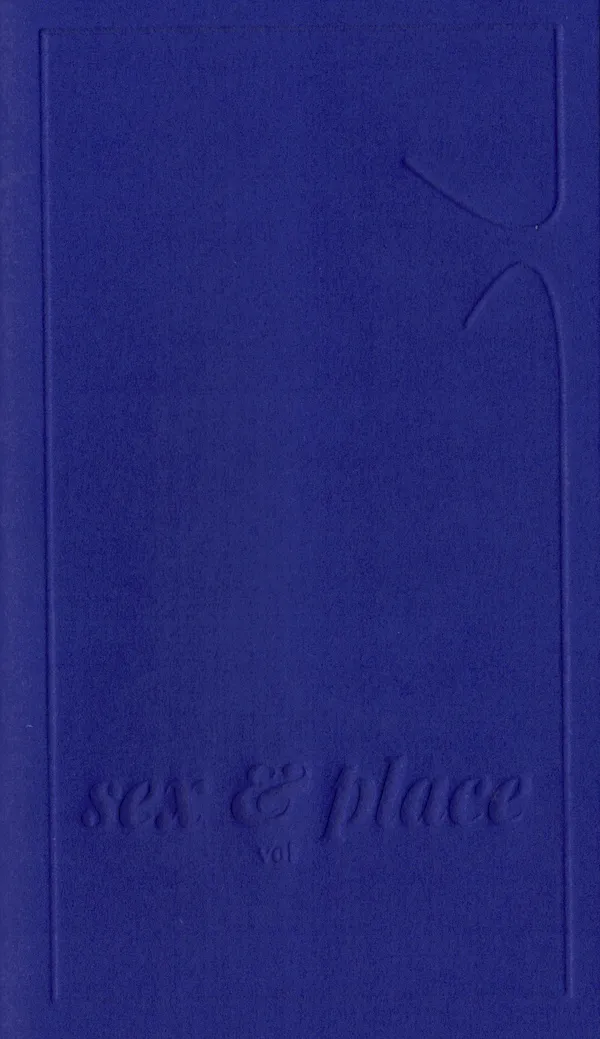
sex and place vol 2
Adriano Wilfert Jensen, Andrea Zavala Folache
sex and place is a series of workshops and publications exploring score-based and semi-anonymous writing as a tool for articulating shared concerns.
Vol 2 ‘discores’ is written by Kexin Hao, Luca Soudant, HaYoung, Andrea Zavala Folache & Adriano Wilfert Jensen. Five strangers are stuck in changing boots next to each other and decide to embark on an intimate conversation starting from the question: “What is troubling your sexuality at the moment?”.
The ‘sex and place’ series is part Domestic Anarchism, a project devoted to coalition-building beyond biological, chosen, or national conceptions of family. Dance serves as a set of tools and knowledge that can be applied beyond “the spectacle” to collectively study, write, and move.
Andrea Zavala Folache and Adriano Wilfert Jensen are choreographers and they co-parent three-year-old Penélope Cleo. Andrea and Adriano use dance and choreography to think about the distribution of care and solidarity beyond ‘the family’, and in turn consider how such a distribution could inform their dance practice. Inevitably themes like sex, economy, gender, and class get activated. But also notions such as prefiguration, anarchism, clitoridian* thinking, zones of non-domination and coalition building. They see dance as a knowledge that can be applied to different practices. Some of these include: co-habitations, score based writing and dancing, self-organised study groups and publications, workshops and dance performances.
sex and place vol 1
Adriano Wilfert Jensen, Andrea Zavala Folache
sex and place is a series of workshops and publications exploring score-based and semi-anonymous writing as a tool for articulating shared concerns.
Vol. 1 ‘preliminiaries’ is written by Andrea Zavala Folache and Adriano Wilfert Jensen. In the midst of (learning) child care, (unlearning) performance and (experimenting with) sex, the publication interweaves three registers of writing as analogies and interruptions of each other.
The ‘sex and place’ series is part Domestic Anarchism, a project devoted to coalition-building beyond biological, chosen, or national conceptions of family. Dance serves as a set of tools and knowledge that can be applied beyond “the spectacle” to collectively study, write, and move.
Andrea Zavala Folache and Adriano Wilfert Jensen are choreographers and they co-parent three-year-old Penélope Cleo. Andrea and Adriano use dance and choreography to think about the distribution of care and solidarity beyond ‘the family’, and in turn consider how such a distribution could inform their dance practice. Inevitably themes like sex, economy, gender, and class get activated. But also notions such as prefiguration, anarchism, clitoridian* thinking, zones of non-domination and coalition building. They see dance as a knowledge that can be applied to different practices. Some of these include: co-habitations, score based writing and dancing, self-organised study groups and publications, workshops and dance performances.

Time has fallen asleep in the afternoon sunshine
Appendix #3: Orality
Victoria Pérez Royo, Léa Poiré and 1 more
Time has fallen asleep in the afternoon sunshine Appendix #3 Orality includes contributions by Simon Asencio, Bruno De Wachter, Peter Szendy, Clara Amaral, Itziar Okariz, Jude Joseph, Léa Poiré and Mette Edvardsen.
Time has The Appendixes #1–4 is an editorial series by Mette Edvardsen, Léa Poiré and Victoria Pérez Royo that developed out of the project Time has fallen asleep in the afternoon sunshine. For a two-year residency at Les Laboratoires d’Aubervilliers* (2022–23), they came together as a small work group, shaping the work process, hosting presentation formats and making this publication series on paper as four cahiers.
The cahiers comprise a collection of commissioned texts and contributions created for this context, selected documents and traces from work sessions and encounters organized during their residency, texts read together and republished for this occasion, a collection of references, notes in progress, unfinished thoughts and loose fragments – on paper, between pages.
The Appendixes are organized around four themes: (1) The gesture of writing, (2) How to organize a library, (3) Orality and (4) Translation. In addition to being published on paper, the editorial series also consisted of other formats of presentations, exchanges and meetings organized as workshops, fieldwork, performances, conferences, collective readings and oral publications, taking place during their residency at Les Laboratoires d’Aubervilliers and in the vicinity.
The Appendixes is the work that continues, material that adds on, some of it perhaps too long or too detailed, unfit or unfinished. The four themes that their research is formulated around originate in specific experiences and questions from the practices of Time has fallen asleep in the afternoon sunshine (2010 – ongoing), and also the large publication on the project ‘A book on reading, writing, memory and forgetting in a library of living books’ (2019). The research was both a means of exploring these themes in greater depth and also of bringing them into contact with other artists and researchers working on similar or related subjects. The Appendixes offered them both the contexts and the pretexts for things to happen (in time, in space, on paper).
The Appendixes #1–4, published in these cahiers, do not present an overview or a summary of all of the activities and presentations that took place during the two years at Les Laboratoires d’Aubervilliers. What these cahiers offer is a space in which to hold some thoughts together and to share them in this form. It is one more step along the way, extending the research and work already begun and that will now continue.

One Shape of the Language: Cyrillic Archives
‘One Shape of the Language: Cyrillic Archives’ is an artist’s book documenting Inna Kochkina’s research into the history, style, and politics of traditional Cyrillic.
This research was born from Kochkina’s self-reflective curiosity about the relationship between cultural heritage and typography and evolved into an examination of the socio-political role of traditional Cyrillic. An ancient script, Cyrillic has been used to express various forms of cultural and territorial domination and continues to serve as an imperialist tool, having long been deployed in support of Slavic nationalism both in Russia and in the former USSR territories.
This publication is the result of Kochkina’s own research into and engagement with archives of typography, as well as conversations with anti-colonial activists, artists, and historians who interrogate traditional Cyrillic and its relationship to colonial power.
Alongside conducting scholarly research, Kochkina also produced drawings in response to archives of traditional Cyrillic. Making these drawings constituted a form of “studying by making.” With these efforts she has sought to construct an anti-colonial feminist narrative, employing both typographic artifacts and ‘patriarchal’ letterforms.
To make her drawings, Kochkina took samples from these low quality typographic archives, enlarging and transforming them into unexpected graphic shapes that were then recorded in a series of experimental prints. The drawing, collating and contact printing process that she followed allowed her to document and reveal the qualities lent to historical artifacts by digital noise. Through this working method she sought to rethink both the subject of her work as well as traditional approaches to type design practice. This book presents the prints in a roughly chronological sequence, poetically portraying Kochkina’s complex relationship with her native script. Variously precise, messy, and destructive, these works ultimately convey a series of “imaginary” shapes through which to reinterpret traditional Cyrillic of the past and present.

Robida 10: Correspondences
Robida is a situated, multilingual cultural magazine published by Robida collective. Each issue explores a topic connected and generated by Topolò/Topolove, the village on the border between Italy and Slovenia where the collective is based.
The chosen topic is thrown into the world and interpreted by people who have never been to Topolò. What people send back after the open call is not only a contribution to the exploration of a defined theme but also a new interpretational tool to explore the collective’s relation to Topolò.
The tenth issue of Robida magazine, which celebrated its tenth year of existence, is made of correspondences, conversations, interviews and letter exchanges where the magazine becomes the pretext to establish new relationships or deepen existing ones. While writing and other creative activities can often be solitary endeavours, this year, Robida’s core purpose was decidedly tangible and hands-on: to go out there and talk, discuss, meet, write to each other, organise and create — together.
The issue contains correspondences about, among other things, fire, bread, dreams, wild tongues, public space, local architecture, community gardens, reading practices, sky, bees, postcards, type design, resistance, be-longings, regenerative agriculture, coding, radical equality and more.
〰️
CONTRIBUTORS
Adele Dipasquale ↔︎ Madison Bycroft, Alice Alloggio ↔︎ Alia Mascia, Antônio Frederico Lasalvia ↔︎ Cécile Malaspina, Anya Jasbar ↔︎ Chris Rocchegiani
Caterina Santullo ↔︎ Neva Zidić, Lukas Horn, Chiara Pavolucci ↔︎ Enrico Malatesta, Else/Xun ↔︎ Ahed Al Kathiri, Emma Verhoeven, Erika Mayr ↔︎ Aljaž Škrlep, Erin Honeycutt ↔︎ Priyam Goswami Choudhury, Tara Habibzadeh, Eva Garibaldi ↔︎ Eva Bevec, Gaja Pegan-Nahtigal, Ana Laura Richter, Lea Topolovec, Francesca Lucchitta ↔︎ Teo Giovanni Poggi
Garance Maurer ↔︎ Elise Boutié, Tonì Casalonga, Alice Cuenot, Daniel Parnitzke, Club de Bridge, Alona Rodeh, Giorgia Maurovich, Giulia Soldati ↔︎ Eline Ex, Suzanne Bernhardt, Agnese Podgornik, Salvatore Ceccarelli, Alysha Aggarwal, Ingeborg van Houwelingen, Sara Vande Velde, Sasha van Aalst, Greta Biondi ↔︎ Vittoria Rubini, Hannah Segerkrantz ↔︎ Mia Tamme
How Melnyczuk, Janja Šušnjar ↔︎ Marjetica Potrč, Karin K. Bühler ↔︎ Raimundas Malašauskas, Kim Kleinert ↔︎ Polina Lobanova, Kirsten Spruit ↔︎ Benjamin Earl, Lalie Thébault Maviel, Laura Cull Ó Maoilearca ↔︎ Rajni Shah, Linsey Rendell ↔︎ Gemma Copeland, LinYee Yuan, Madeleine Reinhart ↔︎ Greta Veresani, Michael Minnis ↔︎ Áine Nic Giolla Coda, Nai-Syuan Ye ↔︎ Merle Findhammer, Nolwenn Vuillier, Ola Korbańska, Ola Lewczyk, Paula König ↔︎ Aida Fernandes, Rachele Daminelli, Rita Gaspar ↔︎ Shams, Rossella Famiglietti ↔︎ Rocco Pisilli, Giuseppe Defilippis, Daniele Pirozzi, Alessandro Bosco, Sarah Marlene Sammito ↔︎ Rūta Žemčugovaitė, Leonardo Sammito, Soph Boobyer ↔︎ Annie Box, Sophie Mak-Schram ↔︎ Katherine Marie Agard, Esyllt Angharad Lewis, Vida Rucli, Alejandra Santillana Ortiz, Jeanne van Heeswijk, Tadej Urh ↔︎ Eva Bevec, Teresa Frausin ↔︎ Anne Kaivo-oja, Vida Rucli ↔︎ Donatella Ruttar, Yiannis I. Andronikidis ↔︎ Mojca Radkovič