rile*books

Search books

Search books by title, author, publisher, keywords...

Cover of Appendix #2 - How to organize a library

Time has fallen asleep in the afternoon sunshine

Appendix #2 - How to organize a library

Mette Edvardsen ed., Léa Poiré ed., Victoria Pérez Royo ed.

€15.00

The Appendixes #1–4 is an editorial series by Mette Edvardsen, Léa Poiré and Victoria Pérez Royo that developed out of the project Time has fallen asleep in the afternoon sunshine. For a two-year residency at Les Laboratoires d’Aubervilliers* (2022–23), they came together as a small work group, shaping the work process, hosting presentation formats and making this publication series on paper as four cahiers.

The cahiers comprise a collection of commissioned texts and contributions created for this context, selected documents and traces from work sessions and encounters organized during their residency, texts read together and republished for this occasion, a collection of references, notes in progress, unfinished thoughts and loose fragments – on paper, between pages.

The Appendixes are organized around four themes: (1) The gesture of writing, (2) How to organize a library, (3) Orality and (4) Translation. In addition to being published on paper, the editorial series also consisted of other formats of presentations, exchanges and meetings organized as workshops, fieldwork, performances, conferences, collective readings and oral publications, taking place during their residency at Les Laboratoires d’Aubervilliers and in the vicinity.

Language: English

recommendations

Cover of Appendix #1: The gesture of writing

Time has fallen asleep in the afternoon sunshine

Appendix #1: The gesture of writing

Victoria Pérez Royo, Léa Poiré and 1 more

Performance €15.00

The Appendixes #1-4 is an editorial series by Mette Edvardsen, Léa Poiré and Victoria Pérez Royo that came out of the project Time has fallen asleep in the afternoon sunshine. For a two-year residency at Les Laboratoires d'Aubervilliers (2022-23), they came together as a small work group, shaping the work process, hosting presentation formats and making the publication series on paper as four cahiers.

The cahiers comprise a collection of commissioned texts and contributions created for this context, selected documents and traces from work sessions and encounters organized during the residency, texts read together and republished for this occasion, a collection of references, notes in progress, unfinished thoughts and loose fragments - on paper, between pages.

p 5-7 Almost on my way to you
p 8-10 Presque en route vers toi
Laía Argüelles Folch

p 12-13 Exercise in translation of Breve ensayo sobre la carta (Brief essay on the letter) by Laía Argüelles Folch
p 14-15 Exercice de traduction de Breve ensayo sobre la carta (Bref essai sur la lettre) de Laía Argüelles Folch
Quim Pujol, Paula Caspão, Simon Asencio, Pascal Poyet, Mette Edvardsen, Léa Poiré, Victoria Pérez Royo & Laía Argüelles Folch

p 16-17 Like a dinosaur upon awakening
p 18-19 Comme un dinosaure au réveil
Pascal Poyet

p 20-23 Is she a translator?
p 24-27 Est-elle traductrice?
Olivia Fairweather

p 28-29 New edition revised by my author
p 30-31 Nouvelle édition revue par mon auteur
Léa Poiré

p 32 Notes from a translation in progress
p 33 Notes d'une traduction en cours
Kate Briggs

p 34-37 Mothers & tongues
p 38-41 Langues (maternelles)
Mette Edvardsen

p 42-43 Collective reading of Finnegans Wake by James Joyce
p 44-45 Lecture collective de Finnegans Wake de James Joyce
Dora García and readers, et les lecteur·rices

p 46-49 Notes for a talk that did not happen
p 50-53 Notes pour une conférence qui n'a pas eu lieu
Olivia Fairweather

p 54-65 Meticulous comparison of two books with their versions rewritten from memory, excerpts from a work document
Comparaison méticuleuse de deux livres avec leurs versions réécrites de mémoire, extraits d'un document de travail
Julián Pacomio & Ángela Millano

Cover of Verzamelde gedichten - Against the Forgetting

Time has fallen asleep in the afternoon sunshine

Verzamelde gedichten - Against the Forgetting

Bruno De Wachter

For the project Time has fallen asleep in the afternoon sunshine a group of people/ performers memorize a book of their choice. Together they form a library collection consisting of living books. After years of learning by heart and reciting for readers, some of the books have now been written down from memory to create new editions, versions resulting from this process. This book is one of those books, chosen by one person, learned by heart and recited many times, and now written down again from memory. This edition is not a re-edition of the original text. It is a re-writing of the text after the process of reading, memorizing and reciting, with all the alterations that might have occured in the course of this process.

www.timehasfallenasleepintheafternoonsunshine.be

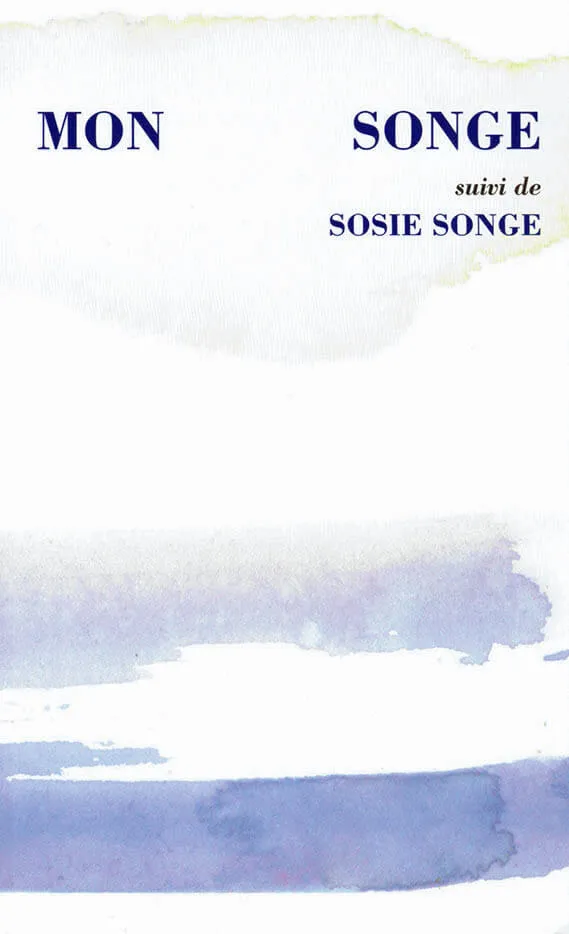
Cover of Mon Songe

Time has fallen asleep in the afternoon sunshine

Mon Songe

Vincent Dunoyer

For the project Time has fallen asleep in the afternoon sunshine a group of people/ performers memorize a book of their choice. Together they form a library collection consisting of living books. After years of learning by heart and reciting for readers, some of the books have now been written down from memory to create new editions, versions resulting from this process. This book is one of those books, chosen by one person, learned by heart and recited many times, and now written down again from memory. This edition is not a re-edition of the original text. It is a re-writing of the text after the process of reading, memorizing and reciting, with all the alterations that might have occured in the course of this process.

Cover of I am Four Quartets by T.S Elliot

Time has fallen asleep in the afternoon sunshine

I am Four Quartets by T.S Elliot

Sébastian Hendrickx

For the project Time has fallen asleep in the afternoon sunshine a group of people/ performers memorize a book of their choice. Together they form a library collection consisting of living books. After years of learning by heart and reciting for readers, some of the books have now been written down from memory to create new editions, versions resulting from this process. This book is one of those books, chosen by one person, learned by heart and recited many times, and now written down again from memory. This edition is not a re-edition of the original text. It is a re-writing of the text after the process of reading, memorizing and reciting, with all the alterations that might have occured in the course of this process.

www.timehasfallenasleepintheafternoonsunshine.be

Cover of Appendix #3: Orality

Time has fallen asleep in the afternoon sunshine

Appendix #3: Orality

Victoria Pérez Royo, Léa Poiré and 1 more

Time has fallen asleep in the afternoon sunshine Appendix #3 Orality includes contributions by Simon Asencio, Bruno De Wachter, Peter Szendy, Clara Amaral, Itziar Okariz, Jude Joseph, Léa Poiré and Mette Edvardsen.

Time has The Appendixes #1–4 is an editorial series by Mette Edvardsen, Léa Poiré and Victoria Pérez Royo that developed out of the project Time has fallen asleep in the afternoon sunshine. For a two-year residency at Les Laboratoires d’Aubervilliers* (2022–23), they came together as a small work group, shaping the work process, hosting presentation formats and making this publication series on paper as four cahiers.

The cahiers comprise a collection of commissioned texts and contributions created for this context, selected documents and traces from work sessions and encounters organized during their residency, texts read together and republished for this occasion, a collection of references, notes in progress, unfinished thoughts and loose fragments – on paper, between pages.

The Appendixes are organized around four themes: (1) The gesture of writing, (2) How to organize a library, (3) Orality and (4) Translation. In addition to being published on paper, the editorial series also consisted of other formats of presentations, exchanges and meetings organized as workshops, fieldwork, performances, conferences, collective readings and oral publications, taking place during their residency at Les Laboratoires d’Aubervilliers and in the vicinity.

The Appendixes is the work that continues, material that adds on, some of it perhaps too long or too detailed, unfit or unfinished. The four themes that their research is formulated around originate in specific experiences and questions from the practices of Time has fallen asleep in the afternoon sunshine (2010 – ongoing), and also the large publication on the project ‘A book on reading, writing, memory and forgetting in a library of living books’ (2019). The research was both a means of exploring these themes in greater depth and also of bringing them into contact with other artists and researchers working on similar or related subjects. The Appendixes offered them both the contexts and the pretexts for things to happen (in time, in space, on paper).

The Appendixes #1–4, published in these cahiers, do not present an overview or a summary of all of the activities and presentations that took place during the two years at Les Laboratoires d’Aubervilliers. What these cahiers offer is a space in which to hold some thoughts together and to share them in this form. It is one more step along the way, extending the research and work already begun and that will now continue.

Cover of one long continuous line or a thought that dissolves into the distance

Varamo Press

one long continuous line or a thought that dissolves into the distance

Mette Edvardsen

A short text or a long line written by Mette Edvardsen for Etcetera magazine (June 2018) on an invitation to elaborate on her approach to text, writing and speech from a choreographic point of view. Held by a cardboard cover, the text is here published on its own as a very slim book.

Cover of LIST OF BOOKS in the LIBRARIES of Time has fallen asleep in the afternoon sunshine

Afternoon Editions

LIST OF BOOKS in the LIBRARIES of Time has fallen asleep in the afternoon sunshine

Mette Edvardsen

Afternoon Editions no. 0: List of books in the library of Time has fallen asleep in the afternoon sunshine. The list consists of books that have been leart by heart within the project (by heart library), an incomplete list of books that were considered to be leart by heart, that played an important role in the process of choice, or that have been considered to be learnt by heart in the future (shadow library), a growing collection of literature, publications, essays, films, ephemera relating to interests within the project (reference library).

Edition last updated May 2020.

Cover of All you have to do is die

Vibrational Semantics

All you have to do is die

Mette Edvardsen

An artist text centring around the ghost lamp “like a sentinel an eerie outpost watching over the theatre.”

140x200mm
14 pages
edition of 150

Cover of Inserts in Real Time: Performance Work 2000–2023

K. Verlag

Inserts in Real Time: Performance Work 2000–2023

Dora Garcia

Performance €35.00

'Inserts in Real Time' is the first monograph on the performance work developed by artist Dora García over the past twenty years. The book contains a conversation between the artist and curator Joanna Zielińska; a selection of her performance scripts; her performances to date, listed, illustrated, described, and contextualized; and three newly commissioned texts – by art historian Sven Lütticken, performance theorist Bojana Cvejić, and Dora García. The publication is co-published with M HKA, Antwerp, and accompanies Dora García’s exhibition 'She Has Many Names'.

Cover of “If It's For The People, It Needs To Be Beautiful,” She Said

What You See Is What You Hear

“If It's For The People, It Needs To Be Beautiful,” She Said

Jeremiah Day

Performance €25.00

Accompanying a series of solo collaborations in 2020, this publication offers the first comprehensive and global perspective on Jeremiah Day's work as an artist, performer, researcher and teacher. As it details Day's specific works and evolution between visual and performing arts and between political reflection and engagement the result also serves as sourcebook for the legacy of the intersection between dance and the visual arts of the 1960s and 70's and the models of cultural practice emerging from the work of Hannah Arendt.

In his work, the Berlin-based American artist Jeremiah Day (born 1974 in Plymouth) re-examines recent political struggles and conflicts, revealing their subjective contexts and traces. To do this, he has developed a narrative and choreographic form in which personal and political realities intermingle, thus offering a thoroughly singular vision of these at times forgotten moments of history. 

The distinctive feature of his method lies in a transversal approach. As a student of and regular collaborator with Simone Forti, one of the pioneers of Post-Modern Dance, he has turned performance into a now central and structure-providing practice. Since 2014, Jeremiah Day has in effect presented many performances, which contain movement, improvisation, photography and the spoken word, in order to broach universal historical and political subjects, but within an intimate and incarnated context.

Cover of Exhibiting for Multiple Senses

Valiz

Exhibiting for Multiple Senses

Eva Fotiadi

Essays €25.00

Exhibiting for Multiple Senses looks into artistic and curatorial research practices that emphasize the multisensory character of the human body in the encounter with artworks. For some time now, numerous contemporary artists and curators have moved beyond the primacy of the visual in the experience of art exhibitions. The book discusses this shift by bringing together experimental exhibition-making, curatorial theory, art, design, and museum research, disability activism and crip theory. Its intent is to demonstrate resonances between curatorial theory and practice and between disability and crip art activism. While the latter is still often regarded as relevant for only small portions of visibly disabled people, in recent years neurodiversity and invisible disabilities have proven to be relevant for the sensory experiences of much larger parts of exhibition audiences.

Exhibiting for Multiple Senses shares famous and lesser-known examples of experimental exhibitions as well as of artistic practices linked to exhibitions. By mobilizing the senses of touch, smell, taste, and hearing, as well as applications of multimodal technologies and insights from neuroscience, these examples all explore abilities and possibilities of the complex and diverse sensory apparatus that is the human body.

Contributors: David Bobier, Luca M. Damiani, Stephanie Farmer & Hettie James, Eva Fotiadi, David Gissen & Georgina Kleege, Adi Hollander, Lilian Korner, Elke Krasny, Renata Pękowska, Caro Verbeek

Cover of Aisopika Aesopica

Ariel Ink

Aisopika Aesopica

Rūta Junevičiūtė

The bilingual book ‘Aesopica’ documents and extends Rūta Junevičiūtė’s research on the Aesopian language and the influence of political censorship to contemporary collective body, first presented in 2020 as the eponymous solo exhibition at the National Gallery of Art and as a permanent outdoor installation at the Rupert Art Center, Vilnius. 

Taking as a starting point the historical phenomenon of Aesopian language, which was widespread in Lithuanian culture during the Soviet era, and in parts of the Russian Empire as early as the 19th century, Junevičiūtė aims to investigate the interrelationship between generations, the gray zones of collective identity creation and the processes of (un)censoring the archives of our bodies.

Aesopian language – a term coined after Ancient Greek fabulist Aesop (gr. Aísōpos), is a type of cryptic communication system, where a text has several layers of meaning often contradictory to each other and which seek to convey official and subversive hidden meanings simultaneously. It is usually employed under conditions of omnipresent state censorship to communicate officially forbidden or taboo subjects and opinions. As a system it contains three members – an author, a censor, and a reader. It uses various modes of circumlocution and euphemisation, innuendo and poetic paraphrasing, which can also be seen as an aesthetic style. It has been advocated for artistic benefits as poetics of omissions, concealment, and travesty. On the other hand, it has been criticized as a sign of conformity and humiliation. In Lithuania, after the fall of the Soviet Union, it has been popularly regarded as a position of dissent, but such an interpretation received criticism from contemporary scholars. “Such a mode of expression is probably as old as censorship itself” – a historian told us.

Text contributors: Alfonsas Andriuškevičius, Edgaras Gerasimovičius, Rūta Junevičiūtė, Goshka Macuga, Anastasia Sosunova, Grėtė Šmitaitė, Tomas Venclova, Ana Vujanović

Language editors: Dangė Vitkienė, Aira Niauronytė, Gemma Lloyd

Translators: Alexandra Bondarev, Erika Lastovskytė, Justinas Šuliokas, Mantė Zagurskytė-Tamulevičienė, Aistis Žekevičius.

Illustrations: Rūta Junevičiūtė.