rile*books

Search books

Search books by title, author, publisher, keywords...

Cover of I am Four Quartets by T.S Elliot

Time has fallen asleep in the afternoon sunshine

I am Four Quartets by T.S Elliot

Sébastian Hendrickx

€12.00

For the project Time has fallen asleep in the afternoon sunshine a group of people/ performers memorize a book of their choice. Together they form a library collection consisting of living books. After years of learning by heart and reciting for readers, some of the books have now been written down from memory to create new editions, versions resulting from this process. This book is one of those books, chosen by one person, learned by heart and recited many times, and now written down again from memory. This edition is not a re-edition of the original text. It is a re-writing of the text after the process of reading, memorizing and reciting, with all the alterations that might have occured in the course of this process.

www.timehasfallenasleepintheafternoonsunshine.be

Hardcover ┊ Language: English

recommendations

Cover of Appendix #4: Translation / Traduction

Time has fallen asleep in the afternoon sunshine

Appendix #4: Translation / Traduction

Victoria Pérez Royo, Léa Poiré and 1 more

Performance €15.00

The Appendixes #1-4 is an editorial series by Mette Edvardsen, Léa Poiré and Victoria Pérez Royo that came out of the project Time has fallen asleep in the afternoon sunshine. For a two-year residency at Les Laboratoires d'Aubervilliers (2022-23), they came together as a small work group, shaping the work process, hosting presentation formats and making the publication series on paper as four cahiers.

The cahiers comprise a collection of commissioned texts and contributions created for this context, selected documents and traces from work sessions and encounters organized during the residency, texts read together and republished for this occasion, a collection of references, notes in progress, unfinished thoughts and loose fragments - on paper, between pages.

Cover of Ik ben Elias of het gevecht met de nachtegalen, door Maurice Gilliams

Time has fallen asleep in the afternoon sunshine

Ik ben Elias of het gevecht met de nachtegalen, door Maurice Gilliams

Wouter Krokaert

Performance €12.00

For the project Time has fallen asleep in the afternoon sunshine a group of people/ performers memorize a book of their choice. Together they form a library collection consisting of living books. After years of learning by heart and reciting for readers, some of the books have now been written down from memory to create new editions, versions resulting from this process. This book is one of those books, chosen by one person, learned by heart and recited many times, and now written down again from memory. This edition is not a re-edition of the original text. It is a re-writing of the text after the process of reading, memorizing and reciting, with all the alterations that might have occured in the course of this process.

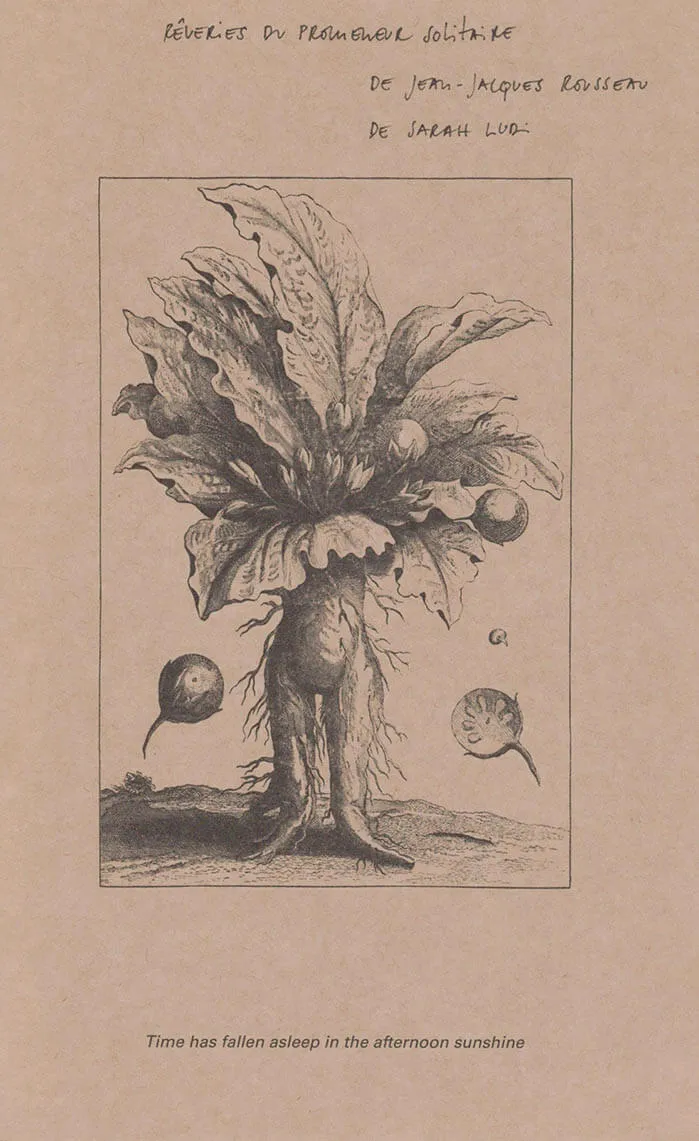
Cover of Rêveries du promeneur solitaire

Time has fallen asleep in the afternoon sunshine

Rêveries du promeneur solitaire

Sarah Ludi

For the project Time has fallen asleep in the afternoon sunshine a group of people/ performers memorize a book of their choice. Together they form a library collection consisting of living books. After years of learning by heart and reciting for readers, some of the books have now been written down from memory to create new editions, versions resulting from this process. This book is one of those books, chosen by one person, learned by heart and recited many times, and now written down again from memory. This edition is not a re-edition of the original text. It is a re-writing of the text after the process of reading, memorizing and reciting, with all the alterations that might have occured in the course of this process.

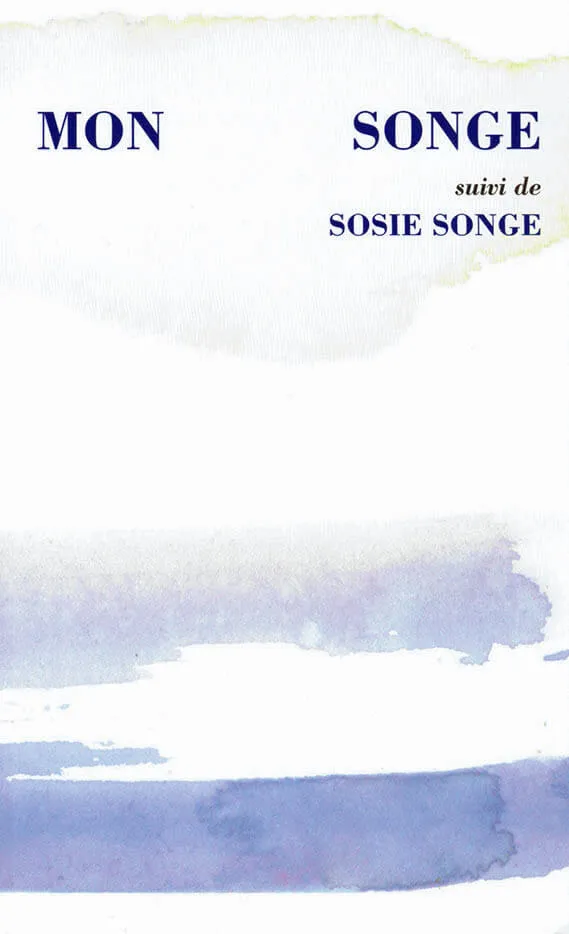
Cover of Mon Songe

Time has fallen asleep in the afternoon sunshine

Mon Songe

Vincent Dunoyer

For the project Time has fallen asleep in the afternoon sunshine a group of people/ performers memorize a book of their choice. Together they form a library collection consisting of living books. After years of learning by heart and reciting for readers, some of the books have now been written down from memory to create new editions, versions resulting from this process. This book is one of those books, chosen by one person, learned by heart and recited many times, and now written down again from memory. This edition is not a re-edition of the original text. It is a re-writing of the text after the process of reading, memorizing and reciting, with all the alterations that might have occured in the course of this process.

Cover of Verzamelde gedichten - Against the Forgetting

Time has fallen asleep in the afternoon sunshine

Verzamelde gedichten - Against the Forgetting

Bruno De Wachter

For the project Time has fallen asleep in the afternoon sunshine a group of people/ performers memorize a book of their choice. Together they form a library collection consisting of living books. After years of learning by heart and reciting for readers, some of the books have now been written down from memory to create new editions, versions resulting from this process. This book is one of those books, chosen by one person, learned by heart and recited many times, and now written down again from memory. This edition is not a re-edition of the original text. It is a re-writing of the text after the process of reading, memorizing and reciting, with all the alterations that might have occured in the course of this process.

www.timehasfallenasleepintheafternoonsunshine.be

Cover of I Am Abandoned

Primary Information

I Am Abandoned

Barbara T. Smith

Poetry €20.00

I Am Abandoned documents a little-known, but visionary performance by Barbara T. Smith. Taking place in 1976, it featured a conversation in real time between two psychoanalytic computer programs (known today as two of the earliest chatbots) alongside a staging of Francisco Goya’s The Naked Maja (1795–1800) and The Clothed Maja (1800–1807), in which the artist projected an image of the famous painting on top of a female model. The publication includes a full transcript of the “conversation” between the two programs; documentation and ephemera from the performance; Smith’s reflections on the night; and an afterword by scholar and artist Mashinka Firunts Hakopian.

I Am Abandoned was part of the exhibition The Many Arts and Sciences at the California Institute of Technology (Caltech) and rather than simply celebrate new technology, Smith also sought to challenge what she saw as a “built-in problem” that “computers were only a new example of the male hypnosis.” In collaboration with computer scientist Dick Rubinstein, she enlisted the computer science teams at Caltech and the Massachusetts Institute of Technology to mount a conversation between a program named DOCTOR, which was designed to be a surrogate therapist, and another named PARRY, which was trained to mimic a paranoid schizophrenic patient.

While the computer operator worked in the next room, each new page of the conversation was projected on the wall where a model dressed as The Clothed Maja reclined beneath the text, with a slide of the nude version of the same painting, The Naked Maja, projected onto her. The audience was rapt with attention for the livestreamed conversation. The performance went on for nearly two hours, before the model eventually grew furious from being ignored (abandoned) by the computer operator, stormed over, and attempted to seduce him. Shortly after, the gallery director pulled the plug on the entire event, claiming it distracted the audience for too long from the other works on view.

To revisit I Am Abandoned today is to see the artistic and truly liberatory potential that art can have when it intervenes in new technologies. Much like the original performance, in which the model grew alienated from the proceedings, what gradually emerges are the stakes these new technologies present. Against today’s backdrop of AI and a still male-dominated tech field, Smith’s early work with emerging technologies, and in this case chatbots, is prophetic and hints at the contemporary conversation around the gendered and racialized machinic biases of our current computational landscape. Though Smith, like many women of her generation, was overlooked by the landmark surveys of art and technology during the 1960s and 70s, her career incisively probed new technologies, using them to question gender dynamics, community, and self. Her projects from the Coffin books (1966–67), created with a 914 Xerox copier in her dining room, to performances like Outside Chance (1975), which created a small snow squall in Las Vegas out of 3,000 unique, computer-generated snowflakes, and the interactive Field Piece (1971), where participants’ movements altered the soundscape of a fiberglass forest, all exemplify her open-ended approach to art and tech. “Each person lit their own way,” Smith remembers, “And produced their own soundtrack.”

Barbara T. Smith is an important figure in the history of feminist and performance art in Southern California. Her work—which spans media and often involves her own body—explores themes of sexuality, traditional gender roles, physical and spiritual sustenance, technology, communication, love, and death. Smith received a BA from Pomona College in 1953, and an MFA in 1971 from the University of California, Irvine. There she met fellow artists Chris Burden and Nancy Buchanan, with whom she co-founded F-Space in Santa Ana, the experimental art space where many of her performances were staged. Smith’s work has been exhibited since the 1960s in solo exhibitions, at the Institute of Contemporary Art, Los Angeles (2024), the Getty Research Institute, Los Angeles (2023), and Pomona College Museum of Art (2005), and featured in group exhibitions, including how we are in time and space: Nancy Buchanan, Marcia Hafif, Barbara T. Smith, Armory Center for the Arts, Pasadena (2022), State of Mind: New California Art Circa 1970, Orange County Museum of Art, Santa Ana (2012); WACK! Art and the Feminist Revolution, Museum of Contemporary Art, Los Angeles (2007); and Out of Actions: Between Performance and the Object, 1949–1979, Museum of Contemporary Art, Los Angeles (1998). Smith is the recipient of the Nelbert Chouinard Award (2020), Civitella Ranieri Visual Arts Fellowship, Umbria, Italy (2014); Durfee Foundation’s Artists’ Resource for Completion (2005, 2009); Women’s Caucus for Art, Lifetime Achievement Award (1999); and several National Endowment for the Arts Grants (1973, 1974, 1979, 1985). The Getty Research Institute acquired Smith’s archive in 2014 and published her memoir, The Way to Be, in 2023. Her survey catalog, Proof: Barbara T. Smith was published by the Institute of Contemporary Art, Los Angeles in 2024.

Cover of KILOBASE BUCHAREST A-Z

P-U-N-C-H

KILOBASE BUCHAREST A-Z

Sandra Demetrescu, Dragoș Olea

KILOBASE BUCHAREST A-Z is a publication which is describing Bucharest through a sort of experimental alphabet book: for each letter of the English alphabet, artists, writers, architects and researchers were invited to choose a key term and develop a contribution representing a sliver of the Romanian capital city, capturing a polyphonic set of perspectives on the infinite facets of a city whose identity is notoriously difficult to define.

Contributions by: Irina Bujor, Serioja Bocsok, studioBASAR, Iuliana Dumitru, Ștefan Ghenciulescu, Kilobase Bucharest, Apparatus 22, Mihnea Mihalache-Fiastru, Ștefan Constantinescu, Sabine Bitter & Helmut Weber, Gruia Bădescu, Ioana Ulmeanu, Decebal Scriba, Sillyconductor, Prosper Center, Geir Haraldseth, Jimmy Robert, Karol Radziszewski, Lea Rasovszky, Ștefan Botez, Simina Neagu, Bogdan Iancu, Andrei Mihail, Mihai Lukács, Mihai Mihalcea, Cosima Opârtan, Juergen Teller, Hans Leonard Krupp.

The publication also includes a republished insert by late artist Ioana Nemeș, and three reprinted contributions previously published in Kilobase Bucharest A-H (Mousse Publishing, 2011) produced on the occasion of "Image to be projected until it vanishes" exhibition at Museion Bolzano.

Cover of The Book of Na

Wendy's Subway

The Book of Na

Na Mira

In The Book of Na, translation acts at the edge of perception. Tracing across projects in film, video, and performance, Na Mira reflects on the violent fragmentation of bodies while refusing the containment of geographic and corporeal borders. In 1977, a name is cut at an immigration office. This gap turns into an intergenerational score for becoming heat, hexagram, hologram. Using oracular and glitching technologies, Mira witnesses what escapes data: doppelgängers, dreams, endangered tigers, tesseracts, A. Turiyasangitananda Coltrane's stairs, Theresa Hak Kyung Cha in a theater, Korean shamanism, frozen ligaments, wildfires, borderlands, subatomic particles, and pink. Syncing to a clock with neither face nor hands, Mira’s hauntological permutations in time, death, and relation travel outside the symbolic order and draw energy from the void.

Na Mira’s autobody rites have been presented at sites including Seoul Museum of Art; Museum of Contemporary Art, Los Angeles; Portland Institute of Contemporary Art; Participant Inc., New York; and Whitney Museum of American Art, New York. She earned an MFA from the University of California, Los Angeles. She grew up between the US and East Asia and teaches outside.