Music & Sound
Music & Sound

Clipping 3
Federica Notari, Cleo Tsw and 1 more
Clipping 3 takes its cue from unbound echo, a sonic installation by Aimée Theriot which explores echo as both a material phenomenon and a conceptual method. Moving between scores, essays, field notes, mythology, and oral traditions, this issue considers echo not as a return of the same, but as a process of transformation—a mediated doubling that reverberates across sounds, memory, technology, architecture, and embodied practice.
With contributions by Aimée Theriot, Emile Frankel, Pelumi Adejumo, Vivian Wang, and more.

Aural Poetics (OEI #98–99)
”The domain of the aural opens, at once, on to the act of composition and on to the iterative context of a composition’s reception; it comprises embodiment(s) imbricated with an array of inscriptive practices. The works of these pages instantiate (as compositions) and contemplate (as critical texts) the differing degrees in which techniques of the body enter into dynamic relation with modes of inscription, forming a feedback loop that co-constitutes their capacities. To this degree, an aural poetics – in opposition to the vast discourse of its homonym – can evade the facile separation of an essentialized “oral” and “written,” veer away from the technological determinism and psychosocial developmental model that commentators have grafted upon this faux binary, and compel us to imagine and examine composition across artistic practices through assessing specific articulations of materials and occasion. Here, listening is manifold.” (Michael Nardone)
With contributions by: Alexandre St-Onge, Amber Rose Johnson, Ame Henderson + Evan Webber, Anne Bourne, Brent Cox + Courtlin Byrd, Carolyn Chen + Divya Victor, Cecilia Vicuña, Constance DeJong, Dalie Giroux, Damon Krukowski, Danny Snelson, Diane Glancy, Dylan Robinson, Eyvind Kang, François Lemieux, Gail Scott, Heather Davis, Ida Marie Hede + Steven Zultanski, Henri Meschonnic, Janel Morin + Peter Morin, Jerome Ellis, John Melillo, Laura Ortman, Lauren Turner, Lewis Freedman, Lisa Robertson, Luke Nickel, Marcus Boon, Marshall Trammel, Max Ritts, Merlin Sheldrake, Michael Nardone, Mitchell Akiyama, Nicholas Komodore, Niiqo Pam Dick, Oana Avasilichioaei, Patrick Nickleson, Raven Chacon, Raymond Boisjoly, Sophie Seita, Stacy Doris, Steven Feld + Xenia Benivolski, Tanya Lukin Linklater, Tiziana La Melia + Ellis Sam, Tom Miller, Valéria Bonafé + Lílian Campesato

Pieds en l’air, loin la terre
Yanka Diaghileva, Marina Skalova
Pieds en l’air, loin la terre rassemble les poèmes et paroles de chanson de Yanka Diaghileva (1966-1991), poétesse et musicienne au sein de l’un des premiers groupes de Punk sibérien. Imprégnées d’éléments de folklore sibérien et de mythologies slaves, les quatre-vingt-cinq textes qui composent ce livre évoquent à la fois l’univers du conte, l’esprit no future et la vie quotidienne en Sibérie à la fin des années 1980. S’ils sont marqués par une certaine forme de désespoir, ils témoignent surtout d’une profonde révolte existentielle et d’une insoumission au pouvoir soviétique. Extrêmement ciselés sur le plan sonore, ils sont nourris par les différents -ismes de la poésie russe (symbolisme, acméisme, futurisme). Mais Yanka Diaghileva ne revendiquait aucune filiation, elle faisait du punk: « Ce sont des étoiles qui tombent du ciel / En mégots des étages du dessus ». « Trouer la brume du paradis », un essai littéraire de Marina Skalova, complète cette éditions.

Black Cine-Body Sonics: Racializing the Soundtrack
Black Cine-Body Sonics: Racializing the Soundtrack surveys how Black audiovisuality developed and thrives in films and television through importing and materializing the sonics of Black musical representation — from 'Blaxploitation' classics (Shaft and Truck Turner) to cine-auteurs (Melvin Van Peebles, Spike Lee and Jordan Peele) to music video performers (Michael Jackson, Beyoncé and Kendrick Lamar) to video artists (Arthur Jafa and Isaac Julien) to contemporary multi-genre explorations of race (Sinners, Lovecraft Country, Atlanta and Swarm). The book views Jazz Soul Funk Disco Hip Hop Techno and House not as 'source music' but as genetic origins in the transformation of movies and shows resulting in new cinematic and televisual formations — all of which foreground the body performance and musicality.
— Philip Brophy
This is the 4th publication in the Echoes of Dissent series, devoted to the politics of the soundtrack.

Slip-Syncs Collapse and Strange Unrealities in the films of Sogo/Gakuryu Ishii
You can talk about Ishii and music and you can talk about Ishii and sound. I want to talk about both. I want to talk about him as a node in a network of musicians and bands that starts with punk but spider webs out to ensnare post-punk industrial and ambient music with a brief free jazz cameo. I also want to talk about the way he uses sound rhythm and silence. This is not just about soundtrack. A soundtrack tends towards telling you something about what’s happening. Soundtracks tell you what to feel whether there is dread or romance or sadness in a scene. Not so for Ishii. For Ishii a soundtrack stands alone is a bed and is a moment but it doesn’t tell you how to feel. It is in Ishii's hands dislocation silencing or distortion of the cause-effect connection between the punch thrown and the punch landing between moving image and the sound that constructs the conceits of the cinema. "He attempted to find a visual equivalent to punk music," wrote critic Tom Mes. "A way to express the same philosophy and spirit with a camera instead of a guitar.”
— Jennifer Lucy Allan
This is the 3rd publication in the Echoes of Dissent series, devoted to the politics of the soundtrack.
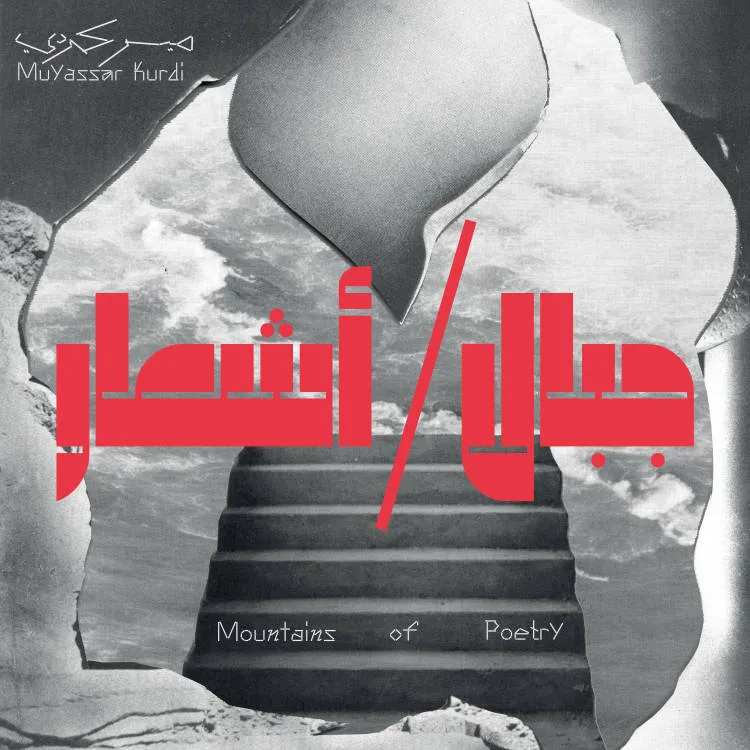
Mountains of Poetry (Limited Edition 12" Coloured)
Mountains of Poetry is a new 8-track studio album produced and developed by interdisciplinary artist Muyassar Kurdi. The album traces the entwined relations between one’s body and land, driven by a sense of urgency. Embedded in the earth, Kurdi imagines her body as a site for sonic excavation of memory and longing. The artist’s voice paired with electronic sound honors the ancient and the futuristic that together form a ritualistic reflection to navigate the tender space of remembering, forgetting and mourning. Departing from her usual emphasis on vocal abstraction, Kurdi turns to concrete words that punctuate the sonic landscape, gathering them into mountains of poetry.
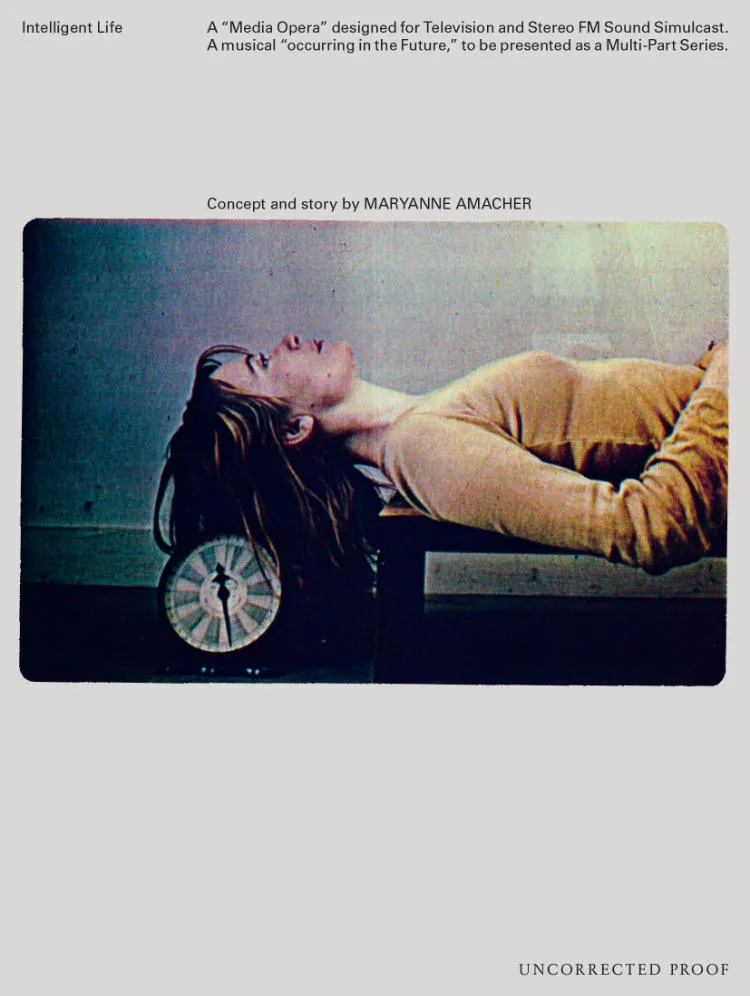
Intelligent Life
Comprehensive and previously unpublished documentation on the American composer's unproduced magnum opus.
Had it been produced, Maryanne Amacher's media opera Intelligent Life would have represented the summation of the composer's concept to date. As she wrote to John Cage in the autumn of 1983, following the untimely deaths of the opera's patrons—Wies Smals, founder of De Appel, and curator Josine van Droffelaar, in a plane crash in the Swiss Alps—she would have at last had the support to "communicate the finest of my thought to others." Amacher's serial, intended for broadcast, sought to transmit her evolving ideas about perception, listening, and composition to a broader public—shifting music away from "nod and tap recognition" toward a transformative practice that could awaken intelligence to "unrecognized and new perceptual modes."
Set in the year 2021, Intelligent Life follows the employees of Supreme Connections LLC, a music entertainment corporation navigating a future in which artificial intelligence generates music faster than composers can. Anticipating an industry-wide downturn, Supreme Connections president Aplisa Kandel seeks advanced technologies that will revolutionize the act of listening and the future of music, including a bio-music script that lets the user hear Bach from the aural perspective of a reindeer and a wearable device that goes beyond replicating the mechanical tympanic resonances of the listening subject to produce the "listening mind" or the "sophisticated perceiver"—capturing and reproducing all the emotional and psychological associations unique to each individual.
Though Amacher could not realize Intelligent Life in any of its intended forms—she theorized its publication as a serialized radio broadcast and television simulcast, among other configurations—she continued designing "treatments" for the opera for much of her career. This volume makes the most complete of these working documents—including episodic scripts, notes on the use of LaserDisc, and an illustrated storyboard for the pilot—available to the public for the first time.
Maryanne Amacher (1938-2009) was a composer of large-scale fixed-duration sound installations and a highly original thinker in the areas of perception, sound spatialization, creative intelligence, and aural architecture. She is frequently cited as a pioneer of what has come to be called “sound art,” although her thought and creative practice consistently challenges key assumptions about the capacities and limitations of that genre. Often considered to be a part of a post-Cagean lineage, her work anticipates some of the most important developments in network culture, media arts, acoustic ecology, and sound studies.
The Future is not Lost: On Music, Technology, and the Creation of New Worlds
Matt Bluemink, Alessandro Sbordoni
Mark Fisher taught a generation to hear the future's disappearance in contemporary music, as if the rhythm of the world was synchronised to the periodic flowering of new creative forms. His diagnosis was devastating: stagnation in music was akin to a venous insufficiency, or worse, some kind of nuclear winter that would ward off the spring for endless generations to come.
Drawing on musicians like SOPHIE, Arca and Iglooghost, Matt Bluemink declares that the future is not lost; it still speaks to us through music. If Fisher’s Hauntology — dwelling on ghosts of the past — is the logic of depression, then Bluemink’s Anti-Hauntology posits a logic of hope where voices from the future continue to guide the development of the present.
Island-hopping through Stiegler's philosophy of technics, Simondon's theory of individuation, and the spatial imaginaries of cyberpunk and solarpunk, Bluemink builds a theoretical framework equal to the times — one that takes seriously our capacity to, not only diagnose the world, but remake it. In order to create a new future we must re-imagine our relationship with music, with technology, and with culture. The world of tomorrow is a blank canvas; an open book. New beginnings are always possible.
Matt Bluemink is the founder and editor-in-chief of Blue Labyrinths online magazine. His research is focused on the relationship between the philosophy of technology, media theory and urbanism. He also writes on contemporary music, literature, and digital culture.

The Twofold Commitment
At once an artist's book and an interview collection by Vietnamese filmmaker, writer and feminist and postcolonial theorist Trinh T. Minh-ha (born 1952), The Twofold Commitment centers on Trinh's 2015 feature film Forgetting Vietnam, which takes up one of the myths surrounding the creation of Vietnam: a fight between two dragons whose intertwined bodies fell into the South China Sea and formed Vietnam's curving, S-shaped coastline. Commemorating the 40th anniversary of the end of the war, the film draws inspiration from ancient legend to stage an ongoing contemporary conversation between land and water, creating a third space, another way, for historical and cultural re-memory.
This book features the film's lyrical, essayistic script, along with rhythmically distributed movie stills. Expanding on this central focus is a series of conversations between the filmmaker and critics and film and sound studies scholars dating from 2016 to 2022, amplified by an index identifying key concepts and ideas in the artist's work.

The Secret History Of Kate Bush (And The Strange Art Of Pop)
The Secret History of Kate Bush, first published in 1982 as Kate was on the verge of superstardom, is a daring and unorthodox dive into the world of music, fame, and cultural obsession. Written by Fred Vermorel—a close associate of Malcolm McLaren and Vivienne Westwood, and renowned for his subversive "anti-biographies"—the book shatters the boundaries of traditional celebrity profiles. Told from the perspective of a die-hard fan, it unveils the mystique of one of pop’s most elusive icons while exposing the capitalist machinery driving the entertainment industry. Part biography, part cultural critique, and entirely provocative, this is not just a book about Kate Bush but a rebellious manifesto against the commodification of art.
Republished in 2022 by Le Gospel in France, this special edition goes even deeper with unpublished treasures from Vermorel’s personal archive. Featuring an exclusive interview with Kate’s father, Dr. Robert Bush, a razor-sharp foreword by novelist and musician Tony O’Neill (Digging the Vein), and Vermorel’s own afterword reflecting on his explosive work four decades later, this is a must-read for anyone fascinated by Kate Bush, the art of fandom, and the raw power of creative rebellion. Fred Vermorel is a pioneer of the in-depth study of celebrity and fan cultures, best known for his controversial "anti-biographies" of pop icons including the Sex Pistols, Kate Bush, Vivienne Westwood, and Kate Moss.

Stalled Death Train
A dark-humored poet’s novel of cruising, contempt, and database crawling, Stalled Death Train rumbles through the death of David Bowie in 2016 to shake apart its narrator’s sense of self. Nick, a burned out office worker and late-Bowie fanatic, spends his days mourning his fallen star, left to decipher the legacy and lyrics of a singular pop icon whose excesses did not cease, even after his greatest moments had passed. Meanwhile, Nick must solve the mystery of why his boyfriend has begun to self-amputate as a form of autonomously upgrading his dimensions—or at least call tech support before he uploads himself to the cloud.

I Speak Radio
Anna Bromley, Achim Lengerer and 1 more
Publishing a selection of her radiophonic essays here for the first time, I Speak Radio reflects Anne Bromley's collaborative radio practice.
Since 2010, Anna Bromley has been inviting artists, activists and cultural researchers into the radio studio to explore language and voice together, in the context of sound, politics and everyday life. What began as an artists' radio research format has developed over the years into a series of exhibition pieces focusing on radio and its visible and invisible transmission bodies.
Publishing a selection of her radiophonic essays here for the first time, I Speak Radio reflects Bromley's collaborative radio practice. The publication also provides insight into the corresponding exhibition formats of these projects, including cooperations with a large number of artists, activists, radio makers and theorists. An index of images and texts on Bromley's other artistic works is inserted into the book.
I Speak Radio opens with Bromley's eponymous multimedia essay on the feminist appropriation of early radio technology in the 1920s. A Voice Exists in Voicing, the series of radio essays and sonic portraits with which Bromley opened the Manifesta Radio in Prishtina in the summer of 2022, comprises the core of the book. The accompanying visual element to this section is a series of drawings by Michael Fesca. Contextualizing texts by Catherine Nichols and Hedwig Fijen provide an introduction to A Voice Exists in Voicing. Finally, Bromley talks to media activist Diana McCarty about the politics of persistent radio voices and considers critical perspectives on radio as a medium within art exhibitions.
The reader series Scriptings: Political Scenarios publishes carefully selected scripts and texts by artists that refer neither to academic forms nor to purely literary forms of writing, but rather embed "text" as a fully integral part of contemporary political and visual art practice.
Contributions by Anna Bromley, Diana McCarty, Hedwig Fijen, Catherine Nichols, Tetsuo Kogawa, Alla Mitrofanova, JD Zazie.

Là
Laszlo Umbreit, Sirah Foighel Brutmann and 1 more
Là is an immersive, politically charged sound journey – a lament for the Al Naqab desert in Palestine. It is the result of a collaboration between Sirah Foighel Brutmann, Eitan Efrat, Laszlo Umbreit, and Ot Lemmens. The album combines acoustic instruments like flute and cymbals with processed electronics and mechanical sounds.
The track Ensemble is made from sound recordings of eleven 16mm film projectors, playing simultaneously and in intervals, creating a texture centered around a single pitch – La/A.
The tracks For Her, There, and No are recordings of live sessions played by Laszlo Umbreit and Eitan Efrat.
The album also features an extended text by Rose Higham-Stainton titled Strategies for Survival, spread across a 12-page booklet.
STW, your favourite station!
STW, your favourite station! functioneert als een radioprogramma. Een boek dat lyrisch proza uitzendt van We make stuff up for a living (een CV medley) tot COMPUTER_SONG, een ceremoniële quiz met Adult Hood & Young als protagonisten, een grillige anekdote van iemand die zich ergert aan een Call Service, en meer! Thanks for tuning in!

Clipping 2: Sum, Parts
Clipping 2: Sum, Parts brings together transcripts, commissioned texts, studies, and personal reflections that explore how transformation is central to building archives that remain alive through time. Clipping, in sonic terms, signals distortion—moments when excess pushes beyond clarity and opens new spaces of possibility.
The issue features contributions by Monique Todd, Andrea Zarza Canova, Cleo Tsw, Zahra Malkani, meLê yamomo, Melisa Cenik, Golnoosh Heshmati, Voice as Landscape (Alec Mateo and Lorenzo García-Andrade Llamas), Atiyyah Khan, Ibelisse Guardia Ferragutti, Femke Dekker, and Alice Twemlow. It is edited by Federica Notari and Cleo Tsw, designed by Catherine Hu and Cleo Tsw, and printed and bound by No Kiss.

Black Ark
The point of departure for the book «Black Ark» with Lee “Scratch” Perry (1936–2021), a Jamaican musical and visual artist who was based in Switzerland, is a detailed inventory of photographs and writings (Spring 2021) from the Black Ark Studios in Kingston, Jamaica, where Lee produced his music from 1973 on. He was a seminal pioneer of dub, an electronic subgenre of reggae that uses sampling, looping, remixing, reverb and echoes to create new songs as well as rework and appropriate pre-recorded songs and tracks.
Black Ark Studios was one of the cradles of dub. It’s also where Lee “Scratch” Perry’s musical approach found an enduring visual counterpart in the form of continuously evolving mural paintings and drawings as well as shape-shifting assemblages of records, instruments, found objects, posters, newspaper and magazine clippings, and appropriated books. The artworks form actual layers upon layers that are rhizomatically intertwined with the studio building itself as well as with the furniture inside—and with Perry’s biography and persona.
Perry created his very own, dense and eclectic world—a world that is documented in «Black Ark», before it disappears for good: the premises have recently been sold. The photographic documentation of the studio was supplemented by efforts to secure and preserve Perry’s cultural objects as part of a joint project with various cultural institutions.
«Black Ark» which reflects the rhythm and layering effects of collage both in its content and the materials used to craft the book. Perry was involved in the conception of the book in its early stages. It also interweaves various media and chronologies. The new photographs of the Black Ark Studios will be juxtaposed with stills from old documentaries and archival photos.
The idea of a “house” serves as both a working hypothesis and a metaphor. It will be the starting point and endpoint of various thematic strands, both visual and textual: for example, the book will explore the Black Ark as a “spiritual yard” in the context of African diaspora, as well as looking into archeomusicological aspects. Furthermore, extended captions by Perry’s biographer will provide the backdrop for a kaleidoscopic panorama of Perry’s eclectic and ingenious work.

YouYou Group – A li'nuage
Handmade artist's book combining drawings, photographs, and archival materials. This publication reflects on the YouYou Group's ten-year journey and its evolving relationship with space. It marks a transitional moment from the group's long-term engagement with public space toward a growing understanding of spatiality and collective presence.
YouYou Group is a Belgian choir that specializes in what is known in Arabic as zaghareed. This trilling cry is used by women at weddings and festive occasions, but also at funerals. Youyou is the French name for zaghareed. Depending on the regional origin, it is also called kululu, tsahalulim, or irrintzi. It is a long, shrill tone that is modulated (by the throat, glottis, or rapid tongue movements) and can be heard from far away. Brussels artist Myriam Van Imschoot was one of the founders of this singing group.

Clipping 1: Coming of Age
Federica Notari, Natasha Rijkhoff
For Clipping I: Coming of Age, editors Federica Notari and Natasha Rijkhoff compiled fragments from the events and gatherings held during the ongoing two-year collaboration between the Nieuwe Instituut’s Through Sounds project and the Rewire Festival. This co-curated, two-part programme explored the social and affective infrastructures of sound and music.
The theme of Coming of Age emerged from a desire to explore processes of becoming, not as a single transition, but as an ongoing iterative state. In this context, music acts as a connective tissue, bridging isolated experiences and communal infrastructures to form networks of shared meaning and distribution. Tracks become social objects: they carry stories, spark interactions and transform spaces.
The publication features written contributions by Emily Moore, Federica Notari, Katía Truijen and Natasha Rijkhoff. It is edited by Federica Notari and Natasha Rijkhoff, designed by Catherine Hu and Cleo Tsw, and printed and bound by No Kiss.

The Trial
The Trial is an extensive publication chronicling the decade-plus-long evolution of one of Rossella Biscotti's seminal works, focusing on the trials of members of the revolutionary left-wing movement Autonomia Operaia in the early 1980s, an emblematic judicial drama of Italy's Years of Lead.
The core of the book is the English transcription of a six-hour audio piece, originally composed from hundreds of hours of the trial's archival recordings broadcast by Radio Radicale. Edited like a theatrical script, The Trial becomes a polyphonic narrative that foregrounds the political voices of defendants in opposition to the structure and language of the legal machine: prosecutors, judges, lawyers. The transcript is accompanied by critical texts by Michael Hardt, Daniel Blanga Gubbay, and Giovanna Zapperi, as well as a conversation between the artist and philosopher Antonio Negri, one of the trial's key defendants. It investigates how political memory is carried, translated, and embodied across time.
Featuring visual documentation and multilingual excerpts from performances staged across various institutions and countries, this publication traces the work's ongoing reactivation through translation, collaboration, and context-specific interventions.

Better Do It Now before You Die Later: Sonny Simmons with Marc Chaloin
Though his years in the New York free-jazz scene of the sixties cemented his reputation as "one of the most forceful and convincing composers and soloists in his field," saxophonist Sonny Simmons (1933–2021) was nearly forgotten by the '80s, which found him broke, heavily dependent on drugs and alcohol, and separated from his wife and kids. "I played on the streets from 1980 to 1994, 365 days a year," Simmons tells jazz historian and biographer Marc Chaloin. "I would go to North Beach, and I'd sleep in the park. The word got around town that Sonny is a junkie, really strung out."
The resurrection of Simmons' career―upon the release of his critically acclaimed Ancient Ritual (Qwest Records) in 1994―has become a modern legend of the genre. In the last two decades of his musical career, Simmons broke through to a new echelon of recognition, joining the pantheon of great innovators and masters of the music. But to this day he remains an undersung figure. Here, in the first ever book dedicated to his life, Simmons recounts his childhood in the backwoods of Louisiana, his adolescence in the burgeoning Bay Area jazz scene and his star-studded life in New York playing alongside the greats.

Thing
Robert Ford, Trent Adkins and 1 more
Started in 1989 by designer and writer Robert Ford, THING magazine was the voice of the Queer Black music and art scene in the early 1990s. Ford and his editors were part of the burgeoning House music scene, which originated in Chicago’s Queer underground, and some of the top DJs and musicians from that time were featured in the magazine, including Frankie Knuckles, Gemini, Larry Heard, Rupaul, and Deee-Lite. THING published ten issues from 1989-1993, before it was cut short by Ford’s death from AIDS-related illness. All ten issues of THING are collected and published here for the first time.
As House music thrived, THING captured the multidisciplinary nature of the scene, opening its pages to a wide range of subjects: poetry and gossip, fiction and art, interviews and polemics. The HIV/AIDS crisis loomed large in its contents, particularly in the personal reflections and vital treatment resources that it published. An essay by poet Essex Hemphill was published alongside the gossip columnist Michael Musto and Rupaul dished wisdom alongside a diary from the March on Washington for Lesbian, Gay, and Bi Equal Rights and Liberation. Joan Jett Blakk’s revolutionary presidential campaign is contained in these pages, as are some of the most underground, influential literary voices of the time, such as Dennis Cooper, Vaginal Davis, Gary Indiana, Marlon Riggs, David Wojnarowicz, and even David Sedaris.
THING was very much in dialogue with the club kids in New York and other Queer publishing ventures, but in many ways, it fostered an entirely unique perspective—one with more serious ambitions. In a moment when the gay community was besieged by the HIV/AIDS crisis and a wantonly cruel government, the influence and significance of this cheaply-produced newsprint magazine vastly exceeded its humble means, presenting a beautiful portrait of the ball and club culture that existed in Chicago with deep intellectual reflections. THING was a publication by and for its community and understood the fleetingness of its moment. To reencounter this work today, is to reinstate the Black voices who were so central to the history of HIV/AIDS activism and Queer and club culture, but which were often sidelined by white Queer discourse. In many ways, THING offered a blueprint for the fundamental role a magazine plays in bringing together a community, its tagline summing up the bold stakes of this important venture: “She Knows Who She Is.”
The magazine included contributions from Trent D. Adkins, Joey Arias, Aaron Avant Garde, Ed Bailey, Freddie Bain, Basscut, Belasco, Joan Jett Blakk, Simone Bouyer, Lady Bunny, Bunny & Pussy, Derrick Carter, Fire Chick, Chicklet, Stephanie Coleman, Bill Coleman, Lee Collins, Gregory Conerly, Mark Contratto, Dennis Cooper, Dorian Corey, Ed Crosby, The Darva, Vaginal Davis, Deee-Lite, Tor Dettwiler, Riley Evans, Evil, The Fabulous Pop Tarts, Mark Farina, Larry Flick, Robert Ford, Scott Free, David Gandy, Gemini, Gabriel Gomez, Roy Gonsalves, Chuck Gonzales, Tony Greene, André Halmon, Lyle Ashton Harris, Larry Heard, Essex Hemphill, Kathryn Hixson, Sterling Houston, Ishmael Houston-Jones, Gary Indiana, Candy J, Jamoo, Jazzmun, Gant Johnson, Owen Keehnen, Lady Miss Kier, Spencer Kincy, Iris Kit, Erin Krystle, Steve LaFreniere, Larvetta Larvon, Marc Loveless, Lypsinka, Malone, Marjorie Marginal, Terry A. Martin, Rodney McCoy Jr., Alan Miller, Bobby Miller, Michael Musto, Ultra Naté, Willi Ninja, Scott “Spunk” O’Hara, DeAundra Peek, Earl Pleasure, Marlon Riggs, Robert Rodi, Todd Roulette, RuPaul, Chantay Savage, David Sedaris, Rosser Shymanski, Larry Tee, Voice Farm, Lawrence D. Warren, Martha Wash, LeRoy Whitfield, Stephen Winter, David Wojnarowicz, and Hector Xtravaganza.

Blank Forms #10 – Alien Roots
The tenth and final anthology from Blank Forms offers an exceptional insight into the work, working methods and thinking of the French pioneer of musique concrète and electroacoustic composition Éliane Radigue, through key texts, a wealth of archival documents (including correspondence, notes and sketches for works, concert flyers, photographs, drawings, reviews, etc.), in-depth interviews and commissioned essays.
This volume explores the early electronic work of French composer Éliane Radigue, whose radical approach to feedback, analog synthesis, and composition on tape has long evaded historical and technical interpretation. Combining key texts, newly translated primary documents, in-depth interviews, and commissioned essays, this compendium interrogates the composer's idiosyncratic compositional practice, which both embraces and confounds the iterative nature of magnetic tape, the subtleties of amplification, and the very experience of listening.
Among these entries is an in-depth overview by cellist Charles Curtis, a close collaborator of Radigue's, examining the composer's earliest experiments with feedback techniques and analog synthesis, her eventual shift to composing for unamplified instruments and live performers, and her unique aesthetic configurations of time and presence. A number of detailed conversations between the composer and researchers Georges Haessig, Patrick de Haas, Ian Nagoski, and Bernard Girard provide crucial insights into her working methods at different points throughout her career. Religious studies scholar Dagmar Schwerk reflects upon Radigue's profound 1988 synthesizer work, Kyema, in the context of Tibetan Buddhist thought and its history, while texts by musicians Daniel Silliman and Madison Greenstone examine, in notably different ways, the technical characteristics of Radigue's sound practice. Sketches for unrealized work, contemporary reviews, concert programs, and other ephemera mapping the performance history of Radigue's early work are presented together for the first time. The anthology concludes with a roundtable discussion between Curtis, Greenstone and Anthony Vine, untangling the knot of paradoxes at the center of Radigue's artistic practice to trace the thread of her continued "ethos of resistance."
Edited by Lawrence Kumpf and Charles Curtis.
Texts by Éliane Radigue, Charles Curtis, Georges Haessig, Patrick de Haas, Ian Nagoski, Bernard Girard, Dagmar Schwerk, Daniel Sillman, Madison Greenstone, Anthony Vine.
Blank Forms' journal brings together a combination of never-before published, lost, and new materials that supplement Blank Forms' live programs. It is envisioned as a platform for critical reflection and extended dialogue between scholars, artists, and other figures working within the world of experimental music and art.
Éliane Radigue (born 1932 in Paris) is considered one of the most innovative and influential contemporary composers, from her early electronic music through to her acoustic work of the last fifteen years. Influenced by musique concrète and shaped by regular sojourns in the United States, where she discovered analogue synthesisers, her work unfolds an intensity which is at once subtle and monumental. Through her deep reflections on sound and listening, not only her music but also her working methods have come to shape a widely resonating set of new parameters for working with sound as musical material.

Bodies of Sound: Becoming a Feminist Ear
‘I am concerned with the power of sound! and what it can do to the body and the mind,’ wrote composer Pauline Oliveros. In the body, histories and politics come together with sound and listening, memory and feeling. Bodies of Sound offers a resonant exploration of feminist sonic cultures and radical listening in over fifty contributions. In this book of echoes, a variety of forms – from essays to text scores to art, fiction and memoir – speak across gender, ways of knowing, witnessing, sounding and voicing, translation, displacement, violence and peace.
With contributions from:
Sara Ahmed, Ximena Alarcón, Svetlana Alexievich, Ain Bailey & Frances Morgan, Anna Barham, Xenia Benivolski, Leanne Betasamosake Simpson & Kite, Elena Biserna, Karen Barad & Black Quantum Futurism, Anne Bourne, Daniela Cascella, Theresa Hak Kyung Cha, Maria Chávez, Don Mee Choi, Carson Cole Arthur, Petero Kalulé & AM Kanngieser, Lindsay Cooper, Julia Eckhardt, Lucia Farinati & Claudia Firth, Ella Finer, Annie Goh, Louise Gray, Christina Hazboun, Johanna Hedva, Sarah Hennies, Tomoko Hojo, IONE, Lee Ingleton, Hannah Catherine Jones, Christine Sun Kim, Nat Lall, Cathy Lane, Jeanne Lee & Lona Foote, Marysia Lewandowska, Annea Lockwood & Jennifer Lucy Allan, Cannach MacBride, Elaine Mitchener & Hannah Kendall, Alison O'Daniel, Naomi Okabe, Pauline Oliveros, Daphne Oram, Gascia Ouzounian, Holly Pester, Roy Claire Potter, Anna Raimondo, Tara Rodgers, Aura Satz & Barbara London, Shortwave Collective, Sisters of the Order of Celestial Nephology, Sop, Syma Tariq, Marie Thompson, Trinh T. Minh-ha & Stoffel Debuysere, Salomé Voegelin

Rab-Rab, Issue 5
The fifth issue of Rab-Rab: Journal of Political and Formal Inquiries in Art includes stories about nation traitors, fierce masses, socialist women struggles, love-forms, psychedelic counter-revolutionaries, workers unions, Brecht fiddlers, jazz surrealism, Soviet trains, and anti-fascism.
Among the contributors to the fifth issue are Anna Thew, Yehuda Safran, Peter Gidal, Cana Bilir-Meier, David Black, Marjo Liukkonen, Alejandro Pedregal, Peter Hallward, Minna Henriksson, and Jyrki Siukonen.
It has also two extensive dossiers. One dedicated to Franklin Rosemont is presented by Joe Feinberg and is introducing some unpublished and difficult to find texts parallel with writings of T-Bone Slim and Joe Hill. The other dossier on Robert Linhart is presented by Tevfik Rada, and it includes a translation of a chapter from Linhart's book on productivism, an article against Western bourgeois dissidents, and an interview with him.