Books
Books

The Jacques Lacan Foundation
It’s fall (or autumn) 2018. The Trump administration wants to fortify the United States-Mexico border, Robert ‘Beto’ O'Rourke is running for Senate, and British grifter Nicki Smith has just secured a “low-paid glamour job” at the University of Texas’ Jacques Lacan Foundation. In between sleeping with the air-conditioning repair guy (or man) and watching Kate Moss make-up commercials (or advertisements) Nicki completes the first ever American-English translation of Lacan’s newly discovered and highly controversial notebook – without knowing any French.
An Anglo-American comedy of manners about identity and class The Jacques Lacan Foundation reveals—and revels in—the numerous pretensions that surround academia and authorship, and the institutions that foster them.

Borderlands / La Frontera: The New Mestiza 5th Edition
A new edition of Anzaldúa's classic text.
Borderlands/La Frontera: The New Mestiza is a 1987 semi-autobiographical work by Gloria E. Anzaldúa that examines the Chicano and Latino experience through the lens of issues such as gender, identity, race, and colonialism. Borderlands is considered to be Anzaldúa’s most well-known work and a pioneering piece of Chicana literature.
Rooted in Gloria Anzaldúa's experience as a Chicana, a lesbian, an activist, and a writer, the essays and poems in Borderlands/La Frontera: The New Mestiza profoundly challenged, and continue to challenge, how we think about identity. Borderlands/La Frontera remaps our understanding of what a border' is, presenting it not as a simple divide between here and there, us and them, but as a psychic, social, and cultural terrain that we inhabit, and that inhabits all of us.

Drag King Dreams
Max Rabinowitz, a butch lesbian bartender at an East Village club, is shaken when her friend, a transvestite, is murdered. As the community of cross-dressers, drag queens, lesbians, and gay men stand together in the face of this tragedy, Max taps into the activist spirit she thought had disappeared.
Leslie Feinberg is an editor, writer, and political organizer. Stone Butch Blues, Feinberg's first novel, is an internationally acclaimed classic of trans literature. It won the Lambda Award and the American Library Association Lesbian and Gay Book Award. Feinberg's other works Trans Liberation, Trans Gender Warriors, and Transgender have also been at the forefront of the trans movement. Feinberg lives with her wife, Minnie Bruce Pratt, near New York City.

Paris, When It's Naked
Etel Adnan's novel Paris, When It's Naked amazes our retinas, ears, lips, fingertips, and noses with sensing, talking, and envisioning the city of Baudelaire and Delacroix, Mallarme and Picasso, Sartre and Djuna Barnes, Miller and Nin, Vietnamese and African refugees, revolutions and Bohemia.
This tale of the Creative Now is told through the fine-tuned sensibility of Etel Adnan, the expatriate poet-painter who knew the French Capital as wholly as she did Beirut and San Francisco, her other homes. She is also the author of Sitt Marie-Rose, an underground novel of the Lebanese Civil War, and many books of poetry. This work is a philosophically charged lyric in prose. The elan vital of every word evokes the eternal present of this wise woman. A highly personal, life-enhancing masterpiece in a deathly age of impersonality. An indespensable book by an indispensable writer. (Words by Morgan Gibson)

The Third Body
In The Third Body, the poet, novelist, feminist critic, and theorist Hélène Cixous interweaves a loose narrative line with anecdotes, autobiography, lyricism, myth, dream, fantasy, philosophical insights, and intertextual citations of and conversations with other authors and thinkers. Cixous evokes the relationship of the female narrator and her lover, a relationship of alternating presences and absences, separations and rejoinings. This relationship assumes protean forms within a complex web of writing, creating a third body out of the entwined bodies of the narrator and her lover.
Hélène Cixous is a professor emerita of literature and founder of the Centre d'études feminines, Paris VIII. Her numerous books include Stigmata, Three Steps on the Ladder of Writing, The Newly Born Woman, The Laugh of the Medusa, and Manhattan: Letters from Prehistory. In 2000, a collection in Cixous' name was created at the Bibliothèque nationale de France.

London-rose — Beauty Will Save the World
The story of failure asks one question only: What do people who lose do next? “Let the best one win.” War is one way. The other way is religion. Let me at the stakes. It’s so much a matter of patience. No fury, beyond all reason, no sequence broken, but diverted. Nothing seems to cooperate when you lose control. Blue becomes violet. Bend your head to the blank. The solution is so simple: don’t identify yourself with your description of yourself.
"It feels we aren’t reading prose but language that oscillates between liturgy and prayer." — Eugene Lim

Up Your Ass
Valerie Solanas's rarely published, legendary play, Up Your Ass, explodes social and sexual mores and the hypocritical, patriarchal culture that produces them through her signature irreverence and wit, incisiveness and camp.
The play, whose full title is Up Your Ass Or From the Cradle to the Boat Or The Big Suck Or Up from the Slime, marches out a cast of screwy stereotypes: the unknowing john, the frothy career girl, the boring male narcissist, two catty drag queens, the sex-depraved housewife, and a pair of racialized pickup artists, among others. At the center is protagonist Bongi Perez—a thinly veiled Solanas—a sardonic, gender-bending hustler who escorts us through the back alleys of her street life. The fictionalized predecessor to SCUM Manifesto, the play shares the same grand, subversive, implicative language, equally spitting and winking, embracing the margins, the scum, and selling a trick along the way.
Valerie Solanas (1936-1988) is an American radical feminist intellectual, known for her SCUM Manifesto—a pamphlet with which she declares the power of women and imagines a political future through the margin—, and for having tried to assassinate Andy Warhol.
Edited by Leah Whitman-Salkin.
With a contribution by Paul B. Preciado.
Graphic design: Roxanne Maillet.

DAISYWORLD MAGAZINE #4
CONTRIBUTORS Anna Bierler, India Boxall, Craig P Burrows, Alex Hampshire, Kayla Adara Lee, Marijn van der Leeuw, Melanie Matthieu, Gabriella T Moreno, Amira Prescott, Harrison Pickering, Astarte Posch, Ananda Serné, Zazie Stevens, Gedvile Tamosiunaite, Mia You.
cover image Ananda Serné & Poyen Wang
DAISYWORLD MAGAZINE is a seasonal art publication on perception, the sensory, the non-human, ecology & erotica with an emphasis on interconnectedness. The artist's intimate knowledge based on observation, questioning anthropocentrism through beauty & language. Reflecting on the past season while softly moving into the next, each issue launches in-between seasons; appreciating experience, transition, and metamorphosis instead of anticipating the next big thing.

Wound Building: Dispatches from the Latest Disasters in UK Poetry
Wound Building is a volume of essays, with digressions, on one group of contemporary poets active in a self-organizing political poetry scene in the UK, most of whom have little to no audience outside of the little magazines that they publish and the reading series they put on. The book is a front-line report on the rapid development of this poetry in the period between 2015 and 2020, with a particular focus on the relationship of poetry to violence and its representation. The poets discussed here write violent love poems and violent elegies as well as violent fantasies composed in stabs of violent verse and violet prose. The poems themselves comprise fantasies of killing David Cameron, dreams of being split open along a seam, basement songs, hundreds of pages of notes on working life in a privatized care home in Hove, East Sussex, a four-line slogan about the Cologne groping scandal of New Year 2016, variations on the Refugees Medical Phrasebook, a life wasted in a factory in Guangzhou, an autobiographical sci-fi internet fever dream, an anarchist elegy, and a refusal to argue. Ultimately, Hayward argues that the lessons this poetry teaches is never to write a "worthy" narrative when a fucked up collage will do. Rather than a cohesive "account" of a "school" of poets, or a "contribution" to the boring tittle-tattle of aesthetic debates over British poetry as an institution, Wound Building is a front-line report on the local disasters of a contemporary UK poetry caught in the grip of the historical cataclysm of capitalist culture.
Wound Building is further concerned with aesthetic problems related to Marxism, anarchism, contemporary trans politics, and class, though its "theoretical" preoccupations are subordinated to its desire to provide a ground-level view on the writing itself, its production, its intellectual aporia, and the ways it finds itself outstripped by the ongoing "march of events." The book will be of interest not only for those concerned with contemporary British political and experimental poetry, but also more generally for anyone who wishes to think carefully about what it means to make art about present-day history and its many horrible enormities.
The book's title is derived from the idea of sublime woundedness that subtends the context of the poets discussed here: the impressions of wounds opening up like LED-lit shopfronts in the night, in a parallel universe in which injury is intoxicatingly impersonal and structural, and which forms the environment in which the poems fight to absolutize the value of every last breath, or face into the reality of extravagantly violent wish fulfillment, or dissolve themselves in a search for new ways of professing love, or transform into a kind of expressionism of vomiting up medical-diagnostic categories found in abstract social labor, or pump their verses full of the convulsive rhythms of surprise and sudden relief, without any guarantee that this is the right thing to do or that anyone will even fucking hear. Wound Building does not historicize this state of affairs as much as it attempts to live alongside the immediacy of this work, in order to see what is still possible for poetry, and criticism, to make and do.

Modern Love
Constance DeJong’s long-neglected 1977 novel, Modern Love, is one thing made up of many: It is science fiction. It is a detective story. It is a historical episode in the time of the Armada and the dislocation of Sephardic Jews from Spain to an eventual location in New York’s Lower East Side. It is a first-person narrator’s story; Charlotte’s story; and Roderigo’s; and Fifi Corday’s. It is a 150-year-old story about Oregon and the story of a house in Oregon. Modern Love’s continuity is made of flow and motion; like an experience, it accumulates as you read, at that moment, through successive moments, right to the end.
An important figure of downtown New York’s performance art and burgeoning media art scene in the late 1970s and early 1980s, DeJong designed Modern Love herself and published it with help from Dorothea Tanning on the short-lived Standard Editions imprint. Critically acclaimed in its time, Modern Love is now back in print on the 40th anniversary of its original publication.
Constance DeJong is an artist and writer who has worked for thirty years on narrative form within the context of avant-garde music and contemporary art. Considered one of the progenitors of media art, or “time-based media,” DeJong shapes her intricate narrative form through performances, audio installations, print texts, electronic objects, and video works. Since the 1980s, DeJong has collaborated with Phillip Glass, Tony Oursler, and the Builders Association on performances and videos at Walker Art Museum, Minneapolis, MN; the Wexner Center, Columbus, OH; Philadelphia Museum of Art; and in New York, at The Kitchen, Thread Waxing Space, the Whitney Museum of American Art, and the Dia Center for the Arts. Her books include I.T.I.L.O.E. and SpeakChamber, and her work is included in the anthologies Up is Up, But So is Down: New York’s Downtown Literary Scene, 1974–1991 (NYU Press, 2006); Blasted Allegories (New Museum/MIT, 1987); and Wild History (Tanam Press, 1985).

Notes on a life not lived
This publication is based on a project by Despina Vassiliadou that ran from 2015-16. It presents a collection of photographs taken during the period, accompanied by fictional short stories.

Eecchhooeess
American poet Norman H. Pritchard's second and final book, EECCHHOOEESS was originally published in 1971 by New York University Press. Pritchard's writing is visually and typographically unconventional. His methodical arrangements of letters and words disrupt optical flows and lexical cohesion, modulating the speeds of reading and looking by splitting, spacing and splicing linguistic objects. His manipulation of text and codex resembles that of concrete poetry and conceptual writing, traditions from which literary history has mostly excluded him. Pritchard also worked with sound, and his dynamic readings—documented, among few other places, on the album New Jazz Poets (Folkways Records, 1967)—make themselves heard on the page.
EECCHHOOEESS exemplifies Pritchard's formal and conceptual sensibilities, and provides an entryway into the work of a poet whose scant writings have only recently achieved wider recognition. DABA's publication of EECCHHOOEESS is unabridged and closely reproduces the design of the original 1971 volume.
Norman H. Pritchard (1939-96) was affiliated with the Umbra group, a predecessor to the Black Arts Movement. He taught writing at the New School for Social Research and published two books: The Matrix: Poems 1960-1970 (Doubleday, 1970) and EECCHHOOEESS (New York University Press, 1971). His work was anthologized in publications including The New Black Poetry (1969), In a Time of Revolution: Poems from Our Third World (1969), Dices or Black Bones: Black Voices of the Seventies (1970), Ishmael Reed's 19 Necromancers from Now (1970), Text-Sound Texts (1980) and others.

The History of Sexuality, Volume 1: An Introduction
Michel Foucault offers an iconoclastic exploration of why we feel compelled to continually analyze and discuss sex, and of the social and mental mechanisms of power that cause us to direct the questions of what we are to what our sexuality is.

the mind is the body
Printed on thick cardboard, this book throws you right back into the child-like explorer mode we know from when we were young. It illustrates the mindful written words of Lisa Gutscher journey through the inner body based on a large archive from found images, screenshots and other image sources to unfold a whole new world in front of your eyes.

Supplication: Selected Poems of John Wieners
Supplication: Selected Poems of John Wieners gathers work by one of the most significant poets of the Black Mountain and Beat generation. Includes poems that have previously never been published, the full text of the 1958 edition of his influential The Hotel Wentley Poems, plus poems from rare sources, facsimiles, notes, and collages by Wieners. An invaluable collection for new and old fans.
John Wieners (1934-2002) was a founding member of the New American poetry that flourished in America after the Second World War. Upon graduating from Boston College in 1954, Wieners enrolled in the final class of Black Mountain College. Following Black Mountain's closure in 1956, he founded the small magazine Measure (1957-1962) and embarked on a peripatetic life, participating in poetry communities in Boston, San Francisco, New York, and Buffalo throughout the late 1950s and 1960s, before settling at 44 Joy Street in Boston in 1972. He is the author of seven collections of poetry, three one-act plays, and numerous broadsides, pamphlets, uncollected poems, and journals. Robert Creeley described Wieners as the greatest poet of emotion of their time.

BFTK — Issue 4: On Translation, Transmission & Transposition
Andrew Walsh‐Lister, Matthew Stuart and 2 more
Bricks from the Kiln is an irregular journal edited by Andrew Lister and Matthew Stuart, sometimes with guest editors, that presents graphic design and typography as disciplines activated by and through other disciplines and lenses such as language, archives, collage, and more. It borrows its title from the glossary notes of Ret Marut’s "Der Ziegelbrenner," which was the ‘size, shape and colour of a brick’, and ran for 13 issues between 1917 and 1921.
The latest installment, "#4: On Translation, Transmission & Transposition," was published as an event (and now) a publication, with events at London College of Communication, Burley Fisher Books & Pig Rock bothy, Socttish National Gallery of Modern Art, and Inga (in November, 2019).
GREENING
Helen Marten
(front / back flaps)
JOY & HAPPINESS, FIDELITY
& INTIMACY IN TRANSLATION
Sophie Collins
(pp.4–13)
PLANETARY TRANSLATION
Don Mee Choi
(pp.15–19)
TRANSLATION AND A LIPOGRAM:
OR, ON FORMS OF AGAIN-WRITING
AND NO- (OR NOT THAT-) WRITING
Kate Briggs
(pp.23–33)
UNHOMING (1 of 4):
FOLLOWING HÖLDERLIN’S ‘HEIMAT’
Phil Baber
(pp.35–47)
SNOW WHITE AND THE WHITE
OF THE HUMAN EYEBALLS
Joyce Dixon
(pp.51–62)
ALTAMIRALTAMIRALTAMIRA
Florian Roithmayr
(pp.65–116)
LEVEL UP, LEVEL DOWN
Jen Calleja
(pp.119–124)
TRANS.MISSION [A.DIALOGUE]:
A JAVASCRIPT FOR THREE VOICES
J.R. Carpenter
(pp.127–134)
THE MECHANISATION OF ART
Edgar Wind
(glosses / annotations / insertions by
Natalie Ferris & Bryony Quinn)
(pp.137–144)
UNHOMING (2 of 4)
Phil Baber
(p.147)
COMMISSION FOR A NOIR MOVIE
B IN THE BAY OF BISCAY
Rebecca Collins
(pp.151–157)
UNHOMING (3 of 4)
Phil Baber
(pp.150–162)
EVERY CONTACT LEAVES A TRACE;
TRANSCRIBING OSTEON
Naomi Pearce
(pp.165–170)
HOW DOES A WORK END?
Karen Di Franco
(pp.173–193)
METONYMY Op.1 & Op.2
James Bulley
(pp.197–201)
AFRIKAN ALPHABETS EXTENDED
Saki Mafundikwa
(pp.204–207)
SUSAN HILLER: 1983
Natalie Ferris
(pp.209–217)
EVERY TELLING HAS A TALING /
EVERY STORY HAS AN ENDING
Matthew Stuart
(pp.220–233)
GRAPHIC PROPRIOCEPTION
James Langdon
(pp.235–254)
UNHOMING (4 of 4)
Phil Baber
(pp.257–263)
TUNNELLING AND AGGREGATING
FOR DESIGN RESEARCH
Bryony Quinn (text) &
Peter Nencini (images)
(pp.265–272)
LET IT PERCOLATE:
A MANIFESTO FOR READING
Sophie Seita
(pp.275–280)
288 pgs, 22.4 × 17 cm, Softcover, 2020
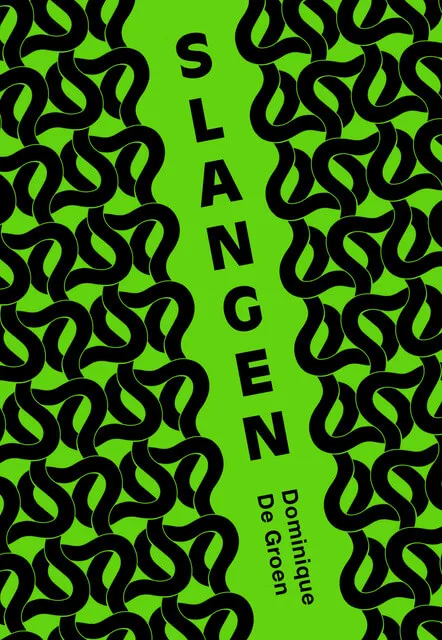
Slangen
Slangen krioelen in de sarcofaag van het heden, in de krochten van de popcultuur, in de mummie van de natuur, in wondes en rot vlees, in artificiële woestijnen en op geoliede dad bods. Ze wentelen zich rond beursgrafieken, raken verstrengeld met wurgende algoritmes, orkestreren een trage ondergrondse revolutie. Een meisje snijdt zich aan een nepdiamanten piramide en werpt haar slangenvel van zich af.
Dominique De Groen is schrijver en beeldend kunstenaar. Ze publiceerde de dichtbundels Shop Girl (2017), Sticky Drama (2019) en offerlam (2020). Ze werd genomineerd voor de Poëziedebuutprijs Aan Zee 2018, de Herman de Coninckprijs 2020 en de Fintroliteratuurprijs 2021 en won de Frans Vogel Poëzieprijs 2019 en de Fintropublieksprijs 2021.
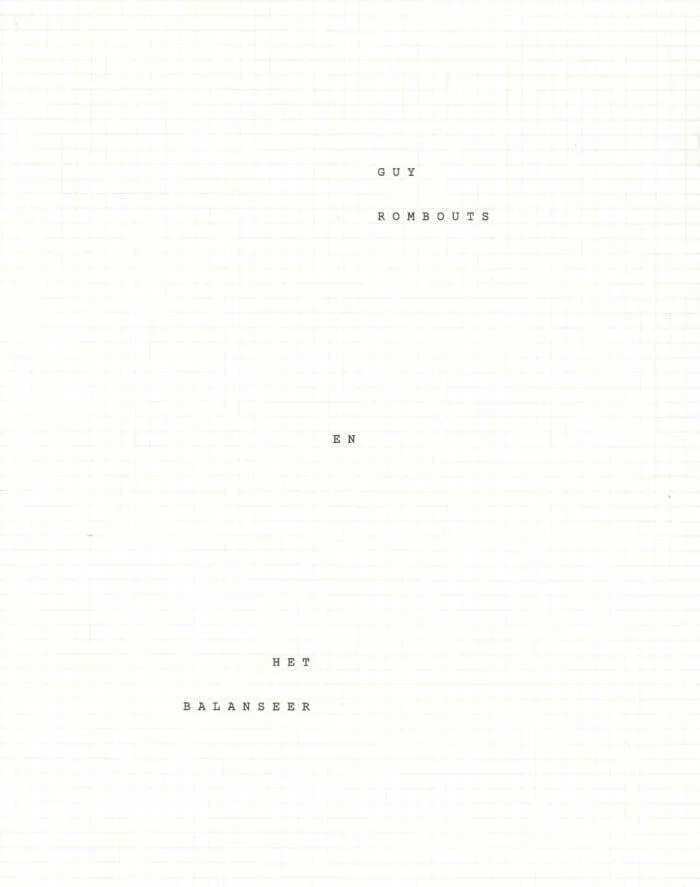
EN
In het begin van de jaren 1970, hield Guy Rombouts een notaboekje bij waarin hij alle woorden, bijvoeglijk naamwoorden en werkwoorden bijhield die hij tegenkwam tijdens het lezen en die met elkaar verbonden waren door het voegwoord ‘en‘.
Ongeveer 50 jaar later en met de hulp van de grafische vormgever Jeroen Wille, is de transcriptie van zijn aantekeningen gepubliceerd als een boek dat gelezen kan worden in twee richtingen (en als enige boek coronaproof met twee tegelijkertijd).
Het boek bevat 2158 verzen met in totaal 4316 EN-combinaties.
De kortste verzen met evenveel letters:
A EN Z
4 EN 6
De langste verzen met evenveel letters:
ONUITSPREKELIJKHEDEN EN IMPONDERABILIA
ONEVENWICHTIGHEID EN ZELFOVERSCHATTING
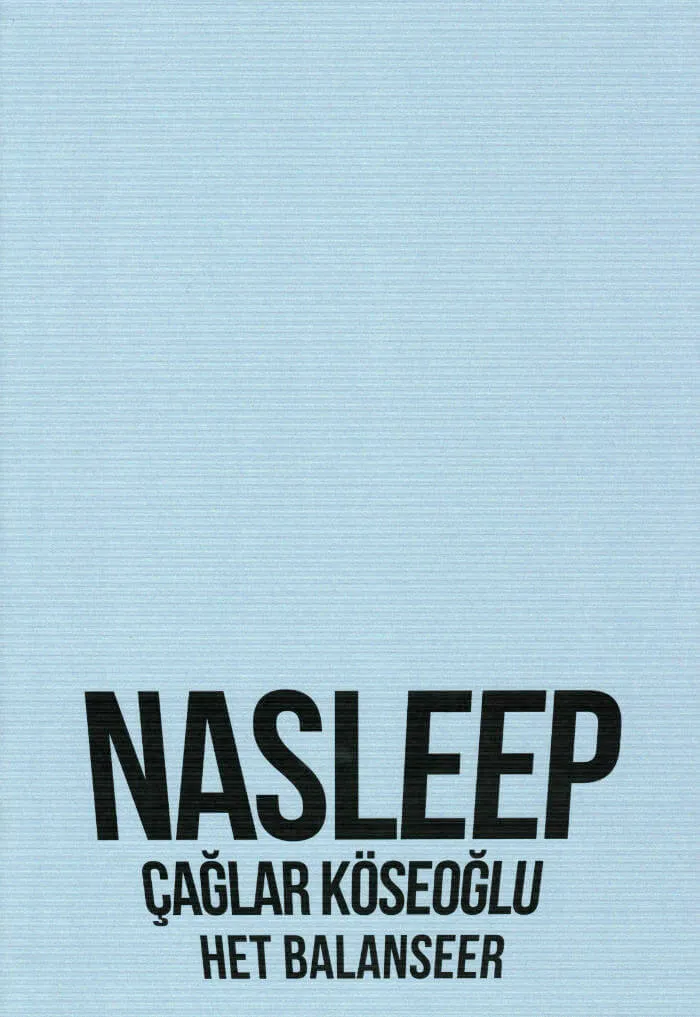
Nasleep
Nasleep neemt de protesten rondom het Gezi Park in 2013 als vertrekpunt en verkent gaandeweg wat er is overgebleven van dit historische moment waarin een andere wereld voor het grijpen leek. Het zijn gedichten die laveren tussen ritmische, conceptuele en kritische noise enerzijds en postrevolutionaire affecten anderzijds, tussen politisering enerzijds en onmacht en radeloosheid anderzijds.

How to love a homeland
Russian writer and philosopher Oxana Timofeeva was born and grew up in various parts of the USSR. The book explores the difficulty of reducing one’s sense of homeland to one’s country alone, the philosophical interconnectedness of movement and rootedness, our plant and animal souls, and how we need to reimagine our desired, fictional if need be, homelands. The book interweaves vignettes from Timofeeva’s childhood across different parts of the USSR with a philosophical discussion of ideas on homeland in the thought of Brecht, Deleuze and Guattari, and other main figures of literature and philosophy.
Oxana Timofeeva is Sc.D., professor at “Stasis” Center for Philosophy at the European University at St. Petersburg, leading researcher at Tyumen State University, member of the artistic collective “Chto Delat” (“What is to be done”), deputy editor of the journal “Stasis”, and the author of books History of Animals (London: Bloomsbury Academic, 2018; Maastricht: Jan van Eyck, 2012), Introduction to the Erotic Philosophy of Georges Bataille (Moscow: New Literary Observer, 2009), Solar Politics(forthcoming, Polity, 2022).
Commissioned and published by Kayfa ta (2020)
Translation from Russian by Maria Afanasyeva
Design template by Julie Peeters
Cover illustration by Jumana Emil Abboud

OEI #86/87 Publishing Practices, Publishing Poetics
Tobi Maier, Cecilia Grönberg and 1 more
Once more, an astonishing issue of OEI – a thrilling, compelling, stimulating feast of ideas regarding publishing and the book: the perfect big companion to read and hug in bed while the virus spreads outside.
Bringing together contributions from circa 130 publishing structures, publishing communities, magazines, small press endeavors, artists, poets, writers, editors, theoreticians, curators, scholars, and art bookstores, OEI # 86–87 reflects upon the challenges, pressures and possibilities of publishing and creating publics in different contexts and places in a time of far-reaching – economical, medial, political, social, technological – transformations.
The potential and the versatility of publishing open it to a diversity of practices and approaches in the arts, but as an eminently social form of art, a collective or micro-collective work with shared responsibilities, it is also a never-ending process of “crafting a variegated approach to how you create, publish, distribute, and build a social ecosystem around your efforts”, of trying to “build up and strengthen the community around these printed forms” (Temporary Services).
It is the conviction of OEI #86–87 that print has the power to play an important part in the construction of social spaces, of a social world. As Benjamin Thorel puts it in one of the essays in the issue, “conceiving of the dynamics of publishing as making publics as well as making things public is not a pun – insofar as the artists/publishers encompass, beyond the book itself, its possible ‘lives’, imagining the different spaces, and the different people, amongst whom a publication will circulate.” This is what Michael Warner has called “a public [as] poetic worldmaking”, implying “that all discourse or performance addressed to a public must characterize the world in which it attempts to circulate, projecting for that world a concrete and livable shape, and attempting to realize that world through address.”
This is also, as stressed by Annette Gilbert and others, what can make publishing such an active force, a force co-constituting texts and publications and publics. Indeed, with Michalis Pichler, it is tempting to say that in publishing as practice – perhaps more than in any other art field – “artists have been able to assert the aesthetic value of their own socio-politically informed concerns and to engage, often under precarious conditions, in cultural activities fully aligned with their political values.”
OEI #86–87 also includes sections on and with contemporary poetry from Canada; Fluxus publishing; Krister Brandt/Astrid Gogglesworth; Kalas på BORD (Öyvind Fahlström); Lars Fredrikson; Claude Royet-Journoud’s poetry magazines; Carl Einstein; Gail Scott; Ållebergshändelser; OEI #79: edit/publish/distribute!; “det offentligas försvinnande” and many many other things. [publisher’s note]
Design by Konst & Teknik

OEI #82-83 Art in the Age of Kleptomania
Jonas J. Magnusson, Cecilia Grönberg and 1 more
Aeron Bergman and Alejandra Salinas, co-editors at INCA Press (along with Irena Borić), are the guest-editors of this issue of OEI: it contains essays, artworks, and archival materials by 21 artists, theorists, writers, and artist-run spaces (mostly from the Americas).
The subject of the issue is art and neoliberalism, and it encompasses essays, images and other works by Dorothée Dupuis, Max Jorge Hindered Cruz, Luciano Concheiro, Yvonne Osei, Diego Bruno, John Riepenhoff, Suhail Malik, Good Weather, The Luminary, Bikini Wax, Beta-Local and more.

Stili Drama XIII-XXI / La Giostra di Lulu XLI-XLIV
The materials collected in the publication have been developed departing from the documentation, transcription and translation of textual, visual, sculptural and audio materials produced between March and November 2021 for STILI DRAMA.
STILI DRAMA is an open-ended episodic para-cinematographic project, which functions as a spontaneous expression of MRZB research. STILI DRAMA XVIII-XXI and LA GIOSTRA DI LULU XLI-XLIV are the two first fragments of the work.
Language: English, Italian
Edition of 100 copies

Água Viva
In Água Viva Clarice Lispector aims to 'capture the present'. Her direct, confessional and unfiltered meditations on everything from life and time to perfume and sleep are strange and hypnotic in their emotional power and have been a huge influence on many artists and writers, including one Brazilian musician who read it one hundred and eleven times. Despite its apparent spontaneity, this is a masterly work of art, which rearranges language and plays in the gaps between reality and fiction.
Clarice Lispector (December 10, 1920 – December 9, 1977) was a Brazilian writer acclaimed internationally for her innovative novels and short stories. Born to a Jewish family in Podolia in Western Ukraine, as an infant she moved to Brazil with her family, amidst the disasters engulfing her native land following the First World War.