Danny Hayward
Danny Hayward
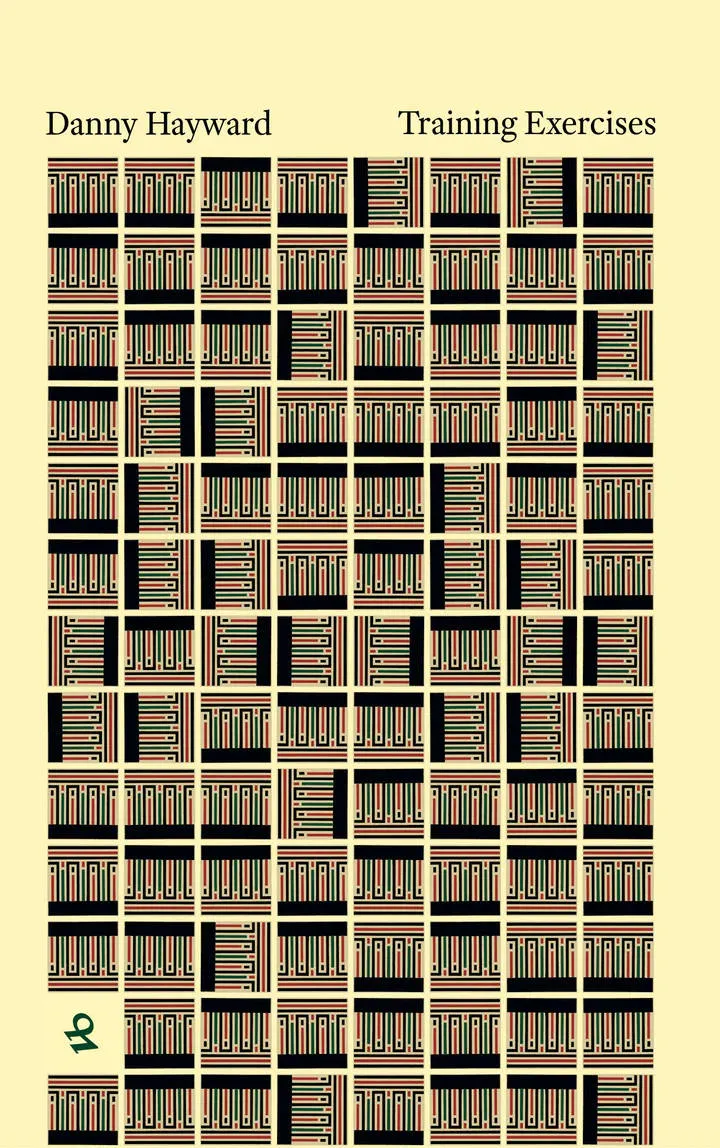
Training Exercises
Organized violence committed on ordinary speech’ is therapy for those who don’t believe in literature as value. Training Exercises is an unpacking of that dictum: seven short essays, letters, reports and anti-biographies written to overcome the feeling of resistance to the defacement of what strikes us as true. An anti-purge written out by lipstick or hammer, scrawled over the top of itself and run through a translation program that turns everything upside inside down, its pieces include: a polemic against catharsis; a letter to the poet Dom Hale on his book Seizures; and a series of on-the-spot reports on the UK Illegal Migration Bill, East London poetry readings, the politics of the war in Ukraine, and a conversation about the meaning of damage in contemporary literature.
‘First you learn to write down your ideas, then you learn again how to write all of your lurid political and intellectual and intimate disappointments and all of your childhood hopes over the top of them’. Jack Spicer scrawled the name of his book in pink lipstick on the cover of the academic journal he had published in: Training Exercises scrawls itself on top of that.

It Was Like Watching
Dear ____,
I happened to look for a while out of “my” window on the 17th floor Palliativstation of the Wiener Allgemeinen Krankenhauses last night, where an enormous orange moon was hanging about, consorting with a lick of dark cloud, near to the tiny gaggle of skyscrapers. I didn’t have much to say for myself and so it just sort of looked back at me.
Every day friends and well-wishers come here and as always I want to run to my room and read a book until they’ve left but for the first time in my life my room is also the room they want to visit, and so I can’t. I wrote down yesterday as best as I could the words of my last long conversation with Marina: there might be more, but the words are running away from her now, which only makes you realise how small and insignificant they are, fleeing from something (from someone) who remains exactly who they were even in their absence: like dust falling from the sun.
*
A voyage in the insight which comes as a kiss and follows as a curse, made after you ran out of things to say.——first halting efforts at mutual understanding——love letters from twelve years ago. journal entries from fifteen years before lick at the edges like flames. Opaque coloured shadows, projected in three dimensions——of a——future that——has. never ceased to exist and which——Doesn’t——.——.——arrive to speak about their fears.—— Beginning with a naked bathroom selfie.
An attempt to live nonjudgmentally and without fear, against the desire to be something other than who you were, as a basic form of class hatred, a fear of the common and of everything that happens there, near speechlessness, trailing off, only sometimes coming back to life again, shame dies so that everything else can be saved, and everything else remains present against the background of this absence, beneath the harsh overhead light, as you pull on the pathetic, unassuming string of the pullcord.
Dedicated to one person, written by one another. “Poems written by / different poets / are my nakedness.”

Wound Building: Dispatches from the Latest Disasters in UK Poetry
Wound Building is a volume of essays, with digressions, on one group of contemporary poets active in a self-organizing political poetry scene in the UK, most of whom have little to no audience outside of the little magazines that they publish and the reading series they put on. The book is a front-line report on the rapid development of this poetry in the period between 2015 and 2020, with a particular focus on the relationship of poetry to violence and its representation. The poets discussed here write violent love poems and violent elegies as well as violent fantasies composed in stabs of violent verse and violet prose. The poems themselves comprise fantasies of killing David Cameron, dreams of being split open along a seam, basement songs, hundreds of pages of notes on working life in a privatized care home in Hove, East Sussex, a four-line slogan about the Cologne groping scandal of New Year 2016, variations on the Refugees Medical Phrasebook, a life wasted in a factory in Guangzhou, an autobiographical sci-fi internet fever dream, an anarchist elegy, and a refusal to argue. Ultimately, Hayward argues that the lessons this poetry teaches is never to write a "worthy" narrative when a fucked up collage will do. Rather than a cohesive "account" of a "school" of poets, or a "contribution" to the boring tittle-tattle of aesthetic debates over British poetry as an institution, Wound Building is a front-line report on the local disasters of a contemporary UK poetry caught in the grip of the historical cataclysm of capitalist culture.
Wound Building is further concerned with aesthetic problems related to Marxism, anarchism, contemporary trans politics, and class, though its "theoretical" preoccupations are subordinated to its desire to provide a ground-level view on the writing itself, its production, its intellectual aporia, and the ways it finds itself outstripped by the ongoing "march of events." The book will be of interest not only for those concerned with contemporary British political and experimental poetry, but also more generally for anyone who wishes to think carefully about what it means to make art about present-day history and its many horrible enormities.
The book's title is derived from the idea of sublime woundedness that subtends the context of the poets discussed here: the impressions of wounds opening up like LED-lit shopfronts in the night, in a parallel universe in which injury is intoxicatingly impersonal and structural, and which forms the environment in which the poems fight to absolutize the value of every last breath, or face into the reality of extravagantly violent wish fulfillment, or dissolve themselves in a search for new ways of professing love, or transform into a kind of expressionism of vomiting up medical-diagnostic categories found in abstract social labor, or pump their verses full of the convulsive rhythms of surprise and sudden relief, without any guarantee that this is the right thing to do or that anyone will even fucking hear. Wound Building does not historicize this state of affairs as much as it attempts to live alongside the immediacy of this work, in order to see what is still possible for poetry, and criticism, to make and do.

Look at Hazards Look at Losses
Marina Vischmidt, Danny Hayward and 1 more
Look at Hazards, Look at Losses developed out of a series of conversations, exchanges and visits between kuda.org, Anthony Iles and Marina Vishmidt over 2015-2017 through which different approaches to common problems of cultural production in early-21st century Europe and its peripheries were debated and conceptually probed. Setting out from Theodor W. Adorno’s concept of ‘the aesthetic relations of production’ these discussions proceeded to explore problems bearing upon organisation in small groups in the field of culture, philosophical idealism and materialism, poetry, error and crisis.
The anthology assembled reflects these concerns through engagement with the writing of others who have helped orientate us through these discussions. The book which is the outcome consists of seven original contributions by poets and theorists which attempt to move toward new political interventions in culture and beyond ‘crisis as a way of life’.
Mentioned in

Parapraxis 08: Groups
To be in a group is to submit to a form of disorganizing organization that hangs on careful balance: to be devoted to a collective without being engulfed, to be disciplined by it without sleepwalking to the tune of a leader’s will, to integrate without dissolving into it. As infants born into a sexual union from which we are then necessarily excluded, the yields and limits of assembly are evident from the outset. Before we arrived in the bloc, we lived our lives in other groups: the family, the religious order, the cafeteria table clique. You can sit with us. You can’t. Some groups we remember entering. Others we didn’t elect, but deselected.
As a form of critique whose object of analysis is suffering, psychoanalysis understands the pains of the group. Its full task is to make sense of them as a condition of the many as much as of the one. As the psychoanalyst Didier Anzieu glosses the problem of thinking about groups, the “commonplace” assumption is that the group “is a pooling, a sharing” through which “the energies, enthusiasm and capacities of individuals who freely assent to the discipline of the group” coalesce into a unified forcefield. Yet, as Anzieu stresses, this idealized description eats itself. It collapses union with sharing, with collectivity. We know that groups rely on sharing. He asks, “a sharing of what?”
Psychoanalytic cults. Cowboy churches. The Epstein Class. Iranian monarchists. Fascist liberals. Clinics and their radicals. Discipline and holding. Getting together, falling apart.
Essays by Séamus Malekafzali, Tracy McNulty, Richard Seymour, Zahid Chaudhary, Danny Hayward, Eri Linsker, hannah baer, and more.

Ends
Lotte L.S.’s ‘selected poems’ (the scare quotes and lower case are important), which begin and end with standardised gaps produced by hitting the tab key with prefabricated empty space symbolising other gaps produced by other textual means, also associates those standardised gaps, these absences, wit acts of what she calls ‘seeing’, meaning seeing as self-seeing; a seeing that is often impossible to distinguish from blindness. The second line of her book ‘she could not see to see’, is modified by its last: ‘o I am so thankful for the seeing’; and the rhyme across distance upholds, if only just, a transitio in grammatical person, a transition in grammar that may also be, or that may represent, though these verbs too are contested—‘she went (an unconvincin verb: went)’—that may also be or represent a transition in experienced subjecthood The suggestion anyway is of development, passage, narrative; of motion towards completion; though the development is no way self-explanatory, and it is punctuated by double takes.
— from Danny Hayward's Preface: A note on Ends

Tripwire 23 - Work/Anti-work
Work/Anti-work issue with writing by Nat Raha /. lisa minerva luxx /Ghayath Almadhoun, trans. Catherine Cobham / Jacqui Germain / Jazra Khaleed, trans. Peter Constantine / Finn Finneran / Cait O’Kane / Rebecca Kosick / Lara Durback Skye /Lotta Thießen / William Rowe / Danny Hayward / Rona Lorimer / Zoe Beloff / Jike Ayou, trans. Yě Yě / Miguel de Vallester, trans. Erasmo Pantoja / Lucas Martínez / ko ko thett / Hung Q. Tu / Raymond de Borja / etaïnn zwer, trans. Ilan A.L.S. Erikson Weisbrod / Annie Raab on Taylor Portela / Rachael Guynn Wilson on Lyn Hejinian / Will Rowe on Danny Hayward / Chloe Watlington on Joshua Clover.

First Nettles
First Nettles collects poems written between 2021 and 2024, from precarious off-key lyrics to sprawling elegies of damaged life. A book of flailing, desperate music, hurt and hopeful, held together by pins and gaffer tape, art and courage and comradeship. Includes the sequence “Seizures” (2022) – “perfect in its openness and lyrical disfigurement” (Danny Hayward).
“[An] exhilarating collection […]. The sequences here are ferociously and admirably radical, with some superb political satire and verve to the poems.” —Adam Piette, Blackbox Manifold, no. 34
Designed and typeset by Phil Baber; cover collage by Sam Keogh

Journal for music, politics and poetics #2
Developed over the past year and a half, Cesura//Acceso Issue 2 contains new writing by Paul Abbott, Hannah Black, Nathaniel Mackey, Larne Abse Gogarty, Verity Spott, Irene Revell with Annea Lockwood, Paul Rekret, and Federica Frabetti with Mark Fell.
Issue 2, in response to the open call Corrupting Desires! Technique, Performance, and Control Cesura present a series of texts which deal with the problems of constraint, restraint and domination in relation to musical production, performance and reception. With contributions from Abject Subject Ensemble (Mattin, Farahnaz Hatam, Sacha Kahir, and Colin Hacklander), Naroder Bourniki, ESW, Danny Hayward, Sophie Hoyle, Sacha Kahir, Pil and Galia Kollectiv, Claire Potter, Byron Peters and Tyler Coburn, David Morris and Kim O'Neil.
Cesura was formed in 2014 as a place to think through the politics of music. The first issue was published in 2014. They have since held workshops, talks, radio shows, and put on gigs exploring the politics of music, poetry and performance.