Books
Books
in random order

Thirty-Odd Functions of Voice in the Poetry of Alice Notley
Alice Notley has consistently peopled her poetry with the voices of those around her: kids, friends, husbands, strangers, and the dead. Thirty-Odd Functions of Voice in the Poetry of Alice Notley offers an array of interpretations of this technique. While not aspiring to completeness, and limiting its attention to one formal aspect of a single author's work, this poem-essay sketches relationships between intimate speech and literary language.

Barking Up the Wrong Tree
How To Become est une maison d'édition autogérée basée à Paris. Nous publions les textes d'auteuces engagés dans des pratiques féministes et peu diffusés par le réseau des grandes maisons d'édition françaises.
Créée en 2016, elle est composée d'artistes et écrivaires en majorité gouines, HTB publie de la litterature expérimentale née d'influences post-post- sapphiques ainsi qu'un choix de tradu d'auteuices non traduites en langue française. HTB s'articule autour d'ateliers d'écriture: How to Become a Lesbian, et d'une revue annuelle publiant les choses issues de l'atelier.

Toxicité coloniale: Documenter le Paysage Radioactif
Toxicité coloniale revient sur les programmes nucléaires français menés entre 1960 et 1966 dans le Sahara algérien. Ce programme secret, qui s’est déroulé pendant et après la guerre d’indépendance algérienne (1954-1962), a permis au régime colonial français de mettre à feu quatre bombes atomiques atmosphériques, treize souterraines et de mener d’autres expériences nucléaires dans le désert. Alors que la grande majorité des documents d’archives sont toujours classés secret aujourd’hui, Toxicité coloniale rassemble une variété de sources permettant de documenter l’histoire violente des activités de la France en Algérie. Le livre constitue un corpus de choix à l’intersection de la justice spatiale, sociale et environnementale pour ceux et celles qui s’intéressent à l’architecture, au paysage et aux pratiques d’archivage dans une démarche décoloniale.
Alors que ces bombes ont eu des conséquences durables pour les populations et les environnements locaux ainsi que pour les vétérans français, le manque de contrôle des explosions, les lacunes de sécurité et l’utilisation des Algériens comme main- d’œuvre sur des chantiers particulièrement dangereux apparaissent comme des faits coloniaux d’une importance majeure.

Issue #9: Companions
Irene de Craen, Katia Krupennikova
The editorial/imaginative centre of the ninth issue of Errant Journal is located in the regions that have experienced Russian imperial aggression from where it makes connections across times, geographies, and ontologies to explore the radical potential of companionship. Companionship is understood not as agreement, but as a shared responsibility across unequal histories. It means not being full without the other. While forms of imperial and colonial violence might differ in places and through times, the issue recognizes how colonial mechanisms are sustained, how they present themselves as if they were past while shapeshifting and continuing in new forms and places in the present. By bringing these contexts in relation, this issue aims to show how certain borders, biases, clichés, and power structures travel, mutate, and shape both human and non-human lives and landscapes. Ultimately, companionship is about prioritizing life and about insisting that no oppression is singular.
This issue is a concept by and co-edited with Katia Krupennikova.
Contributors: Adriana Arroyo, Keto Gorgadze, Andreas Kalkun, Chung Kai Lee, Samira Makki, Ana Mikadze, Petrică Mogoș, Fabienne Rachmadiev, Vaim Sarv, Victoria Soyan Peemot, Czyka Tumaliuan, Iryna Zamuruieva, Irene de Craen, Katia Krupennikova

Superior and Inferior
Superior and Inferior presents a facsimile reprint of Italian abstract artist and feminist Carla Accardi's provocatory publication Superiore e Inferiore and the first ever English translation of the full text.
"In this book, I have bought together the transcripts of dialogues I recorded on tape in three girls' classes from the first, second and third year of a state middle school. For having proposed this unauthorised activity, I was dismissed from teaching in the light of a formal complaint". – Carla Accardi introducing her book Superiore e Inferiore, 1972.
First published in 1972 by Carla Accardi, the book Superiore e Inferiore features discussions among girls at a middle school—all between 10 and 13—about society's discriminatory behaviour towards women. They also commented the Manifesto of the revolutionary feminist group Rivolta Femminile—collectively written by Accardi, art critic and feminist activist Carla Lonzi, and Elvira Banotti—which first appeared posted on city walls in Rome in July 1970. For having discussed sex-related issues with pupils, Accardi was fired and permanently suspended from teaching. (Her letter of dismissal issued by the Italian Ministry of Education forms part of the introduction to the book.) Along the lines of Pasolini's Comizi d'Amore (Love Meetings), Accardi's own voice is secondary in the book, giving way to the thoughts, narratives, opinions, and debates expressed among girls on the role of women and girls, family conflicts and intimate relations.
Carla Accardi (1924–2014) was an Italian abstract painter associated with the Arte Informale and Arte Povera movements, and a founding member of the Italian art groups Forma (1947) and Continuità (1961). She experimented with different forms of art, such as black and white painting and Sicofoil. During the late 1970s, she became part of the feminist movement with critic Carla Lonzi. Together, they founded Rivolta femminile in 1970, one of Italy's first feminist groups. Accardi's first solo exhibition in the United States was in 2001 at MoMA PS1.

ODD / GARİP
"[…] this new poetry will not serve the taste of the prosperous class. which only represents a minority. The people who populate this earth find the right to live at the end of a constant struggle. Like everything else, they also have a right to poetry, and it will appeal to their taste."
Three friends —Orhan Veli Kanik, Melih Cevdet Anday and Oktay Rifat— followed this principle as they were composing their "odd" poems. Their aim was to write poetry for everyone, about everyone.
This books gathers the poems Orhan Veli published with his friends in Odd (1941), the manifesto he wrote for this new poetry, and the foreword he wrote for the 1945 re-edition.

Ana Patova Crosses a Bridge
“Ana Patova Crosses a Bridge is the third volume of Renee Gladman’s magnificent, melancholy series about the city-state of Ravicka, or about the architectures of its absence. It is tempting to read the Ravickian books as an extended allegory—of architecture itself, perhaps, except that architecture is already half-allegorical, its every element raised to prefigure whatever meanings can make their way to them. If any can. In Ravicka, meanings—indeed most contact of any kind—remain in abeyance, building, in absentia, the constitutive negative spaces of the narrative. There is a plot; it lays out zones of sheer ambience. Experiences, of which there are many, unfold as a redolent lingering in the structures of immateriality, the radical realities of the insubstantial. Gladman is a philosopher of architecture, though not that of buildings. Rather, she thinks (and writes) the drifts, partitions, and immobilities of identity, affect, communication, the very possibility of being human. Profound, compelling—haunting, even—the story of Ravicka is astonishingly ours.” - Lyn Hejinian

Rip It Up
Rip It Up is the first ever English translation of Kou Machida's award-winning novel, an undertaking over five years in the making and the inaugural title of Inpatient Press's new translation imprint Mercurial Editions.
Set in a kaleidoscopic hyperreal Japan circa Y2K, Rip It Up catalogues the misdeeds and misgivings of a down-and-out wannabe debonair who ekes out a meager living at the fringes of the art world, wracked by jealousy at his friend's success and despondency of his own creative (and moral) bankruptcy. In turn hilarious and also horrifying, Machida's pyrotechnic prose plumbs the discursive depths of the creative spirit, a head-spinning survey of degeneration and self-sabotage.
Kou Machida is a punk singer, actor, and author, who turned to poetry and fiction after releasing one of the seminal Japanese punk albums with his band INU, 1981’s Meshi kuuna! (Fuck Eating!). He has won the Akutagawa and Tanizaki prizes among many others, and his 2005 novel Kokuhaku (Confession) was named one of the three best books of the last thirty years by the Asahi Newspaper.
Daniel Joseph is a translator, editor, and musician who spent his salad days shouting in dank basements before getting a master’s degree in medieval Japanese literature. Recent translation projects include contributions to Terminal Boredom (Verso, 2021), a collection of stories by science fiction pioneer Izumi Suzuki; and the memoir Try Saying You’re Alive! (Blank Forms, 2021) by outsider folk maniac Kazuki Tomokawa.
Winner of the 2000 Akutagawa Prize for Fiction

The Sniper in the Brain
Upside-down trees with roots reaching toward the cosmos, glasses, pitchers, transparent vessels, and bodies blending human and animal, male and female features populate Jacopo Pagin’s works. These figures reveal themselves in their decadent and symmetrical being, caught within a web of references centered on the evocative power of the gaze.
The first monograph dedicated to Jacopo Pagin, designed and edited by Ismaël Bennani and Orfée Grandhomme and featuring a critical contribution by Alessandra Franetovich, brings together over 200 drawings and paintings to explore the visionary, obsessive, and hypnotic qualities of the artist’s work and its profound connections with exotic, mediumistic, and new-age practices.
The book is co-published with Make Room, Los Angeles.

Invisible Oligarchs
Bill Berkson's Invisible Oligarchs is like a book jotted on the back of a poet's hand—a hand that picks up everything that sings to it, from gold-leaf proverb to chopstick sheath, on its quick trip through a few places in urban Russia, 2006. Across faintly ruled Japanese paper, many pages reproduced here in facsimile, snapshots change hands, new poems blink, and poetry politics meet political gossip over lunch in St. Petersburg. Berkson's educated guesswork about that elusive quality once known the Great Russian Soul, is framed here by letters from his friend Kate Sutton and encompassing encounters with poets and cab drivers, Moscow conceptualists and a White Night at the Mariinsky Ballet. As a sharply observant poet and the most soulful art critic alive, Berkson knows how to get us behind the set, and reading this book is as nice as taking a high dive with him into a perfectly mixed White Russian.
Bill Berkson was born in New York in 1939. He moved to Northern California in 1970 and now divides his time between San Francisco and New York. He is a poet, critic, sometime curator, and professor emeritus at the San Francisco Art Institute, where he taught art history and literature for many years. A corresponding editor for Art in America, he has contributed to such other journals as Artforum, Aperture, Modern Painters, and artcritical.com. His recent books include PORTRAIT AND DREAM: NEW & SELECTED POEMS (Coffee House Press, 2009); BILL, a words-and-images collaboration with Colter Jacobsen; Lady Air; Not an Exit with drawings by Léonie Guyer; REPEAT AFTER ME (Gallery Paule Anglim, 2011), with watercolors by John Zurier; and a collection of his art writings, FOR THE ORDINARY ARTIST (BlazeVOX books, 2010), as well as a new collection of his poems, Expect Delays, from Coffee House Press in 2014 and INVISIBLE ORLIGARCHS out from Ugly Duckloing Presse in 2016.

Still Life 4
STILL LIFE is an online and printed zine about relationships and configurations in which one person is still while others are not. Or where one person is passive and others are active. It’s about how we put ourselves in other people’s hands. Or how we are put in other people’s hands. It’s about care and power and vulnerability and agency. And other things not so clearly named. It’s about the different kinds of knowledge that people have about their own and other people’s bodies. And the kind of philosophical and political understandings woven into that knowledge.

Decolonizing Art Book Fairs – Pratiques de l'édition indépendante dans les Sud(s)
Parfait Tabapsi, Michalis Pichler and 3 more
A manifesto for the decolonization of art book fairs and publishing.
Can we decolonize art book fairs? Can we decentralize knowledge and deconstruct privilege in our contexts? Decolonizing Art Book Fairs aims to rethink through the existing and speculative frameworks of organizational practice in the art book fairs. This workbook attempts to introduce new narratives and help deconstruct the frontiers between north(s) and south(s), putting an emphasis on practitioners and initiatives from the African continent and diaspora. A workbook with (primarily newly commissioned) texts and interviews.
Contributions by Jean-Claude Awono, Yaiza Camps, Chayet Chiénin, Chimurenga, Renata Felinto, Wanjeri Gakuru, Moritz Grünke, Aryan Kaganof, Sharlene Khan, Grada Kilomba, Carla Lever, Fouad Asfour, Dzekashu MacViban, Gladys Mendía, James Murua, Tinashe Mushakavanhu, Simon Njami, Bonaventure Soh Bejeng Ndikung, Monica Nkodo, O Menelick 2Ato, Pascale Obolo, Michalis Pichler, Mario Pissarra, Sergio Raimundo, Djimeli Raoul, Flurina Rothenberger, Bienvenu Sene, Bisi Silva, Kwanele Sosibo, Parfait Tabapsi, Louise Umutoni, Zamân Books & Curating.

First Nettles
First Nettles collects poems written between 2021 and 2024, from precarious off-key lyrics to sprawling elegies of damaged life. A book of flailing, desperate music, hurt and hopeful, held together by pins and gaffer tape, art and courage and comradeship. Includes the sequence “Seizures” (2022) – “perfect in its openness and lyrical disfigurement” (Danny Hayward).
“[An] exhilarating collection […]. The sequences here are ferociously and admirably radical, with some superb political satire and verve to the poems.” —Adam Piette, Blackbox Manifold, no. 34
Designed and typeset by Phil Baber; cover collage by Sam Keogh

Le Chauffage #3 - Day Job
Francesca Percival, Felix Rapp and 1 more
The third issue of Le Chauffage is an inquiry into the relationship between the practices of artists/ writers and their day jobs. This subject stems from a question fundamental to the existing mandate of Le Chauffage: 'how do you keep warm?' and subsequently, 'how do you pay the bills?' As these perennial concerns occupy our everyday lives, we ask artists/writers to consider the influence that their day jobs, side hustles, creative or non- creative forms of employment have on their respective practices.
This issue tries to account for the significant ways in which complex economic realities come to shape the art we produce, look at, and discuss. How do we deal with limited time and resources? How do we reclaim and steal time back? How do our day jobs shape and influence what we make? How do we subvert the means of production of the workplace? Can the constraint of a day job also be a way to alleviate the pressure of professionalising?
With contributions by Daniel Bozhkov, Nathan Crompton Pippa Garner, Chauncey Hare Marisa Kriangwiwat Holmes, Garrett Lockhart, Jannis Marwitz Reba Maybury, Tiziana La Melia, Dan Miller, Ragen Moss, Jean Luc Moulène, Jean Katambayi Mukendi Paul Niedermayer, Sophie Nys, Megan Plunkett, Chris Reinecke, Jacquelyn Zong Li Ross On Gabrielle L Hirondelle Hill Margaux Schwarz, Eleanor Ivory Weber James Welling, Werker, The Wig.

Acker
A lyric essay written through Kathy Acker's evocative prose, public statements, and private archives.
A cover of Kathy Acker’s career and a study of the development of narrative in her books deftly tracing Acker’s interactions with a diverse palette of avant-gardisms, world letters, cultures, and theory. Martin follows Acker through New York’s downtown St. Mark’s Poetry Project scene, Black Mountain College, and the Beats, as Acker embarks on her own deconstructions of subjects autobiographical and historical, art procedurals, proto-conceptual writing, legacies, and spirits.

stewarding
stewarding maps the joyful and embodied ways we can resist oppressive structures that control our food, housing, and socialisation. We begin in an abandoned school, previously the union headquarters for a coal board, which became a legal guardianship, now condemned. We witness acts of communing between human inhabitants, composting worms, microbes in fermentation, and learn working class histories along the way. Here, complex networks emerge between agents, and thrive, disrupting the monolithic power of corporate extraction. Sean Roy Parker’s debut collection of poetry is a generous account of hopeful ways to eat and ways to live.

Viscose 01: Style
The very first issue of Viscose tackles the expansive notion of “style”. Both a noun and a verb, style can be understood as the most basic unit or currency of fashion. Style names the very movement of aesthetics in society, and thus holds an important place in the critique of art and visual culture more broadly.
As a verb, it connotes a tactic: a dynamic tool for persuasion and communication through the bricolage of signifiers. It also relates directly to the contemporary profession of “styling”; a practice native to the fashion industry, but increasingly prevalent across the arts, media, consumerism, and politics. Thiss issue of Viscose sets out to critically gesture to all of these connotations and their potential intermingling through concrete case studies and cross disciplinary philosophical speculation.
with contributions by:
Shanzhai Lyric, David Lieske, Bakri Bakhit, Dena Yago, Matthew Linde, Burke Battelle & Ada O’Higgins, Davide Stucchi, Taylore Scarabelli, Mahoro Seward, Jordan Richman, Giorgi Gago Gagoshidze, Hito Steyerl, & Milos Trakilović, Laura Gardner, Avena Gallagher, Alex Esculapio, Elise by Olsen and Jeppe Ugelvig

First Meeting
Santiago de Paoli, Martina Panelli
First Meeting is the first monograph on Argentinian artist Santiago de Paoli. Covering de Paoli’s oeuvre from his early, experimental projects to his most recent explorations, the book delves into his innovative approach of painting on unconventional materials, from plaster to bread, felt to canvas, aluminum to wool, and socks to fur. It features newly commissioned essays by Fernanda Brenner, and Mariano Mayer, as well as a conversation between Christian Rattemeyer and the artist.

Katalog 2
Assembled and copied by Jan Matthé at Permeke Library Antwerp, September—October 2022. Edited at Kransen, printed in Borgerhout in an edition of 200, bound by De Wrikker in Berchem. Released on the occasion of Permeke draait door met Risiko Press, Sunday 27 November 2022 at Permeke Library, with readings and performances by Tina Schott, Jóhanna Kristbjörg Sigurðardóttir, Stefanie Alexandra, Sis Matthé, Ria Pacquée, Jan Matthé, Clodagh Kinsella and Roman Hiele. Thanks to Christel Kumpen for the invitation, Allon McKaye for the Saturday and Toni Matthé for the unicorn with a heartshaped tail.
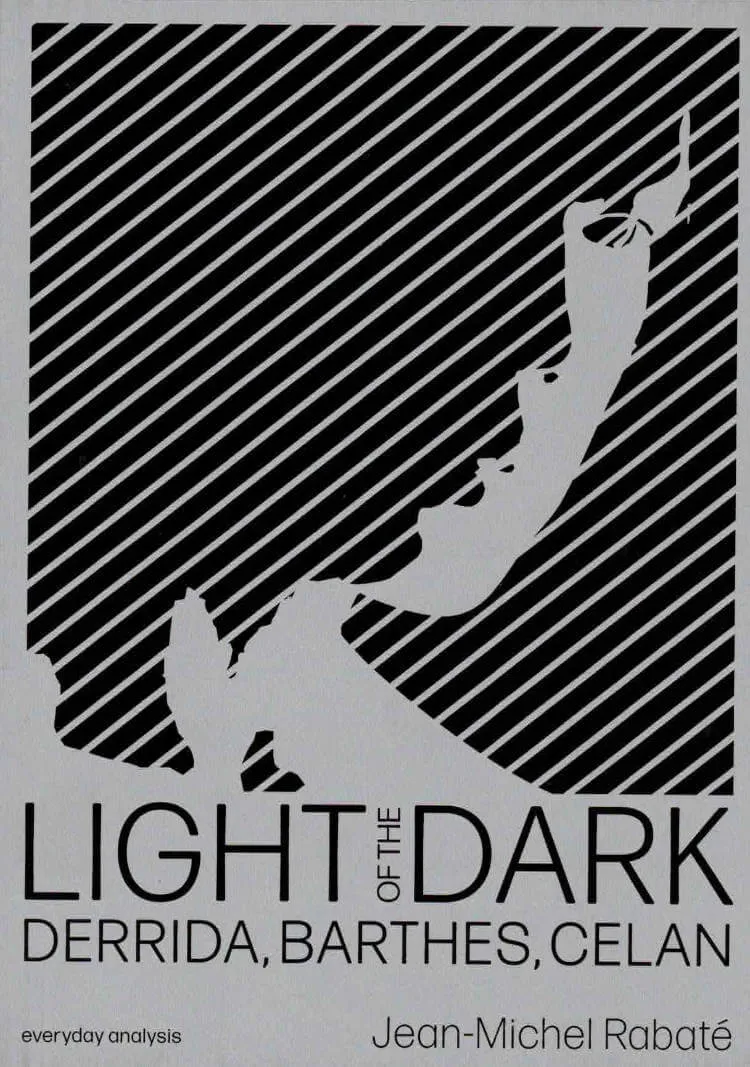
Light Of The Dark: Derrida, Barthes, Celan
Derrida’s essay “Aletheia” discusses the work of Japanese photographer Kishin Shinoyama. Reading Derrida, Rabaté investigates how, behind the classical concept of truth as a beautiful naked woman, Derrida argues that any photographic image tells the Truth, but a truth obscured as it comes to light: “nothing is more black than the visibility of light.” Staging a critical conversation with Roland Barthes’s theses in Camera Lucida and Paul Celan’s poems from Breathturn to Lightduress, Rabaté argues for a theoretical approach to truth that counters the prevailing truth-discourses of today.

Assembling a Black Counter Culture
DeForrest Brown, Jr.’s Assembling a Black Counter Culture presents a comprehensive account of techno with a focus on the history of Black experiences in industrialized labor systems—repositioning the genre as a unique form of Black musical and cultural production.
Brown traces the genealogy and current developments in techno, locating its origins in the 1980s in the historically emblematic city of Detroit and the broader landscape of Black musical forms. Reaching back from the transatlantic slave trade to Emancipation, the Industrial Revolution, and the Great Migration from the rural South to the industrialized North, Brown details an extended history of techno rooted in the transformation of urban centers and the new forms of industrial capitalism that gave rise to the African American working class. Following the groundbreaking work of key early players like The Belleville Three, the multimedia output of Underground Resistance and the mythscience of Drexciya, Brown illuminates the networks of collaboration, production, and circulation of techno from Detroit to other cities around the world.
Assembling a Black Counter Culture reframes techno from a Black theoretical perspective distinct from its cultural assimilation within predominantly white, European electronic music contexts and discourse. With references to Theodore Roszak’s Making of a Counter Culture, writings by African American autoworker and political activist James Boggs, and the “techno rebels” of Alvin Toffler’s Third Wave, among others, Brown draws parallels between movements in Black electronic music and Afrofuturist, speculative, and Afrodiasporic practices to imagine a world-building sonic fiction and futurity embodied in techno.
DeForrest Brown, Jr. is an Alabama-raised rhythmanalyst, writer, and representative of the Make Techno Black Again campaign. As Speaker Music, he channels the African American modernist tradition of rhythm and soul music as an intellectual site and sound of generational trauma. On Juneteenth of 2020, he released the album Black Nationalist Sonic Weaponry on Planet Mu. His written work explores the links between the Black experience in industrialized labor systems and Black innovation in electronic music, and has appeared in Artforum, Triple Canopy, NPR, CTM Festival, Mixmag, among many others. He has performed or presented work at Haus der Kulturen der Welt, Berlin; Camden Arts Centre, UK; Unsound Festival, Krakow; Sónar, Barcelona; Issue Project Room, New York; and elsewhere. Assembling a Black Counter Culture is Brown’s debut book.
—
Editor: Rachel Valinsky
Editorial Consultant: Ting Ding and Camille Crain Drummond
Designer: Scott Ponik
Copy Editor: Madeleine Compagnon

Light in the Dark/Luz En Lo Oscuro: Rewriting Identity, Spirituality, Reality
Light in the Dark is the culmination of Gloria E. Anzaldua's mature thought and the most comprehensive presentation of her philosophy. Focusing on aesthetics, ontology, epistemology, and ethics, it contains several developments in her many important theoretical contributions.

Adrenalin
Adrenalin is Syrian-born, Stockholm-based Palestinian poet Ghayath Almadhoun’s first collection to be published in English. This sinuous translation by Catherine Cobham comprises poems that span years and continents, that circulate between cities, ideas, lovers, places of refuge, war zones, time zones, histories. Here is a vital, relentless, intertextual voice that refuses arrest by sentimentality, that pursues the poetry coursing underneath the poetry.

Aesthetical Relations
Aesthetical Relations is a constellation of essays on art, fashion, cancer, comedy, Los Angeles, and your mom. Martinez whips elements of fiction and stand up material into bits and pieces addressing such concerns as: how many times you may kiss an art-world acquaintance, the theoretical stakes of sexting, and why German performance art is like French clowning. Aesthetical Relations is titled after Martinez’s ongoing conceptual comedy talk show of the same name. This new revised and expanded third edition includes new essays written from 2020-2025.
Christina Catherine Martinez (Mexican American, b. Bellflower, CA) lives and works between Los Angeles, Mexico City, and New England. She was named both a Comedian You Should Know by Vulture and a Comic to Watch by TimeOutLA, and is a recipient of an Andy Warhol Foundation Arts Writers Grant for her varied approaches to art criticism, published in platforms such as The Los Angeles Times, Aperture, Frieze, Artforum, Bookforum, e-flux criticism, DOCUMENT Journal, Dirt.fyi and Texte Zur Kunst.