rile*books

Search books

Search books by title, author, publisher, keywords...

Explore

Categories
Visit
Collections
Publishers
Back in stock
Any books
Cover of Katalog 2

Risiko Press

Katalog 2

Jan Matthé

€14.00

Assembled and copied by Jan Matthé at Permeke Library Antwerp, September—October 2022. Edited at Kransen, printed in Borgerhout in an edition of 200, bound by De Wrikker in Berchem. Released on the occasion of Permeke draait door met Risiko Press, Sunday 27 November 2022 at Permeke Library, with readings and performances by Tina Schott, Jóhanna Kristbjörg Sigurðardóttir, Stefanie Alexandra, Sis Matthé, Ria Pacquée, Jan Matthé, Clodagh Kinsella and Roman Hiele. Thanks to Christel Kumpen for the invitation, Allon McKaye for the Saturday and Toni Matthé for the unicorn with a heartshaped tail.

Published in 2022 ┊ 114 pages ┊ Paperback ┊ Language: English

recommendations

Cover of Twenty Bookmarks

Risiko Press

Twenty Bookmarks

Zines €12.00

Twenty Bookmarks is a result of Production & Workflow class of Graphic Design Department at the Royal Academy of Fine Arts Antwerp, Ba1 Class of 2026.

Cover of Biarritz

Risiko Press

Biarritz

Jan Matthé

Poetry €10.00

Written and edited in Biarritz, Borgerhout and Midsommarkransen, 2016—2021. Dedicated to Räffi, with much love. Another version of this text was published in Pfeil Magazin 10 (Montez Press, 2018); editor: Anja Dietmann, copy-editor: Stacy Skulnik. Epigraph from Numéro Deux (1975) by Anne-Marie Miéville and Jean-Luc Godard. Presented on Saturday February 5th 2022 at Kransen, Borgerhout.

128x201mm, 40p, staple bound. Riso-printed on Arcoprint Edizioni Avorio 90g and Clairefontaine Blue 210g. Design by Kaye–Matthé, typefaces: Tribute, Gillies Gothic Light. Printed by Risiko Press at Kransen, covers silkscreened at Afreux, bound by Drukkerijcollectief De Wrikker. Edition of around 200.

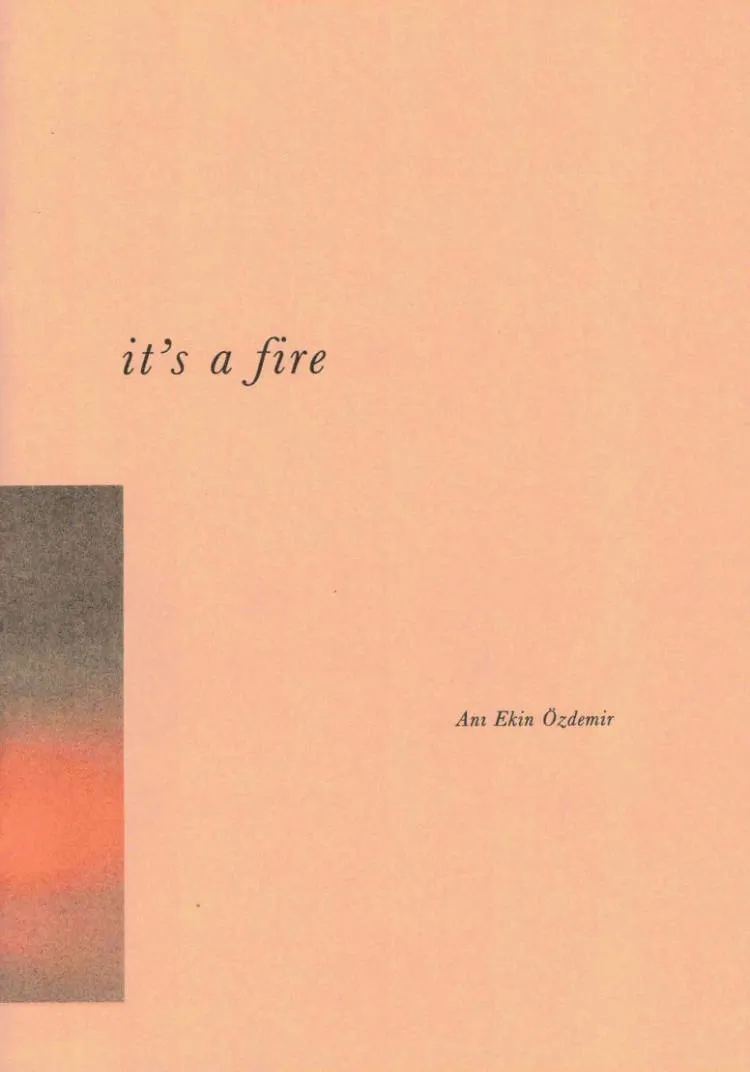
Cover of It's a Fire

Risiko Press

It's a Fire

Anı Ekin Özdemir

Poetry €10.00

It's a Fire is a collection of poems that weaves together dreamt and experienced situations, written in movement, with the intensity of senses, weather conditions, and the impossibility of fulfilment and ownership—which also makes it a reflection on desire as a force that disorganizes capitalist productivity, disciplined subjectivity, and neoliberal self-improvement. Along the way, it burns, contaminates, multiplies, and keeps on desiring.

Cover of Manifest ( ) gathered angry woman loving

Risiko Press

Manifest ( ) gathered angry woman loving

Chiara Di Luca, Emma Burel and 2 more

Zines €7.00

Words gathered from The Carrier Bag Theory of Fiction (Ursula K. Le Guin, 1986), Natural Enemies of Books (MMS, 2020), Non credere di avere dei diritti (Libreria delle donne di Milano, 1987), Dada Cannibalistic Manifesto (Francis Picabia, 1920) and WITCH (Rebecca Tamás, 2019). A first version of this poem/pamphlet was made in the context of See What I Mean, a workshop by Phil Baber at Antwerp’s Royal Academy of Fine Arts, october 2024.

Cover of Sforzando - Pastels 2020 - 2022

Goswell Road

Sforzando - Pastels 2020 - 2022

David West

At midday, March 17th, 2020, Macron’s government decided to place France in suspended animation. Total confinement. The first in a series of strict debilitating lockdowns to combat the spiralling Covid-19 pandemic. This first confinement lasted 55 days. It ended on 11th May 2020. The first part of a dramatic trilogy.

One month in, in April 2020, David West picked up a box of pastels that used to belong to his mother. He had had them for many years but never used them. New to the medium, locked in his Paris studio, he sets himself to the task. Naturally, violence ensues. Folk horror. Animals are disembowelled. Faceless sexualised female bodies perform. Screaming faces educate. Covered figures stand motionless. Shadows. Hooded beings populate. Stabbing, scratching, fading, softening, sforzando. Crescendo. Schadenfreude.

Occasional respite comes when West ventures outside - andante - but the externalised screaming pushes him back in. Hagazussa. Ghosts from West’s past, real and unreal, appear and disappear, figures and shapes, compositional arcs, a slimy snaking emerald hand parts the waves for colour to gush forth a new language verde fosforescente, worm purple, rosa shocking, vermillion, cobalt, ultra-black.

This book reproduces a small selection of some 300 works, in chronological order, in an attempt to document time, evolution, revolt, epiphany and joy. Joy in colour, horror, form, symphony, and finally, West’s visions of a new utopia. Marcato. Decrescendo.

Softcover (21cm x 29.7cm)
100 Pages
50 copies
Signed and numbered by David West

Cover of Abstract Coloring Book

Bierke Verlag

Abstract Coloring Book

Coumba Samba

A coloring book conceived as an artist book. Coumba Samba’s publication prompts you to explore geometric forms and structures with a small set of colored pencils. Using those simple materials one realises how interaction and experimentation challenge again and again the relationship between color, abstraction and internalised form systems.

Published in connection with the exhibitions deutschland at Kunstverein in Hamburg and Coumba Samba at MauMaus in Lisbon.

Cover of What does an oracle look like?

Leaky Press

What does an oracle look like?

Perri MacKenzie

What does an oracle look like? gathers essays and drawings made by Perri MacKenzie between 2020 and 2024, themed loosely around pottery painting and vocal expression. The drawings, rendered in splashy India ink and collage, range from expressive sketches to theatrical still lives and experimental bandes dessinées. The book presents for the first time the essay Cathedral. Part memoir, part literary/sonic investigation, it meditates on the vocal texture of a Hollywood actor.

Designed by Ilke Gers.

Cover of In the forest of grief I grew into a shrub of gold

Archivist Addendum

In the forest of grief I grew into a shrub of gold

Delaine Le Bas

Design €47.00

For British artist Delaine Le Bas, dress is divine. Clothes appear as both mask a nd memorial within an expansive body of work exploring mythologies of Le Bas’s Romani ancestry. Embroidered and hand-painted textile is central to the artist’s lyrically activist practice, alongside costume, writing and performance. In a new series of portraits by the British photographer Tara Darby, directed by Jane Howard, gold leaf dances across the planes of Le Bas’s face in repose, it wraps and jangles around her wrists, glimmers across her clothes. In a notebook she has inscribed: “In the forest of grief I grew into a shrub of gold.” The grief is alchemical.

As Stephen Ellcock writes:

‘The maxim ‘Know Thyself’ was inscribed in gold on a column on the threshold of Pythia’s temple, serving as a warning that wisdom, understanding, empathy and anything remotely resembling peace of mind are unachievable without selfawareness, reflection and ruthless self-criticism.’

The fragments of hope, anger, magic and curiosity redolent in Le Bas’s work form a call to action. A reminder of the racism, exclusion and subjugation that abound. Photographs of Le Bas, which Darby has been making for more than a decade, present the artist as truth sayer, inquisitive goddess and modern-day Sibyl.

Through the incorporation of texts—a conversation between gallerists John Marchant and Keiko Yamamoto with curator Claire Jackson—drawings from Le Bas’s journals, archival images taken at her home and the restyling—and reflection—of her own personal wardrobe, In the forest of grief I grew into a shrub of gold radiates psychological, social and political wisdom. Fashion is revealed as both tyrannical disguise and liberating regalia.

Cover of Terminal Boundaries and A natural water course diverted reduced or displaced

Primary Information

Terminal Boundaries and A natural water course diverted reduced or displaced

Lawrence Weiner

Made in 1969 but never published, Terminal Boundaries is an artist book by Lawrence Weiner, a sculptor whose medium was language. The manuscript for the publication, which was recently brought to light, contains two related bodies of work represented as typewritten statements on paper that Weiner pasted to the pages of a small composition notebook. The book’s absence from Weiner’s oeuvre plagued him as it marked a terminus of his relationship to the physical construction of his artworks, and illustrated the principle of “specific” and “general” which he applied to his art.

Created from a standard notebook purchased in a stationery store, the manuscript is two books in one: Terminal Boundaries and A natural watercourse diverted reduced or displaced. A tête-bêche with two front covers, the book can begin from either cover by turning it upside down.

Weiner was a traveler by nature and the materials he refers to in these works are those that one can encounter on a road trip. The artist was traveling across Europe when this manuscript was composed. Struck by the tumultuous times and the critical illuminations about the climate from the Club of Rome discussions, the works in this book are in Weiner’s words, “concerned with the relationship of natural resources in relation to human beings.” Distinct from his contemporaries associated with the Land Art movement, in Terminal Boundaries and A natural water course diverted reduced or displaced, Weiner constructs his landscape interventions in language—the specific and/or general act and the location are stated—offering the reader/viewer the opportunity to consider each work’s existence, to build it in their mind’s eye. One can only wonder what Weiner did to divert, reduce, or displace a natural water course in Saltsrumen, Norway, the location of the world’s strongest maelstrom, or in nearby Bodø at the site of Svartisen glacier. A work in Terminal Boundaries titled The joining of France Germany and Switzerland by rope demonstrates the geopolitical perspective of Weiner’s land art. Requiring physical and mental borders to be transgressed in performing this work; how and where could this happen?

Terminal Boundaries finds Weiner just off the cusp of his decision to make art that lived centered in language, emphasizing the viewer’s responsibility to engage with it to make it whole. The book marks a crucial inflection point in the artist’s practice, defining his direction to make work that “attempts to present something to people that is not just about me,” but about materials and the world we find ourselves in here and now.