rile*books

Search books

Search books by title, author, publisher, keywords...

Explore

Categories
Visit
Collections
Publishers
Back in stock
Any books
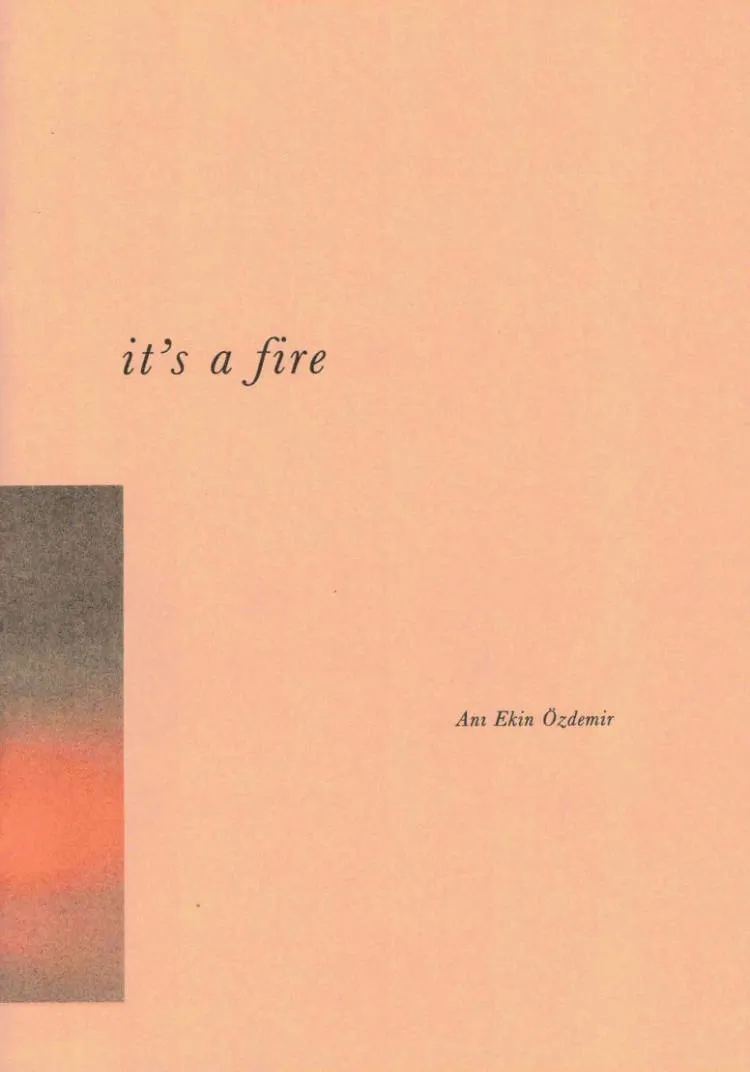
Cover of It's a Fire

Risiko Press

It's a Fire

Anı Ekin Özdemir

€10.00

It's a Fire is a collection of poems that weaves together dreamt and experienced situations, written in movement, with the intensity of senses, weather conditions, and the impossibility of fulfilment and ownership—which also makes it a reflection on desire as a force that disorganizes capitalist productivity, disciplined subjectivity, and neoliberal self-improvement. Along the way, it burns, contaminates, multiplies, and keeps on desiring.

Published in 2026Paperback ┊ Language: English

recommendations

Cover of Twenty Bookmarks

Risiko Press

Twenty Bookmarks

Zines €12.00

Twenty Bookmarks is a result of Production & Workflow class of Graphic Design Department at the Royal Academy of Fine Arts Antwerp, Ba1 Class of 2026.

Cover of Manifest ( ) gathered angry woman loving

Risiko Press

Manifest ( ) gathered angry woman loving

Chiara Di Luca, Emma Burel and 2 more

Zines €7.00

Words gathered from The Carrier Bag Theory of Fiction (Ursula K. Le Guin, 1986), Natural Enemies of Books (MMS, 2020), Non credere di avere dei diritti (Libreria delle donne di Milano, 1987), Dada Cannibalistic Manifesto (Francis Picabia, 1920) and WITCH (Rebecca Tamás, 2019). A first version of this poem/pamphlet was made in the context of See What I Mean, a workshop by Phil Baber at Antwerp’s Royal Academy of Fine Arts, october 2024.

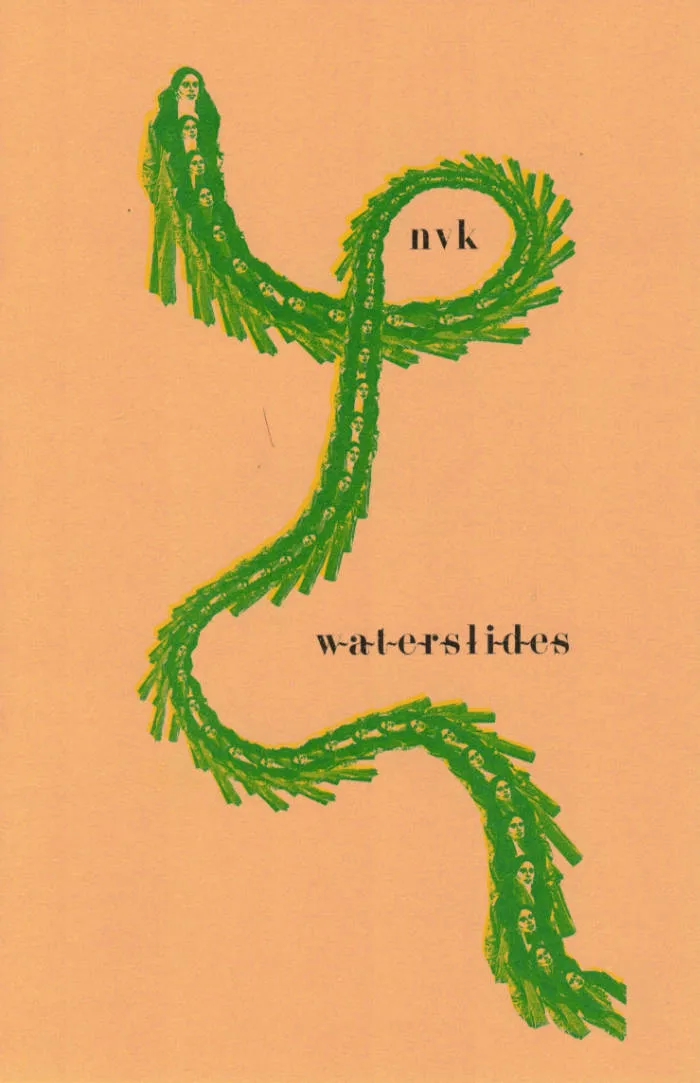
Cover of Waterslides

Risiko Press

Waterslides

nvk

Poetry €10.00

"Waterslides is a falling and plunging, short starts and stops aided by movement, until we splash, climb and plunge again. Each sliding is the same but different—with each descent new expectations and thoughts swirl, shifting focus and gaining new insights or blockages. Waterslides are brief moments of remembering, remembering as a present tense activity, one that happens as we think of it, projected on our now. The waterslide is the moment of past and present working in tandem, a movement of repeating, revisiting and remembering all at once.”

Written by nvk 2021-2023. Dedicated to Judi, MM & TNN.

A version of these poems was published as an audio work through Ignota Press’ The Mountain (2023) and included in a reading with James Loop on Montez Press Radio (2023). nvk would like to thank Jan Matthé, Stine Sampers and Michelangelo Miccolis for their patience & love.

This book was first presented at Kransen in Antwerp, May 6th 2023, with a performance by Sassy (costume by Rosa Schützendorf). Printed and bound at Risiko Press, Borgerhout. Cover image by nvk. Fonts: Adonis, Garamond Pro. Limited to 150 copies.

128x195mm, 16p., stapled, cover: green, yellow and black risoprint on 160gsm caramel paper, inside: black and blue riso on 120gsm Munken Pure paper.

Cover of Biarritz

Risiko Press

Biarritz

Jan Matthé

Poetry €10.00

Written and edited in Biarritz, Borgerhout and Midsommarkransen, 2016—2021. Dedicated to Räffi, with much love. Another version of this text was published in Pfeil Magazin 10 (Montez Press, 2018); editor: Anja Dietmann, copy-editor: Stacy Skulnik. Epigraph from Numéro Deux (1975) by Anne-Marie Miéville and Jean-Luc Godard. Presented on Saturday February 5th 2022 at Kransen, Borgerhout.

128x201mm, 40p, staple bound. Riso-printed on Arcoprint Edizioni Avorio 90g and Clairefontaine Blue 210g. Design by Kaye–Matthé, typefaces: Tribute, Gillies Gothic Light. Printed by Risiko Press at Kransen, covers silkscreened at Afreux, bound by Drukkerijcollectief De Wrikker. Edition of around 200.

Cover of Eselsohren Dog Ears

Risiko Press

Eselsohren Dog Ears

Pol Matthé

"The impossible takes a little longer. [pen scribbling]"

Presented at Kransen in Borgerhout, 1—3 March 2024, with an exhibition titled Dog Ears and a remote reading by fellow-Stockholmian artist Dave Allen.

Cover of Eecchhooeess

DABA

Eecchhooeess

N.H. Pritchard

Poetry €24.00

American poet Norman H. Pritchard's second and final book, EECCHHOOEESS was originally published in 1971 by New York University Press. Pritchard's writing is visually and typographically unconventional. His methodical arrangements of letters and words disrupt optical flows and lexical cohesion, modulating the speeds of reading and looking by splitting, spacing and splicing linguistic objects. His manipulation of text and codex resembles that of concrete poetry and conceptual writing, traditions from which literary history has mostly excluded him. Pritchard also worked with sound, and his dynamic readings—documented, among few other places, on the album New Jazz Poets (Folkways Records, 1967)—make themselves heard on the page.

EECCHHOOEESS exemplifies Pritchard's formal and conceptual sensibilities, and provides an entryway into the work of a poet whose scant writings have only recently achieved wider recognition. DABA's publication of EECCHHOOEESS is unabridged and closely reproduces the design of the original 1971 volume.  

Norman H. Pritchard (1939-96) was affiliated with the Umbra group, a predecessor to the Black Arts Movement. He taught writing at the New School for Social Research and published two books: The Matrix: Poems 1960-1970 (Doubleday, 1970) and EECCHHOOEESS (New York University Press, 1971). His work was anthologized in publications including The New Black Poetry (1969), In a Time of Revolution: Poems from Our Third World (1969), Dices or Black Bones: Black Voices of the Seventies (1970), Ishmael Reed's 19 Necromancers from Now (1970), Text-Sound Texts (1980) and others.

Cover of Moon Mirrored Indivisible

University of Chicago Press

Moon Mirrored Indivisible

Farid Matuk

Poetry €18.00

Multilayered lyric poems that resist systems of power and foster intimacy. 

An inheritor of lineages marked by colonial and gendered violence, Farid Matuk approaches the musical capacities of verse not as mere excitation or decoration, but as forms that reclaim pleasure and presence. Entering the sonic constellations of Moon Mirrored Indivisible, the reader finds relief from nesting layers of containment that systems of power impose on our bodies and imaginations. In this hall of historical mirrors, fictions of identity are refracted, reflected, and multiplied into a vast field of possibilities. Matuk’s meditations on place and power offer experiments in self-understanding, moving through expansive conversations between a lyric “I” and others, including poets, the speaker’s partner, ancestors, and the reader, and creating spaces for strange intimacy. Each of the book’s four sections of poems builds on the other to ask how we might form a collective—a people—not founded in orthodoxies of originality but in the mutual work of mirroring one another.

Cover of Sudden Wealth with Roy Claire Potter

Slimvolume Synthesis

Sudden Wealth with Roy Claire Potter

Chris Evans, Roy Claire Potter

Proposed by Chris Evans, Sudden Wealth is a collaboration with Morten Norbye Halvorsen, Graham Kelly and invited poets and artists who use spoken word as their medium. 

Sudden Wealth looks to how the flux of subjectivity in language can be shaped, agitated and re-imagined through a triangulation between written composition, intonation, and extrinsic sound composition. The latter spans analogue and digital instrumentation, foley recordings and algorithmically derived musical patterns. Divergent methods of composition work on and into a voice, modelling intonation, and affecting its sense and intent. 

This first iteration has been made with Roy Claire Potter, an artist who tells stories from fragmented, intense images that depict moving bodies or domestic scenes and architectural settings. A rapid vocal delivery, a sense of restricted or partial views of space, complex social and group dynamics and the aftermath of violent events are recurrent strands of Potter’s writing, which are often delivered with a dark and sometimes wilful humour. 

Chris Evans was the bassist with the now defunct Life Without Buildings and has previously produced musical compositions with Morten Norbye Halvorsen together with farmers and accountants for his ongoing series ‘Jingle’. Graham Kelly joins Evans and Halvorsen for this present series, Sudden Wealth.

Vocals: Roy Claire Potter.
Electronics: Morten Norbye Halvorsen.
Bass: Chris Evans.
Guitar: Graham Kelly.
Arranged and mixed by Morten Norbye Halvorsen.

Cover of Harmless Medicine

Manic D Press

Harmless Medicine

Justin Chin

Poetry €16.00

Fiercely devoted to the margins of life in the generation after the devastating first wave of the AIDS epidemic, this cathartic collection of poems explores illness, travel, contagion, the meaning of home, identity, tainted purity, and the bits of life that contain them and hold them together in spite of the harsh exigency of daily life. In more than 40 pieces, Chin fearlessly delivers everything from his first exposure to science (Magnified) to a mail order fantasy experience (I Buy Sea Monkeys); from backroads travel in Asia (Little Everest in Your Palm) to the plight of immigrants in America (The Men's Restroom at the INS Building). Chin's brutal honesty and sharp humor frame a profound and original collection.

Justin Chin is the author of two collections of poetry, Harmless Medicine and Bite Hard (Manic D Press), and two collections of essays, Burden of Ashes (Alyson Press) and Mongrel: Essays, Diatribes and Pranks (St. Martin's Press). In the 1990's, as a performance artist, he created several performance works that were presented nationally and abroad.

Cover of A Psalm for the Third Wind

Self-Published

A Psalm for the Third Wind

Damien Troadec

Book: 11.7 × 18 cm
Book and Glove: 13.5 × 31.5 cm

Presented in a monster glove

Three broken halves of one god walk a city that wants them dead
Their bodies speak in static hunger and rust
Something follows breathing through their mouths
Read it Bleed from it


In A Psalm for the Third Wind, a film script written from 3 perspectives, Damien Troadec is aiming to address in parallel narrative the struggle of having multiples inner voices and the danger of following their distinct desires. One question is raised without any light at the end of the tunnel, confronting the reader to a conflict : THE COMFORT OF MISERY OR THE PAIN OF CHANGE ?