rile*books

Search books

Search books by title, author, publisher, keywords...

Cover of PARANOID CITI

Tabloid Publications

PARANOID CITI

Shannon Hearn

€12.00

"Desperate and playful. This iterative poetic series cries through the panic of now to bestill an ecstatic people. Paranoid Citi finds no doubt that if understanding is a matter of form, survival necessitates transformation." - Crystal Odelle, author of Trans Studies

"Who doesn't like to post ethereal lightly? Who isn't a citizenry draped in lilac ethics? Are you a froth? In Shannon Hearn's PARANOID CITI, an interrogative story is shaping up. She's uploading music for grace in crisis. She's writing poems for you, citizen, and kindly so." - Nick Sturm

Includes a bag tag and drawing by Elise Houcek.
Published as part of Paraphernalia and Addenda 2.2 of Tabloid Publications.

Published in 2026 ┊ 32 pages ┊ Language: English

recommendations

Cover of GOAT FOIL

Tabloid Publications

GOAT FOIL

Maxwell Gontarek

Poetry €14.00

"Marie’s fragrance, smashed out of the bottle for another breath. We should always doubt that the air is pure. We should always doubt that the air is not." 
–Alexandre Curlet

Includes an excerpt from Josh Barber's "Omnipotence".
Published as part of Paraphernalia and Addenda 2.2 of Tabloid Publications.

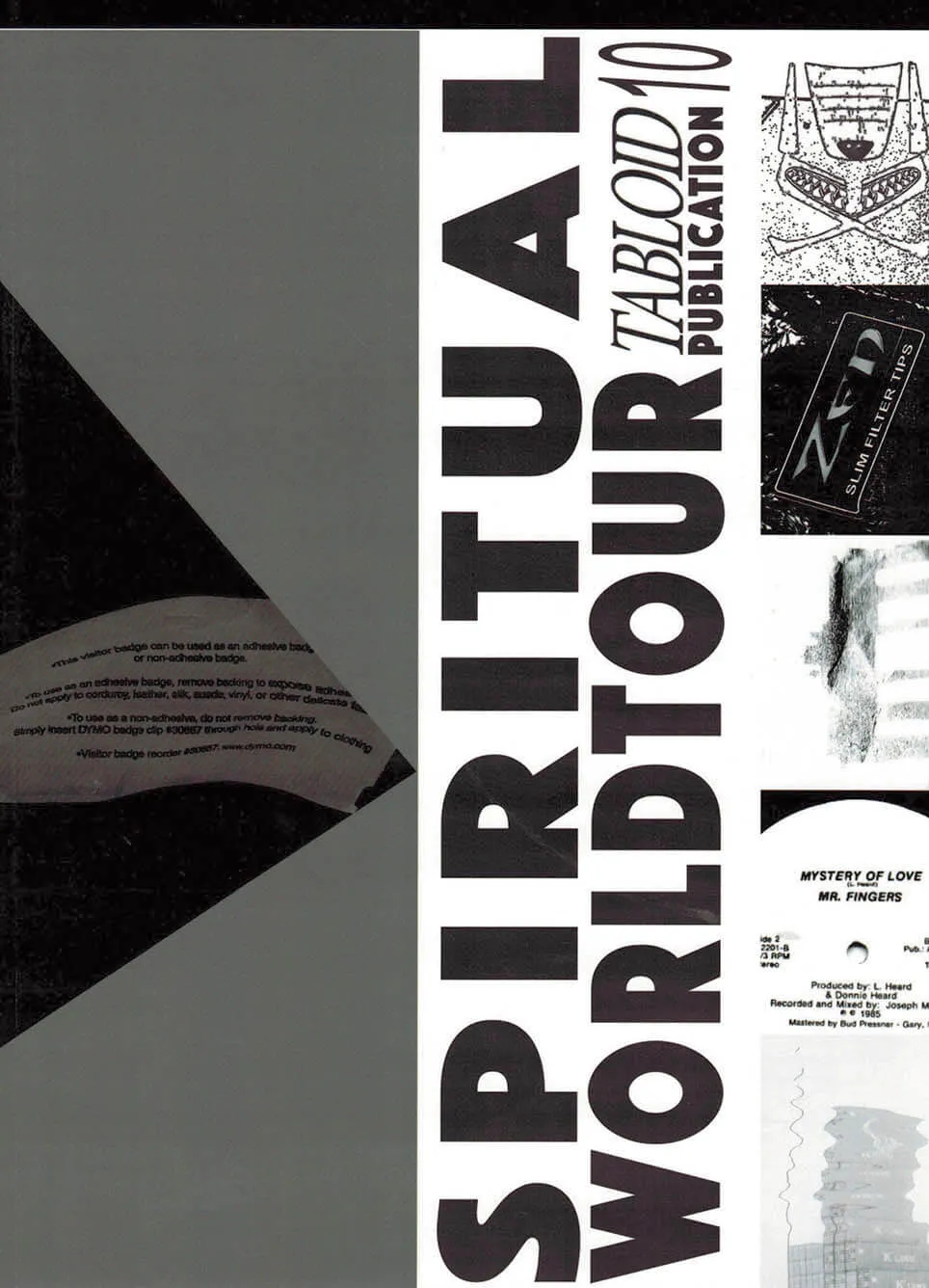
Cover of Spiritual World Tour

Tabloid Publications

Spiritual World Tour

Nat Marcus

Spiritual World Tour by Nat Marcus.
Cover of UNIVERSAL PRODUCT CODE

Tabloid Publications

UNIVERSAL PRODUCT CODE

Kelly Clare

Poetry €12.00

"Like the Elizabeth Bishop painting “Interior with Extension Cord,” Kelly Clare’s helical, light-filled Universal Product Code delicately traces a bewildering infrastructure. This incantatory song, “busy in green,” points its reader to the disturbing beauty in stripey checksum barcodes, to arrays of imported figs at the grocer, to words like cloud or lime that now mean too much. Humorous, musical, perspicacious, this chapbook rocks."

- Katherine Gibbel, April 2026

Includes 3 poems by Dre Roelandt.
Published as part of Paraphernalia and Addenda 2.2 of Tabloid Publications.

Cover of Juvenilia #2

Tabloid Publications

Juvenilia #2

Willa Smart

Poetry €12.00

Ludi Juvenales (Latin for "juvenile games') is a poetry, art and games series interested in youth, childhood, play, and immaturity. 

Ludi Juvenales is edited by Elise Houcek & Zoe Darsee

www.ludijuvenales.com

Juvenilia #2 by Willa Smart.
Copyright C Willa Smart 2024. All rights reserved.
Cover art by K. Fabricant.
Design by Elise Houcek & Zoe Darsee.
Risograph printed with BearBear in Milwaukee, Wisconsin.
Edition of 50.

Cover of The Flesh

Tabloid Publications

The Flesh

Yves B. Golden

Essays €18.00

The Flesh is a collection of Yves B. Golden's poems, lyric essays and social criticism – and often these generic distinctions become blurred. Published by Ediciones La Escocesa (Barcelona, ES), TABLOID facilitated this book's production as editors and book designers. A selection of Golden's texts are also translated by Leto Ybarra, rendering the author's work into Spanish for the first time.

“Respectfully! The Flesh feels like a conjuring and a force of nature—unyieldingly raw, full of delectable sensitivity that shapes a world Yves B. Golden deliveries with formidable honesty—where her word is the journey, the body and the bond. Yves writes: ‘not one bird is declined entry into heaven’. The Flesh is succulent in the mouth of the mother— Yves is a steward of time machines, celestial bliss and untethered healing. The Flesh unties the tongue, waters the mouth and the garden. Within Yves’ 5th book she offers us a timeline in recognizing that all birds and angels alike can touch the sky. We are always, already, held and drenched in glory and deserving of love and safety. The Flesh is Black like obsidian. May our love bloom like the flesh in every lifetime.”
- keioui keijaun thomas

“Yves B Golden has given us a protection spell against tyranny; a Blue Guide for the conscious and the daydream; raw free jazz that knows the standards as well. Golden’s linguistically liberated fantasies can transmute into a body of politically imperturbable ethoses in the same sentence. This book offers information for an evolutionary sensitivity, for the next level of sense-making and particularity of the human being. Though the poet urges us to de-realize the flesh, to split our own heads open, we must also accommodate the flesh’s intangibles that interlock, conjoin, negate, and negotiate: such ‘outward and inward facing conundrums’ go on and on. Welcome this ‘bearer of turbulent news.’”
- Losarc Raal

Cover of Malibongwe: Poems from the Struggle by ANC Women

Uhlanga

Malibongwe: Poems from the Struggle by ANC Women

Sono Molefe

Poetry €16.00

In the late 1970s, Lindiwe Mabuza, a.k.a. Sono Molefe, sent out a call for poems written by women in anc camps and offices throughout Africa and the world. The book that resulted, published and distributed in Europe in the early 1980s, was banned by the apartheid regime.

Authorised by the editor, this re-issue of Malibongwe re-establishes a place for women artists in the history of South Africa's liberation. These are the struggles within the Struggle: a book that records the hopes and fears, the drives and disappointments, and the motivation and resilience of women at the front lines of the battle against apartheid. Here we see the evidence, too often airbrushed out of the narratives of national liberation, of a deep and unrelenting radicalism within women; of a dream of a South Africa in which not only freedom reigned, but justice too.

Cover of Cadavres

cry mimi cry

Cadavres

Phœbe Hadjimarkos-Clarke, Rozenn Voyer

Poetry €17.00

Cadavres rassemble 13 poèmes écrits par Phœbe Hadjimarkos - Clarke sur les errances dans les villes âpres, les campagnes humides et les maisons branlantes. Les poèmes sont accompagnés de 15 dessins de Rozenn Voyer.

Cover of Seeing for Ourselves

Hajar Press

Seeing for Ourselves

Suhaiymah Manzoor-Khan

Poetry €18.00

Why do we yearn to be seen when we are already far too visible? How do we want to be perceived, and how are we exposed? Could we ever really see for ourselves?

In memoir, vignettes, poetry and essays, Suhaiymah Manzoor-Khan records her observations from the stands at the dizzying circus of being seen and unseen. She surveys the criminalising stadium of civic life, the open-air arenas of family, friendship and grief, the performative pageantry of the public eye and the unclad secrets of the self in solitude, paying attention to what’s on show and what goes undetected.

Perhaps the strangest, most exciting possibilities are opened when we surrender to another kind of sight. Submitting to the gaze of the Unseen and the All-Seeing, Manzoor-Khan invites us to close our eyes and discover what it would mean to look with our souls instead.

Suhaiymah Manzoor-Khan is a poet and writer whose work disrupts assumptions about history, race, violence and knowledge. She is the author of Tangled in Terror and the poetry collection Postcolonial Banter; a co-author of A FLY Girl’s Guide to University; and a contributor to the anthologies Cut from the Same Cloth? and I Refuse to Condemn. She is based in Leeds and is currently writing for theatre.

Cover of Women in Concrete Poetry: 1959-1979

Primary Information

Women in Concrete Poetry: 1959-1979

Mónica de la Torre, Alex Balgiu

Anthology €30.00

An expansive anthology focused on concrete poetry written by women in the groundbreaking movement’s early history. It features 50 writers and artists from Europe, Japan, Latin America, and the United States selected by editors Alex Balgiu and Mónica de la Torre.

Women in Concrete Poetry: 1959-1979 takes as its point of departure Materializzazione del linguaggio—the groundbreaking exhibition of visual and concrete poetry by women curated by Italian feminist artist Mirella Bentivoglio for the Venice Biennale in 1978. Through this exhibition and others she curated, Bentivoglio traced constellations of women artists working at the intersection of the verbal and visual who sought to “reactivate the atrophied tools of communication” and liberate words from the conventions of genre, gender, and the strictures of the patriarchy and normative syntax.

The works in this volume evolved from previous manifestations of concrete poetry as defined in foundational manifestos by Öyvind Fahlström, Eugen Gomringer, and the Brazilian Noigandres Group. While some works are easily recognized as concrete poetry, as documented in canonical anthologies edited by Mary Ellen Solt and Emmett Williams in the late ’60s, it also features expansive, serial works that are overtly feminist and often trouble legibility. Women in Concrete Poetry: 1959-1979 revisits the figures in Bentivoglio’s orbit and includes works by women practicing in other milieus in the United States, Eastern Europe, and South America who were similarly concerned with activating the visual and sonic properties of language and experimenting with poetry’s spatial syntax.

Artists and writers include Lenora de Barros, Ana Bella Geiger, and Mira Schendel from Brazil; Mirella Bentivoglio, Tomaso Binga, Liliana Landi, Anna Oberto, and Giovanna Sandri from Italy; Amanda Berenguer from Uruguay; Suzanne Bernard and Ilse Garnier from France; Blanca Calparsoro from Spain; Paula Claire and Jennifer Pike from the UK; Betty Danon from Turkey; Mirtha Dermisache from Argentina; Bohumila Grögerová from the Czech Republic; Ana Hatherly and Salette Tavares from Portugal; Madeline Gins, Mary Ellen Solt, Susan Howe, Liliane Lijn, and Rosmarie Waldrop from the US; Irma Blank and Ruth Wolf-Rehfeldt from Germany; Chima Sunada from Japan; and Katalin Ladik and Bogdanka Poznanović from the former Yugoslavia.

Cover of Permanent Volta

Nightboat Books

Permanent Volta

Rosie Stockton

Poetry €17.00

Permanent Volta is a book of poems about constraint and debt, as much as it is about excess, credit, loving luxury, and hating work. These are love poems about how queer intimacies invent political and poetic forms, how gender deviance imagines post-sovereign presents and futures.

Taking cues from Rosa Luxemburg's birdsongs and the syntax of invasive flowers, these poems strive to love lack. If history sees writers as tops and muses as bottoms, these poems are motivated by refusal, inversion, and evading representation. In Permanent Volta, the muses demand wages, and then they demand the world. Full of bad grammar, strange sonnets, and truncated sestinas, these poems are melancholy and militant, lazy and anti-state, greedy and collective.

Permanent Volta is for anyone motivated by the homoerotic and intimate etymology of comrade: one who shares the same room.