rile*books

Search books

Search books by title, author, publisher, keywords...

Cover of The Flesh

Tabloid Publications

The Flesh

Yves B. Golden

€18.00

The Flesh is a collection of Yves B. Golden's poems, lyric essays and social criticism – and often these generic distinctions become blurred. Published by Ediciones La Escocesa (Barcelona, ES), TABLOID facilitated this book's production as editors and book designers. A selection of Golden's texts are also translated by Leto Ybarra, rendering the author's work into Spanish for the first time.

“Respectfully! The Flesh feels like a conjuring and a force of nature—unyieldingly raw, full of delectable sensitivity that shapes a world Yves B. Golden deliveries with formidable honesty—where her word is the journey, the body and the bond. Yves writes: ‘not one bird is declined entry into heaven’. The Flesh is succulent in the mouth of the mother— Yves is a steward of time machines, celestial bliss and untethered healing. The Flesh unties the tongue, waters the mouth and the garden. Within Yves’ 5th book she offers us a timeline in recognizing that all birds and angels alike can touch the sky. We are always, already, held and drenched in glory and deserving of love and safety. The Flesh is Black like obsidian. May our love bloom like the flesh in every lifetime.”
- keioui keijaun thomas

“Yves B Golden has given us a protection spell against tyranny; a Blue Guide for the conscious and the daydream; raw free jazz that knows the standards as well. Golden’s linguistically liberated fantasies can transmute into a body of politically imperturbable ethoses in the same sentence. This book offers information for an evolutionary sensitivity, for the next level of sense-making and particularity of the human being. Though the poet urges us to de-realize the flesh, to split our own heads open, we must also accommodate the flesh’s intangibles that interlock, conjoin, negate, and negotiate: such ‘outward and inward facing conundrums’ go on and on. Welcome this ‘bearer of turbulent news.’”
- Losarc Raal

Language: English

recommendations

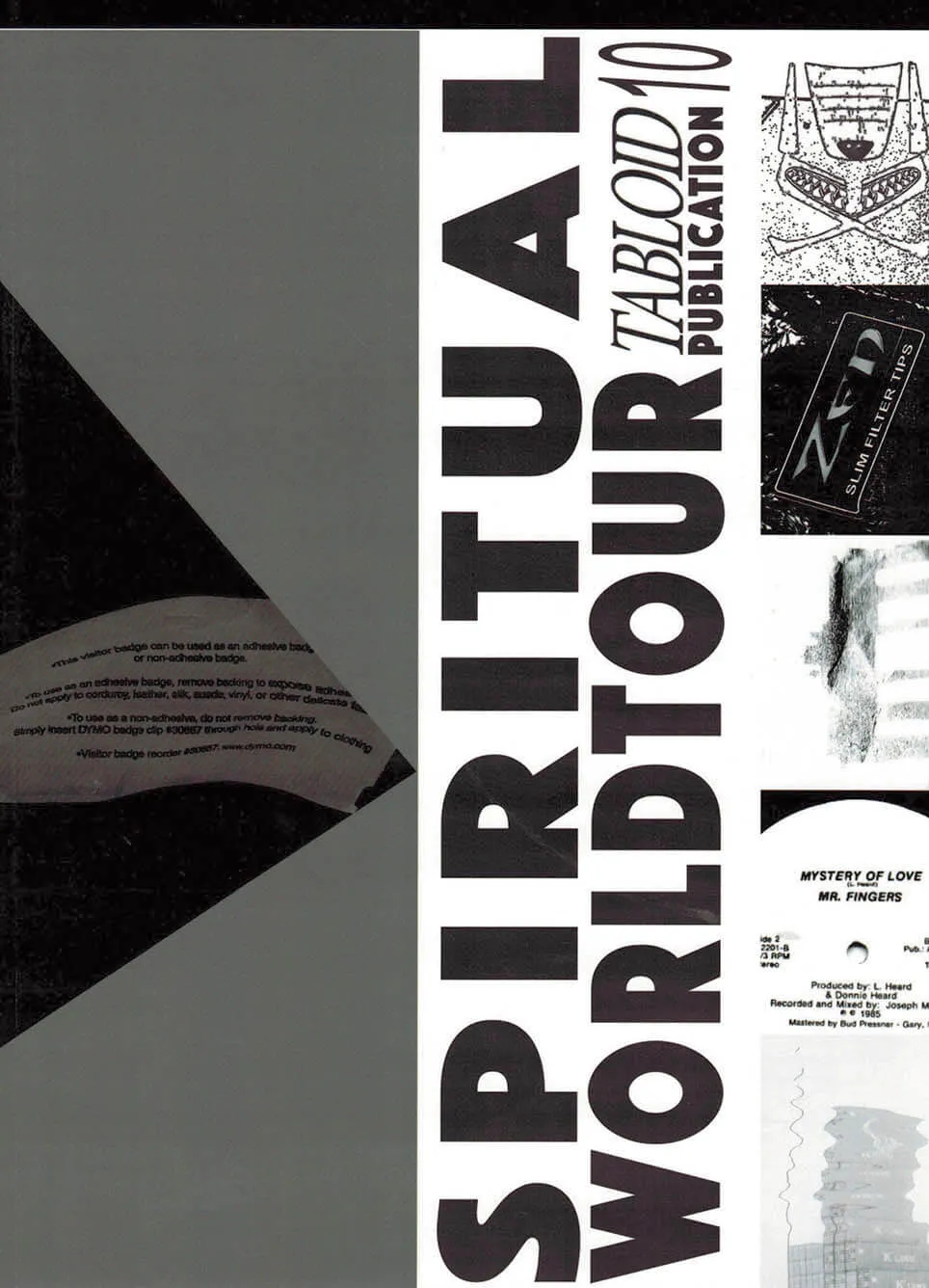
Cover of Spiritual World Tour

Tabloid Publications

Spiritual World Tour

Nat Marcus

Spiritual World Tour by Nat Marcus.
Cover of [45-120]

Caniche Editorial

[45-120]

Bea Ortega Botas, Leto Ybarra

Poetry €20.00

Personal space is understood as the distance between 45 and 120 cm that surrounds a person. This bilingual anthology brings together the work of eighteen contemporary poets who take this intimate measurement as a starting point to challenge its apparent rigidity and explore how political, social, sexual, racial, class, and accessibility factors shape it. Beyond a simple physical distance, personal space also becomes a stage where desire draws and negotiates the boundaries between the inside and the outside.

The publication contains contributions by Samuel Ace, Justin Chin, Kyle Dacuyan, Rhea Dillon, Tracy Faud, Elijah Jackson, Taylor Johnson, Nadia Marcus, Park McArthur, Nat Raha, Joan Retallack, Trish Salah, Juan de Salas, María Salgado, Assotto Saint, Cedar Sigo, S*an D.Henry-Smith, Nayare Soledad, Perla Zúñiga.

Bilingual edition, edited by Juf.

JUF (Bea Ortega Botas and Leto Ybarra) explores the relationship between poetry, contemporary art, and theatricality through the organization of performances, readings, and exhibitions. They also publish online texts and a PDF series as an extension of their curatorial and research practice. Currently based between Madrid and New York.

Cover of đừng giấu cơn điên / don’t hide the madness

Materials

đừng giấu cơn điên / don’t hide the madness

Nhã Thuyên, Kaitlin Rees

Poetry €13.00

Nhã Thuyên’s đừng giấu cơn điên / don’t hide the madness contains eight poems excerpted from the forthcoming book vị nước (taste of water). To read this work is to be wrenched out of oneself and into the opening and closing world of language: a world in equal parts vegetal, liquid, human, stone, at once bordered river and open sea, enclosed maze and open field; a labyrinth, but a labyrinth of the utmost clarity; a rising or collapsing building made of words that’s not a ‘dwelling’ so much as a refusal to dwell, which is its loneliness and bereftness and consolation and strength, all at once. “Steps here pulled forth by some line of poetry out of time”, such work “fabricate[s] a bed out of sea, build[s] a house out of tremendous immensity”. It’s the result of a lifelong investigation of the Vietnamese language, deep, joyous, scrupulous and sometimes painful; of a lifelong investigation of the whole deep field of history and time as it’s lived deep within the person and in the field beyond the personal that poetic language affords us. This is a realm, not of simple freedom, but of the struggle for the fullest record and the fullest measure towards which a poet can strive. Don’t hide the madness. Don’t be at peace. [D.G.]

NHÃ THUYÊN secludedly anchors herself to Hà Nội, Việt Nam and totters between languages. She has authored several books in Vietnamese and/or in English translations, including viết (writing) (2008), rìa vực (edge of the abyss) (2011), từ thở, những người lạ (words breathe, creatures of elsewhere) (2015), and bất\ \tuẫn: những hiện diện [tự-] vắng trong thơ Việt (un\ \martyred: [self-] vanishing presences in Vietnamese poetry) (2019). Her next book of poetry vị nước (taste of water) is waiting to see the moon. She has been unearthing her notebooks and rubbing her words in Berlin as a 2023 DAAD Artists-in-Berlin fellow, and learning to quietly speak up with care.

KAITLIN REES is a translator, editor, and public school teacher based in New York City. She translates from the Vietnamese of Nhã Thuyên, with whom she co-founded AJAR, the small bilingual journal-press that organizes an occasional poetry festival. Her translations include moon fevers (Tilted Axis, 2019), words breathe, creatures of elsewhere (Vagabond Press, 2016), and the forthcoming book of poetry taste of water.

Cover of Eros the Bittersweet: An Essay

Princeton University Press

Eros the Bittersweet: An Essay

Anne Carson

Essays €17.00

Anne Carson's remarkable first book about the paradoxical nature of romantic love. Since it was first published, Eros the Bittersweet, Anne Carson's lyrical meditation on love in ancient Greek literature and philosophy, has established itself as a favorite among an unusually broad audience, including classicists, essayists, poets, and general readers.

Beginning with the poet Sappho's invention of the word "bittersweet" to describe Eros, Carson's original and beautifully written book is a wide-ranging reflection on the conflicted nature of romantic love, which is both "miserable" and "one of the greatest pleasures we have."

Cover of Feminist Fatwas

Everyday Analysis

Feminist Fatwas

Rafia Zakaria

Essays €10.00

Feminist Fatwas traces how Muslim feminists are resisting misogynistic interpretations of the Quran (like the verse male clerics have used to condone wife-beating). 

For centuries, the translators and interpreters of the Holy Quran have been men. This is changing now as more and more Muslim feminists cast their eye on the patriarchal contexts of these interpretations. Feminist Fatwas tells the story of  Verse 34 in Chapter 4 which has been interpreted by male clerics as condoning a husband beating his wife. This essay traces the groundbreaking work of knocking down this misogynist Quranic interpretations. The story of how Muslim feminists are doing this work is a chronicle of the slow and quiet feminist revolution taking place within Islam as women take on significant and powerful roles. 

Rafia Zakaria is a Pakistani-American attorney, feminist, journalist, and author. She has written for The Nation, Guardian Books, The New Republic, The Baffler, Boston Review, and Al Jazeera. In 2021, she published Against White Feminism, in which she critiques the emphasis that conventional feminist thought places on the experiences of white women while excluding women of color

Cover of Heights of Macchu Picchu

The Economy Press

Heights of Macchu Picchu

Pablo Neruda

Poetry €18.00

Pablo Neruda’s Alturas de Macchu Picchu is a poem that distrusts solitary authority even as it passes through a single voice, moving from the lyric “I” toward a collective utterance grounded in labor, history, and shared breath. 

Producing the first collaborative translation of Alturas de Macchu Picchu is not incidental but consonant with its deepest claims. Attentive to Neruda’s unique lyric pressure, this new English version resists the tradition of singular, authoritative renderings by allowing meaning, rhythm, and decision to emerge through dialogue and negotiation. 

In this way, the translation does not merely transmit Neruda’s poem but enacts its insistence that voice is a collective achievement, not a solitary possession.

Cover of An Anarchist Playbook. Radical Translation Workshop

Tenement Press

An Anarchist Playbook. Radical Translation Workshop

Cristina Viti, Jacob McGuinn and 2 more

Essays €25.00

The Conspiracy of Equals (1796) is often hailed as the first revolution against a revolutionary state. Even if the conspirators were soon found out and put on trial, their ideas of radical equality and liberty shaped future generations of revolutionaries worldwide. An Anarchist Playbook—the first publication in Tenement’s new imprint, No University Press—gathers together many of the key documents from their trial across a myriad forms, with a number of these texts appearing herein in their first English-language translation.

Assembled in the Playbook are the last words of Gracchus Babeuf, the leader of the conspiracy and a radical proponent of the abolition of private property, and of his fellow conspirator Augustin Darthé, as they faced the guillotine. We’ve a letter, written in the popular idiom of the sans-culottes, that urges the common soldier to rebel; the score and lyrics of a street song that names the new class enemy: the wealthy bourgeoisie who have profited from the revolution; a first-time English translation of ‘The Last Judgement of All Kings’—an extraordinary one-act play by Sylvain Maréchal, the unofficial poet of the Conspiracy, that was performed to considerable acclaim in Year II of the Revolution (and that the Workshop is in the process of adapting for contemporary audiences). 

Many of these texts were never published in their own time, and form a part of the testament left behind by Philippe Buonarroti, a leading conspirator who inspired new generations of revolutionaries across Europe over the course of the nineteenth and early twentieth centuries. Among the best known works included is the Manifesto of Equals, long considered a founding text of social, communist and anarchist revolutions. The Playbook presents a translation of the Manifesto alongside other key texts by the conspirators, reconstructing the richness and variety of revolutionary communication that informs the editorship, shape, and scope of this volume.