Books
Books
in random order

The Carrier Bag Theory of Fiction
In The Carrier Bag Theory of Fiction, visionary author Ursula K. Le Guin tells the story of human origin by redefining technology as a cultural carrier bag rather than a weapon of domination.
Hacking the linear, progressive mode of the Techno-Heroic, the Carrier Bag Theory of human evolution proposes: ‘before the tool that forces energy outward, we made the tool that brings energy home.’ Prior to the preeminence of sticks, swords and the Hero’s killing tools, our ancestors’ greatest invention was the container: the basket of wild oats, the medicine bundle, the net made of your own hair, the home, the shrine, the place that contains whatever is sacred. The recipient, the holder, the story. The bag of stars.
This influential essay opens a portal to terra ignota, where the possibilities of human experience and knowledge can be discovered anew.

The Literary Workshop
A bold, revelatory argument for the power of language by leading radical lesbian feminist and author of The Straight Mind.
The Literary Workshop takes readers inside Monique Wittig’s creative process, unlocking the practice of writing both in material and political terms. Wittig provides her most complete account of how literature and politics work together. Part of the generation that revolutionized French literature, Wittig reveals the secret of her craft: that the work a writer does with language is itself a form of resistance.
Born and raised in France, Monique Wittig (1935–2003) was a driving force in second-wave feminism and one of the most brilliant authors of her generation. A provocative thinker, she famously declared that lesbians are not women and introduced women into a materialist framework by treating them as a class. Wittig is the author of, among other titles, The Straight Mind, Les Guérillères, and The Lesbian Body. Her debut novel, The Opoponax, won Le Prix Medicis.

Birthday
Bridget Mullen is the ruler of an unruly roost. Between 2021 and 2023, she gave birth to forty-seven paintings, each twelve-by-nine inches: kin ugly and cute, monstrous, fleshy, repulsive, droopy-eyed, and sneering as they cross the universal threshold into the no less frightening world that awaits. Birthday reunites Mullen's uncanny litter alongside a conversation between the artist and Lucas Blalock.
The paintings in New York-based artist Bridget Mullen's Birthday series utilize two distinct parameters to guide the creation of the iterative works: a vertical orientation at an intimate scale of 12 x 9 inches and a visualization of perhaps the ultimate creative act—the moment of birth. Through this consistent scale and thematic hyper focus, the artist employs endless formal variations in composition, color, and paint application. The result is a series of paintings that share a common structure yet champion individuality.
Contrasting colors provoke a visible tension, one that is at times compressed and, in other moments, elastic. Suddenly, abstract shapes come into focus as human anatomies, capable of expressing emotion. Undulating lines of various thicknesses and layered colors squeeze together, revealing peculiar faces and gestures that emerge from a central point. The repetition of thin lines creates a visual stutter of pigment, alluding to the passage of time or rapid movement.
The works in Birthday build on Mullen's practice, combining color, decisive mark-making, intuition, and experimentation to conjure psychedelic configurations. Sculptural dimensionality and flatness, representation and abstraction, and solidity and fluidity, serve not as dichotomies within these works, but as two complementary halves of a whole. Together, the forms and figures of the Birthday series are imbued with a sense of life, pregnant with agency and potential.

Stars at Midday –نجوم الضُهر
Stars at Midday –نجوم الضُهر is a personal diary in which the artist and filmmaker Noor Abed compiles visual and poetic notes from the production phase of her film A Night We Held Between, filmed in Palestine in 2023 with family and friends.
Like the film, the book interweaves narrative fragments, song and diaristic observations, creating a fusion of natural and composed sequences of movement, of documentary and fictional elements.
Through a choreography of bodies, sites, stories, and temporalities, Abed’s work prompts contemplation on the manifestations of social action and resistance in everyday life.

In the forest of grief I grew into a shrub of gold
For British artist Delaine Le Bas, dress is divine. Clothes appear as both mask a nd memorial within an expansive body of work exploring mythologies of Le Bas’s Romani ancestry. Embroidered and hand-painted textile is central to the artist’s lyrically activist practice, alongside costume, writing and performance. In a new series of portraits by the British photographer Tara Darby, directed by Jane Howard, gold leaf dances across the planes of Le Bas’s face in repose, it wraps and jangles around her wrists, glimmers across her clothes. In a notebook she has inscribed: “In the forest of grief I grew into a shrub of gold.” The grief is alchemical.
As Stephen Ellcock writes:
‘The maxim ‘Know Thyself’ was inscribed in gold on a column on the threshold of Pythia’s temple, serving as a warning that wisdom, understanding, empathy and anything remotely resembling peace of mind are unachievable without selfawareness, reflection and ruthless self-criticism.’
The fragments of hope, anger, magic and curiosity redolent in Le Bas’s work form a call to action. A reminder of the racism, exclusion and subjugation that abound. Photographs of Le Bas, which Darby has been making for more than a decade, present the artist as truth sayer, inquisitive goddess and modern-day Sibyl.
Through the incorporation of texts—a conversation between gallerists John Marchant and Keiko Yamamoto with curator Claire Jackson—drawings from Le Bas’s journals, archival images taken at her home and the restyling—and reflection—of her own personal wardrobe, In the forest of grief I grew into a shrub of gold radiates psychological, social and political wisdom. Fashion is revealed as both tyrannical disguise and liberating regalia.

In Pursuit of Revolutionary Love: Precarity, Power, Communities
Violence is arrayed against us because we’re Black, or female, or queer, or undocumented. There is no rescue team coming for us. With that knowledge, we need a different operational base to recreate the world. It is not going to be a celebrity savior. Never was, never will be. If you’re in a religious tradition that is millennia-old, consider how the last savior went out. It was always going to be bloody. It was always going to be traumatic. But there’s a beauty to facing the reality of our lives. Not our lives as they’re broken apart, written about, and then sold back to us in academic or celebrity discourse. But our lives as we understand them. The most important thing is showing up. Showing up and learning how to live by and with others, learning how to reinvent ourselves in this increasing wasteland. That’s the good life.
Foreword by Da’Shaun L. Harrison.
Afterword by Mumia Abu-Jamal.
"Joy James’s Revolutionary Love is umph-degree love; or love beyond measure. It is anything love. It is love without reckoning. It is love that dares all things, beyond which others may find the spirit-force to survive; to live to fight another day. Such love is also fighting itself, for the sake of ensuring that others may live." — Mumia Abu-Jamal

Marlie Mul
Marlie Mul (b. 1980 in Utrecht, the Netherlands; lives and works in Brussels) is characterized by a strong material awareness, spatial thinking, and an ongoing engagement with conditions of labor, systems of value, and forms of collectivity. Her practice foregrounds a sustained interest in sculptural concerns, direct engagement with materials, and processes of layering, transformation, meaning and re-meaning across multiple levels of articulation. Central to this is a continuous process of familiarizing herself and working with new materials and practices, which are repeatedly extracted from their conventional contexts and expanded into new bodies of work. These are, in turn, accompanied and reframed by other materials as well as by more social formats of production and presentation.
The first comprehensive monograph on Marlie Mul’s work is published on the occasion of her solo exhibition Das Budget (2025) at Kunsthaus Glarus. It offers a comprehensive chronological overview of key bodies of work from the early 2000s to the present and, through a richly illustrated index, unfolds a complex structure of contexts, collaborations, and modes of production. The publication includes new contributions by Annie Goodner, Lili Reynaud-Dewar and Frank Wasser, a dialogue between the artist and the editor, as well as numerous reprints of texts that have accompanied Mul’s work over the years, including writings by the artist herself.

I Speak Radio
Anna Bromley, Achim Lengerer and 1 more
Publishing a selection of her radiophonic essays here for the first time, I Speak Radio reflects Anne Bromley's collaborative radio practice.
Since 2010, Anna Bromley has been inviting artists, activists and cultural researchers into the radio studio to explore language and voice together, in the context of sound, politics and everyday life. What began as an artists' radio research format has developed over the years into a series of exhibition pieces focusing on radio and its visible and invisible transmission bodies.
Publishing a selection of her radiophonic essays here for the first time, I Speak Radio reflects Bromley's collaborative radio practice. The publication also provides insight into the corresponding exhibition formats of these projects, including cooperations with a large number of artists, activists, radio makers and theorists. An index of images and texts on Bromley's other artistic works is inserted into the book.
I Speak Radio opens with Bromley's eponymous multimedia essay on the feminist appropriation of early radio technology in the 1920s. A Voice Exists in Voicing, the series of radio essays and sonic portraits with which Bromley opened the Manifesta Radio in Prishtina in the summer of 2022, comprises the core of the book. The accompanying visual element to this section is a series of drawings by Michael Fesca. Contextualizing texts by Catherine Nichols and Hedwig Fijen provide an introduction to A Voice Exists in Voicing. Finally, Bromley talks to media activist Diana McCarty about the politics of persistent radio voices and considers critical perspectives on radio as a medium within art exhibitions.
The reader series Scriptings: Political Scenarios publishes carefully selected scripts and texts by artists that refer neither to academic forms nor to purely literary forms of writing, but rather embed "text" as a fully integral part of contemporary political and visual art practice.
Contributions by Anna Bromley, Diana McCarty, Hedwig Fijen, Catherine Nichols, Tetsuo Kogawa, Alla Mitrofanova, JD Zazie.

Working Museum
"In Spring and All, William Carlos Williams figures imagination as the springing off point to greater connection with the world and its gentle motions. ‘It is spring,’ he writes: ‘life again begins to assume its normal appearance as of “today.” Only the imagination is undeceived.’ Embracing the haecceity of the everyday and allowing the imagination to make silent and surprising connections are ways to withhold the deceptiveness of relying on old habits of thinking and writing.
Ziddy Ibn Sharam’s Working Museum begins with another quotation from Spring and All: ‘There is not confusion – only difficulties’, and the sequence offers delicate, poetical examinations how the confusions and frustrations of interpersonal communication are beneficent difficulties to be embraced and considered in gentle depth. This is a gorgeous sequence of poems, offering generous, gracious and graceful glimpses of a family’s birthday pilgrimage to Amberley Museum and Heritage Centre in Sussex. Working Museum is a tour de force of delicate poetry of feelings and feeling through feelings in a world of wordless connections and contacts, navigating the liminal but intimately understood spaces between two brothers and their family. In these poems,
Sharam is trying to be still in language, as smiles, touches and profound intimacies are exchanged. Observing and being in his brother’s presence during this special time of spring, Sharam re-learns to experience, to become ‘plugged’ in, as he writes, to new ‘switchboards’ of sensation, thought and poetic possibility. The ‘old machines’ of mental expectation and habit are, in the presence of his other-sensing brother, found wanting for the appreciation of his ‘intellect just as it is’. Here, Sharam learns to ‘do things minimally’ and to revel in the ‘seismic proportions’ of the apparently mundane. Sharam and his readers are offered a space to share in a brother’s beautifully vivid world and are privileged to witness a profound, ‘beginning, // again." - Gareth Farmer

Água Viva
In Água Viva Clarice Lispector aims to 'capture the present'. Her direct, confessional and unfiltered meditations on everything from life and time to perfume and sleep are strange and hypnotic in their emotional power and have been a huge influence on many artists and writers, including one Brazilian musician who read it one hundred and eleven times. Despite its apparent spontaneity, this is a masterly work of art, which rearranges language and plays in the gaps between reality and fiction.
Clarice Lispector (December 10, 1920 – December 9, 1977) was a Brazilian writer acclaimed internationally for her innovative novels and short stories. Born to a Jewish family in Podolia in Western Ukraine, as an infant she moved to Brazil with her family, amidst the disasters engulfing her native land following the First World War.

Gay Pompeii 79 A.D.
With her debut chapbook, award-winning author and curator Legacy Russell returns to poetry with her GAY POMPEII, a collection of lyric poems that begin at the end of the world.
Rising out of Russell's 2022-2023 Digital Fellowship for Pompeii Commitment. Archaeological Matters, the first long-term, contemporary art programme established by the Archaeological Park of Pompeii, the author and curator explores ash, filth, dirt, and decay, intersectional with the fetishistic mythos of Pompeii and its destruction in 79 CE by the eruption of Mount Vesuvius. Pompeii today is a UNESCO World Heritage Site that receives over two million visitors per year to view its archeological excavation. Russell puts the mass voyeurism, sensation, extraction, and loss of Pompeii—a devastating moment frozen in time—to work. In GAY POMPEII, the site becomes a device with which Russell unspools birth, death, genocide, visual culture, and space-time. The title of this compilation underscores the essence and demand of capitalism: to be carefree in the face of looming extinction. Russell's GAY POMPEII is a selfie taken at the edge of catastrophe and a polyphonic elegy.
Legacy Russell (born 1986 in New York City) is a curator and writer. She is the Executive Director & Chief Curator of the experimental arts institution The Kitchen. Formerly she was the Associate Curator of Exhibitions at The Studio Museum in Harlem. Russell holds an MRes with Distinction in Art History from Goldsmiths, University of London with a focus in Visual Culture. Her academic, curatorial, and creative work focuses on gender, performance, digital selfdom, internet idolatry, and new media ritual. Russell's written work, interviews, and essays have been published internationally.
CUNY Center for the Humanities
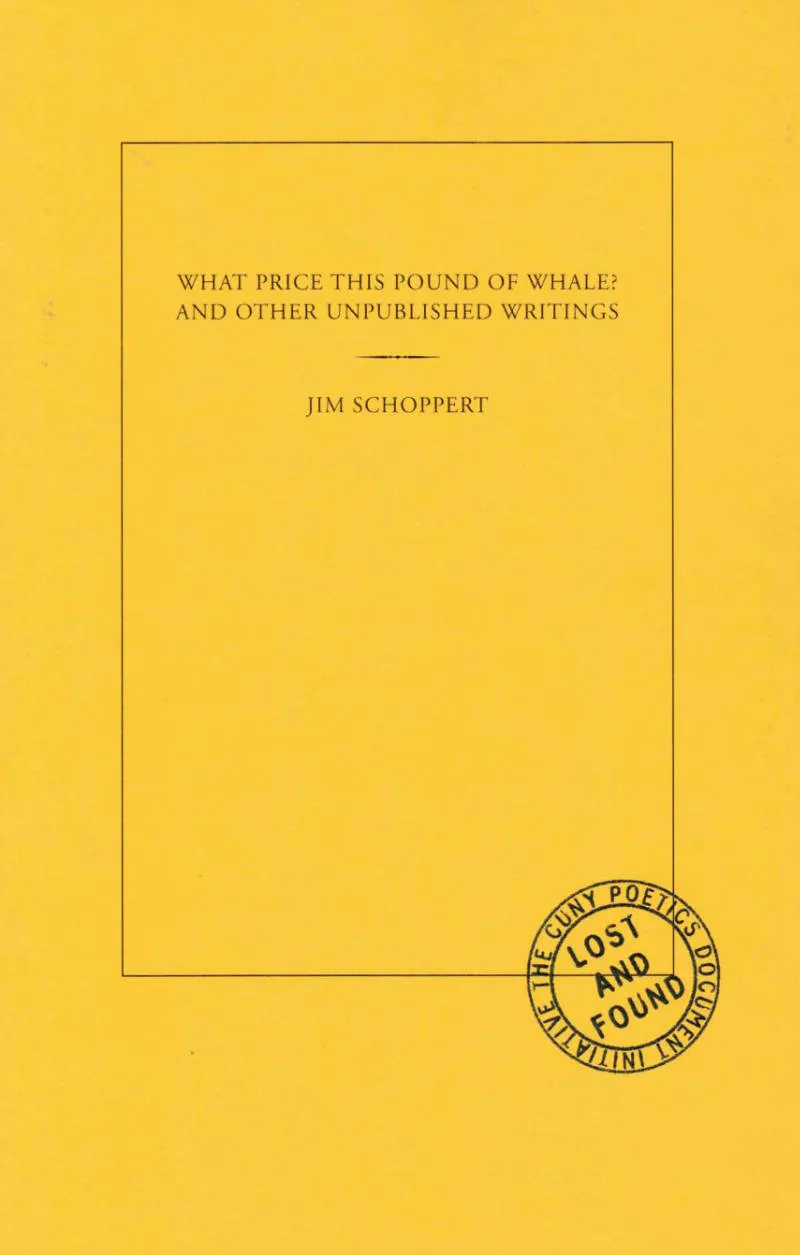
What Price This Pound of Whale? and Other Unpublished Writings
The Tlingit artist Jim Schoppert (1947-1992) was among the most accomplished, innovative, and prolific Alaska Native artists of the twentieth century. His whimsical sculptures and large scale painted wooden carvings reconfigure Tlingit visual motifs, and he challenged the binary categories against which Indigenous artists are so often defined, such as traditional and contemporary, historic and innovative, and artist or craftsperson. While known primarily for his modernist interventions in Tlingit visual traditions, Schoppert was also a prolific writer, an eloquent speaker, and an ardent advocate for Alaska Native artists. This publication brings together a selection of his unpublished poetry and writings from the artist’s personal papers. Presented alongside never before seen sketches and studies, this selection bridges Schoppert’s written and artistic practices in a deeply personal portrait of the artist and Alaska Native life that upsets preconceptions about Native art and unsettles the established narrative of Euro-American and Indigenous aesthetic relations.
Jim Schoppert (1947-1992) was a Tlingit multidisciplinary artist and writer. He was a Taku Tlingit Raven of the Ishkahittaan (Inland Frog) clan from his Tlingit mother and half-German from his father and carried the Łingit name Dom-Yetz. Born in Juneau, Alaska, he earned a BFA in Sculpture and Printmaking from the University of Alaska—Anchorage and an MFA from the University of Washington. In addition to his artistic career, Schoppert was instrumental in promoting Alaska Native arts and organizations. He was Director of Arts and Crafts at the Cook Inlet Native Association, Director of the Alaska Arts in Prisons Program for the University of Alaska Juneau, and organized exhibitions and workshops across Alaska and the Pacific Northwest. He was visiting professor in visual art at the University of Alaska, Fairbanks and directed its Native Art Center. He sat on the Washington State Arts Commission and on the boards of the Alaska State Council on the Arts and the Institute of Alaska Native Arts. His work is held in public and private collections across the United States, including the Smithsonian National Museum of the American Indian, the Anchorage Museum, the Heard Museum, and the Newark Museum, among others. His writing and poetry has appeared in The Greenfield Review and Journal of Alaska Native Arts, among other publications.

Raven Chacon: A Worm’s Eye View From a Bird’s Beak
Stefanie Hessler, Katya García-Antón and 1 more
A career-spanning catalogue featuring excerpts from Raven Chacon’s scores, musical prompts, and drawings interspersed with full-color documentation and descriptive texts of installations, sculptures, and performances. Raven Chacon is a composer and artist creating musical experiences that explore relationships among land, space, and people.
In an experimental practice that cuts across the boundaries of visual art, performance, and music, Chacon breaks open musical traditions and activates spaces of performance where the histories of the lands the United States has encroached upon can be contemplated, questioned, and reimagined. In 2022, Raven Chacon became the first Native American to win the Pulitzer Prize for Music, and was awarded a prestigious MacArthur “genius” fellowship in 2023.
Texts by Raven Chacon, Lou Cornum, Aruna D'Souza, Candice Hopkins, Anthony Huberman, Ingir Bål Nango, Marja Bål Nango, Dylan Robinson & Patrick Nickleson, Eric-Paul Riege, Sigbjørn Skåden, Ánde Somby.
Foreword by Katya García-Antón and Stefanie Hessler.

The Twofold Commitment
At once an artist's book and an interview collection by Vietnamese filmmaker, writer and feminist and postcolonial theorist Trinh T. Minh-ha (born 1952), The Twofold Commitment centers on Trinh's 2015 feature film Forgetting Vietnam, which takes up one of the myths surrounding the creation of Vietnam: a fight between two dragons whose intertwined bodies fell into the South China Sea and formed Vietnam's curving, S-shaped coastline. Commemorating the 40th anniversary of the end of the war, the film draws inspiration from ancient legend to stage an ongoing contemporary conversation between land and water, creating a third space, another way, for historical and cultural re-memory.
This book features the film's lyrical, essayistic script, along with rhythmically distributed movie stills. Expanding on this central focus is a series of conversations between the filmmaker and critics and film and sound studies scholars dating from 2016 to 2022, amplified by an index identifying key concepts and ideas in the artist's work.

Through an Addict’s Looking-Glass
Through an Addict’s Looking-Glass is an exercise in meaning-making, a thinking-out-loud. Waithera Sebatindira unravels how it feels to live as an addict under capitalism, pondering how engaging with these experiences could bring the horizon of liberation towards us.
Through embodied explorations of addiction and recovery, Sebatindira invites us to inhabit crip time, a concept that describes different temporal realities in the lives of disabled people. In this collection, the addict’s crip time is distorted, mutable and non-linear, hopping backwards and forwards through memory loops and memory loss. Blackout is time travel; sobriety is failure; finitude, freedom.
An uncompromising rejection of the objectification of addicts across the political spectrum, this powerful meditation on illness, disability, solidarity and spirituality illuminates their indispensable contributions to the building of a new world.
Waithera Sebatindira is a Kenyan writer based in London. Their previous writing and research interests have included food imperialism, drag kings and gender transformation. They are a co-author of A FLY Girl’s Guide to University.

Salamander's Wool
The involuntary whispering of the dew-harvest.
A grimoire carved in scarlet, SALAMANDER'S WOOL is the inaugural full-length collection of writing by V Manuscript, amalgamating a vast array of arcane rituals into an ensorcelling poetic corpus. To read SALAMANDER'S WOOL is to consort with spirits and scry with dæmons, a linguistic alchemy which transmutes both language and reader.
V Manuscript is a poet and scriptomancer living in New York City.

Verlag der Buchhandlung Walther König
Past Words
Past Words is three books in one: a collection of previously published texts and two exhibition-like experiments: A Year with Prem Krishnamurthy at the KW Institute for Contemporary Art, Berlin, and Endless Exhibition at the Kunsthal Gent. These parts are iinterconnected but distinct, not least because each is designed by a different designer—Ann Richter, David Knowles, Mark Foss & Valentijn Goethals. Together, they chart the past—and future—of a peripatetic performance of a practice, taking stock of a fifteen-year period through writing, a medium that 1s both primary and secondary. This writing is about design, about curating, about exhibition-making, and about how all three are themselves forms of storytelling. They allow us to draft narratives that stand just to the side of accepted realities, to sneak wild ideas into the world with the hope they may—with time—turn into facts.
Based in Berlin and New York, designer and curator Prem Krishnamurthy (born 1977) is head of the artist group Department of Transformation and of the design consultancy Wkshps. In 2015 he was the recipient of the Cooper Hewitt’s National Design Award for Communication essDesign. As both creator and curator, Krishnamurthy aims to discover “how art & design can be agents of transformation for individuals, communities and institutions.”
With an introduction by Krist Gruijthuijsen.

Exhibiting for Multiple Senses
Exhibiting for Multiple Senses looks into artistic and curatorial research practices that emphasize the multisensory character of the human body in the encounter with artworks. For some time now, numerous contemporary artists and curators have moved beyond the primacy of the visual in the experience of art exhibitions. The book discusses this shift by bringing together experimental exhibition-making, curatorial theory, art, design, and museum research, disability activism and crip theory. Its intent is to demonstrate resonances between curatorial theory and practice and between disability and crip art activism. While the latter is still often regarded as relevant for only small portions of visibly disabled people, in recent years neurodiversity and invisible disabilities have proven to be relevant for the sensory experiences of much larger parts of exhibition audiences.
Exhibiting for Multiple Senses shares famous and lesser-known examples of experimental exhibitions as well as of artistic practices linked to exhibitions. By mobilizing the senses of touch, smell, taste, and hearing, as well as applications of multimodal technologies and insights from neuroscience, these examples all explore abilities and possibilities of the complex and diverse sensory apparatus that is the human body.
Contributors: David Bobier, Luca M. Damiani, Stephanie Farmer & Hettie James, Eva Fotiadi, David Gissen & Georgina Kleege, Adi Hollander, Lilian Korner, Elke Krasny, Renata Pękowska, Caro Verbeek

One Big Bang
One Big Bang brings together 78 charcoal and pastel drawings from Adel Abdessemed's recent series Nature Morte and Politics of Drawing, where everyday objects, animals, and flowers are subtly charged with tension. Through these works, Abdessemed explores the intersections of beauty, fragility, and unrest. With texts by Hélène Cixous and David Elliott, One Big Bang offers a thoughtful entry into an artist's visual language shaped by memory, myth, and political urgency.
Published following the eponymous exhibition at Projeckt Brussels in 2024.
Adel Abdessemed (born 1971 in Constantine, Algeria, lives and works in Paris and Berlin) deconstructs identity codes, tackling head-on the tensions that permeate our society. His works, with their typical simplicity—sculptural installations, drawings, photographs, videos and performances—echo precise facts and familiar situations, but go beyond narrative commentary and militant criticism. Adel Abdessemed questions, among other things, the social and economic status of the artist in a system where his foothold is slight, by shrewdly keeping a distance in a gesture of subversive and committed resignation.
Abdessemed refuses to be limited to a single ideology. In his early works he passionately tackled religious, sexual, and taboos subjects and his later exhibitions have often focused on the theme of global violence. In an interview with Elisabeth Lebovici he stated, "I do not live between two cultures. I am not a postcolonial artist. I am not working on the scar and am not mending anything. I am just a detector … In the public sphere, I use passion and rage. Nothing else. I don't do illusions."
Sometimes reduced to a simple word, as in "Mohammedkarlpolpot" (1999), a condensation of names evoking totalitarism and religion, and sometimes complex and monumental installations such as "Habibi" (2004), a suspended skeleton of 17 meters propelled by a jet engine, Abdessemed's practice belongs to a new generation of artists who appeared recently on the French art scene, looking to offer another perspective on culture and identity.

Firespitter
Like the jazz rhythms that inspired and punctuated her practice, Jayne Cortez improvised her way through and across disciplines, bridging poetry and performance with music and the visual arts to create a unique body of work. Consciously rupturing the boundaries between art and politics, Cortez’s practice uneasily fits within literary movements of the 20th century, residing everywhere and nowhere between the Black Arts Movement, Surrealism, feminism, and early performance art. As intersectional as it is interdisciplinary, her work is consistently visceral and fearless, acting as a powerful expression of collective rage on behalf of the disenfranchised and dispossessed. In the words of historian Robin D.G. Kelley, “her poetry was never ‘protest’ but a complete revolt, a clarion call for a new way of life.”
The appearance of Firespitter (Nightboat, 2025), a 600-page-plus collected poems, is immensely valuable and long overdue . . . Hers [Jayne Cortez’s] is a voice—both on and off the page—that speaks with authority, curiosity, and an unshakeable faith in the power of poetry to change consciousness and change lives. - David Grundy, Poetry Foundation

The Glover Group – A Los Angeles Story
A portrait of the cohesive community of women artists in Frogtown, Los Angeles, including Ruby Neri, Hilary Pecis, Megan Reed, Lily Stockman, and Austyn Weiner.
The Glover Group: A Los Angeles Story narrates the journey of an extraordinary group of artists who have nurtured their unique artistic voices within the same studio complex in Frogtown, Los Angeles. The Glover Group includes Ruby Neri, Hilary Pecis, Megan Reed, Lily Stockman, and Austyn Weiner, a coincidental yet cohesive community of women artists sharing a unique bond through their interconnected workspace.
This catalog, designed to document their collaborative exhibition held at MASSIMODECARLO in Milan during July and August 2023, features interviews to the artists by Cecilia Alemani, Alison M. Gingeras, Justine Ludwig, Marta Papini, and Heidi Zuckerman, together with photographs by Tracy Nguyen.
Contributions by Ruby Neri & Alison M. Gingeras, Hilary Pecis & Cecilia Alemani, Megan Reed & Marta Papini, Lily Stockman & Heidi Zuckerman, Austyn Weiner & Justine Ludwig.
![Cover of أحمد [Ahmed] – Writing](https://rile.space/storage/4500/conversions/01KTRKW207R5ABRVS27RYCB9M1-webp.webp)
أحمد [Ahmed] – Writing
[Ahmed] is the quartet of Pat Thomas (piano), Joel Grip (double bass), Antonin Gerbal (drums) and Seymour Wright (alto saxophone). Since 2014, أحمد [Ahmed] have excavated and re-imagined the music of Ahmed Abdul-Malik, in an ever ongoing search for future music.
[Ahmed] – Writing (EXV01) gathers together the [Ahmed] ‘paper’ texts from the last decade: liner-notes; covers of the releases; and writing by the band members – Antonin and Joel have written two fresh ones for this book, Seymour’s have appeared alongside the records, and some of Pat’s come from a time (long) before [Ahmed]. “Together, the ideas-energy in these things gives a sense of what we have done, do, think together (and apart) in living music, how our different ways come together, and how, together, we learn through be-doing [Ahmed]… These texts are woven together (the etymology of text is from weave) through (and into) a rich fabric of enquiry. A collaborative weaving together of difference(s) to make a whole (thing).” (Seymour Wright)
Contributions by Pat Thomas, Seymour Wright, Antonin Gerbal, Joel Grip, Robert Levin, James G. Spady, John Chantler, Edward George, Fred Moten
Edited by [Ahmed]
Series Editors: Stoffel Debuysere, Jef Lambrechts, Will Holder
Initiated by Stoffel Debuysere
Produced and designed by Will Holder [lps’ original design: Maja Larsson]

New Ancient Words
New Ancient Words is the first translation of Ellen Lima Wassu's poetry into English. A trilingual edition between her native Tupi indigenous language of the land of Pindorama, now Brazil, Portuguese, and English, this collection offers a wider readership her resistant yet intimate poetry, which flows seamlessly between her relational woes, a decolonial voice, and an animated playfulness with words and imagery. In her poems, history is an unstable landscape, where the personal, the mythical, and the natural are ever entwined and ever shifting in meaning.
Ellen Lima Wassu is a multiartist, freshwater fish, perplexed human, apartment gardener, and more beast than person. Born in Rio de Janeiro, she is Indigenous to the Wassu Cocal people (Alagoas, Brazil) and currently lives in Portugal, where she is pursuing a PhD, developing artistic practices, teaching courses, giving lectures, and working as an activist. In addition to contributing to literary magazines and anthologies, she has published ybykûatiara um livro de terra (Urutau, 2023) and ixé ygara voltando pra ’y’kûá (Urutau, 2021). Her practice weaves together art, poetry, performance, activism, critique, counter-colonial studies, essayistic writing, good encounters, river baths, listening sessions, and conversations with flowers.
Translation by Isadora Neves Marques and Alice dos Reis, revised by Marta Espiridião

Enthusiasm
{ENTHUSIASM} is the 7th poetry collection by poet, artist, curator and vanguardist SJ Fowler. It follows highly-acclaimed collections including The Rottweiler's guide to the Dog Owner and Enemies: the selected collaborations of SJ Fowler. The book's 81 poems are intended as individual pieces in their own right, but are interlinked by subjects including battle and violence, infants and infancy, religion, economy and population, the self, modernity, and the past.