Books
Books
in random order

This Is Not My Cat
Renowned Japanese photographer Takashi Homma observes his daily life through the poses of his cat.
A cat wanders, perches, and lounges in various spaces around a humble Tokyo apartment. It is perfectly tranquil in its surroundings, simply going about its daily life. In one image, the cat lays serenely amidst pot plants on the balcony, squinting in morning sunlight; in others, it balances precariously on the edge of the bath, snuggles beneath a sleeping bag, plays in a cardboard box, hides beneath an open umbrella. Here and there, evidence of the cat's fellow inhabitant in the apartment—a man, who also happens to be the internationally renowned photographer Takashi Homma—creeps into the frame. A knee, a foot, a shock of blonde hair, half of a face. There are artefacts of his life and practice too. Framed photographic prints draped in bubblewrap lean against a wall; a tangle of musical effects pedals make for colourful constellation against the cool blue of the carpet.
Many have written of the unique atmosphere and energy of Takashi Homma's pictures. His photographic mannerisms are so light, so subtly empathetic to his subjects, that we all but dissolve into the world he creates. The photographs that populate This Is Not My Cat are no exception. Unencumbered by a sense of fussiness or perfection, these images are casual, diaristic, and quotidian. As viewers, we become part of the images and their atmosphere, rather than poring over their details. They are about feeling as much as they are about looking
The title—This Is Not My Cat—seems multipart. Whereas the anomaly imbedded in Homma's iconic photobook Tokyo and My Daughter is that the girl pictured was not in fact his own child, here, his own cat is recast as belonging to another. Or perhaps it is that a cat's independence cannot be truly curbed. They quietly live, play, and exist alongside us. They move through life in our shadow, but forever in their own world.
Takashi Homma (born 1962, lives and works in Tokyo) is one of the most internationally recognised Japanese photographers active at the front lines of contemporary photography today.

Forgetful Secretary
After diagnosis, the fact was that Austin Gross lived in his home country. He sat on the porch squinting like a potato and it was a comforting thing to imagine: rock-climbing with a blindfold. ‘Can swim, eyes open,’ he jotted and covered his eyes again. Sun, centrifuge, prognosis, bird-listening. The collision shaped genres like tectonic ripples. Windows open, a story while forgetting. ‘I am a memory eater.’
Aras was furloughed from prison that summer. Five years before, she’d missed their movie plan, and the fact was that since then, she lived in her home country. Furlough, Aras wrote, was ‘no-time.’ They investigated the situation together.
Austin Gross is an essayist and collaborator in elliptical orbit. His home discipline is philosophy and language English, on one condition: having left home. Trans-disciplinarity gives us a chance to be hosts and guests.

A Nazi Word for a Nazi Thing
An essay on art, bodies and fascism.
In an era where identity politics is being weaponised against the very people it has sought to make visible, how can we reclaim complexity?
In 1937 the Nazis staged an exhibition of seized modernist artworks. Named Entartete ‘Kunst’ – Degenerate ‘Art’ – it sought to define degeneracy, display it and destroy it.This act of violent appropriation is one episode in a long and ongoing history of the erasure of queer and non-normative cultures.
A Nazi Word for a Nazi Thing works against this erasure; it is a manifesto – a catalogue for an exhibition that could never take place. Drawing on work from dissident sexologist Magnus Hirschfeld to South African artist Zanele Muholi, as well as a century of queer cinema from Sergei Eisenstein to Pedro Almodóvar, So Mayer creates an archive of resistance.
‘This book is a small revolution that becomes a party that you won’t be leaving soon. I believe we’re living in a time of fresh erasures, systemic violences working that global pandemic to take some other bodies out. Looking so freshly at the history of queerness, sexual deviance and the long long coordinated erasures of colonialism, bigotry and transphobia the essential non binary nature of art opens up right here like the wildly singing flower it is and So Mayer’s compelling version makes sense, makes me listen.’
— Eileen Myles
‘A Nazi Word for a Nazi Thing is a reflective, creative walk through some of the worst – and best – people of the last hundred years, looking at the power of images and their relationship(s) with text. In a time of rising fascism, So Mayer highlights ways that artists have found strategies of resistance, and offers hope in historical analysis.’
— Juliet Jacques

In Concrete
Garréta’s first novel in a decade follows the mania that descends upon a family when the father finds himself in possession of a concrete mixer. As he seeks to modernize every aspect of their lives, disaster strikes when the younger sibling is subsumed by concrete.
Through puns, wordplay, and dizzying verbal effect, Garréta reinvents the novel form and blurs the line between spoken and written language in an attempt to confront the elasticity of communication.
Anne F. Garréta is a graduate of the Ecole Normale Supérieure, received her License de Lettres at the Université Paris 4 (Sorbonne), her Maitrise and her D.E.A at the Université Paris 7 (Diderot), and a PhD at New York University. The author of six novels, Garréta was coopted to the Oulipo in 2000. Her first novel, Sphinx (1986), which caused a sensation when Deep Vellum published its first English translation in 2015, tells a love story between two people without giving any indication of grammatical gender for the narrator or their lover. She won France’s prestigious Prix Médicis in 2002 and the Albertine Prize in 2018 for her book, Not One Day, which was also nominated for a Lambda Literary Award. Garréta teaches regularly in France at the Université Rennes 2, and more recently at Paris 7 (Diderot), and is a professor at Duke University.

October
What do we carry from one year to the next? What remains after devastation, and what, despite everything, takes root again?
October in Lebanon is heavy with memory. The euphoria of the 2019 revolution feels far away, its anniversaries marked by crisis, war and the genocide in Gaza.
Across multiple Octobers, Nur Turkmani meditates on rupture, transformation and the quiet undoing and remaking of relationships during collective catastrophe. Part archive, part love letter, her debut poetry collection holds the ordinary and the extraordinary in the same breath, spanning balconies and border towns, fig trees and songs for friends, autumn light and the instinct to flee.
Formally spare and emotionally saturated, October refuses both numbness and spectacle. These poems ask what it means to survive the world and still long for it; and how we hold what’s disappearing, or changing too quickly to make sense of.

Moi
The straplines of a number of advertisements drawn from magazines of the 1950s are turned into drawings, as though a particularly vain and narcissistic woman speaks (as of course she does), She is ‘en pleine forme’ of her beauty. (2016).

knot body
Bringing together poetry, essay, and letters to “lovers, friends and in-betweens,” Eli Tareq El Bechelany-Lynch confronts the ways capitalism, fatphobia, ableism, transness, and racializations affect people with chronic pain, illness, and disability. knot body explores what it means to discover the limits of your body, and contends with what those limitations bring up in the world we live in.
knot body was shortlisted for the QWF First Book Prize. Their second collection of poetry, The Good Arabs (Metonymy Press), won the 2022 Grand Prix du Livre de Montréal.
“For me, the power of knot body stems from its courage and unique voice in writing the ache, the ache of chronic pain, the ache of faulty diagnoses and bodily misreadings, and, equally, the ache for honest answers on how to love each other in all our dignity. Eli Tareq El Bechelany-Lynch is an artist and philosopher of talent, generosity, and heart.” – David Chariandy, author of Brother (Penguin Random House)
“In this moment, when trans, racialized and disabled bodies are met with violent and polarizing commentary within the public sphere, Eli Tareq El Bechelany-Lynch offers us the uninterrupted intimacy of knot body. As self-communional as Kiese Laymon’s Heavy and Terese Marie Mailhot’s Heart Berries, they amplify and queer the epistolary memoir genre. Each letter is emotionally and thematically complete and, too, each letter decidedly speaks to the next. Readers may ruminate on the sharp and sensual inquiry offered by each individual letter, or read cover-to-cover and be present to the gorgeously-engaged, call-and-response quality of knot body as a whole.” – Amber Dawn, author of My Art is Killing Me (Arsenal Pulp Press)
“knot body is such a generous tapestry of tenderness—a collection that brilliantly utilizes the direct address in a way that is not universal, but still beautifully communal. I reached the end of this collection and breathed in a newer, better world.” – Hanif Abdurraqib, author of A Fortune for Your Disaster (Tin House)
Eli Tareq El Bechelany-Lynch is a queer Arab poet living in Tio’tia:ke, unceded Kanien’kehá:ka territory (Montreal). Their work has appeared in The Best Canadian Poetry 2018 anthology, GUTS, carte blanche, the Shade Journal, The New Quarterly, Arc Poetry Magazine, Room Magazine, and elsewhere. They participated in the Banff Centre’s ‘Centering Ourselves’ BIPOC residency, and they were longlisted for the CBC Poetry Prize in 2019. Their second collection of poetry, The Good Arabs, was published by Metonymy Press in 2021.

Correspondences de Appel 1975–2025
This volume brings together 50 years of correspondence from the archive of de Appel contemporary arts centre in Amsterdam. In tracing a relational and affective history of the institution, each piece offers a glimpse into the artistic projects and programmes de Appel has commissioned and championed; the cultural shifts and careers it has nurtured; the celebrations and struggles it has weathered; and the collaborations and friendships sparked along the way. The book gathers materials from more than 100 voices, with paper and digital exchanges covering an intricate web of people, places, and events, ultimately coalescing into what can be perceived as the unified work of an institution.
Includes a light-blue satin Ribbon by Alison Knowles.

Lex Icon
Appearing for the first time in English translation, LEX ICON presents everyday objects through the lens of modern art and abstraction. As abstraction distills the geometrical shape of an object by shedding its function, so too do Tavares’s poems distill the essence of everyday items in language. LEX ICON connects Tavares’s early poetry to her later graphic sculptural poems. Foregrounding insights into human sociality, labor, and domesticity that dwell in simple household objects, the poems collected here also present these as almost mystical artifacts that partake in some unnamed ritual.
Salette Tavares (1922-1994) was a Portuguese writer, theorist, and visual artist. She was a member of the experimental poetry group PO.EX and was involved in the publication of the first issues of Poesia Experimental. Her books include Quadrada (Moraes Editores), Lex Icon (Moraes Editores), Obra Poética 1957-1971 (Imprensa Nacional Casa da Moeda), and Poesia Gráfica (Casa Fernando Pessoa). Her spatial poems were exhibited at the 2014 retrospective, Salette Tavares: Spatial Poetry, at the Calouste Gulbenkian Museum in Lisbon.
Translated by Isabel Sobral Campos, Kristofer J. Petersen-Overton

Coups de putes
Faut-il cautionner la prostitution pour soutenir les travailleuses du sexe ? Faut-il pénaliser les clients ? La prostituée est-elle le symbole de l'oppression des femmes ? Juno Mac & Molly Smith posent un regard nouveau sur ces questions souvent conflictuelles. Elles rejettent l'alternative entre condamnation et glorification du travail du sexe, et étendent leur propos à des problématiques plus larges : les frontières, l'exploitation, le sexisme et la suprématie blanche. En délaissant les symboles passionnés et en examinant les effets concrets des différents régimes législatifs, elles démontrent que la lutte des travailleuses du sexe est d'une importance capitale pour le mouvement social.

Your Life Is Not A (Fucking) Story
In this new collected edition of his recent articles, Simon Critchley - one of the most important living philosophers - takes us through his reflections on death, questions of doubt and reason, the legacy of David Bowie, the nature of fear and empathy in a broken society and a critique of narrative identity - among other things. YOUR LIFE IS NOT A STORY explores the contemporary world and its psychological impact on us, offering us a way to see our situation different and resist its tricks and contrivances.
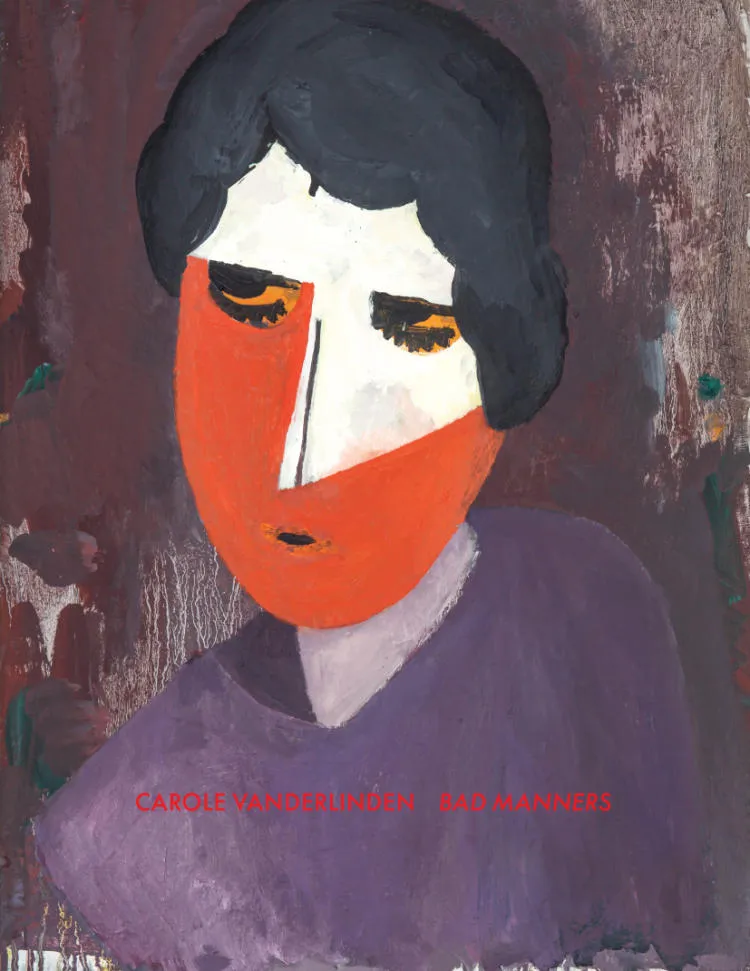
Bad Manners
Carole Vanderlinden's first monograp covers over a decade of the artist's practice. It gathers close to 200 paintings and works on paper, alongside texts by Belgian novelist Jean-Philippe Toussaint, essays by curators Ann Hoste, Ory Dessau, and Hans den Hartog Jager, as well as a conversation between musician and composer Joëlle Léandre and Vanderlinden.
Born 1973 in Brussels, Carole Vanderlinden has been developing a highly improvisational, rich artistic practice since the mid-1990s. While her work is primarily focused on painting (often using thick, hand-mixed oil paints), it regularly encompasses drawing, watercolor, collage, and small objects. Vanderlinden's practice is famously unhampered by the constraints of a single style. Her work nimbly blurs the line between figuration and abstraction, reacting intuitively to the rhythm, color, and possibilities of her medium rather than adhering to a single signature aesthetic.

Trophy Logic
We stand at the edge of the world’s mercy, as subjects destined to fall. Instead, we posit: what might unfurl when we discard the uniform of the individual, and instead orient towards tinkering with the fluctuating dynamics of desire, value, infrastructure, touch, and language. Don’t be fooled, for the dynamics are brittle. Unrestricted interplay has a limit, and method is to be found at its rim. That a tangible or decorative item may serve as recognition or evidence of merit might somehow become a logic of itself. This publication presents a collection of explorations of excess, limitation, dehydrated thought, proclivity, sublimation, debauchery, and the narrowly-defined. Indeed, the subject is destined to fall, but ultimately does not! As we reckon with the illegibility of merit, we are beckoned to reconsider our relationship to one another, the unseen settings of nostalgia, the monolithic, and the stifling hold that comes not from the absence of violence, but the sheer overabundance of it. The winner just might take it all,but we’re all destined to some sort of trophy.
with Brandon Chow, Jody Aikman, Kessy Paller-Bain, Maximilian Pellizzari, Milda Valiulytė, António Manso, Preto Macarena, Magaña Villar, Sara Vallis, Cecilie Jensen, Iris Verge Ferrer, Mia You, Mehmet Süzgün, Emma Adjari, gervaise alexis savvias, Emanuella Cunt, Greta þorkelsdóttir. Designed by Miglė Lukoševičiūtė

The Interjection Calendar 005
Emily Pope, Christiane Blattmann
For the Interjection Calendar each month Montez Press invites an artist, a writer, a poet or a doer of some sorts to say things. All 12 pieces have introspection and reflection in common. They are a subjective overview of writing in the expanded field of contemporary art and writing in the year 2019. This is the Interjection Calendar 2019, the fifth collection in this series.
With contributions by sabrina soyer, Lisa Robertson, Hatty Nestor, Adrianna Whittingham, Sondria, Claudia Pagès, Laetitia Paviani, Bella Milroy, Georgina Tyson, Son Kit, Alix Jean Vollum, Rene Matic and bleubaglife.
Find the last 12 PDF's on montezpress.com.

Diversity of Aesthetics
Jose Rosales, Andreas Petrossiants
Critical conversations and reflections about lessons learned at the intersection of social movements and artist production.
Diversity of Aesthetics collects powerful and timely conversations among leading cultural critics, artists, and organizers to connect the threads between some of the most pressing social struggles and conflicts of our time: policing, war, borders and migration, economic crisis.
Across three themes—infrastructure, migration, and riots—militant thinkers, artists, educators, and others discuss aesthetic production, forms of social organization, modes of struggle against gendered and racialized capitalism, and revolutionary theory. Common to all three conversations is a commitment to rethinking the relationship between forms of critique and forms of struggle undertaken by collective social practices, offering lessons for tactics, strategies, and practices.
With contributions by Claire Fontaine, Iman Ganji, Saidiya Hartman, Vicky Osterweil, Andreas Petrossiants, Christina Sharpe, Stevphen Shukaitis, Michael Rakowtiz, Shellyne Rodriguez, Jose Rosales, Rinaldo Walcott, Andreas Petrossiants, Jose Rosales
Andreas Petrossiants is a writer and associate editor of e-flux journal. His work has appeared in Historical Materialism, Social Text, New Inquiry, AJ+ Subtext, Frieze, Bookforum.com, Roar Magazine, the Verso blog, the Brooklyn Rail, Hyperallergic. He is a PhD candidate in performance studies at NYU where he is researching anti-eviction, squatting, and tenants’ movements as they relate to the production of social space.
Jose Rosales is an independent researcher and journalist based in Lisbon, Portugal. His work has appeared in e-flux notes, Lumpen: A Journal of Poor and Working Class Writers, and has contributed a chapter called “Communism As the Riddle Posed to History” in Double Binds of Neoliberalism (2022).

To the Other Side of the Concrete Wall
A collection of translated essays by feminists in Iran that attempts to imagine beyond walls of oppression by navigating the intersections of writing and the everyday becomings of a feminist revolution.
The book includes writings of Elaheh Mohammadi and Niloofar Hamedi, the journalists who were arrested in September 2022 after covering the news of Jina Amini’s murder. Niloofar and Elaheh are still in Tehran’s notorious Even prison today. To the Other Side of the Concrete Wall also includes an essay on the experience of arrest and detention at Evin prison told from the perspective of an anonymous writer who was incarcerated following the Jina Uprising which started about a year ago. These pieces together with two essays by Elaheh and Niloofar’s friend and editor-in-chief of the feminist platform Harass Watch, Ghoncheh Ghavami, are brought together and translated into English for the first time in the Other Side of the Concrete Wall.
To the Other Side of the Concrete Wall was seed-funded by BAK and published by Jina Collective. Jina Collective is a Netherlands-based feminist, leftist, anti-capitalist, anti-sexist, and pro-LQBTQ+ activist group that emerged from the Jina Uprising.

Otherhow: Essays and Documents on Art and Disability 1985–2024
Otherhow brings together four decades of writings, lectures, interviews, and documentation of work by the artist Joseph Grigely. Deaf since the age of ten, his art and writing have long questioned and made use of various modes of communication—photographs, handwritten notes, lipreading, newspaper headlines, paintings, and TV captions—to examine and scrutinize the ableism embedded in cultural and media production. From his brilliant series of postcards addressed to Sophie Calle, where he began to formulate a theory on the intersection of disability and art, to his epic lecture “On Failure,” which brings together the poet Keats, “the first woman of fly tying” Helen Shaw, and the filmmaker Andrei Tarkovsky to the same table for a conversation on beauty, Grigely’s writing is erudite, but clear; righteous with fury, but dryly humorous.
An underlying theme throughout are modes of access and how issues of accessibility and their resolution provide a benefit to everyone, not just the disabled. Chapters devoted to art, access, and advocacy underpin the interconnected nature of these issues in a maddening, but ultimately enlightening manner. Letters of complaint, faxes and emails, unpublished op-eds, exhibition proposals, statements on equality and access; each provide a glimpse into how Grigely’s work has been shaped by—or constructed from—the “tangled process” of opening access.
Joseph Grigely, artist, educator, and activist, is currently a Professor of Visual and Critical Studies at the School of the Art Institute of Chicago. He holds a Doctorate in Philosophy from Oxford in English literature and has taught at Gallaudet University, Stanford University, and the University of Michigan. Exhibiting widely in the US and Europe, his most recent show In What Way Wham? was presented at MASS MoCA in 2023–24. His work is in the collections of the Museum of Modern Art (NY), the Whitney Museum of American Art, the Tate Modern, and the Stedelijk Museum, among others.

All Ah We is One: Caribbean Carnival Costume
Caribbean Carnivals have been taking place around the UK since 1959. These joyous celebrations of culture and community began as acts of resistance in the face of enslavement — a defiant stand from communities who refused to lose who they were and where they came from.
Drawing from this rich and radical history, Aisling Serrant explores Carnival through one of its most vibrant and unmissable features: costume. First turned to by former slaves in the Caribbean as an act of reclamation and quiet resistance, with roots in West African and European masquerade alike, the colourful costumes of Carnival weekend remain a vital mode of self-expression, protest, and camaraderie. From Canboulay to Leeds and Notting Hill, the costume makers, wearers, and the communities they attract, embody Carnival in the spirit of an expression used across the Caribbean to signify unity among nations and peoples: all ah we is one.

Shagging the Boss
Rebecca Rowland is one of the sharpest writers that I know. This little book combines elements of life in the publishing industry, #MeToo, and a literal boogeyman. It’s long been my desire to do more “social horror.” And Shagging the Boss is the stick I use to measure other submissions in that vein. (Back Cover Text) “Lesson number one: don’t get attached to anyone. Being a cannibal is the only way to truly succeed in this business.” He placed one hand on the door handle, then thought a moment and smiled to himself. “The problem is, once you take a bite, it will never be enough.” After a fortuitous encounter at a local book convention, a liberal arts graduate accepts a position at a flashy publishing company under the tutelage of its charismatic owner only to learn that the press is led, and fed, by a literal boogeyman.
“Rowland tells an exceptionally tight and fast-paced tale about a unique legendary creature stalking the modern publishing industry” — Michael Arnzen, Bram Stoker Award-winning author of Licker and 100 Jolts
“Rowland’s tale is a transgressive mindf*ck that will leave you irreparably unnerved” — L. Stephenson, author of The Goners
“Rowland has a narrative mastery that makes you feel as if a good friend is pulling you in close to tell you some special secret…You’ll be left shook” —Tim Murr, Stranger With Friction

Choquer le monde à mort – Elles sont de sortie – Pascal Doury – Bruno Richard
Bruno Richard, Pascal Doury and 1 more
"Elles sont de sortie" is the title of a periodic publication launched in 1977 by Pascal Doury and Bruno Richard. The plural and feminine form of the enigmatic phrase "elles sont de sortie," chosen almost by chance, announces a protean work and often collective experience. From its origins to the most recent iterations, including Doury's more confidential individual trajectory after "Elles sont de sortie," Choquer le Monde à Mort traces five decades of a corpus of nearly three hundred publications. It addresses some of the most emblematic editorial works, as well as others that remain unpublished, alongside ambitious and sometimes scandalous exhibitions, few of which are documented.
This work is the result of several years of research, enriched by numerous firsthand interviews, and unfolds in three parts: a chronology and analysis of a singular and marginal artistic history, works and iconographic documents, and an anthology bibliography. Together, these elements reveal the complexity of an editorial object with porous boundaries, both in its forms and its contents, oscillating between graphzine, artist book, poetry collection, and personal journal. Its ramifications, status, and legacy retrospectively reveal the importance of a discreet yet seminal work.
Thus, "Elles Sont de Sortie" also serves as an opportunity to revisit the paths of two aesthetic and provocative artists, deeply devoted to their art and true free spirits in an art world often too narrow for them. It immerses us in a plethora of works that are intimate and raw, as well as subtle and refined, all in service of a project that, in Doury's words, aims to "shock the world to death."
Edited by Tiphanie Blanc, Jonas Delaborde, Anna Lejemmetel.
Contribution by Anna Lejemmetel.

Les Diaboliques Parlures
Les Diaboliques Parlures rassemble trois textes qui nous font découvrir une voix contemporaine majeure de la poésie et du théâtre queer. Ces œuvres, à la croisée du poétique, du politique et de l’intime, explorent le désir, la vulnérabilité, la marginalité et l’identité masculine et queer.
L’Ardeur déploie une langue brûlante pour interroger le désir, la passion et la communauté des outsiders, transformant l’ardeur en force vitale et émancipatrice.
One Night at the Golden Bar offre une écriture intimiste où le romantisme kitsch devient vecteur de poésie et de réflexion sur la vulnérabilité, l’amour et la monstruosité de l’humain.
Analphabet, quant à lui, questionne le langage, l’expression et les limites de la communication, confrontant le lecteur à la puissance de la langue et à sa capacité à révéler l’identité.

La rabbia / Anger
Pier Paolo Pasolini, Cristina Viti
In a first-time English language translation by Cristina Viti to mark the poet’s centenary, Tenement Press will publish Pier Paolo Pasolini’s groundbreaking, filmic work of prose and verse, La rabbia / Anger.
Why is our life dominated by discontent, by anguish, by the fear of war, by war? In order to answer this question I have written La rabbia, not following a chronological or perhaps even a logical thread, but only my political reasons and my poetic sense. - Pier Paolo Pasolini
Written in response to producer Gastone Ferranti’s request for his comments on a set of newsreel items, the poet would respond with a montage of his own. Via the unfolding of a chrysalis of images, in La rabbia (1963), Pasolini’s lens pans over Soviet repression in Hungary; the Cuban revolution; (the utopian object of) space exploration; political imprisonment in Algeria; the liberation of the former European colonies; the election of Pope John XXIII; the prospect of revolution in Africa and the Middle East; in Europe and in Latin America... Here, we’ve a panoply of photorealist intimations of Pasolini’s ‘poetic sense.’ The death of Marilyn Monroe crests as an idea in this tidal pooling of reflections, and as the poet’s line lights out for conceptual rhymes and counterpoints.
In Viti’s translation, the weave of prose and poetry that forms La rabbia portrays the vitality of Pasolini’s work in its capacity to speak to both the specifics of his contexts, the character of our own present tense, and the ironic fact of a life lived against the gulf of discontent in its myriad forms. Here, we’ve a startling confrontation of a revolutionary struggle in stasis set in lines that crystallise a rallying call against blindness. ‘I’ll not have peace, not ever,’ he writes. A lucid acceptance of the poet’s restlessness, and a marker for Pasolini’s commitment to a solidarity with the oppressed that we find reaffirmed on every page, in La rabbia the poet charts how ‘the powerful world of capital takes an abstract painting as its brash banner’ in this unravelling of ‘crisis in the world.’

Beauty Kit
BEAUTY KIT – AN ECO-EROGENOUS ART PROJECT by Isabel Burr Raty with contributions by Kristin Rogghe, Elke Van Campenhout, Gosie Vervloessem, Pablo Diartinez and Tim Vets, is an experimental catalog summarizing Isabel Burr Raty’s research on conceptualizing and manufacturing eco-erogenous para-pharmaceutical products. It tells the story of the BKFF, a mobile farm where she and other females harvest their orgasmic juices to produce beauty bio-products, used for treatments in the BK Spa, critically discussed in the BK Focus Group and moving forward into becoming a village, where every-body harvests each other. The catalog comes with contributing text, “Harvesting bodies – The Farm as Paradox” by Elle/Elke Van Campenhout, and other reflections on the project.
Isabel Burr Raty is a Belgian-Chilean artist, filmmaker, and Media Art History teacher in ERG (École de Recherche Graphique), living between Brussels and Amsterdam. She is currently developing her second feature film, about the colonial impact on Easter Island, and creating live art and new media installations that queer production understandings, such as the Beauty Kit Project. Her works have been shown internationally.

of sirens, body & faultlines
of sirens, body & faultlines is a book of prophecy against this Brexit era, rising from a post-2008 London, where crisis and austerity meet the vanity projects of the super-rich. Committed to the immediacy of a present that is precarious and under surveillance, of sirens... attends to queer, transfeminist and people of colour counter-memories and histories. It seeks new expressions of desire and modes of breath, pushing against the gravities that would rather these lives and worlds disappear.
While arguing with the radio may seem futile, syntax, punctuation, grammar and the page must still all be mobilised to help create new conditions of possibility – for collectivity, for poetry to speak. Raha’s exceptional, experimental, queer lyric mobilises all aspects of language to reveal contradictions of capitalism and defuse populist rhetoric. This is a writing of city life against the flows to capital; labouring bodies speaking back to the demands of work and the fictions of xenophobic politicians. It concerns herstory, transfeminism, collectivity; the everyday of South East London, transformation and decolonisation, through counter-memories, anti-memoir, and a trans poetics.
"Nat Raha has written some of the most exciting poetry of the last decade. Transfeminist, communist, revolutionary – with great quickness and nimble intensity, her syllables and survival codes dash through police-lines as high-level transmissions signalling absolute solidarity, insisting that other lives are still possible. Originally published as a series of home-made pamphlets that seemed to come as much from post-punk zine culture as from avant-garde poetics, it's good to see them gathered here in one place for the first time and as a body of evidence of a culture of struggle. These poems do not merely comment on that struggle, but emerge from within it. They are poems that break open a space in which to think through what has happened, who we have been, and what has been done to us. These are fearsome times. Raha writes poetry that acknowledges that fear and refuses to flinch in the face of it, which is in itself an act of the fiercest solidarity." – Sean Bonney