rile*books

Search books

Search books by title, author, publisher, keywords...

Explore

Categories
Visit
Collections
Publishers
Back in stock
Any books
Cover of On Breathing

Peninsula Press

On Breathing

Jamieson Webster

€18.00

A beautiful, expansive essay about care, dependence, and what it means to breathe in an age of environmental catastrophe. 

A few moments after birth we begin to use our lungs for the first time. From then on, we must continue breathing for as long as we are alive. And although this mostly happens unconsciously, in a society plagued by anxiety, climate change, environmental racism, and illness, there are more and more instances that ‘teach us about the privilege that is breathing.’

Why do we so easily forget the air that we breathe in common? What does it mean to breathe when the environment that sustains life now threatens it? And how can life continue to flourish under conditions that are increasingly toxic?

To approach these questions, Jamieson Webster draws on psychoanalytic theory and reflects on her own experiences as an asthmatic teenager, a deep-sea diver, a palliative psychologist during covid, a psychoanalyst attentive to the somatic, and a new mother. The result is a compassionate and timely exploration of air and breathing as a way to undo the pervasive myth of the individual by considering our dependence on invisible systems, on one another, and the way we have violently neglected this important aspect of life.

Published in 2025 ┊ 255 pages ┊ Paperback ┊ Language: English

recommendations

Cover of The Dissenters

Peninsula Press

The Dissenters

Youssef Rakha

Fiction €16.00

Amna, Nimo, Mouna – these are all names for a single Egyptian woman whose life has mirrored that of her country. After her death in 2015, her son, Nour, climbs to the attic of their house where he glimpses her in a series of ever more immersive visions: Amna as a young woman forced into an arranged marriage in the 1950s; as a coquettish student of French known to her confidants as Nimo; a self-made divorcee and a lover; a ‘pious mama’ donning her hijab; and, finally, as a feminist activist during the Arab Spring.

Charged and renewed by these visions of a woman he has always known as Mouna, Nour begins a series of fevered letters to his sister – who has been estranged from Mouna and from Egypt for many years – in an attempt to reconcile what both siblings know about this mercurial woman, their country, and the possibility for true revolution after so much has failed.

Hallucinatory, stylish, and erotic, The Dissenters is a transcendent portrait of a woman and an era that explodes our ideas of faith, gender roles, freedom, and political agency.

YOUSSEF RAKHA is an Egyptian author of fiction and nonfiction working in Arabic and English. He is the author of The Book of the Sultan’s Seal, The Crocodiles, and Paulo, which was long-listed for the International Prize for Arabic Fiction and won the 2017 Sawiris Award.

Cover of A Nazi Word for a Nazi Thing

Peninsula Press

A Nazi Word for a Nazi Thing

So Mayer

Essays €12.00

An essay on art, bodies and fascism.

In an era where identity politics is being weaponised against the very people it has sought to make visible, how can we reclaim complexity?

In 1937 the Nazis staged an exhibition of seized modernist artworks. Named Entartete ‘Kunst’ – Degenerate ‘Art’ – it sought to define degeneracy, display it and destroy it.This act of violent appropriation is one episode in a long and ongoing history of the erasure of queer and non-normative cultures.

A Nazi Word for a Nazi Thing works against this erasure; it is a manifesto – a catalogue for an exhibition that could never take place. Drawing on work from dissident sexologist Magnus Hirschfeld to South African artist Zanele Muholi, as well as a century of queer cinema from Sergei Eisenstein to Pedro Almodóvar, So Mayer creates an archive of resistance.

‘This book is a small revolution that becomes a party that you won’t be leaving soon. I believe we’re living in a time of fresh erasures, systemic violences working that global pandemic to take some other bodies out. Looking so freshly at the history of queerness, sexual deviance and the long long coordinated erasures of colonialism, bigotry and transphobia the essential non binary nature of art opens up right here like the wildly singing flower it is and So Mayer’s compelling version makes sense, makes me listen.’
— Eileen Myles

‘A Nazi Word for a Nazi Thing is a reflective, creative walk through some of the worst – and best – people of the last hundred years, looking at the power of images and their relationship(s) with text. In a time of rising fascism, So Mayer highlights ways that artists have found strategies of resistance, and offers hope in historical analysis.’
— Juliet Jacques

Cover of Cast in Doubt

Peninsula Press

Cast in Doubt

Lynne Tillman

Fiction €19.00

It is 1974. American and English expatriates, artists, writers, and eccentrics find their home in a quiet town on the island of Crete. Among them is Horace Vaughn, a sixty-five-year-old gay American writer who has long been at work on Household Gods, his attempt at the Great American Novel, and who in the meantime supports himself by dashing off detective stories.

Horace’s young Greek lover often annoys him, provides little satisfaction, and Horace idles his time away with alcohol, friends, and machinations. That is, until a young, enigmatic nineteen-year-old American woman named Helen arrives, another outsider. In Helen, Horace discovers someone brilliant, beautiful, and stubbornly mysterious. He is fascinated by her punk style and elusive pose. In this small town, gossip spreads fast, and Helen’s past begins to follow her to Crete: a suicidal ex-lover appears without warning, and there are whispers of her long-dead sister. The Henry Moore crowd dislike her, and a Greek waiter’s wife threatens to murder her.

When Helen vanishes, Horace is determined to follow her, to find her, especially her diary. His journey around Crete in his beat-up VW bug is funny and poignant, and for Horace, the mystery continues.

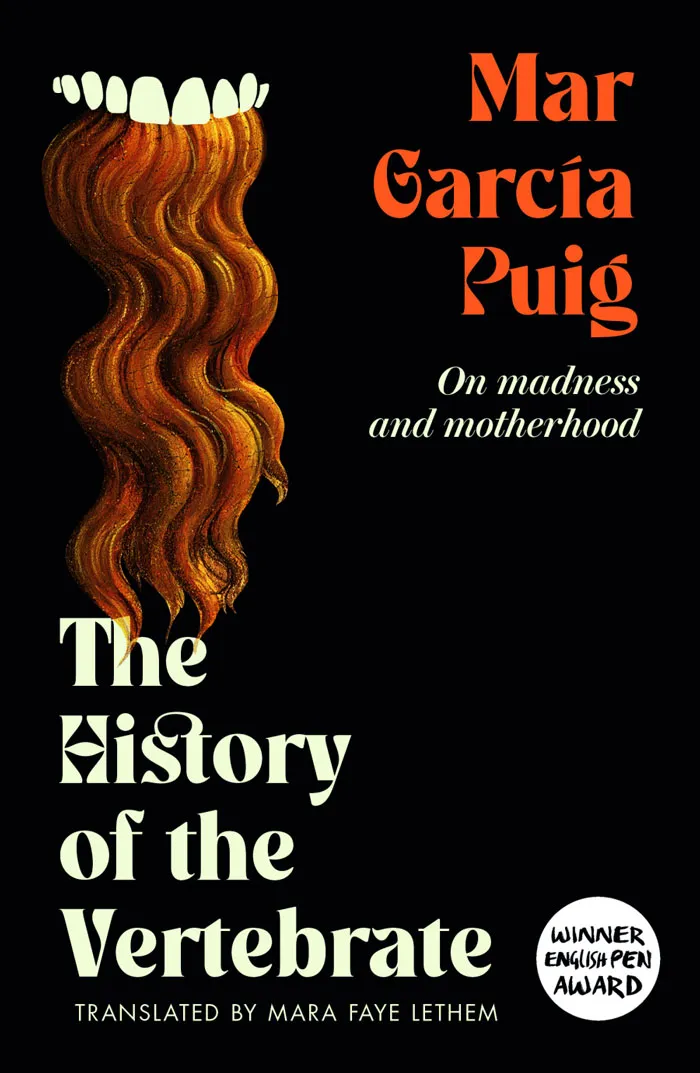
Cover of The History of the Vertebrate

Peninsula Press

The History of the Vertebrate

Mar García Puig, Mara Faye Lethem

Mothering €19.00

‘On 20 December 2015 I became a mother and I went mad.’ 

On a single day, Mar García Puig gives birth to twins and becomes elected to the Spanish Parliament as a member of the insurgent left-wing party Podemos. What might have been the best day of her life becomes the start of a terrifying ordeal; García Puig’s grip on reality begins to slip as she grapples with uncertainty, the weight of expectation, and misogyny in both of her new roles. 

In defiance of a culture that tells her the problem lies within, García Puig chooses to look outwards, examining the imbrication of madness and motherhood across centuries of science, myth, and politics while dissecting the ways in which women have been pathologized and banished from public life. 

At once intimate and epic, The History of the Vertebrate is a searing account of postpartum madness. Moving between memory, culture, and the history of medicine, García Puig transforms her experience into a story about the countless women who have felt that sanity was leaving them, and about the patriarchal forces that have silenced them. 

MAR GARCÍA PUIG is an editor and author. From 2015 to 2023 she was a member of the Spanish Congress of Deputies for Podemos, where she served on the Culture Committee and the Equality Committee. Her books include The History of the Vertebrate and This Thing of Darkness.

Cover of Parapraxis 06: Resistance

Parapraxis

Parapraxis 06: Resistance

Non-fiction €25.00

In 1911, Sigmund Freud addressed his followers gathered at Nuremberg, where he restated the import of his practice: “the task of psychoanalysis lies not at all in the discovering of complexes, but in the dissolving of resistances.” A formal antipode to political resistance, psychoanalytic resistance dams up desire and obstructs traumatic knowledge. It is conservative, allergic to change, and aims for the kind of frictionless normativity against which the unconscious drives rail. Meanwhile, we associate political resistance with change itself, with a blockade that pushes for revolution—rather than a blockage that censors its very possibility. If we read Freud as urging his followers to help their patients move through their resistance, psychoanalysis is a project on the side of material and political reality by bringing patients out of isolation and into social struggles. However, psychoanalysis is often glossed in reverse: as a project of isolated relief for the stubborn individual.

Should psychoanalysis only succeed at rendering patients compliant in their cure? Is psychoanalysis a tool for nullifying political resistance? If so, Freud’s edict for the aim of psychoanalysis is now but an epitaph. It would be easy, then, to give up the ghost, to let psychoanalysis go. But why should psychoanalysis retreat from collective symptoms back into the consulting room for individual treatment—away from strikes, riots, and uprisings, and toward complacency and normativity, if not quite literally marriage and babies? Why should the clinic not dare to be in and of the world?

Feeling restless. Hunger tactics. Laughing in the face of fascism. Breaking through. Diagnosing revolution. Madness in the Maghreb. Essays by Fady Joudah, Jamieson Webster, Dylan Saba, Yasmin El-Rifae, Ussama Makdisi, Mary Turfah, Hannah Proctor, and more.

In Memory of Joshua Clover (1962-2025).

Cover of Dominique: The Case of an Adolescent

Divided Publishing

Dominique: The Case of an Adolescent

Françoise Dolto, Ivan Kats

Non-fiction €17.00

"Dolto’s Dominique is the only case I’ve found that rivals Freud, and brings us up to date, replete with questions of incestuous trauma, repressed sexualities, autism and cognitive disability, and a profound sense for the contradictions of polite society and histories of colonial and racist violence. I love this child and encountering Dolto’s otherworldly voice as an analyst." — Jamieson Webster

While the child psychoanalyst Françoise Dolto stands alongside Jacques Lacan as a leading light of the Other French School, she has been little translated and remains curiously unknown in the English-speaking world. First published in 1971, Dominique: The Case of an Adolescent is frank and close to the clinical experience. A masterpiece of the genre, it is at once a granular psychological portrait of a troubled adolescent and his familial inheritance, and a historical case study, set in the France of the 1960s, of the of the relationship between subjectivity, nationality, and time and space.

With a foreword by Michael Ryzner-Basiewicz

Translated by Ivan Kats, revised by Lionel and Sharmini Bailly

Cover image by Mike Kelley, Untitled 1975

Françoise Dolto (born 6 November 1908, Paris) was a psychoanalyst and paediatrician. Alongside private practice at her home, where she saw adults and children, Dolto practised in four institutions where she saw only children patients: the Polyclinique Ney, the Centre Claude Bernard, the Hôpital Trousseau and the Centre Etienne Marcel. From 1967 to 1969, Dolto answered adult and child listeners of the French radio station Europe No. 1, live and anonymously under the name ‘Docteur X’. The programme enjoyed excellent ratings, but Dolto found dialogue to be hindered by the demands of live broadcasting and advertising. In 1976, she agreed to return to radio with Lorsque l’enfant paraît on France Inter, on the condition that she replied to listeners’ letters, which enabled her to go into depth. The programme was a huge success, and would make her a household name. In 1978 Dolto retired as an adult psychoanalyst: her fame had become such that it distorted the therapeutic relationship with patients. She now devoted herself to prevention, training of young analysts, group and individual supervision, publications, conferences and radio and television broadcasts. She also continued her work with children in the care of the Aide Sociale à l’Enfance, some of whom she received at her home until the end of her life. In 1979, along with a small team, she founded the Maison Verte, a place for early-years socialisation welcoming children from ages zero to four along with their caregivers, for sessions of play and talk. This model spread throughout France and Europe, to Russia, Armenia and Latin America. Dolto is the author of more than a dozen books, and several essays, interviews and seminars. In English, her books have been translated as Psychoanalysis and Pediatrics (Routeledge, 2013) and The Unconscious Body Image (Routledge, 2022). Françoise Dolto died on 25 August 1988 in Paris.

Cover of Bodies of Extraction

Kyklàda.press

Bodies of Extraction

Lydia Xynogala, Lorena Vicini and 1 more

Essays €12.00

What does it mean to drill deep and interfere with the configuration of tectonic plates? What does it mean to hollow out and alienate islandic undergrounds? How is wealth extracted and exploited from the ground, crumbled into fragments, transformed into matter, pieces of power, moved away to be represented elsewhere? Whose lungs and souls are capitalized upon and hidden under the suffocating dust in mining shafts? To whom do the surface of the land and its underground belong?

This book takes proto-industrial mining in the Aegean island of Serifos as an entry point for disclosing historical and contemporary consequences of politics of the soil through land extraction, and looks at how mineral evidence was historically produced, disseminated, and capitalized upon in the Aegean region and beyond.

Contents:

Mineral Travels:
Fragments of Geographies on the Move
by Lydia Xynogala

The Evil in the Surface
by Lorena Vicini

Consuming Land at Serifos
by Asli Özdoyuran
and David Bergé

Letter from Frikas Fortress
by Constantinos Speras

Iron Lungs
by Milica Ivic

Walking on Marble: Materialized Histories
by Anna Run Tryggvadottir

Cover of Read Me: Selected Works

Ugly Duckling Presse

Read Me: Selected Works

Holly Melgard

Essays €20.00

Read Me gathers the tools necessary to make sense of contemporary problems so ubiquitous they seem too big to name. Spanning a multiplicity of genres, media, and tonal registers, this book surveys Holly Melgard’s formally experimental poetic works produced between 2008 and 2023, including sound poems, essays on poetics, and books that exploit print on demand to, for example, counterfeit money. In often wildly comic turns of thought, Melgard’s work cleaves personal agency from automated defaults by mapping trauma and technocracy from the inside out.

From critical talks to fictional monologues, the poet translates into language the unremarkable torments of neoliberalization in the digital age.

Cover of Pedagogies of Travesti Liberation

Archive Books

Pedagogies of Travesti Liberation

Maria Clara Araújo dos Passos, Natália Affonso

Essays €15.00

Maria Clara Araújo dos Passos examines the interplay of education, identity, and liberation in Brazil's travesti community.

In Pedagogies of Travesti Liberation, Maria Clara Araújo dos Passos critiques traditional pedagogical frameworks that marginalize gender nonconforming narratives and highlights the effects of systemic discrimination on travestis' psychosocial well-being. The book advocates for inclusive educational practices and emphasizes the need for affirmative curricula.
Newly translated from Portuguese, this work contributes towards connecting political struggles globally and navigating the complexities of translation—particularly of the term "travesti"—across various geographical and political contexts, featuring a conversation between Araújo dos Passos and translator Natália Affonso.

Maria Clara Araújo dos Passos (born 1996 in Recife) is a Brazilian Afro-transfeminist educator and sociologist, and an activist for LGBT rights.

Cover of Wretched Strangers

Boiler House Press

Wretched Strangers

Ágnes Lehóczky, JT Welsch

Poetry €18.00

In response to surges of violent British nationalism and political paranoia around borders, and to related social and ethical crises, JT Welsch and Ágnes Lehóczky have assembled an anthology to mark the vital contribution of non-UK-born writers to this country’s poetry culture. Wretched Strangers brings together innovative writing from around the globe, celebrating the irreducible diversity such work brings to ‘British’ poetry. While documenting the challenges faced by writers from elsewhere, these pieces offer hopeful re-conceptions of ‘shared foreignness’ as Lila Matsumoto describes it, and the ‘peculiar state of exiled human,’ in Fawzi Karim’s words.

The book is published by Boiler House Press to commemorate the anniversary of the June 2016 EU Referendum and in solidarity through struggles ongoing and to come. Proceeds will be donated to charities fighting for the rights of refugees.

Alireza Abiz • Astrid Alben • Tim Atkins • Andre Bagoo • Veronica Barnsley • Khairani Barokka • Leire Barrera-Medrano • Katherine E. Bash • Áine Belton • Caroline Bergvall • Sujata Bhatt • Rachel Blau DuPlessis • Fióna Bolger • Ben Borek • Andrea Brady • Serena Braida • Wilson Bueno • James Byrne • Kimberly Campanello • J.R. Carpenter • Mary Jean Chan • che • Matthew Cheeseman • Iris Colomb • Giovanna Coppola • Anne Laure Coxam • Sara Crangle • Emily Critchley • Ailbhe Darcy • Nia Davies • Tim Dooley • Benjamin Dorey • Angelina D’Roza • Katherine Ebury • Dan Eltringham • Ruth Fainlight • Kit Fan • León Felipe • Alicia Fernández • Veronica Fibisan • Steven J Fowler • Livia Franchini • Ulli Freer • Anastasia Freygang • Kit Fryatt • Monika Genova • Geoff Gilbert • Peter Gizzi • Chris Gutkind • Cory Hanafin • Edmund Hardy • David Herd • Jeff Hilson • Áilbhe Hines • Alex Houen • Anthony Howell • Nasser Hussain • Zainab Ismail • Maria Jastrzębska • Lisa Jeschke • Evan Jones • Loma Sylvana Jones • Maria Kardel • Fawzi Karim • Kapka Kassabova • Özgecan Kesici • Mimi Khalvati • Robert Kiely • Michael Kindellan • Igor Klikovac • Ágnes Lehóczky • Éireann Lorsung • Patrick Loughnane • John McAuliffe • Aodán McCardle • Niall McDevitt • Luke McMullan • Christodoulos Makris • Ethel Maqeda • Lila Matsumoto • Luna Montenegro • Stephen Mooney • Ghazal Mosadeq • Erín Moure • Vivek Narayanan • Cristina Navazo-Eguía Newton • Alice Notley • Terry O’Connor • Wanda O’Connor • Gizem Okulu • Claire Orchard • Daniele Pantano • Astra Papachristodoulou • Fani Papageorgiou • Richard Parker • Sandeep Parmar • Albert Pellicer • Pascale Petit • Adam Piette • Jèssica Pujol Duran • Alonso Quesada • Ariadne Radi Cor • Nat Raha • Nisha Ramayya • Peter Robinson • William Rowe • Lisa Samuels • Jaya Savige • Ana Seferovic • Sophie Seita • Seni Seneviratne • Timea Sipos • Zoë Skoulding • Irene Solà • Samuel Solomon • Agnieszka Studzinska • James Sutherland-Smith • George Szirtes • Rebecca Tamás • Harriet Tarlo • Shirin Teifouri • Virna Teixeira • David Toms • Sara Torres • Kinga Toth • Claire Trévien • David Troupes • Arto Vaun • Juha Virtanen • J. T. Welsch • David Wheatley • Elżbieta Wójcik-Leese • Jennifer Wong • Isaac Xubín • Jane Yeh