rile*books

Search books

Search books by title, author, publisher, keywords...

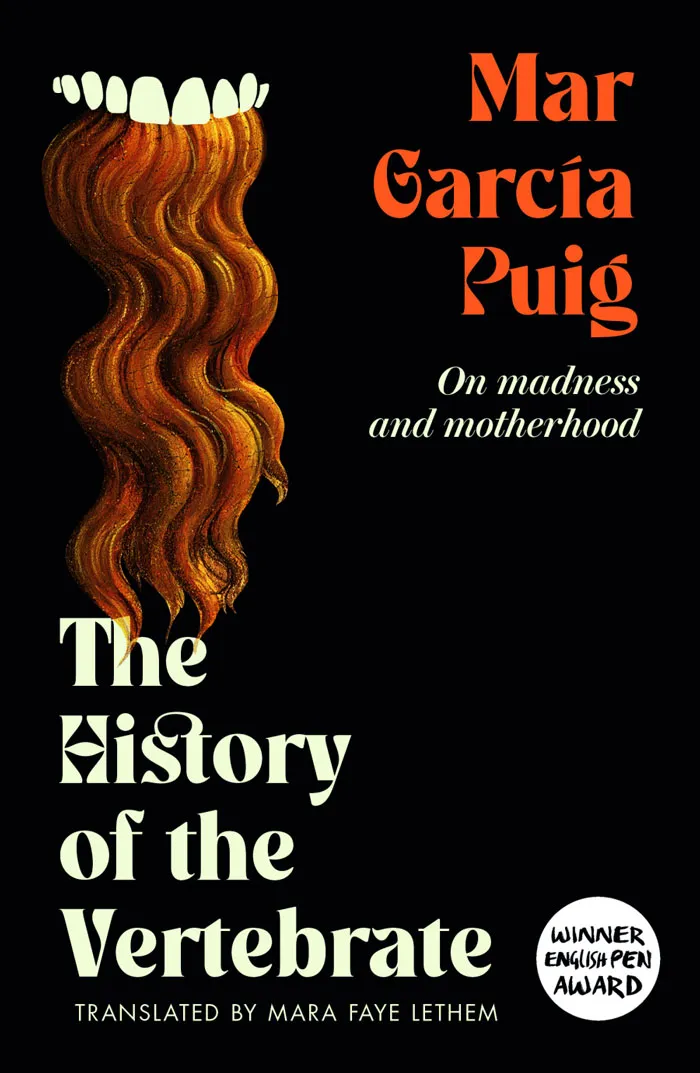
Cover of The History of the Vertebrate

Peninsula Press

The History of the Vertebrate

Mar García Puig, Mara Faye Lethem trans.

€19.00

‘On 20 December 2015 I became a mother and I went mad.’ 

On a single day, Mar García Puig gives birth to twins and becomes elected to the Spanish Parliament as a member of the insurgent left-wing party Podemos. What might have been the best day of her life becomes the start of a terrifying ordeal; García Puig’s grip on reality begins to slip as she grapples with uncertainty, the weight of expectation, and misogyny in both of her new roles. 

In defiance of a culture that tells her the problem lies within, García Puig chooses to look outwards, examining the imbrication of madness and motherhood across centuries of science, myth, and politics while dissecting the ways in which women have been pathologized and banished from public life. 

At once intimate and epic, The History of the Vertebrate is a searing account of postpartum madness. Moving between memory, culture, and the history of medicine, García Puig transforms her experience into a story about the countless women who have felt that sanity was leaving them, and about the patriarchal forces that have silenced them. 

MAR GARCÍA PUIG is an editor and author. From 2015 to 2023 she was a member of the Spanish Congress of Deputies for Podemos, where she served on the Culture Committee and the Equality Committee. Her books include The History of the Vertebrate and This Thing of Darkness.

Published in 2026 ┊ 263 pages ┊ Language: English

recommendations

Cover of Weird Fucks

Peninsula Press

Weird Fucks

Lynne Tillman

Fiction €17.00

A brilliant novella from a legendary figure in American fiction.

A young woman drifts through dimly lit bars and rented rooms, reporting from the erogenous zones of New York and Europe. Encountering increasingly bizarre sexual situations, she turns her curious, comic, and fierce eye onto the contemporary world of sex and desire.

The men of this world evade and simper, they prey, preen, and fall hopelessly in love. In the narrator’s deadpan portraits, we see young women indulging their freedom through hope and disappointment, and young men wearing various guises of masculinity.

This novella surprises with unlikely fucks, disturbing fucks, outlandish fucks, and some truly weird fucks – all written with the smart, elegant, and tough style which could only be that of Lynne Tillman.

Cover of Lovebug

Peninsula Press

Lovebug

Daisy Lafarge

Non-fiction €17.00

In Lovebug, Daisy Lafarge explores metaphors of love and disease as she seeks to understand human vulnerability and our intimacy with microbial life.

Turning to microbiology, mysticism, and psychoanalysis – as well as the raw materials of love and life – Lafarge navigates the uncomfortable intimacy between the human body and the many bacteria, viruses, and parasites to which it is host.

Lovebug is a book about the poetics of infection, and about how we can learn to live with multispecies ambivalence. How might we forge non-phobic relationships to our ‘little beasts’? How might we rewild our imaginations? In weaving the personal with the pathological, Lovebug complicates the idea of coherent selfhood, revealing life as a site of radical vulnerability and an ongoing negotiation with limit.

"The pathogen arrives anyway and takes a seat at the table. Conditioned to welcome damage, I am curious about this uninvited guest. You must sit down, says Love, and taste my meat".

Cover of A Nazi Word for a Nazi Thing

Peninsula Press

A Nazi Word for a Nazi Thing

So Mayer

Essays €12.00

An essay on art, bodies and fascism.

In an era where identity politics is being weaponised against the very people it has sought to make visible, how can we reclaim complexity?

In 1937 the Nazis staged an exhibition of seized modernist artworks. Named Entartete ‘Kunst’ – Degenerate ‘Art’ – it sought to define degeneracy, display it and destroy it.This act of violent appropriation is one episode in a long and ongoing history of the erasure of queer and non-normative cultures.

A Nazi Word for a Nazi Thing works against this erasure; it is a manifesto – a catalogue for an exhibition that could never take place. Drawing on work from dissident sexologist Magnus Hirschfeld to South African artist Zanele Muholi, as well as a century of queer cinema from Sergei Eisenstein to Pedro Almodóvar, So Mayer creates an archive of resistance.

‘This book is a small revolution that becomes a party that you won’t be leaving soon. I believe we’re living in a time of fresh erasures, systemic violences working that global pandemic to take some other bodies out. Looking so freshly at the history of queerness, sexual deviance and the long long coordinated erasures of colonialism, bigotry and transphobia the essential non binary nature of art opens up right here like the wildly singing flower it is and So Mayer’s compelling version makes sense, makes me listen.’
Eileen Myles

‘A Nazi Word for a Nazi Thing is a reflective, creative walk through some of the worst – and best – people of the last hundred years, looking at the power of images and their relationship(s) with text. In a time of rising fascism, So Mayer highlights ways that artists have found strategies of resistance, and offers hope in historical analysis.’
Juliet Jacques

Cover of Tosquelles: Healing Institutions

Divided Publishing

Tosquelles: Healing Institutions

Joana Masó

Non-fiction €24.00

Having fled to France in the aftermath of the Spanish Civil War, the Catalan psychiatrist Francesc Tosquelles joined the Saint-Alban psychiatric hospital, where he carried out a transformative clinical practice for over twenty years, in part under the Vichy regime. 

Saint-Alban was an extraordinary event, a commune, an informal refuge in a time of extreme danger, a sort of upwelling spread through word of mouth. Those entering the asylum were welcomed, and that welcome never stopped. Care happened through a broad range of communal activities for staff and patients: theater, cinema, collective writing, horticulture, the sorting of colored pearls, gymnastics, singing, a monthly newspaper. The dignity of every patient was of foremost importance. 

Now, as then, warmongers are willing to poison and slaughter without blinking, making all of life difficult if not impossible: the pull of such asylums is obvious. Tosquelles is a ground-breaking record of the life and work of the founder of institutional psychotherapy. Assembled by Joana Masó, with many texts translated to English for the first time, it is a direct encounter with Tosquelles’s clinical, intellectual, and political writings. 

“Tosquelles’s work serves as a model for dismantling capitalist institutions, a revolutionary venture whose essence Joana Masó captures.”
Paul B. Preciado 

“This remarkable collection allows us to experience the genius of Tosquelles in all its dimensions for the first time. We accompany him through his early work in Reus and Barcelona, the development of his therapeutic ideas and inventive practices in war-torn Catalonia and in exile at the Septfonds Camp, his legendary years at Saint Alban and his lesser-known later years in Melun, Nouvelle Forge and La Candélie. Joana Masó guides us to the creative heart of a man whose counter-cultural, counter-intuitive thinking excited generations of intellectuals in France and now inspires the world.”
Rosie Stockton 

“Resistance hero, anti-Stalinist Marxist, Surrealist, revolutionary practitioner of social therapy, mentor to Frantz Fanon: Francesc Tosquelles was one of the most innovative thinkers in modern psychiatry, a visionary whose moment may finally have arrived.”
Adam Shatz

With texts by Francesc Tosquelles, trans. Robert Hurley and Mara Faye Lethem

Cover of Désapprendre en traduisant – Une pratique critique et collective

Villa Arson

Désapprendre en traduisant – Une pratique critique et collective

Virginie Bobin

Essays €12.00

The act of translation as a pedagogical tool, a political act, and ultimately a gesture of care in these tense cultural times.

Virginie Bobin operates across research, curatorial and editorial practices, writing, pedagogy and translation, with a particular interest in performance, experimental forms of artistic research, the role of art, artists and art institutions in the public sphere, and formats that exceed that of the exhibition. Between 2009 and 2018, she has worked for various art centers and residency programs (Villa Vassilieff, Bétonsalon, Witte de With, Les Laboratoires d'Aubervilliers, Performa). She is a Doctor in Artistic Research (PhD-in-Practice, Academy of Fines Arts, Vienna, 2023), a professor in Art and Social Practices at ésadhar (Rouen, since 2024), and a co-founding member of the editorial and curatorial platform Qalqalah قلقلة. In addition to her contributions to various international journals, she has edited the collective publications Composing Differences (Les presses du réel, 2015), Republications (with Mathilde Villeneuve, Archive Books, 2015), and Bestiario de Lengüitas (with Mercedes Azpilicueta, k.verlag, 2024).

Cover of Another Sun

Divided Publishing

Another Sun

Françoise Vergès, Mayra A. Rodríguez Castro

Non-fiction €15.00

Waiting at Martinique Aimé Césaire International Airport, in the city of Le Lamentin, Mayra A. Rodríguez Castro browses the airport kiosk. Alongside books by Césaire, it offers titles by Frantz Fanon, Maryse Condé and Patrick Chamoiseau. She picks up a copy of Nègre je suis, nègre je resterai, a conversation between Françoise Vergès and Césaire published in 2005, and embarks. In Another Sun, Rodríguez Castro and Vergès revisit that seminal conversation, resulting in an eclectic text shaped by ongoing struggles.

In 2005, Françoise Vergès published a book with Aimé Césaire, in which she recorded – three years before his death – powerful remarks by the poet, as incisive and combative as ever, yet imbued, as always, with the universal humanism to which he had remained committed throughout his life. It is fortunate that, drawing inspiration from this interview, Another Sun allows us to hear, in their intertwining, the voices of Césaire and Vergès herself, conveying a message of emancipation and fraternity/sorority that our world needs to hear today. —Souleymane Bachir Diagne

With poems by Danielle Legros Georges, Wole Soyinka, Ishion Hutchinson, Clarisse Baleja Saïdi, Aimé Césaire and Jean Érian Samson.

Cover of Coups de putes

Hystériques & AssociéEs

Coups de putes

Molly Smith, Juno Mac

Non-fiction €23.00

Faut-il cautionner la prostitution pour soutenir les travailleuses du sexe ? Faut-il pénaliser les clients ? La prostituée est-elle le symbole de l'oppression des femmes ? Juno Mac & Molly Smith posent un regard nouveau sur ces questions souvent conflictuelles. Elles rejettent l'alternative entre condamnation et glorification du travail du sexe, et étendent leur propos à des problématiques plus larges : les frontières, l'exploitation, le sexisme et la suprématie blanche. En délaissant les symboles passionnés et en examinant les effets concrets des différents régimes législatifs, elles démontrent que la lutte des travailleuses du sexe est d'une importance capitale pour le mouvement social.

Cover of Constructing Worlds Otherwise

AK Press

Constructing Worlds Otherwise

Raúl Zibechi, George Ygarza Quispe

Non-fiction €18.00

A new collection from one of Latin America's most dynamic radical thinkers—in the tradition of Frantz Fanon and Eduardo Galeano.

Through a survey of the most marginalized voices across Latin America—feminists, the Indigenous, people of African descent, and inhabitants of urban favelas and rural towns—Zibechi introduces the Anglo world to a range of critical perspectives and new forms of struggle in Peru, Mexico, Brazil, Colombia, and Bolivia. His book contributes to global geographies of autonomous and anti-state thinking, including that of the revolutionaries in Rojava and Abdullah Öcalan, ideological theorist of Kurdish resistance, for a rich and dynamic survey of movements of nonstate power. Constructing Worlds Otherwise comes at a time when the global left—struggling to expand its vision in an era of climate chaos and rising authoritarianism—finds itself at an impasse, desperate to animate and renew its critical imaginary.

Cover of Archival Textures - (Re)claiming

Archival Textures

Archival Textures - (Re)claiming

Noah Littel, Tabea Nixdorff

Non-fiction €18.00

The book (Re)claiming presents ways in which various queer and feminist communities and initiatives in the Netherlands have (re)claimed the triangle—along with other symbols, words and stories—and in doing so take up an empowering position in a hostile society.

Besides a collection of buttons, archival materials featured in this book include short statements and flyers by queer groups such as SUHO, Sjalhomo, Roze Front, Roze Driehoek, Roze Gebaar, Van Doofpot tot Mankepoot, Interpot/ILIS, Lesbisch Archief Amsterdam, Strange Fruit Vrouwen and Groep Zwarte Vrouwen Nijmegen, as well as a text by Karin Daan, the designer of the Homomonument in Amsterdam. With this selection, this book brings together queer, trans, crip, feminist, Jewish and Black perspectives on (re)claiming as an activist strategy.

Most of these materials were researched at IHLIA LGBTI Heritage in Amsterdam, with additions found at the International Institute of Social History and the International Archive for the Women’s Movement (IAV-Atria) in Amsterdam, and LAN Lesbisch Archief Nijmegen.