rile*books

Search books

Search books by title, author, publisher, keywords...

Explore

Categories
Visit
Collections
Publishers
Back in stock
Any books
Cover of The Dissenters

Peninsula Press

The Dissenters

Youssef Rakha

€16.00

Amna, Nimo, Mouna – these are all names for a single Egyptian woman whose life has mirrored that of her country. After her death in 2015, her son, Nour, climbs to the attic of their house where he glimpses her in a series of ever more immersive visions: Amna as a young woman forced into an arranged marriage in the 1950s; as a coquettish student of French known to her confidants as Nimo; a self-made divorcee and a lover; a ‘pious mama’ donning her hijab; and, finally, as a feminist activist during the Arab Spring.

Charged and renewed by these visions of a woman he has always known as Mouna, Nour begins a series of fevered letters to his sister – who has been estranged from Mouna and from Egypt for many years – in an attempt to reconcile what both siblings know about this mercurial woman, their country, and the possibility for true revolution after so much has failed.

Hallucinatory, stylish, and erotic, The Dissenters is a transcendent portrait of a woman and an era that explodes our ideas of faith, gender roles, freedom, and political agency.

YOUSSEF RAKHA is an Egyptian author of fiction and nonfiction working in Arabic and English. He is the author of The Book of the Sultan’s Seal, The Crocodiles, and Paulo, which was long-listed for the International Prize for Arabic Fiction and won the 2017 Sawiris Award.

Published in 2025 ┊ 327 pages ┊ Language: English

recommendations

Cover of A Nazi Word for a Nazi Thing

Peninsula Press

A Nazi Word for a Nazi Thing

So Mayer

Essays €12.00

An essay on art, bodies and fascism.

In an era where identity politics is being weaponised against the very people it has sought to make visible, how can we reclaim complexity?

In 1937 the Nazis staged an exhibition of seized modernist artworks. Named Entartete ‘Kunst’ – Degenerate ‘Art’ – it sought to define degeneracy, display it and destroy it.This act of violent appropriation is one episode in a long and ongoing history of the erasure of queer and non-normative cultures.

A Nazi Word for a Nazi Thing works against this erasure; it is a manifesto – a catalogue for an exhibition that could never take place. Drawing on work from dissident sexologist Magnus Hirschfeld to South African artist Zanele Muholi, as well as a century of queer cinema from Sergei Eisenstein to Pedro Almodóvar, So Mayer creates an archive of resistance.

‘This book is a small revolution that becomes a party that you won’t be leaving soon. I believe we’re living in a time of fresh erasures, systemic violences working that global pandemic to take some other bodies out. Looking so freshly at the history of queerness, sexual deviance and the long long coordinated erasures of colonialism, bigotry and transphobia the essential non binary nature of art opens up right here like the wildly singing flower it is and So Mayer’s compelling version makes sense, makes me listen.’
Eileen Myles

‘A Nazi Word for a Nazi Thing is a reflective, creative walk through some of the worst – and best – people of the last hundred years, looking at the power of images and their relationship(s) with text. In a time of rising fascism, So Mayer highlights ways that artists have found strategies of resistance, and offers hope in historical analysis.’
Juliet Jacques

Cover of Weird Fucks

Peninsula Press

Weird Fucks

Lynne Tillman

Fiction €17.00

A brilliant novella from a legendary figure in American fiction.

A young woman drifts through dimly lit bars and rented rooms, reporting from the erogenous zones of New York and Europe. Encountering increasingly bizarre sexual situations, she turns her curious, comic, and fierce eye onto the contemporary world of sex and desire.

The men of this world evade and simper, they prey, preen, and fall hopelessly in love. In the narrator’s deadpan portraits, we see young women indulging their freedom through hope and disappointment, and young men wearing various guises of masculinity.

This novella surprises with unlikely fucks, disturbing fucks, outlandish fucks, and some truly weird fucks – all written with the smart, elegant, and tough style which could only be that of Lynne Tillman.

Cover of Bad Language

Peninsula Press

Bad Language

So Mayer

Essays €20.00

There is no such thing as a safe word. 

In Bad Language, So Mayer blends memoir and manifesto as they explore the politics of speech, while looking at how language has been used – and abused – in their own life. What is the relationship between language and sexual violence? And how can we ‘make ourselves up’ in language when words themselves are encoded by a dominant culture that insists we see ourselves as powerless listeners rather than active speakers? 

Examining the semantic traps of their multi-lingual childhood – and taking in texts from the Torah to Grimms’ Fairytales, from protest bust cards to the works of Ursula K. Le Guin – Mayer asks who gets to speak, and who is forced into silence. Bad Language calls out the harm that words can do, while searching for crafty ways through which we can collectively reclaim language for protest and pleasure. 

‘Mayer’s writing is generous, astute and sincere; in Bad Language, they choose their words carefully, using incantation and spell to distil a complex argument – the transformative power of language lay in its ability to shape sense perception. For Mayer, the task of ‘making ourselves up’ is another way of asking, what kind of world do we want to live in?’ – Lola Olufemi

SO MAYER is a writer, editor, bookseller and organiser. Truth & Dare, their first collection of speculative fiction, was longlisted for the Republic of Consciousness and Edge Hill Short Story prizes. With Sarah Shin, they co-edited Ursula K. Le Guin, Space Crone, winner of the 2024 Locus Award for non-fiction. Bad Language is their second book for Peninsula, after A Nazi Word for a Nazi Thing.

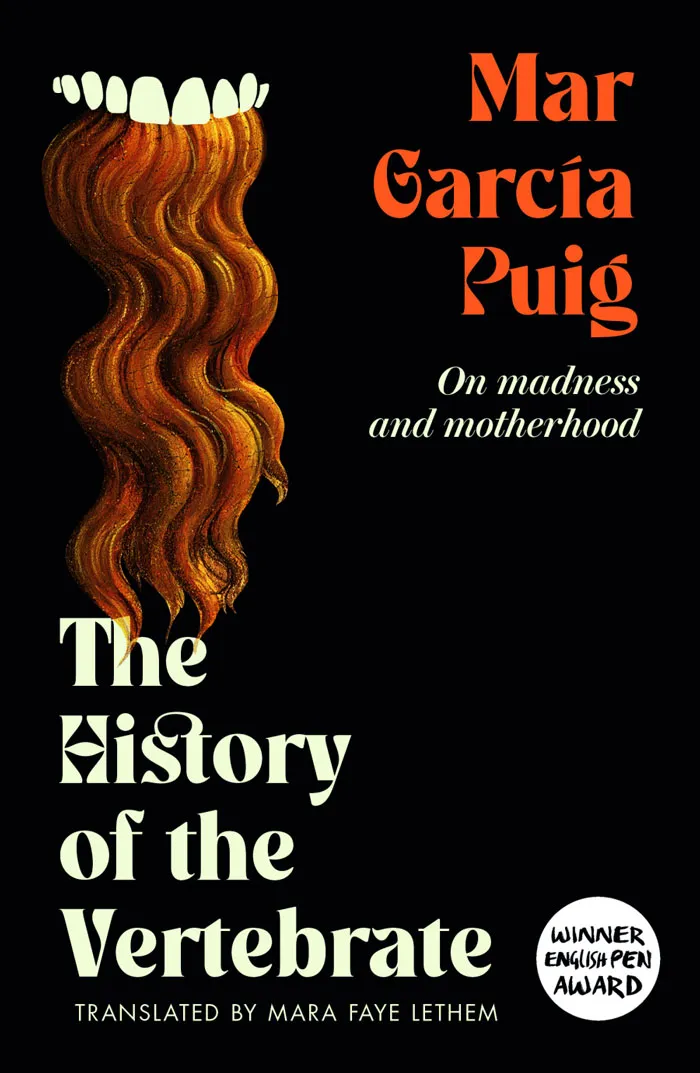
Cover of The History of the Vertebrate

Peninsula Press

The History of the Vertebrate

Mar García Puig, Mara Faye Lethem

‘On 20 December 2015 I became a mother and I went mad.’ 

On a single day, Mar García Puig gives birth to twins and becomes elected to the Spanish Parliament as a member of the insurgent left-wing party Podemos. What might have been the best day of her life becomes the start of a terrifying ordeal; García Puig’s grip on reality begins to slip as she grapples with uncertainty, the weight of expectation, and misogyny in both of her new roles. 

In defiance of a culture that tells her the problem lies within, García Puig chooses to look outwards, examining the imbrication of madness and motherhood across centuries of science, myth, and politics while dissecting the ways in which women have been pathologized and banished from public life. 

At once intimate and epic, The History of the Vertebrate is a searing account of postpartum madness. Moving between memory, culture, and the history of medicine, García Puig transforms her experience into a story about the countless women who have felt that sanity was leaving them, and about the patriarchal forces that have silenced them. 

MAR GARCÍA PUIG is an editor and author. From 2015 to 2023 she was a member of the Spanish Congress of Deputies for Podemos, where she served on the Culture Committee and the Equality Committee. Her books include The History of the Vertebrate and This Thing of Darkness.

Cover of 49 Venezuelan Novels

La Barba Metafísica

49 Venezuelan Novels

Sebastian Castillo, Elisa Díaz Castelo

Fiction €20.00

This new bilingual edition of Sebastian Castillo's long-out-of-print first book reintroduces a classic of American microfiction and features a translation into Spanish by acclaimed Mexican author Elisa Díaz Castelo.

Forty-nine pages of unique and surreal micro-fiction, Sebastian Castillo’s 49 Venezuelan Novels is a magical book with a new story on every page. Full of depth and imagination, Castillo uses imagery in a simple yet intense way. From stories of fish markets to spiteful violins, it almost seems that these novels are snippets of family stories long passed down, just now put to paper. With the nature of a born storyteller, Sebastian Castillo provides the readers of this fantastic read with gorgeous stories that define micro-fiction.

Cover of Secrèt

Dépense Défensive

Secrèt

Théo Robine-Langlois

Fiction €12.00

Mystique des rues vides et peu éclatantes des banlieues pavillonnaires, ce court poème en prose interpelle par sa langue sombre. Dans une parodie de messe noire – beigeasse comme le crépis des façades –, Théo Robine-Langlois dépeint le monde mystérieux des maisons individuelles, du repli sur soi démonique, et des vieilles qui marmonnent entre leurs gencives au retour du marché, le panier plein de gros sel et de radis noirs en guise d'hostie. Les mots occitans qui ponctuent le texte comme des conjurations en accroissent l’escur.

Cover of How to live from fire to fire

Kayfa ta

How to live from fire to fire

Olivier Marboeuf

Fiction €10.00

Olivier Marboeuf takes us on a journey through myths, archives, and fables, where fire symbolizes Caribbean culture, colonial oppression, and ecological disasters, and where the echo of past revolts becomes the spark for future insurrections.

How to Live from Fire to Fire brings together two closely linked texts by Olivier Marboeuf. The volume opens with Marboeuf's latest work, How to Live from Fire to Fire, written as a new commission, and is followed by the first English translation of his earlier text The Night Just Before the Fire, originally published in French in 2025 by Atlantiques déchaînés.

Written as if in the same breath, the two texts follow one another in a fevered, relentless movement. In The Night Just Before the Fire, Marboeuf reworks Bernard-Marie Koltès's play La Nuit juste avant les forêts (Éditions de Minuit, 1977), transforming it into the delirious, unbroken monologue of a man with dark blue skin calling out to another man in the streets of a major European city. Through this act of rewriting, the echo of past revolts becomes the spark for future insurrections. Next time, a riot.

"The French believed that burning the king of the carnival would suffice to erase these old stories and impose a modicum of order in the beautiful Caribbean colony. They thought that everyone would return home and that the streets would take on their usual amnesiac calm after this necessary moment of release. At the end of the celebration, on Ash Wednesday, King Vaval would be burned and along with him, corruption, excess, and bad lives would burn too. But nothing was said about monopolies. Because even when residents returned home, exhausted by the festivities, even when the dark of night cloaked this whole little world and emptied its public squares, water continued to flow dark from taps and poison snaked a path into the land and its gardens. Somewhere, forests and cities continued to burn."
—Olivier Marboeuf

Olivier Marboeuf (born 1971) is an author-storyteller, artist, independent curator, cultural theorist and film producer from Guadeloupe. In the early 1990s, he co-founded éditions Amok (now Frémok) publishing and launched the Parisian literary café Autarcic Comix. He was artistic director of Espace Khiasma (2004–2018) which contributed to introducing postcolonial theories to the French art scene through numerous exhibitions and encounters

Translated from the French by Liz Duff Young.

Cover of Modern Love

Primary Information

Modern Love

Constance DeJong

Fiction €18.00

Constance DeJong’s long-neglected 1977 novel, Modern Love, is one thing made up of many: It is science fiction. It is a detective story. It is a historical episode in the time of the Armada and the dislocation of Sephardic Jews from Spain to an eventual location in New York’s Lower East Side. It is a first-person narrator’s story; Charlotte’s story; and Roderigo’s; and Fifi Corday’s. It is a 150-year-old story about Oregon and the story of a house in Oregon. Modern Love’s continuity is made of flow and motion; like an experience, it accumulates as you read, at that moment, through successive moments, right to the end.

An important figure of downtown New York’s performance art and burgeoning media art scene in the late 1970s and early 1980s, DeJong designed Modern Love herself and published it with help from Dorothea Tanning on the short-lived Standard Editions imprint. Critically acclaimed in its time, Modern Love is now back in print on the 40th anniversary of its original publication.

Constance DeJong is an artist and writer who has worked for thirty years on narrative form within the context of avant-garde music and contemporary art. Considered one of the progenitors of media art, or “time-based media,” DeJong shapes her intricate narrative form through performances, audio installations, print texts, electronic objects, and video works. Since the 1980s, DeJong has collaborated with Phillip Glass, Tony Oursler, and the Builders Association on performances and videos at Walker Art Museum, Minneapolis, MN; the Wexner Center, Columbus, OH; Philadelphia Museum of Art; and in New York, at The Kitchen, Thread Waxing Space, the Whitney Museum of American Art, and the Dia Center for the Arts. Her books include I.T.I.L.O.E. and SpeakChamber, and her work is included in the anthologies Up is Up, But So is Down: New York’s Downtown Literary Scene, 1974–1991 (NYU Press, 2006); Blasted Allegories (New Museum/MIT, 1987); and Wild History (Tanam Press, 1985).

Cover of Self-Romancing

Dopamine Books

Self-Romancing

L Scully

Fiction €18.00

In a tonal mash-up of Jenny Holzer’s Truisms, confessional poetry, and fortune telling, Self-Romancing draws you into the amorous and obsessive inner life of an unnamed romantic. Relatable and snarky, heartfelt and horny, L Scully fortifies irony with vulnerability, bringing readers into a narrative as intimate as slumber parties and ordinary as Trader Joe’s. Bursting with the giddy charm of the everyday, Self-Romancing plays with form, turning a book into a crush, a crank call, a manifesto.