Books
Books
published in 2020

Deux Soeurs
From Audre Lorde and Adrienne Rich to Basma Alsharif and Pauline Oliveros, Deux Soeurs brings together a chorus of voices that explore representations of parenthood, friendship, and disobedience.
The book acts as a reader to artist Beatrice Gibson's films, I Hope I'm Loud When I'm Dead (2018) and Two Sisters Who Are Not Sisters (2019), and includes material that informed Gibson's working process, together with the artist's texts and notes used in both films. Turning to the figure of the poet as a guide in times of chaos, Deux Soeurs presents a framework for an ethics of artistic and social collaboration.

Piles of Bricks / Piles de briques
‘Piles of Bricks / Piles de briques’ by Bie Michels presents the working proces of her project ‘Bricks in Madagascar’. This project consists of two films, ‘La couleur de la brique’ and ‘Ingahy Kama’, the installation ‘Circular construction versus human body—referring to Toshikatsu Endo’, which she showed in Madagascar (October 2017) and Argos Brussels (May 2018), and the performance ‘Piles of bricks (working process)’, on which she will work 8 weeks before the book presentation and which will be performed at that moment.
Besides images and stills, five writers deliver a contribution in their own working field related to the project: Hobisoa Raininoro (Art assistent and former director of CRAAM (Centre de Ressources des Arts Actuels de Madagascar, MG), Rafolo Andrianaivoarivony (Professor History University of Antanarivo, MG), Petra Van Brabandt (Doctor philosophy Sint Lucas Antwerp, B), Gwyn Campbell (Professor History Mc Gill University, CA) and Nanne op ‘t Ende (writer, NL)

Lecture For Every One
During seven years, 16 performers spread Lecture For Every One throughout Europe. They intervened in more than 300 different gatherings, from a corporate sales meeting to a brass-band rehearsal and a municipal council. As uninvited guests, they addressed every one with exactly the same text. Until now, the project has remained largely invisible to the wider public. This book now sheds light on the information and expertise Lecture For Every One has generated—feedback, stories and memories from a range of perspectives. It reflects on how places where people gather can become political instances, on the (im)possibility of addressing every one, and on the value of fiction in our daily lives.
Sarah Vanhee is an artist, performer and writer. Her interdisciplinary work moves between the civilian space and the institutional arts sector, and is best known for its radical gestures and its engagement with non-dominant voices and narratives. Since 2007 she has created several onstage performances, (semi-)public interventions and site-specific works that have been widely presented internationally.
With texts & contributions by: Adinda Van Geystelen, Anabela Almeida, Anne Thuot, Anton Wilsens, Bojan Djordjev, Carola Bärtschiger, Christine De Smedt, Christophe Slagmuylder, Daniel Blanga Gubbay, Deborah Hazler, Edith Goddeeris, Elina Pirinen, Evelyne Coussens, Gurur Ertem, Iiris Viirpalu, Ilse Ghekiere, Jan De Brabanter, Jan de Zutter, Joe Kelleher, Katja Dreyer, Kristien Van den Brande, Kristof Blom, Lara Barsaq, Lex Bohlmeijer, Linda Sepp, Mariel Supka, Marika Ingels, Matthieu Goeury, Mylène Lauzon, Robin Vanbesien, Salka Ardal Rosengren, Sarah Vanagt, Sarah Vanhee, Silvia Bottiroli, Taziana Pyson and many others.
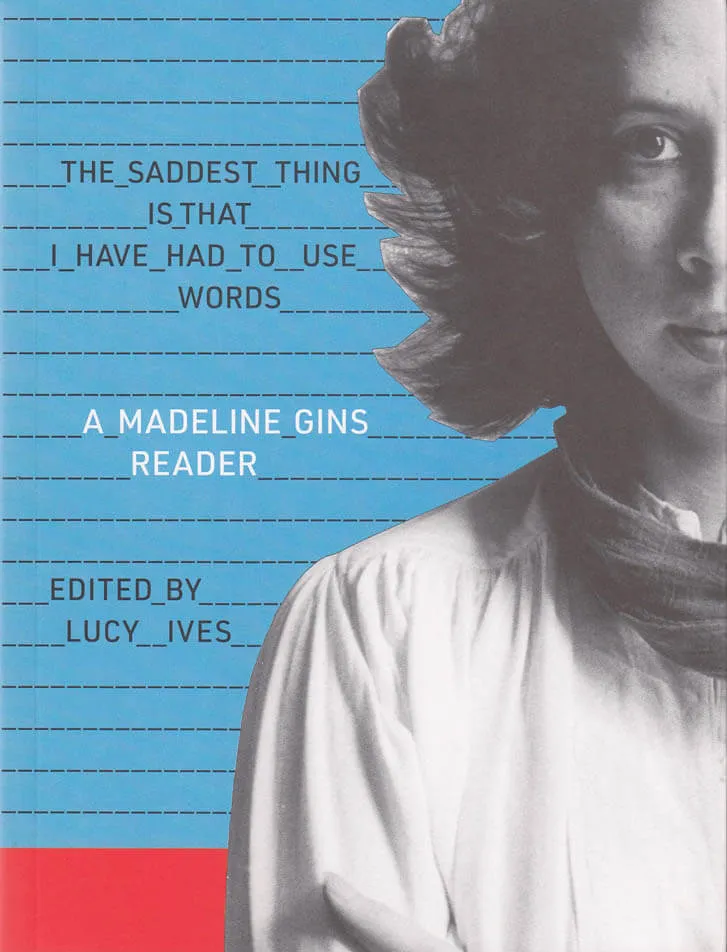
The Saddest Thing Is That I Have Had to Use Words: A Madeline Gins Reader
Poet, philosopher, speculative architect and transdisciplinary artist, Madeline Gins is well known for her collaborations with her husband, the artist Arakawa, on the experimental architectural project Reversible Destiny, in which they sought to arrest mortality by transforming the built environment. Yet, her own writings — in the form of poetry, essays, experimental prose and philosophical inquiries — represent her most visionary and transformative work. Like Gertrude Stein before her, Gins transfigures grammar and liberates words. Like her contemporaries in conceptual art, her writing is attuned to the energized, collaborative space between reader and page.
The Saddest Thing Is That I Have Had to Use Words: A Madeline Gins Reader is a revelatory anthology, edited and with an introduction by the writer and critic Lucy Ives. It brings never-before-published poems and essays together with a complete facsimile reproduction of Gins' 1969 masterpiece, WORD RAIN (or A Discursive Introduction to the Intimate Philosophical Investigations of G, R, E, T, A, G, A, R, B, O, It Says), along with substantial excerpts from her two later books What the President Will Say and Do!! (1984) and Helen Keller or Arakawa (1994). Long out of print or unpublished, Gins' poems and prose form a powerful corpus of experimental literature, one which is sure to upend existing narratives of American poetics at the close of the 20th century.
Edited by Lucy Ives.
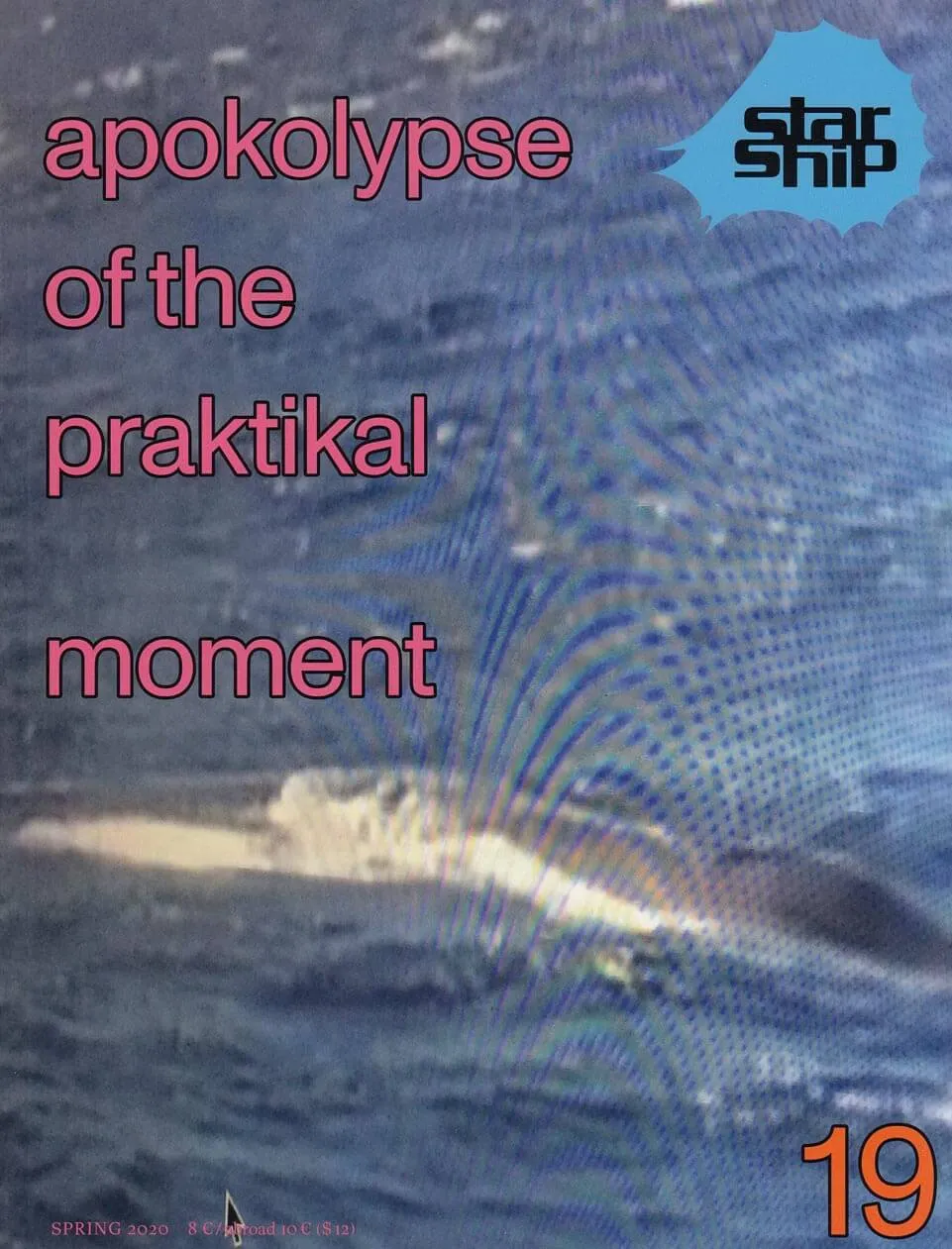
Apokolypse of the praktikal moment
Starship Magazine #19 presents contributions by John Boskovich, Elijah Burger, Simon Denny, Cornelia Herfurtner, Yuki Kimura, Vera Palme, Nora Schultz, Jack Smith; and by Rosa Aiello, Carter Frasier, María Galindo, Samuel Jeffery & Daniel Herleth, Elisa R. Linn, Paul B. Preciado, and Haytham El-Wardany
introducing new columnists: Mihaela Chiriac, Michèle Graf & Selina Grüter, Julia Jung, The Parliament of Bodies, and Ulla Rossek
and our columnists: Tenzing Barshee, Gerry Bibby, Mercedes Bunz, David Bussel, Eric D. Clark, Jay Chung, Hans-Christian Dany with Valérie Knoll, Francesca Drechsler, Stefanie Fezer & Vera Tollmann, Julian Göthe, Karl Holmqvist, Stephan Janitzky, Jakob Kolding, Lars Bang Larsen, Ariane Müller with Huang Rui, Robert M. Ochshorn, Mark von Schlegell, Max Schmidtlein, Amelie von Wulffen, and Florian Zeyfang
and artworks by Melvin Edwards, Elizabeth Ravn, Nong Shoahua, and Mark van Yetter.
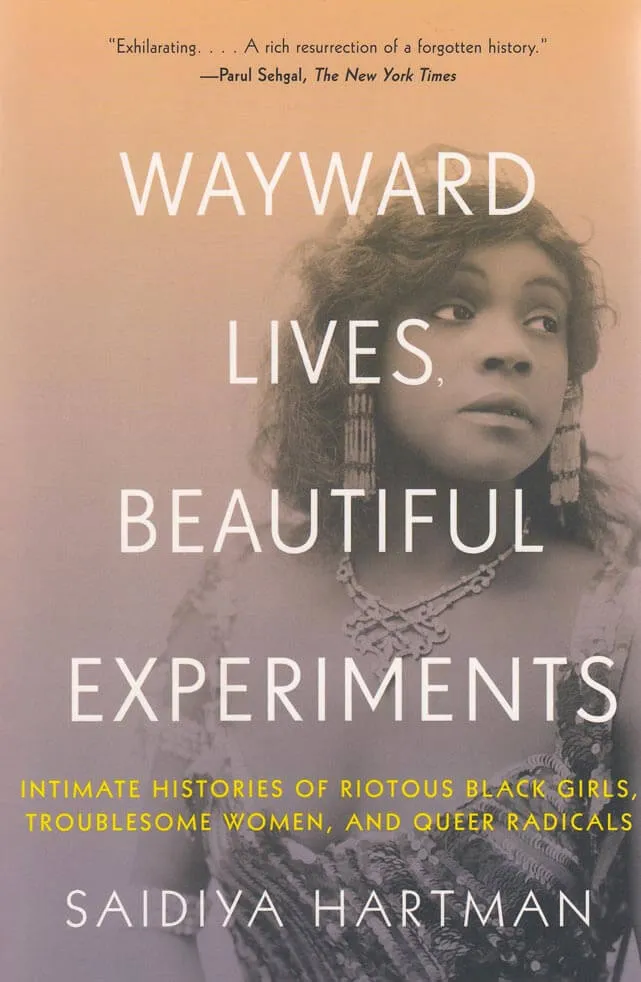
Wayward Lives, Beautiful Experiments
Wayward Lives, Beautiful Experiments examines the revolution of black intimate life that unfolded in Philadelphia and New York at the beginning of the twentieth century. In wrestling with the question of what a free life is, many young black women created forms of intimacy and kinship indifferent to the dictates of respectability and outside the bounds of law. They cleaved to and cast off lovers, exchanged sex to subsist, and revised the meaning of marriage. Longing and desire fueled their experiments in how to live. They refused to labor like slaves or to accept degrading conditions of work. Here, for the first time, these women are credited with shaping a cultural movement that transformed the urban landscape. Through a melding of history and literary imagination, Wayward Lives, Beautiful Experiments recovers these women's radical aspirations and insurgent desires.
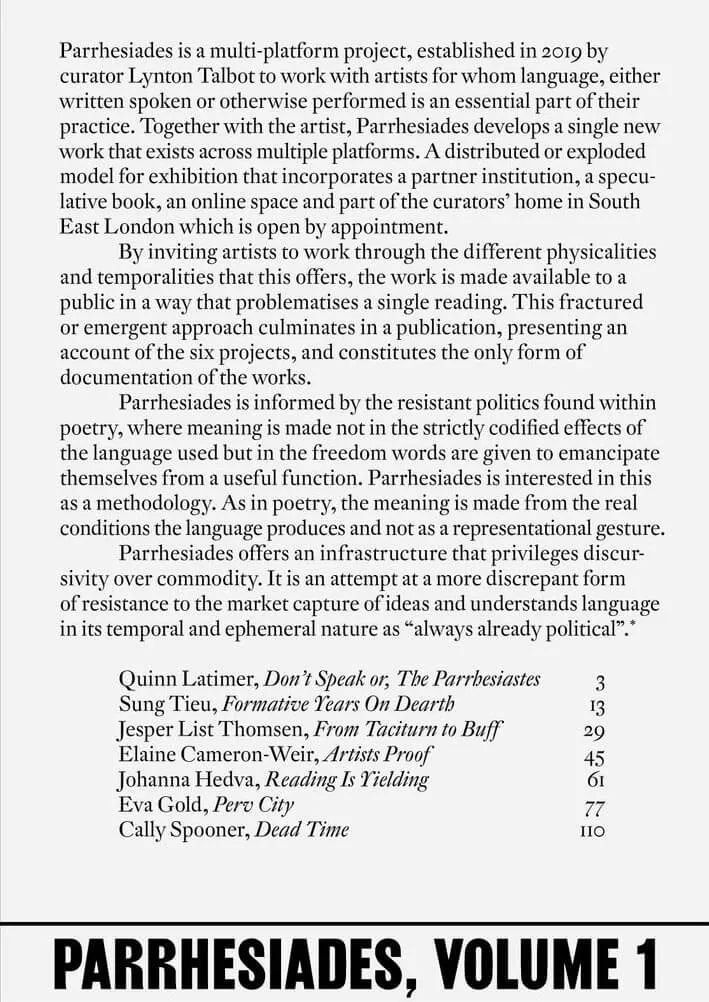
Parrhesiades Vol. 1
Parrhesiades is a multi-platform project, established in 2019 by curator Lynton Talbot to work with artists for whom language, either written spoken or otherwise performed is an essential part of their practice. Together with the artist, parrhesiades develops a single new work that exists across multiple platforms. With contributions by Quinn Latimer, Sung Tieu, Jesper List Thomsen, Elaine Cameron-Weir, Johanna Hedva, Eva Gold and Cally Spooner.
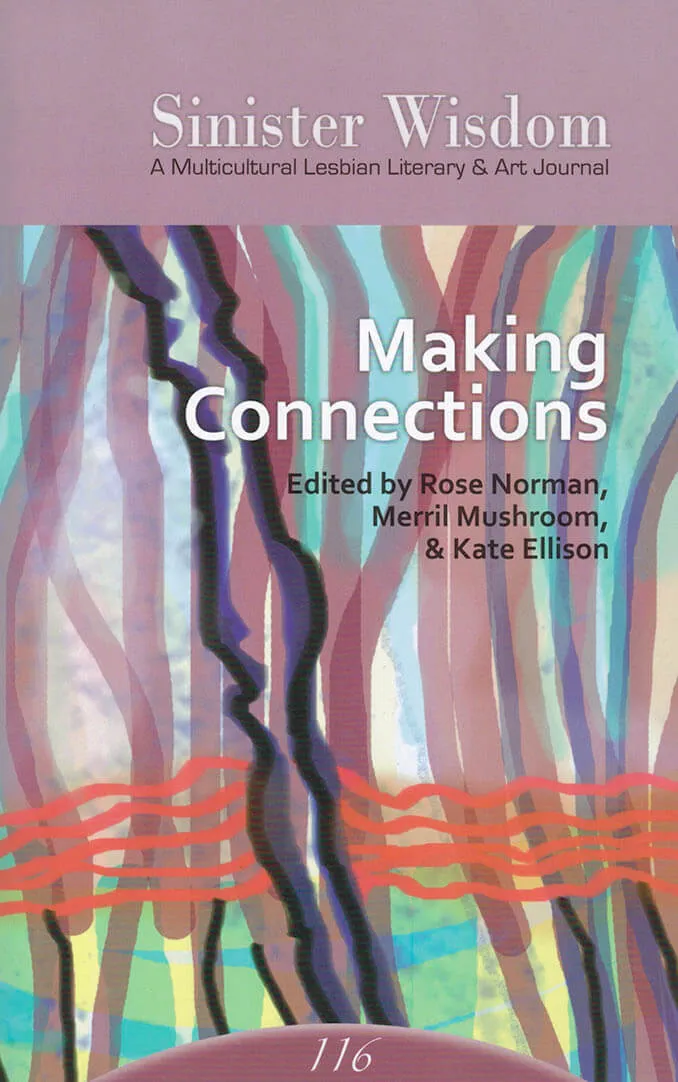
Making Connections
Kate Ellison, Merril Mushroom and 1 more
Making Connections is the fifth issue of Sinister Wisdom's series of work edited by the Southern Lesbian Feminist Activist Herstory Project, documenting the vital lesbian-feminist activism that proliferated in the US South during the 1970s, 1980s, and 1990s. Making Connections details the extensive networking of lesbian booksellers, publishers, writing groups, and newsletter through engaging interviews, first person narratives, and innovative graphic timelines.
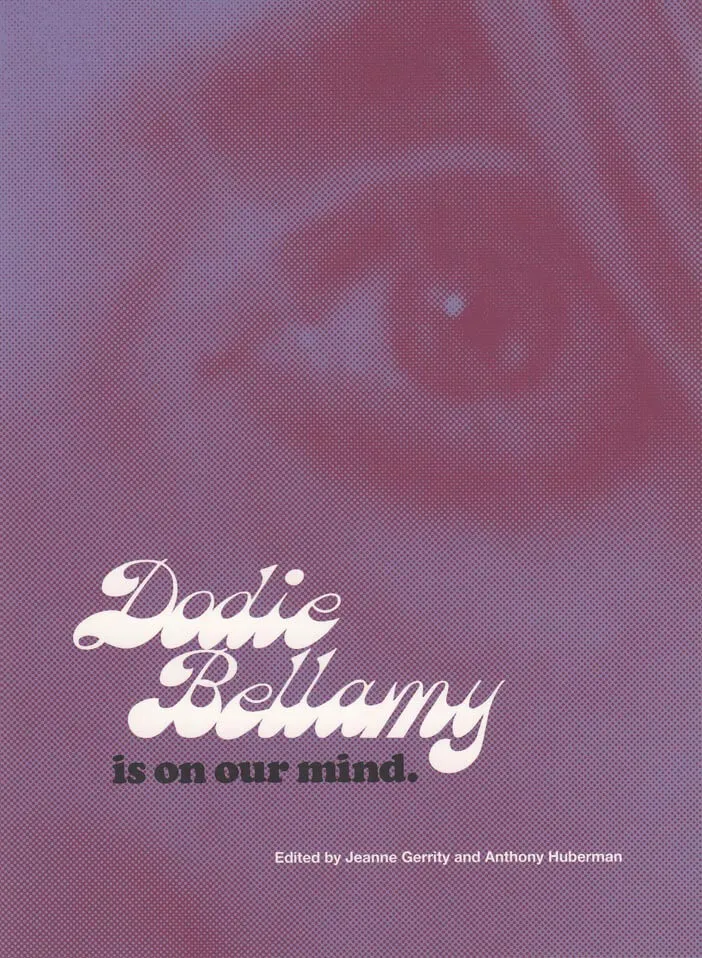
Dodie Bellamy Is on Our Mind
Anthony Huberman, Jeanne Gerrity
Examining the genre-bending writing of Dodie Bellamy, whose work has focused on sexuality, politics, feminism, narrative experimentation, and all things queer.
Dodie Bellamy Is on Our Mind is the first major publication to address Bellamy's prolific career as a genre-bending writer. Megan Milks made several trips to San Francisco in order to spend time with Bellamy and craft a provocative and fascinating profile of the writer. Originally delivered as a lecture at the Wattis Institute, Andrew Durbin's text takes the form of a personal essay, expertly weaving anecdotes of his own encounters with Bellamy's writing with insights into broader themes in her work. Academic Kaye Mitchell takes a close look at the role of shame and its relationship to femininity in particular texts by Bellamy. And Bellamy and her late husband Kevin Killian offer deeply personal, emotionally wrenching ruminations on topics from the mundane (drawing) to the profound (mortality). These texts, alongside archival photos and a complete bibliography make, this book an important compendium on Bellamy.
Dodie Bellamy (b. 1951, in North Hammond, Indiana) has lived and worked in San Francisco since 1978. A vital contributor to the Bay Area's avant-garde literary scene, Bellamy is a novelist and poet whose work has focused on sexuality, politics, feminism, narrative experimentation, and all things queer. In her words, she champions “the vulnerable, the fractured, the disenfranchised, the fucked-up.”
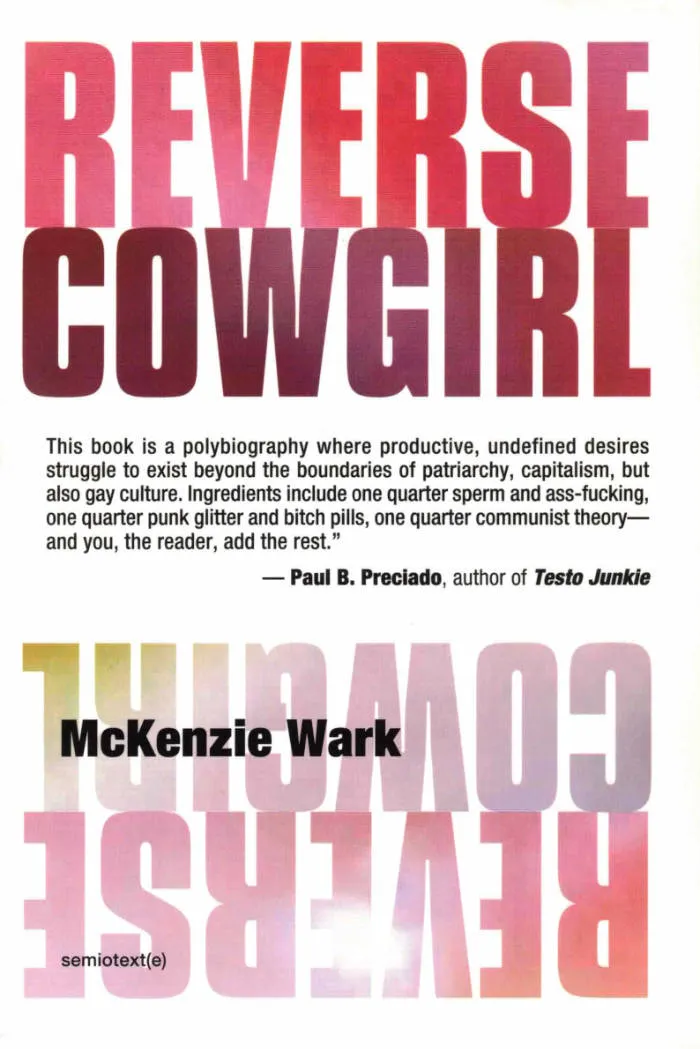
Reverse Cowgirl
McKenzie Wark invents a new genre for another gender: not a memoir but an auto-ethnography of the opacity of the self.
Another genre for another gender.
What if you were trans and didn't know it? What if there were some hole in your life and you didn't even know it was there? What if you went through life not knowing why you only felt at home in your body at peak moments of drugs and sex? What if you expended your days avoiding an absence, a hole in being? Reverse Cowgirl is not exactly a memoir. The author doesn't, in the end, have any answers as to who she really is or was, although maybe she figures out what she could become.
Traveling from Sydney in the 1980s to New York today, Reverse Cowgirl is a comedy of errors, chronicling the author's failed attempts at being gay and at being straight across the shifting political and media landscapes of the late twentieth century. Finding that the established narratives of being transgender don't seem to apply to her, Wark borrows from the genres of autofiction, fictocriticism, and new narrative to create a writing practice that can discover the form of a life outside existing accounts of trans experience: an auto-ethnography of the opacity of the self.
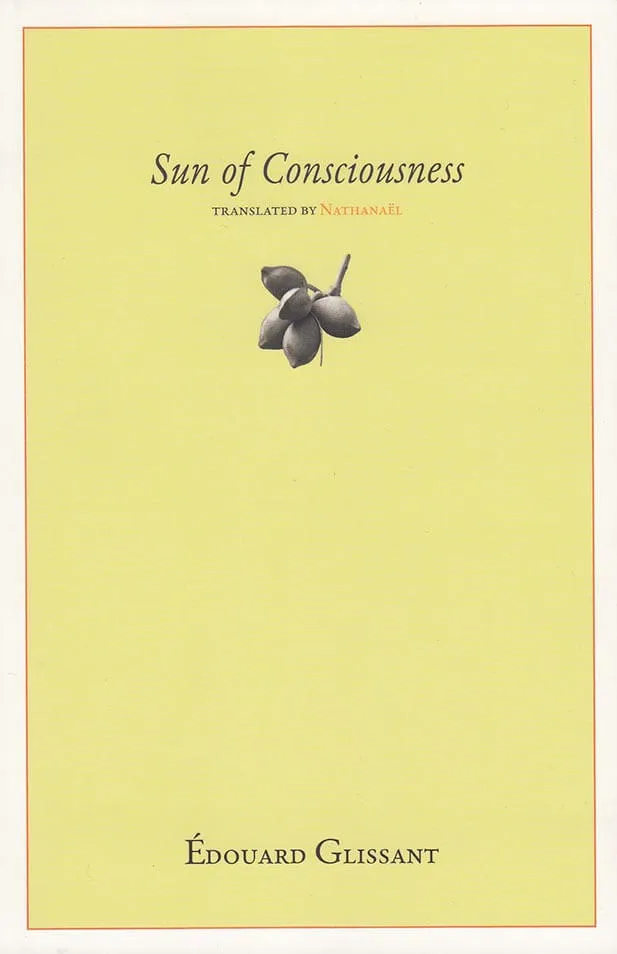
Sun of Consciousness
Soleil de la Conscience (Sun of Consciousness) was Martinican philosopher Édouard Glissant's first published work, and opened the Poétique (Poetics) strain of his oeuvre. This book-length essay, which is characterized by its exploratory, intimate character, announces Glissants concerns with créolisation (creolization), mondialité (worldliness, as against globalization), or opacité (opacity) and inscribes in this work a refusal of colonialism and of inverted exoticism. The sense of estrangement experienced by the author who arrives as a "foreigner" in a country to which he is bound by "the first page of his passport" is the author's principal preoccupation. By positioning himself as both different and same, Glissant opens a space for the writing of a(nother) history: that of the Caribbean.

Zizanies
As she tries to collect them for an essay that she is wanting to write, voices begin interfering in Clara’s Schulmann life. Voices of women, heard on the radio, in podcasts, songs, and films; voices of novelists or feminist theorists; voices of friends or of strangers overheard in the street. Like weeds, like bad seeds (what « zizanies » stands for in French), these wayward words invade her thoughts and her life, and the essay that she once had in mind unfolds in a picaresque tale full of twists and turns. Zizanies is a timely and elegant narrative that reveals Clara Schulmann as a new author whose own voice is going to matter in the years to come. (The texts in this book are French only.)

Ce Que Laurence Rassel Nous Fait Faire
Agathe Boulanger, Signe Frederiksen and 1 more
In 2018, a group of three visual artists — Agathe Boulanger, Signe Frederiksen and Jules Lagrange— started a year-long conversations with Laurence Rassel, exploring her social and educational background, her ways of working, and examining the tools she applies in her daily practice of running institutions: feminism, the open source and free software movements, and the institutional psychotherapy developed by François Tosquelles and Jean Oury in the psychiatric field around the mid-20th century.

Matters of Feminist Practice
Matters of Feminist Practice, edited by Poupeh Missaghi and Karla Kelsey, brings together scholars, writers, poets, and artists of different identities and backgrounds to confer on the urgent topic of “feminist practice” through seven topics: the body, the quotidian, hybridity, language, documentation, environment, and conflict.
In the twenty-five scholarly and creative-critical pieces included in our introductory volume, each contributor brings unique visions, insights, approaches, voices, and forms to launch the conversation, which will continue to unfold online at mfpjournal.com.
Contributors to the inaugural issue include: Alexis Almeida, Mary-Kim Arnold, Mildred Barya, Teresa Carmody, Julie Carr, Serena Chopra, Caroline Crumpacker, Lynne DeSilva-Johnson, Marcella Durand, Jennifer Firestone, Yanara Friedland, Carla Harryman, Madhu Kaza, Petra Kuppers, Jean Lee, Rachel Levitsky, Megan Madden, Saretta Morgan, Lida Nosrati, Adrienne Perry, Frances Richard, Kat Savino, Celina Su, and Rachael Guynn Wilson.

Forms Of Life Of Forms
FORMS OF LIFE OF FORMS brings artistic research into form – not merely as an aesthetic question but as a social and political one. Indeed, there are no politics without form! With Forms of Life, Rob Ritzen curated several “Moments” that assembled works, collective readings, and other references into a single installation. This publication reshuffles documentation of these “Moments” as a visual reflection of the trajectory of this research.
Rob Ritzen works as a curator with a background in philosophy. His curatorial practice is focusing on self-organized and cooperative formats. Consciously positioned at the margins of established institutions and outside of market-oriented spaces, his practice is placed in close association with communities of cultural practitioners. His initiatives are attempts to reconfigure the politics of making art and alternative forms of production and presentation.

ROT
ROT is a publication reflecting the research “Wicked technology/Wild fermentation,” by Sara Manente that focuses on forms and practice of fermentation as ways to rethink bodies and their making. This glossy magazine performs research, aiming to infect the reader, and questioning how to spread, publish, and help the work survive.
Sara Manente is a performance artist, dance maker and researcher born in Italy and living in Brussels. She is interested in narrowing the distance between the performer, the audience, and the work. Her research starts from a dance practice that problematizes perception, translation, and ways of doing. Her work comes out in hybrid forms: book launch, 3Dfilm, written text, interview, choreographic piece, workshop, telepathic experience, collaboration, et al.

Zoological Vandalism
ZOOLOGICAL VANDALISM by Sina Seifee in collaboration with editor Renan Lauran and designer Foad Farahani, is immersion in the compiling and composing of Seifee’s notes on medieval bestiaries, and placing them in sequential order. It is the first chapter of a series that creates context and opens small descriptive steps towards (what Latour might call) “knowing interestingly” about bestiaries. It is a speculative adventure in bio-techno tales and old styles of knowing. As an “ecology of obligation” with Iranian sensuality and its ardent materiality, somewhere in the menagerie of found and feral animal videos on Whatsapp and Telegram, is Seifee’s undisciplined grounding in visual crafts.
Sina Seifee researches as an artist in the fields of narrative, performance, and knowledge production. He has been working on the question of technology and storytelling in the arts and sciences of the middle ages and the past-present of material reading practices in collective life. He studied Applied Mathematics in Tehran, received his MA in Media Arts in KHM Cologne. In 2017 he finished an advanced research program in performance studies in a.pass.

Soon
By means of a dialogue between the text and the visual material from the videos, Steyn Bergs and Emma van der Put want to take a critical look at how images are mobilised, not only to illustrate certain visions of the future, but also how they contribute to the creation of such visions—which are never ‘neutral’—in the present. On the basis of the videos made by Van der Put, this publication focuses on the specific working and politics of images in the Noordwijk and the Expo area in Brussels. Within these locations, developments that are currently taking place throughout Europe (from property speculation to migration flows) manifest themselves in a concrete and local manner.

The Interjection Calendar 005
Emily Pope, Christiane Blattmann
For the Interjection Calendar each month Montez Press invites an artist, a writer, a poet or a doer of some sorts to say things. All 12 pieces have introspection and reflection in common. They are a subjective overview of writing in the expanded field of contemporary art and writing in the year 2019. This is the Interjection Calendar 2019, the fifth collection in this series.
With contributions by sabrina soyer, Lisa Robertson, Hatty Nestor, Adrianna Whittingham, Sondria, Claudia Pagès, Laetitia Paviani, Bella Milroy, Georgina Tyson, Son Kit, Alix Jean Vollum, Rene Matic and bleubaglife.
Find the last 12 PDF's on montezpress.com.

The Gendered Cable Manifesto
"Gender as a concept is not only applicable to humans. When the idea of gender is applied to the cables, its meaning is reduced into a relationship of insertion. As a non-binary individual and designer, I find this problematic that such way of classifying gender violently erases the existence of everyone that doesn’t neatly fit into those categories. However, instead of insisting on abolishing those terms, I discovered that the idea of gender that we applied to the electric cables functioning in very queer ways that we couldn’t expect." More on www.d-act.org.

Another Version: Thinking through Performing
ANOTHER VERSION: Thinking Through Performing approaches performance as a method of producing different versions of the self, referred to as ‘versioning’. It explores technologies and processes that produce such versions, and asks the question of how to understand the self within this multiplicity. ANOTHER VERSION: Thinking Through Performing proposes strategies of versioning as a means of attaching gesture, speech or lived experience to research questions or problems.
It is comprised of 7 cahiers containing games, scores, short stories, images, quotes and reflections that are often products of collaborative practices. Each cahier opens up a particular territory or lens, indicated through its title: CAHIER I Multiplicators, CAHIER II Pandiculators, CAHIER III Arena, CAHIER IV Objectaffilia, CAHIER V Animalities and CAHIER VI Ledger.
The content of each cahier is structured into eight categories: conversation, image as score, notes, quote, reference text, report, score and short story. These can be used as the reader/user sees fit, a story, an image or a quote can be used as a score, a score can be reversed or a reflection can be cut up and transformed into a new text.
Cahier 0 reflects and expands on the content of the publication and the research from which it springs. It contains a conversation Multiplicity, Multiplicators and the Supermarket Scorebetween Philippine Hoegen and Sebastian Olma, and an essay Ecstatic Methods — Seven Vectors Addressed to Philippine Hoegen by Kristien Van den Brande.

The Baudelaire Fractal
One morning, Hazel Brown awakes in a badly decorated hotel room to find that she's written the complete works of Charles Baudelaire. In her bemusement the hotel becomes every cheap room she ever stayed in during her youthful perambulations in 1980s Paris ... This is the legend of a she-dandy's life. Part magical realism, part feminist ars poetica, part history of tailoring, part bibliophilic anthem, part love affair with nineteenth-century painting, The Baudelaire Fractal is poet and art writer Lisa Robertson's first novel.
'As far as I'm concerned, it's already a classic.' - Anne Boyer

Beyond The Periphery Of The Skin
Feminist, antiracist, trans, ecological movements: all look at the body as a ground of confrontation with the state and a vehicle for transformative social practices. Concurrently, the body has become a signifier for the reproduction crisis generated by the neoliberal turn in capitalist development and for the international surge in institutional repression and public violence. In Beyond the Periphery of the Skin, lifelong activist and bestselling author Silvia Federici examines these complex processes, placing them in the context of the history of the capitalist transformation of the body into a work-machine, expanding on one of the main subjects of her first book, Caliban and the Witch. In this process she confronts some of the most important questions for contemporary radical political projects.

Night Philosophy
Night Philosophy is collected around the figure of the child, the figure of the child not just as a little person under the tutelage of adults, but also the submerged one, who knows, who is without power, who doesn’t matter. The book proposes a minor politics that disperses all concentrations of power. Fanny Howe chronicles the weak and persistent, those who never assimilate at the cost of having another group to dominate. She explores the dynamics of the child as victim in a desensitized era, when transgression is the zeitgeist and the victim–perpetrator model controls citizens.
With an afterword by Chris Kraus.