Translations
Translations

Howdunnit 2 - Panorama
Merle Kröger, Rubaica Jaliwala
Navina Sundaram is sitting in the editing room in Hamburg. She has managed to reduce the complexity of the Kemal Altun case to the required 2 minutes and 40 seconds for the political magazine; a journalistic feat considering the legal terminology and the international political situation, which must be presented in simple terms. She places her interview with the judge at the back. The audience therefore first gets an impression of perhaps the best-known deportation prisoner of the republic on trial here. The phone rings. I imagine she is displeased about the disturbance. It’s the day of the broadcast; the report still needs to be approved. It rings again. She answers. Peter Boultwood is on the phone and says, “Did you hear? Kemal jumped out of the window in the courtroom. He’s dead.”
Merle Kröger lives in Berlin where she works as a novelist, screenwriter and dramaturg. She was a member of the Berlin film collective dog film (1992–1999) and founded pong lm in 2001. Kröger is the co-author of Philip Scheffner’s internationally awarded films Revision (2012), Havarie (2016) and Europe (2022). Kröger has published five novels to date, including Grenzfall (2012), Havarie/ Collision (2015) and Die Experten/ The Experts (2021). Her novels have received numerous awards, including Best Crime Novel of the Year, the Radio Bremen Prize for Crime Fiction and the German Crime Fiction Prize.
Translated by Rubaica Jaliwala

The Hour of the Star
Clarice Lispector, Benjamin Moser
The devastating final work by Brazil’s greatest modern writer, The Hour of the Star tells the haunting tale of Macabéa—a typist who lives in the slums of Rio—underfed, sickly, and unloved, yet inwardly free.
Translated from the Portuguese by Benjamin Moser. With a contribution by Paulo Gurgel and Valente Colm Tóibín.
The Hour of the Star, Clarice Lispector's consummate final novel, may well be her masterpiece. Narrated by the cosmopolitan Rodrigo S.M., this brief, strange, and haunting tale is the story of Macabéa, one of life's unfortunates. Living in the slums of Rio de Janeiro and eking out a poor living as a typist, Macabéa loves movies, Coca-Cola, and her rat of a boyfriend; she would like to be like Marilyn Monroe, but she is ugly, underfed, sickly, and unloved. Rodrigo recoils from her wretchedness, and yet he cannot avoid realization that for all her outward misery, Macabéa is inwardly free. She doesn't seem to know how unhappy she should be. Lispector employs her pathetic heroine against her urbane, empty narrator—edge of despair to edge of despair—and, working them like a pair of scissors, she cuts away the reader's preconceived notions about poverty, identity, love, and the art of fiction. In her last novel she takes readers close to the true mystery of life, and leaves us deep in Lispector territory indeed.

Sea and Fog
These interrelated meditations explore the nature of the individual spirit and the individual spiritedness of the natural world. As skilled a philosopher as she is a poet, in Sea & Fog, Adnan weaves multiple sonic, theoretical, and syntactic pleasures at once.
Sea and Fog won the 2013 Lambda Book Prize in Poetry and the 2013 California Book Award in Poetry.
Etel Adnan was born in Beirut, Lebanon in 1925. She studied philosophy at the Sorbonne, U.C. Berkeley, and at Harvard, and taught at Dominican College in San Rafael, California, from 1958-1972. In solidarity with the Algerian War of Independence (1954-1962), Adnan began to resist the political implications of writing in French and became a painter. Then, through her participation in the movement against the Vietnam War (1959-1975), she began to write poetry and became, in her words, "an American poet." In 1972, she returned to Beirut and worked as cultural editor for two daily newspapers—first for Al Safa, then for L'Orient le Jour. Her novel Sitt Marie-Rose, published in Paris in 1977, won the France-Pays Arabes award and has been translated into more than ten languages. In 1977, Adnan re-established herself in California, making Sausalito her home, with frequent stays in Paris. Adnan is the author of more than a dozen books in English, including Journey to Mount Tamalpais (1986) The Arab Apocalypse (1989), In the Heart of the Heart of Another Country (2005), and Sea and Fog (2012), winner of the Lambda Literary Award for Lesbian Poetry and the California Book Award for Poetry. In 2014, she was awarded one of France's highest cultural honors: l'Ordre de Chevalier des Arts et Lettres. Many of her poems have been put to music by Tania Leon, Henry Treadgill, Gavin Bryars, Zad Moultaka, Annea Lockwood, and Bun Ching Lam. Her paintings have been widely exhibited, including Documenta 13, the 2014 Whitney Biennial, CCA Wattis Institute for Contemporary Arts, The New Museum, and Museum der Moderne Salzburg. In 2014, Mathaf: Arab Museum of Modern Art mounted a retrospective of her work.

My Manservant and Me
My Manservant and Me is a story about the trials and tribulations of having a live-in valet. Written from the uneasy perspective of an aging, incontinent author of extremely successful middlebrow plays, we learn about his manservant, a young film actor who is easily moved to both delicate gestures and terrible tantrums; who's been authorized to handle his master's finances, who orders stock buys, dictates his master's wardrobe, sleeps in his master's bed, and yet won't let him watch variety television. My Manservant and Me reveals the rude specificities of this relationship with provocative humor and stylistic abjection. This manservant won't be going anywhere.
Hervé Guibert (1955-1991) was a French writer and photographer. A critic for Le Monde, he was the author of some thirty books, most notably To the Friend Who Did Not Save My Life, which presents an intimate portrait of Michel Foucault and played a significant role in changing public attitudes in France towards AIDS.

Rip It Up
Rip It Up is the first ever English translation of Kou Machida's award-winning novel, an undertaking over five years in the making and the inaugural title of Inpatient Press's new translation imprint Mercurial Editions.
Set in a kaleidoscopic hyperreal Japan circa Y2K, Rip It Up catalogues the misdeeds and misgivings of a down-and-out wannabe debonair who ekes out a meager living at the fringes of the art world, wracked by jealousy at his friend's success and despondency of his own creative (and moral) bankruptcy. In turn hilarious and also horrifying, Machida's pyrotechnic prose plumbs the discursive depths of the creative spirit, a head-spinning survey of degeneration and self-sabotage.
Kou Machida is a punk singer, actor, and author, who turned to poetry and fiction after releasing one of the seminal Japanese punk albums with his band INU, 1981’s Meshi kuuna! (Fuck Eating!). He has won the Akutagawa and Tanizaki prizes among many others, and his 2005 novel Kokuhaku (Confession) was named one of the three best books of the last thirty years by the Asahi Newspaper.
Daniel Joseph is a translator, editor, and musician who spent his salad days shouting in dank basements before getting a master’s degree in medieval Japanese literature. Recent translation projects include contributions to Terminal Boredom (Verso, 2021), a collection of stories by science fiction pioneer Izumi Suzuki; and the memoir Try Saying You’re Alive! (Blank Forms, 2021) by outsider folk maniac Kazuki Tomokawa.
Winner of the 2000 Akutagawa Prize for Fiction

كيف تلتئم – عن الأمومة وأشباحها - How to Mend: Motherhood and Its Ghosts
A highly personal and sensitive exploration of motherhood.
In How to Mend: On Motherhood and its Ghosts, Iman Mersal navigates a long and winding road, from the only surviving picture of the author has with her mother, to a deep search through what memory, photography, dreams and writing, a search of what is lost between the mainstream and more personal representations of motherhood and its struggles. How to mend the gap between the representation and the real, the photograph and its subject, the self and the other, the mother and her child.
"If I'd been more aware and someone had asked me about 'my mother's picture' I would have shown them the bird she'd stitched onto the canvas herself. It is not aesthetic vision or skill that summons my mother's presence in this canvas, but the slight punctum the bird gives me. I get nothing of this sort from our studio portrait. The bird's eyes are always looking at me, as though they belong to her. The bird: motionless, for whose sake my mother sat and stitched by the window where the light came in, each pinprick a symbolic laceration in the process of its embodiment: cuts by the hundred to make it whole."
Iman Mersal (born 1966 à Mit 'Adlan) is an Egyptian poet, writer, academic and translator. She works as an Associate professor of Arabic literature and Middle Eastern studies at the University of Alberta, Canada. An anthology of her works was translated into more than twenty languages and she has five poetry collections published.

How to Mend: Motherhood and Its Ghosts
In How to Mend: On Motherhood and its Ghosts, Kayfa ta’s 4th monograph, Iman Mersal navigates a long and winding road, from the only surviving picture of the author has with her mother, to a deep search through what memory, photography, dreams and writing, a search of what is lost between the mainstream and more personal representations of motherhood and its struggles. How to mend the gap between the representation and the real, the photograph and its subject, the self and the other, the mother and her child.
Iman Mersal is an Egyptian poet and associate professor of Arabic Literature and Middle Eastern Studies in the University of Alberta, Canada.
Editors: Maha Maamoun and Ala Younis
Co-publishers: Kayfa ta and Sternberg Press
Design: Julie Peeters
Size: 9.6 x 14.8 cm

Visualisation. L'interprétation modélisante
Les diagrammes, cartes et visualisations de données ont conquis le domaine de la recherche en arts, lettres et sciences humaines. Pour certains chercheurs, ces formes graphiques consistent à exploiter des données quantitatives jusqu’ici délaissées, pour d’autres, elles offrent la possibilité d’explorer les relations discrètes qu’entretiennent des corpus hétérogènes. Mais sur quels fondements épistémologiques reposent ces opérations techniques et intellectuelles ? Dans le cadre de la production du savoir et de son interprétation en régime numérique, est-il possible de dépasser le simple effet d’affichage des données, certes bluffant au premier abord, et d’envisager autrement les interfaces et les logiciels ?
Considérée aujourd’hui comme l’une des plus importantes théoriciennes des humanités numériques, Johanna Drucker livre dans cet ouvrage, spécialement rédigé pour la collection, une alternative aux formes dominantes de la visualisation de l’information. Héritière de la tradition humaniste, elle propose une approche qui réhabilite l’idée d’un sujet situé et incarné qui expérimente et conceptualise les connaissances par le prisme de la représentation graphique.

La Gentrification des Esprits
La Gentrification des esprits est un retour captivant sur la crise du sida et l’activisme d’ACT UP dans le New York des années 1980 et 1990. Sarah Schulman, elle-même new-yorkaise et militante de la cause LGBT, se souvient de la disparition du centre-ville, pratiquement du jour au lendemain, de la culture rebelle queer, des loyers à bas coût et du prolifique mouvement artistique qui se développait au coeur de Manhattan, remplacés par des porte-parole gays conservateurs, ainsi que par le consumérisme de masse.
Elle décrit avec précision et engagement le « remplacement d’une communauté par une autre » et le processus de gentrification qui toucha ces quartiers concomitamment à la crise du sida. Sarah Schulman fait revivre pour nous le Lower East Side qu’elle a connu. Elle ravive autant le souvenir de ses ami•e•s de l’avant-garde queer que celui de l’ombre inquiétante des premières années de la crise du sida, telles que vécues par une militante. Les souvenirs personnels s’entremêlent à une analyse percutante des deux phénomènes, et du poids invisible qu’ils font aujourd’hui peser sur la société américaine.
L’auteure rend compte de son expérience en tant que témoin de la « perte de l’imagination » de toute une génération, et des conséquences entraînées par cette perte.

Le conflit n’est pas une agression
Des relations intimes aux politiques globales, Sarah Schulman fait le constat d’un continuum: individus comme États font souvent basculer les situations conflictuelles dans le registre de l’agression, criminalisant leurs opposants pour couper court à la contradiction et échappant ainsi à leur propre responsabilité dans les conflits. En distinguant conflit et agression, l’autrice interroge notre culture de la stigmatisation.
Ce travail profond, aussi courageux qu’impertinent, montre comment la sanction et la répression prennent le pas sur l’auto-analyse à l’échelle individuelle et collective, et comment l’altérité sert de justification à la violence et à l’exclusion. Ce livre intentionnellement polémique offre un aperçu des dynamiques contemporaines et historiques qui prennent les différences intimes, raciales et géopolitiques pour des éléments déclencheurs de la course à l’injustice, à l’exclusion et à la répression.
Le conflit n’est pas une agression est un virulent plaidoyer contre le phénomène culturel de l’accusation, révélant combien les personnes en situation de pouvoir exacerbent et manipulent la crainte de l’« autre » pour éviter toute remise en question.

Mon musée de la Cocaïne
L’or et la cocaïne sont les deux matériaux bruts de Mon musée de la Cocaïne. C’est au cours de leur transformation et raffinement que ces deux substances ramènent avec elles une histoire de l’oppression et de l’esclavage.
Dans ce livre, l’anthropologue australien Michael Taussig prend comme point de départ la proposition de bâtir un musée de la Cocaïne (qui serait l’image reflétée du musée de l’Or de la Banque de la République à Bogotá) et dresse un portrait sans concession de la vie des mineurs afro-colombiens aspirés dans le monde dangereux de la production de cocaïne au fin fond de la forêt tropicale, sur la côte pacifique de la Colombie. Il décrit la violence, la pauvreté, mais aussi les croyances qui surgissent des marais envahis de mangroves et des rivières tropicales qui, pendant plus de cinq cent ans, ont attiré, ruiné et décontenancé Amérindiens, orpailleurs, conquistadors et pirates, esclaves africains, ingénieurs russes et guérilleros marxistes.
Mon musée de la Cocaïne se présente comme un assemblage éclectique d’histoires et d’anecdotes, présenté comme autant de salles d’un hypothétique musée de la Cocaïne, au sein desquelles le lecteur est invité à déambuler, en croisant des références qui vont de Charles Dickens à Franz Kafka en passant par la poésie de Seamus Heaney.

Palma Africana
Dans Palma africana, l’anthropologue australien Michael Taussig explore la production d’huile de palme en Colombie. Alors que cette dernière envahit tout, des chips au vernis à ongles, l’auteur examine les conséquences écologiques, politiques et sociales de cette exploitation.
Bien que la liste des horreurs induites par la culture du palmier à huile soit longue, nos terminologies habituelles ne permettent plus de rendre compte des réalités qu’elles décrivent. À travers cette déambulation anthropo-poétique au cœur des marécages colombiens, c’est donc la question du langage que l’auteur interroge. Comme William Burroughs, pour qui les mots sont aussi vivants que des animaux et n’aiment pas être maintenus en pages – Michael Taussig souhaite couper ces dernières, et les rendre à leur liberté.
Pensé à partir d’une vie d’exploration philosophique et ethnographique, Palma africana cherche à contrecarrer la banalité de la destruction du monde et offre une vision pénétrante de notre condition humaine. Illustré de photographies prises par l’auteur et écrit avec la verve expérimentale propre à l’anthropologue, ce livre est le Tristes Tropiques de Michael Taussig pour le XXIe siècle.
Traduit de l’anglais par Marc Saint-Upéry.

Les sous-communs – Planification fugitive et étude noire
A political and aesthetic critique of racial capitalism and modes of social experimentation in the form of resistance to the colonial commons.
Stefano Harney (born 1962) is Honorary Professor at The Institute of Gender, Race, Sexuality and Social Justice at the University of British Columbia and a Visiting Critic at Yale School of Art. He has held teaching positions in New York, Leicester, London, and Singapore. He now teaches at the Dutch Art Institute. An interdisciplinary scholar, his research spans (the intersections of) social sciences, arts and humanities, as well as the fields of business and management.
Preface by Jack Halberstam.
Collective translation (original title: The Undercommons: Fugitive Planning & Black Study, Minor Compositions, 2013).
Graphic design: Sophie Demay & Maël Fournier-Comte (In the Shade of a Tree).
published in February 2022
French edition
12,5 x 19,5 cm (softcover)
208 pages

Self-portrait
Allison Grimaldi Donahue, Carla Lonzi and 1 more
Recorded and transcribed throughout the 1960s, Carla Lonzi’s Self-portrait ruptures the narration of post-war modern art in Italy and beyond. Artmaking struck Lonzi as an invitation to be together in a ‘humanly satisfying way’, and this experiment in art-historical writing is a testament to her belief. Lonzi abolishes the role of the critic, her own, seeking change over self-preservation by theorising against the act of theorising.
The life and work of Carla Lonzi (1931–1982) is inseparable from the cultural, political, and social history of Italy in the decades following the Second World War; she occupies a singular position, which today merits reevaluation. A reputed art critic of the 1960s artistic scene, both friend and collaborator of such figures as Carla Accardi, Luciano Fabro, Giulio Paolini, and Jannis Kounellis, she wrote “Autoportrait” in 1969, a “love letter” to the artists and to creation, but also a farewell chorus to art criticism and the art world. The following year she founded Rivolta Femminile, an active feminist collective, thus becoming the central figure of Italian feminism.
Interviews with Carla Accardi, Getulio Alviani, Enrico Castellani, Pietro Consagra, Luciano Fabro, Lucio Fontana, Jannis Kounellis, Mario Nigro, Guilio Paolini, Pino Pascali, Mimmo Rotella, Salvatore Scarpita, Guilio Turcato, Cy Twombly.
Afterword by Claire Fontaine.
Translated by Allison Grimaldi Donahue.
978-1916425088
105 b&w illustrations
21.6 x 13.9 cm
364 p.
Paperback
November 2021

Hurricane Season
Fernanda Melchor, Sophie Hughes
The Witch is dead. And the discovery of her corpse—by a group of children playing near the irrigation canals—propels the whole village into an investigation of how and why this murder occurred. Rumors and suspicions spread. As the novel unfolds in a dazzling linguistic torrent, with each unreliable narrator lingering details, new acts of depravity or brutality, Melchor extracts some tiny shred of humanity from these characters that most would write off as utterly irredeemable, forming a lasting portrait of a damned Mexican village.
Like Roberto Bolano's 2666 or Faulkner's novels, Hurricane Season takes place in a world saturated with mythology and violence—real violence, the kind that seeps into the soil, poisoning everything around: it's a world that becomes more and more terrifying the deeper you explore it.
Translated by Sophie Hughes.

Poetic Intention
This is the first English-language translation of Poetic Intention, Glissant’s classic meditation on poetry and art. In this wide-ranging book, Glissant discusses poets, including Stéphane Mallarmé and Saint-John Perse, and visual artists, such as the Surrealist painters Matta and Wilfredo Lam, arguing for the importance of the global position of art. He states that a poem, in its intention, must never deny the “way of the world.” Capacious, inventive, and unique, Glissant’s Poetic Intention creates a new landscape for understanding the relationship between aesthetics and politics.
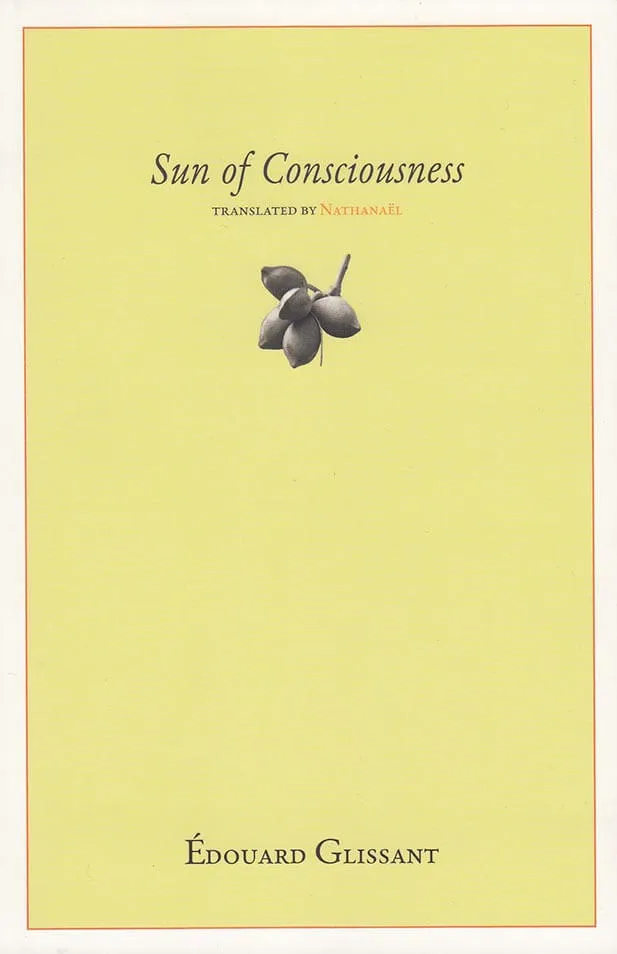
Sun of Consciousness
Soleil de la Conscience (Sun of Consciousness) was Martinican philosopher Édouard Glissant's first published work, and opened the Poétique (Poetics) strain of his oeuvre. This book-length essay, which is characterized by its exploratory, intimate character, announces Glissants concerns with créolisation (creolization), mondialité (worldliness, as against globalization), or opacité (opacity) and inscribes in this work a refusal of colonialism and of inverted exoticism. The sense of estrangement experienced by the author who arrives as a "foreigner" in a country to which he is bound by "the first page of his passport" is the author's principal preoccupation. By positioning himself as both different and same, Glissant opens a space for the writing of a(nother) history: that of the Caribbean.

Vampyroteuthis Infernalis
Vilem Flusser, Rodrigo Maltez Novaes
Flusser introduces an infernal creature from the oceanic abysses, who slowly emerges, not from the oceans, but from man's own depths to gaze spitefully into his eyes and reflect back at his own existence.
Originally published only in German in 1987, this version has been edited and translated by Rodrigo Maltez Novaes, Ph.D. candidate at the European Graduate School, Saas-Fee, under the supervision of Prof. Dr. Siegfried Zielinski, from the original, unpublished and extended Brazilian-Portuguese version of the manuscript recently found at the Vilém Flusser Archive at the Universität der Kunst, Berlin. This edition is also accompanied by a selection of previously unpublished excerpts from Flusser's correspondence with Milton Vargas and Dora Ferreira da Silva, with whom he discussed the development of the present text.

My Mother Laughs
Chantal Akerman, Daniella Shreir
In 2013, the filmmaker Chantal Akerman's mother was dying. She flew back from New York to Brussels to care for her, and between dressing her, feeding her and putting her to bed, she wrote. She wrote about her childhood, the escape her mother made from Auschwitz but didn't talk about, the difficulty of loving her girlfriend, C., her fear of what she would do when her mother did die. Among these imperfectly perfect fragments of writing about her life, she placed stills from her films. My Mother Laughs is both the distillation of the themes Akerman pursued throughout her creative life, and a version of the simplest and most complicated love story of all: that between a mother and a daughter.
With an introduction by Eileen Myles and afterword by Frances Morgan.

Writing Out Loud
Writing Out Loud is a publication that brings together the transcriptions of eight lectures by the artist Jon Mikel Euba that were live translated from Spanish to English during the course Action unites, words divide (On praxis, an unstated theory) at the DAI. The lectures were delivered across the academic year 2014 – 2015 at the invitation of If I Can’t Dance. They sit within a larger writing-centred project by the artist that he has pursued for almost a decade, through which he aims to define a form of praxis that could evolve into a technical theory.