Books
Books
in random order

Hardscapes / Here
Hardscapes / Here documents and brings together two exhibition projects by artists Nina Canell and Maria Hassabi. Produced on the occasion of the exhibitions of the same name curated by Samuele Piazza at the OGR Torino, the publication consists of two graphically specular books that merge into a single volume. Essays, unpublished materials and a rich set of photographic materials form the driving force behind two visual narratives that offer new keys to understanding the research of the two artists.
Hassabi's live installation Here calls on visitors to share space and spend time with six performers portrayed in a decelerated rhythmic choreography within a sculptural environment. In constant motion, the dancers contribute to a situation of shifting presence, demonstrating the contestable nature of the "here and now." Immobility and slowing down are thus used both as techniques and as subjects of representation: the performing bodies oscillate between dance and sculpture, subject and object, living body and static image.
Canell's Hardscapes combines two works that focus on the concepts of circulation and transformation as well as on unexpected forms of coexistence. Energy Budget (2017–18), a video that alternates between two subjects: a basement in which a leopard snail crawls over an electrical panel, and the gradual shifting of the frame away from "dragon gates"—portal-like openings in huge buildings on the Hong Kong waterfront. Muscle Memory (16 Tonnes) (2020–21) is a floor sculpture, decomposed and transformed by the density of moving bodies, which literally crumbles under the soles of passing visitors.
In addition to texts by the curator, the publication includes essays by Felicia Leu and Laura Preston, along with a conversation by Maria Hassabi and Nina Canell with Lorenzo Giusti.
Published on the occasion of the epoymous exhibitions at OGR Torino in 2022.
Edited by Samuele Piazza.
Texts by Lorenzo Giusti, Felicia F. Leu, Samuele Piazza, Laura Preston.

Terminal Boundaries and A natural water course diverted reduced or displaced
Made in 1969 but never published, Terminal Boundaries is an artist book by Lawrence Weiner, a sculptor whose medium was language. The manuscript for the publication, which was recently brought to light, contains two related bodies of work represented as typewritten statements on paper that Weiner pasted to the pages of a small composition notebook. The book’s absence from Weiner’s oeuvre plagued him as it marked a terminus of his relationship to the physical construction of his artworks, and illustrated the principle of “specific” and “general” which he applied to his art.
Created from a standard notebook purchased in a stationery store, the manuscript is two books in one: Terminal Boundaries and A natural watercourse diverted reduced or displaced. A tête-bêche with two front covers, the book can begin from either cover by turning it upside down.
Weiner was a traveler by nature and the materials he refers to in these works are those that one can encounter on a road trip. The artist was traveling across Europe when this manuscript was composed. Struck by the tumultuous times and the critical illuminations about the climate from the Club of Rome discussions, the works in this book are in Weiner’s words, “concerned with the relationship of natural resources in relation to human beings.” Distinct from his contemporaries associated with the Land Art movement, in Terminal Boundaries and A natural water course diverted reduced or displaced, Weiner constructs his landscape interventions in language—the specific and/or general act and the location are stated—offering the reader/viewer the opportunity to consider each work’s existence, to build it in their mind’s eye. One can only wonder what Weiner did to divert, reduce, or displace a natural water course in Saltsrumen, Norway, the location of the world’s strongest maelstrom, or in nearby Bodø at the site of Svartisen glacier. A work in Terminal Boundaries titled The joining of France Germany and Switzerland by rope demonstrates the geopolitical perspective of Weiner’s land art. Requiring physical and mental borders to be transgressed in performing this work; how and where could this happen?
Terminal Boundaries finds Weiner just off the cusp of his decision to make art that lived centered in language, emphasizing the viewer’s responsibility to engage with it to make it whole. The book marks a crucial inflection point in the artist’s practice, defining his direction to make work that “attempts to present something to people that is not just about me,” but about materials and the world we find ourselves in here and now.

The Refusalist International
The many mass protests that have taken place since 2011 have been characterised by an unmistakable need to challenge, overthrow and destroy the prevailing political representations without proposing new ones. The protests are not concerned with replacing the current government or leader with others, and thus getting a better version of what we already have. Instead, they refuse all leaders, including the most critical opposition leaders: these protests are about dismantling the need for leaders. More and more people are coming to the view that it is not possible to manage the many crises within the framework of the political institutions we have today.
The new protests are political acts that are neither class struggle nor the establishment of an opposition to those in power. Rasmussen argues that we should understand these protests as the emergence of a new kind of revolutionary action that is as much an anthropological as a political transformation: it is an attempt to break free from all the traditional notions of how the social context that we call society and the nation-state is organised.

Anarchitecture After Everything: A Trans Manifesto
A revolutionary way of seeing bodies and built environment that unites radical politics and trans aesthetics.
From a leading author and queer theorist known for reframing many of the most pressing questions about counter-intuitive ways of being.
Anarchitecture, a radical aesthetic practice of unmaking the built environment, staged a vigorous confrontation with urban renewal and gentrification projects in the 1970s. In Anarchitecture After Everything, Jack Halberstam identifies a powerful lexicon of transformation within anarchitecture, joining the movement’s practices of cutting and splitting with the destabilizing power of transness to detonate acts of formal violence in our time.
Anarchitecture describes the aesthetic practice of splitting and cutting, dismantling and undoing, unmaking, unbuilding, and ultimately unworlding. The trans body splits bodily coherence, dismantles the gender binary, and unbuilds bodily meaning. In these chapters, Gordon Matta-Clark’s cuts, along with Alvin Baltrop’s 1970s images of collapsing warehouses and Beverly Buchanan’s post-demolition fragmentary sculptures, return with a vengeance through the contemporary aesthetic gestures of Yve Laris Cohen, Jesse Darling, Nicole Eisenman, Kiyan Williams, Cassils, boychild, and Every Ocean Hughes. Anarchitecture unmakes space and offers a new rhetoric for emptiness. In its conclusion, the book explores this rhetoric through Renee Gladman’s anarchitectural experiments with language.
By reading anarchitecture through transness and transness through anarchitecture, Halberstam helps us see the trans body as a space of radical unmaking and as a portal to new lexicons for transformation.

Hack 'N' Slash
Kamil Bouzoubaa-Grivel réalise au printemps 2020 la série de dessins Hack’n’slash.
Ces collages sont faits à partir d’aplats de couleur autocollants Letrafilm Color/Tint Overlay, que l’on pourrait traduire par Couleur/Teinte Superposition, permettant ainsi de nommer l’importance des jeux de profondeur qui s’y trouvent.
L’artiste se calque là-dessus et joue alors avec la confrontation entre le hack: détournement et réemploi d’outils techniques (trames numériques, encres d’imprimante, dessin manuel) – et le slash: le fait de trancher/juxtaposer les formes venant de différentes dimensions pour composer ses dessins.
Chaque édition a une couverture unique sérigraphiée sur du papier Pantone Letraset par l’Atelier PPP et un texte critique-fiction de Mia Brion.
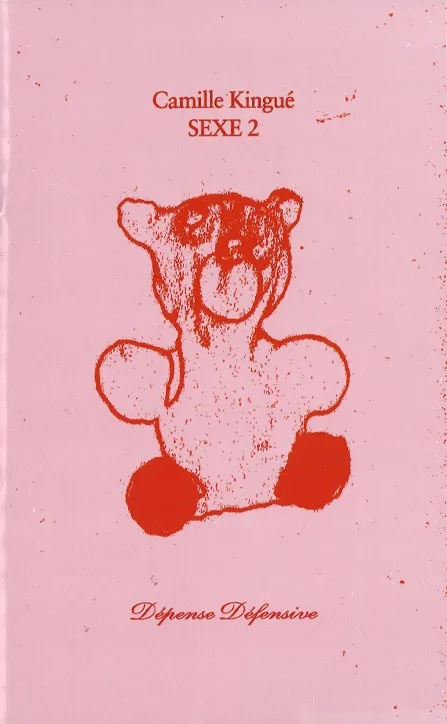
Sexe 2
Confession sur le désir (l’action et l’objet du), les liens de mutualité et de résistance, Sexe 2 alterne prose et versification en 27 fragments numérotés à l’adresse plus ou moins dure, plus ou moins sincère, plus ou moins formulée car plus ou moins éloignée du Toi et du Je. Camille Kingué s’attache à révéler, à voir quelque chose à travers son image réelle et virtuelle, agrandie et rétrécie, droite et renversée, déployant une recherche des principes de l’amour (l’amour comme amour, pourquoi est ce qu’il y a de l’amour) où la métaphysique et la compréhension de soi – donc de l’autre – n’ont jamais été aussi sexy.
Claire Star Finch, dans la magnifique préface qu’iel signe au début de l’ouvrage, écrit : « Après avoir lu tous les livres de Kingué, je ne sais pas si je crois en “l’amour”, que ce soit en tant que substantif absolu ou en tant que proto-résidu de tout ce que “le sexe” peut signifier. Mais je crois définitivement qu’il faut l’écrire. » Définitivement.

The Dissenters
Amna, Nimo, Mouna – these are all names for a single Egyptian woman whose life has mirrored that of her country. After her death in 2015, her son, Nour, climbs to the attic of their house where he glimpses her in a series of ever more immersive visions: Amna as a young woman forced into an arranged marriage in the 1950s; as a coquettish student of French known to her confidants as Nimo; a self-made divorcee and a lover; a ‘pious mama’ donning her hijab; and, finally, as a feminist activist during the Arab Spring.
Charged and renewed by these visions of a woman he has always known as Mouna, Nour begins a series of fevered letters to his sister – who has been estranged from Mouna and from Egypt for many years – in an attempt to reconcile what both siblings know about this mercurial woman, their country, and the possibility for true revolution after so much has failed.
Hallucinatory, stylish, and erotic, The Dissenters is a transcendent portrait of a woman and an era that explodes our ideas of faith, gender roles, freedom, and political agency.
YOUSSEF RAKHA is an Egyptian author of fiction and nonfiction working in Arabic and English. He is the author of The Book of the Sultan’s Seal, The Crocodiles, and Paulo, which was long-listed for the International Prize for Arabic Fiction and won the 2017 Sawiris Award.

The North Road Songbook
The North Road Songbook collects together eight sequences of poems, most of which were composed between 2019 and 2024. The title sequence is a set of lyrics written around North Road in Brighton, originally a mediaeval field boundary, now a chaotic thoroughfare filled with ghosts, sirens and songs.
Verity Spott is a poet, teacher and care worker from Brighton, England, whose books include Hopelessness (the 87press), Poems of Sappho (in translation) and Prayers Manifestos Bravery (Pilot Press). Verity’s poetry has appeared in The New York Times and has been translated into French, German and Greek.

Klosterruinenzines
Anna M. Szaflarski, Christopher Weickenmeier
Four zines, documenting and continuing a series of four exhibitions that took place last summer, also known as the summer of 2021 at Klosterruine Berlin. Digging up what’s always already left behind, this series reframes the exhibition as an excavation site and engages archeology as a speculative and aesthetic procedure. A map, a notebook, a calendar and a dream diary, these four zines allow you to become your own archeologist.
Texts: Simone Fattal, Bassem Saad, Anna M. Szaflarski, Christopher Weickenmeier
Designer: Studio Manuel Raeder

Studies on Squats
Studies on Squats is an evocative exploration of embodied resistance and political movement that uses the multifaceted posture of the “Asian Squat” as a lens through which broader concepts of migration, illness, and resilience are examined. In Studies on Squats, the body—in its most vulnerable and potent states—becomes a speculative site for reclaiming agency by crafting new forms of protest that draw from ancestral strength, humor and eroticism. This posture, rich with cultural resonance, offers as an entry point to imagine ways in which the body can engage in acts of defiance against systems of oppression. Studies on Squats invites the audience to consider how dance and choreographic thinking can serve as tools for envisioning alternative futures, where artistry empowers those enduring systemic social injustices to transform their realities.

Through an Addict’s Looking-Glass
Through an Addict’s Looking-Glass is an exercise in meaning-making, a thinking-out-loud. Waithera Sebatindira unravels how it feels to live as an addict under capitalism, pondering how engaging with these experiences could bring the horizon of liberation towards us.
Through embodied explorations of addiction and recovery, Sebatindira invites us to inhabit crip time, a concept that describes different temporal realities in the lives of disabled people. In this collection, the addict’s crip time is distorted, mutable and non-linear, hopping backwards and forwards through memory loops and memory loss. Blackout is time travel; sobriety is failure; finitude, freedom.
An uncompromising rejection of the objectification of addicts across the political spectrum, this powerful meditation on illness, disability, solidarity and spirituality illuminates their indispensable contributions to the building of a new world.
Waithera Sebatindira is a Kenyan writer based in London. Their previous writing and research interests have included food imperialism, drag kings and gender transformation. They are a co-author of A FLY Girl’s Guide to University.

Ordinary Notes
A singular achievement, Ordinary Notes explores profound questions about loss and the shapes of Black life that emerge in the wake. In a series of 248 notes that gather meaning as we read them, Christina Sharpe skillfully weaves artifacts from the past—public ones alongside others that are poignantly personal—with present realities and possible futures, intricately constructing an immersive portrait of everyday Black existence. The themes and tones that echo through these pages—sometimes about language, beauty, memory; sometimes about history, art, photography, and literature—always attend, with exquisite care, to the ordinary-extraordinary dimensions of Black life.
At the heart of Ordinary Notes is the indelible presence of the author’s mother, Ida Wright Sharpe. “I learned to see in my mother’s house,” writes Sharpe. “I learned how not to see in my mother’s house . . . My mother gifted me a love of beauty, a love of words.” Using these gifts and other ways of seeing, Sharpe steadily summons a chorus of voices and experiences to the page. She practices an aesthetic of "beauty as a method,” collects entries from a community of thinkers toward a “Dictionary of Untranslatable Blackness,” and rigorously examines sites of memory and memorial. And in the process, she forges a brilliant new literary form, as multivalent as the ways of Black being it traces.

the boy, the bucket and the persistent tide
the netherlands has been the home of irishman charlie jermyn for the last 5 years; it’s a nation that has been dredged up from the water and which attempts, to this day, to hold back the persistent tide. in this brilliant and very-hard-to-describe debut novel, jermyn brings the common and absurd to crisp, shimmering life through his essays and short non-fiction pieces, reminding us to take note of the mad and brilliant world around us before the tide comes in again.
illustrated by samuel van heijningen

the mind is the body
Printed on thick cardboard, this book throws you right back into the child-like explorer mode we know from when we were young. It illustrates the mindful written words of Lisa Gutscher journey through the inner body based on a large archive from found images, screenshots and other image sources to unfold a whole new world in front of your eyes.

University of California Press
Novel Palestine
Palestinian writing imagines the nation, not as a nation-in-waiting but as a living, changing structure that joins people, place, and time into a distinct set of formations. Novel Palestine examines these imaginative structures so that we might move beyond the idea of an incomplete or fragmented reality and speak frankly about the nation that exists and the freedom it seeks. Engaging the writings of Ibrahim Nasrallah, Nora E. H. Parr traces a vocabulary through which Palestine can be discussed as a changing and flexible national network linking people across and within space, time, and community. Through an exploration of the Palestinian literary scene subsequent to its canonical writers, Parr makes the life and work of Nasrallah available to an English-language audience for the first time, offering an intervention in geography while bringing literary theory into conversation with politics and history.
NORA E. H. PARR is a Research Fellow at the University of Birmingham and at the Center for Lebanese Studies. She coedits Middle Eastern Literatures.
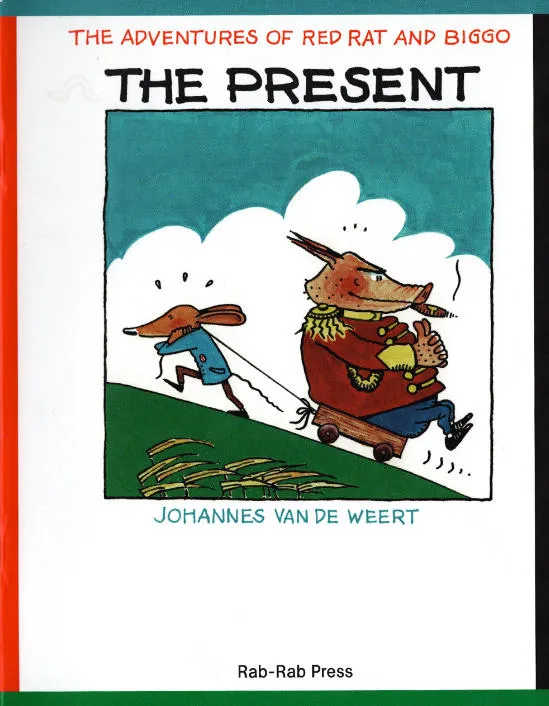
The Adventures of Red Rat and BIGGO – The Present
A children's book by Johannes van de Weert, a veteran of the punk underground (Rondos, The Ex, Red Rat, Raket).
The Adventures of Red Rat and BIGGO – The Present is a remake of Bram konijn en Piet de muis [Bram the Rabbit and Piet the Mouse], a 1982 children's book by Johannes van de Weert, a veteran of the Dutch punk underground who played with Rondos and The Ex, and who was the force behind Red Rat and Raket editions.
The Present is a 2010 remake telling the story of a bully pig who terrifies a poor rat on a daily basis. After a while, the rat falls ill with fear and has to stay in bed. The lonely, evil pig has no one to play with and becomes depressed. The pig gives the rat a present—a bunch of beautiful flowers—and all is well. Now the two can play together.
The 2010 remake, featuring different characters and intended for a North Korean audience, was never published. The 2025 English version opens with an introduction by Van de Weert, telling a bizarre story of a failed political career and an absurd vaudeville class struggle behind the seemingly harmless educational children's book.
Johannes van de Weert was a cartoonist active in the Rotterdam punk and squatter's movements of the 1980s. He was a singer with the punk band De Rondos and he started self-publishing small comic booklets in the late 1970s. He created his character "Redrat" for the fanzine Raket in 1980. The character soon became an icon for the squatter's movement.

DEARS No. 5 ever:over
Robert Steinberger, Delphine Chapuis Schmitz and 1 more
DEARS is a print magazine for transversal writing practices at the crossroads of art, poetry and experimental writing. It brings together authors and writers from different backgrounds and constitutes a dedicated platform for texts escaping the usual genres and disciplinary boundaries.
DEARS promotes the exploration of new forms of language as a way to foster new forms of living together, and emphasizes the growing relevance of trans- versal writing practices in this respect.
DEARS no. 5 / Summer 2023 / ever.over
With texts by Diaty Diallo, Douglas Keaney, Dzifa Benson, Sevinç Çalhanoğlu, Jana Vanecek, and an epigraph by Trinh T. Minh-ha.

Ferrara Deux (Faits Divers)
faits divers are the various reports in a news bulletin, miscellaneous human interest stories, theorised by Roland Barthes as ‘total’ and ‘immanent’ information.
ferrara deux (faits divers) scrolls around the discovered corpse of a talented street musician named Landau, mangled and sealed into vacuum bags in the walk-in of a modern Italian-American restaurant. Street performance is content for an attention economy, playing on authenticities and profiting from recognition.
In this debut novel, artist Ivan Cheng reconfigures recent performance texts into an approximation of a murder mystery.

Weaknesses
Afternoon Editions no. 2: text and drawings by Chrysa Parkinson titled Weaknesses. Between January and March 2019 Time has fallen asleep in the afternoon sunshine was presented as a solo-exhibition at Index Foundation in Stockholm. During this period Chrysa Parkinson was invited as a guest writer for Afternoon Editions. Weaknesses is a leap in memory.

bruit
Edition of 265 copies. A deluxe edition, accompanied by an original work numbered n/508 (oil pastel on paper A3), has been produced in 35 copies signed and numbered by the artist.
Hardcover, offset printing, 508 p., 31.8 x 25 cm. Printed by Cultura, Gent.

Vrai travail
Le Collectif Occasionnel a organisé en Suisse deux expositions qui présentaient les oeuvres de personnes à la fois artistes et travailleureuses du sexe. Cet ouvrage prolonge leur travail en proposant des textes et des entretiens avec des Tds ou des alliéxes. Permettant l’auto-représentation des personnes interrogées, les entretiens mettent en lumière la pluralité des pratique du travail du sexe, mais aussi l’importance de construire des solidarités travailleuses, des outils pour défaire les stigmates et des perspectives de luttes intersectionnelles.

Clarifications
Hourja Bouteldja, Alain Brossat
Alain Brossat est ex-militant de la LCR ancré dans une lecture anti-impérialiste de la politique. Houria Bouteldja est la cofondatrice du QG Décolonial et une figure de l'antiracisme politique. Dans cet entretien exigeant, les deux penseur·ses et militant·es clarifient leurs divergences et leurs convergences autour de la religion, du racisme, de l'État, du fascisme et de l'impérialisme. Alors que ces questions clivent celles et ceux qui luttent pour l'émancipation, rendant parfois les discussions impossibles, les deux auteur·ices reviennent sur leurs parcours politiques et philosophiques, sans pour autant feindre le consensus de leurs héritages politiques. Entretien coordonné par Marianne VL Koplewicz.

Sketchbook 1-10
“Sketchbook 1-10” with Antoinette d’Ansembourg bundles a complete collection of pocket sketches created between 2020 and 2023, stretched across ten different notebooks. These sketches, despite their two-dimensionality, form the mainstay of her sculptural output, offering a glimpse into the intimate process behind her stately installations.

Afterimages 3: Lis Rhodes Volume 1
This DVD contains:
Light Reading, 1978, 20 min.
Pictures on Pink Paper, 1982, 35 min.
Cold Draft, 1988, 28 min.
Lis Rhodes has been at the forefront of British experimental filmmaking since the early 1970s. She studied at the North East London Polytechnic and the Royal College of Art. A strong formal aesthetic has been developed in her films, reflecting her involvement with the debates and practice which emerged from the London Filmmakers' Co-operative, where she was Cinema Curator 1975-6. Early 'expanded' works such as Light Music (1975) fused performance and multi-screen projection with an exploration of the visual qualities of sound. Her analysis of broader political and social questions can be traced to her later films, which combine formal rigour with a passionate critique of issues from nuclear power to domestic violence. As an active campaigner for women's rights, Rhodes was a founder member of Circles, the first women's artist film and video (1979) and was an Arts Advisor to the Greater London Council between 1982 and 1985. She lives and works in London and teaches at Slade School of Fine Art, University College, London.