Books
Books
in random order

Agitated Air: Poems After Ibn Arabi
Born in Murcia in 1165, Ibn Arabi was a prolific Muslim philosopher and poet. He travelled extensively before settling in Damascus, where he died in 1240. Tarjuman al-Ashwaq, or The Interpreter of Desires, is a cycle of sixty-one Arabic poems. They speak of loss and bewilderment, a spiritual and sensual yearning for the divine, and a hunger for communion in which near and far collapse.
Agitated Air is a correspondence in poems between Istanbul and Cape Town, following the wake of The Interpreter of Desires. Collaborating at a distance, Yasmine Seale and Robin Moger work in close counterpoint, making separate translations of each poem, exchanging them, then writing new poems in response to what they receive. The process continues until they are exhausted, and then a new chain begins.
Translated and re-translated, these poems fray and eddy and, their themes of intimacy across distance made various, sing back and forth, circling and never landing. Absence and approach, knowing and unknowing, failure and repetition: Ibn Arabi’s cycle of ecstatic love shimmers with turbulence. Seale and Moger move into and against these contending drifts, finding in the play of dissatisfaction and endurance a prompt for new poetry.
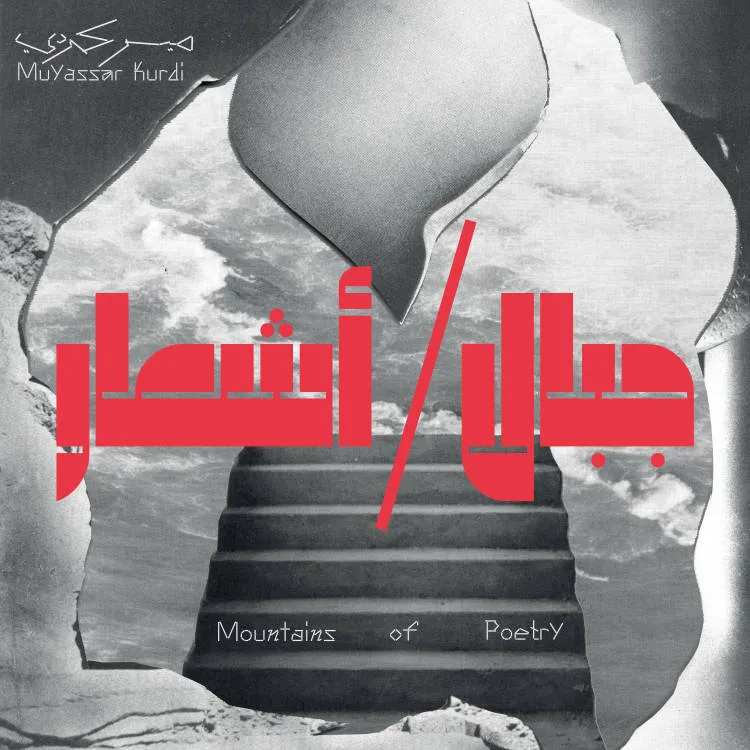
Mountains of Poetry (Limited Edition 12" Coloured)
Mountains of Poetry is a new 8-track studio album produced and developed by interdisciplinary artist Muyassar Kurdi. The album traces the entwined relations between one’s body and land, driven by a sense of urgency. Embedded in the earth, Kurdi imagines her body as a site for sonic excavation of memory and longing. The artist’s voice paired with electronic sound honors the ancient and the futuristic that together form a ritualistic reflection to navigate the tender space of remembering, forgetting and mourning. Departing from her usual emphasis on vocal abstraction, Kurdi turns to concrete words that punctuate the sonic landscape, gathering them into mountains of poetry.

Devenir minéral | L’éditeur du dimanche
Echoing Jean Dubuffet's idea that thought must arise from material in artistic practice, Giuliana Prucca, through this essay, reinterprets a moment in the history of 20th-century art using materials such as stone, sand, earth, and dust. She employs the mineral to illustrate that the creative act would be a trace of the body's disappearance. The loss of humanity and the deconstruction of the subject objectify themselves in the image. In other words, art resides in the tension between representation and its loss, ultimately leaving nothing but an image.
Drawing from the influential figure of Antonin Artaud, she weaves critical and poetic connections between the texts and works of various artists, writers, and thinkers, ranging from Jean Dubuffet to Jan Fabre and Anselm Kiefer, Yves Klein and Gutaï, Joë Bousquet to Camille Bryen and Francis Ponge, Gaston Bachelard to Gilles Deleuze, and Georges Bataille to Aby Warburg.
The material is not merely a thematic pretext; it is an active and explosive catapult that questions the arbitrary linearity of a conventionally assimilated art history. Following Ponge's example, Prucca applies the principles of poetry to criticism, starting from Artaud's material, the most undisciplined of poet-artist-thinkers of the modern era. This results in a critically inventive approach dangerously suited to its object, celebrating an anti-critique. The chosen writing materials, stonepaper for the cover and recycled paper for the pages, is consistent, intending to give the impression of being covered in dust.
The essay disrupts traditional reading habits and shatters the conservatism of art criticism by inhabiting writing space differently, presenting a physically engaging interaction. This is an essay in the literal sense, an experience where form never contradicts content, urging readers to take the risk of thinking deeply and embracing a new rhythm. A complex and challenging design invites them to choose different reading options, ultimately treating criticism as one would poetry.
Giuliana Prucca [Paris | Berlin] is an independent curator, researcher, and writer. She is the founder and art director of the publishing house AVARIE, specialising in contemporary art books that explore the relationships between text and image, body and space.
Graphic design, art direction by Vito Raimondi

Issue 8: Garden Tools
More than a mere extension of the hands, the garden tool is what helps the gardener materialise their vision. Much like the painter’s brush and the sculptor’s chisel – without it, one would be helpless. This issue of Pleasant Place dives into the world of garden tools, the essential, the practical, and the beautiful.
Including:
Instruments of Care – An introduction by Norbert Peeters with some philosophical remarks on garden tools.
Wardens of Good – A visual essay of the wonderful objects of Garden and Wood, a business selling vintage garden tools and ephemera.
Trusted Tools – Gardeners like Piet Oudolf and Jonny Bruce talk about their favourite tools that are illustrated in detail by artist Floris Tilanus.
Passing the Trowel – A visit to Sneeboer, the Netherlands most famous garden tool company, where the trowel has been passed down for four generations.
Toolmorrow – Artists are challenged to create new types of garden tools, for lazy gardening, stylish gardening and collective gardening.
Cover by Lou-Lou van Staaveren
Inside cover by José Quintanar
Centrefold miniatures by Zilan Zhao
Graphic design is by fanfare
Concept and editing by Guus Kaandorp, Floor Kortman and Lou-Lou van Staaveren

Histoire de la séparation
Pour les révolutionnaires des deux derniers siècles, l’accumulation du capital devait unifier la classe ouvrière sous la bannière du sujet révolutionnaire. Le mouvement ainsi né était appelé à renverser la société de classes et les clivages divisant les prolétaires. Mais le mouvement de la valeur a finalement triomphé, pour donner naissance à la société de la séparation. L’atomisation a pris le pas sur les puissances du rassemblement. La civilisation du capital traverse aujourd’hui une crise sans fin, mais les forces capables de la défaire brillent par leur absence.
Ces textes tirés de la revue Endnotes, réunis pour la première fois en français, dessinent la carte d’un présent ponctué de paysages désindustrialisés, de centres logistiques et de bidonvilles où s’entassent les populations rejetées aux marges de l’accumulation – autant de coordonnées nécessaires pour continuer à penser le dépassement du capitalisme : une fois encore, reprendre le chantier de l’hypothèse communiste.
Endnotes est une revue théorique communiste produite par un groupe de discussion du même nom basé en Grande-Bretagne et aux États-Unis.
Traduction: Pablo Arnaud
Préface: Aaron Benanav Et John Clegg

La Redoutable
La Redoutable compile les archives lesbiennes de trois provenances distinctes mais complémentaires. Aux abords de l’ARCL (Archives Recherches Culture Lesbiennes) se rencontre Caroline Drieu, Roxanne Maillet et Suzette Robichon. Elles se racontent des mots imprimés sur des t-shirts et des gapettes. Ces slogans, fruits de détournements, plagiats et jeux de mots sont en plus d’être revendicateurs, des signes distinctifs pour un réseau de lesbiennes absolument occupées à incarner les attitudes qui les définissent. Ces viragos peuvent se connaître ou non, mais un jour, ielles se retrouveront certainement dans des jardins partagés, à des groupes de lecture, des barbecues ou des karaokés.

Exophony
Yoko Tawada, Lisa Hofmann-Kuroda
Yoko Tawada's first essay collection in English presents and electrifying new side of the National Book Award-winner as she dives deep into her lifelong fascination with cross-hybridizing languages. The accent here, as in her fiction, is on the art of drawing closer to the world through defamiliarization. Tawada famously writes in both Japanese and German, but her interest in language reached beyond any mere dichotomy.
The term "exophonic," which she first heard in Senegal, has a special allure for the author: "I was already familiar with similar terms. 'immigrant literature,' or 'creole literature,' but 'exophonic' had a much broader meaning, referring to the general experience of existing outside of one's mother tongue." Exophony opens a new vista into Yoko Tawada's world and delivers more of her signature erudite wit—at once cross-grained and generous, laser-focused and multidimensional, slyly ironic and warmly companionable.
A New Yorker Best Book of 2025. Translated from Japanese by Lisa Hofmann-Kuroda.

The Mollino Set
New York-based professor Lytle Shaw journeys to Italy in this adventurous exploration of the life and work of architect, designer, and photographer Carlo Mollino (1905–1973). In 1933 the young Mollino received a commission from Mussolini’s regime for his first building: an administrative centre in Piedmont. Later works include furniture and interior design, a book on photography, and an asymmetrical car that raced at Le Mans in 1955.
The book centres around Shaw’s realisation that this prolific talent’s conflicted legacy offers a unique window on the role that post-war Italian politics and culture played in the country’s reimagining of itself as a victim, rather than a proponent, of fascism.

Not a Force of Nature
If capital makes life a seething, complex nightmare for most people on the planet's surface, if "words do cleave the producer from the land," then what does all this dispossession feel like? Amy De'Ath turns poetry into a hot, potent, and highly funny form of criticism, in which social force is felt intimately, and voiced in the acid niceness of a work email. Amy's poems move like pieces of machinery in a cognitive amusement park, which spit you a thousand feet into the air but keep your viewpoint fixed on the same spot as before—what's different? "Land in Saskatchewan, land in Delhi," or "everything…that you want from women and gays." Not a Force of Nature makes me want to change everything. "Behold me I'm you now," Amy writes—we should be so lucky, to be thus transformed. — Kay Gabriel
Not a Force of Nature's expertly crafted poems explore the catastrophe we live among and speak through. They form a sort of feminist manifesto addressed to all forms of resistance. But also: here are love sonnets! This book is angrily precise and always a lot of fun. "No, you're a Canadianist!" — Kevin Davies
Not a Force of Nature is the kind of book that becomes possible only after rejecting the "we" evoked so often in contemporary literary culture—sometimes said to need poetry now more than ever, sometimes called community. Amy De'Ath's motley vision of solidarity, of "actual emboldened people," is way weirder, more lively, and possible. Nor do these poems content themselves, like the ghost of Marxist theory past, with pointing towards the contradictions that surround them. Do you remember email? Sonnets? Not a Force of Nature is like that, thrashing inside generic forms and always coming next: after the tendency of the rate of profit to fall, after Jane's abortion service, after the 1970s, 80s, and 90s, after Creeley, after Raworth, after Mayer, after the Xenofeminist Manifesto, after Pluto enters Aquarius. "There are still tactics like this roaming free," De'Ath writes. There are still these fervent lyric parries. Be with Not a Force of Nature now. — Stephanie Young
Through slips of verbal acuity, Amy De'Ath scrapes her way out of determinism to a world "made by hands," where our material relations are ours to make and break. History is long and history is short. History is translucent. De'Ath presents the Ferris wheel of capitalist production, where the subject lives once as worker, twice as commodity. Here, in these "concrete trousers," is a "totally liberated" working class poem turning everything into nothing as praxis. — Anahita Jamali Rad

École nationale supérieure des beaux-arts de Lyon
Initiales #05 — Andrea Fraser
Claire Moulène, Emmanuel Tibloux
Le cinquième numéro de la revue d'art et de recherche « rétro-prospective » est consacré à l'artiste et performeuse Andrea Fraser, figure clé de l'art des années 1990 et 2000 et du courant de la « critique institutionnelle » (une monographie complétée par une grande enquête sur l'espace critique réalisée auprès d'une cinquantaine d'artistes, critiques et philosophes internationaux).
Avec contributions de Kader Attia, Eva Barto, Sophie Bonnet-Pourpet, Marie de Brugerolle, Gregory Buchert, Daniel Buren, Marie Canet, Gregory Castéra, Inès Champey, Thierry Chancogne, Claire Fontaine, François Cusset, Judith Deschamps, Paul Devautour, Philippe Durand, Joao Enxuto & Erica Love, Andrea Fraser, Nicolas Frespech, Dora García, Romain Grateau, Emmanuel Guez, Thomas Hirschhorn, Aliocha Imhoff & Kantuta Quirós, Béatrice Josse, Franck Larcade, Ju Huyn Lee, Sven Lütticken, Fabrice Mabime, Bartomeu Mari, Chus Martínez, Gwenael Morin, Claire Moulène, Jean-Luc Moulène, Yan Moulier Boutang, Vincent Normand, François Pain, Gerald Petit, Anne Querrien, Thierry Raspail, Sinziana Ravini, Delphine Reist & Laurent Faulon, Christophe de Rohan Chabot, Phillippe Roux, Jean-Baptiste Sauvage, Thomas Schlesser, Ida Soulard, Fabien Steichen, Michel Surya, Emmanuel Tibloux, Vier 5, Ulf Wuggenig, Italo Zuffi.

Inhabiting the 0.6%: The reality of Seoul's Black Hole
Cette édition documente la surpopulation de Séoul et les statistiques tragiques qui s'y rapportent. Elle rassemble les voix de ceux qui y vivent, de ceux qui y ont vécu, de ceux qui doivent s'y rendre et de ceux qui l'ont quittée. La production suit les principes écologiques énoncés par la graphiste, Sara de Bondt en 2014. Pour éviter le gaspillage, des formats standard (A4) et du papier 100% recyclé ont été choisis, avec une impression en risographie. Pourquoi cet exode massif vers Séoul ? Comment Séoul est-elle devenue un trou noir ?
This edition documents Seoul’s overpopulation and the tragic statistics associated with it. It gathers the voices of those who live there, those who have lived there, those who must travel there, and those who have left. The production follows the ecological principles set forth by the graphic designer Sara de Bondt in 2014. To avoid waste, standard formats (A4) and 100% recycled paper were chosen, with an impression in risography. Why this massive exodus toward Seoul? How has Seoul become a black hole?
[KO] 이 책은 서울의 인구 과밀화와 이와 관련된 비극적인 통계들을 기록한다. 서울 거주자, 과거의 거주자, 가야만 하는 자, 그리고 이방인까지. 이들의 목소리를 인터뷰로 담았다. 2014년 그래픽 디자이너 사라 드 본트가 제시한 생태적 원칙을 따라 A4 규격 사이즈의 100% 재생용지 위에 리소그래피로 인쇄되었다. 왜 모두가 이토록 서울로 몰려드는 것일까? 서울은 어쩌다 블랙홀이 되었을까?

SABR N°04 - Half a life
“Perhaps much of what we once believed was never truth but a gentle and necessary illusion.It was something we chose quietly and almost unconsciously so we could continue without falling apart.”
Bayan Abu Nahla is a visual artist born in 2001 in Gaza, Palestine. Her artistic practice functions as a visual diary, documenting and reflecting rapidly evolving events, both before and after the genocide. Through her work, she explores realities and daily living conditions often unknown to those who have not lived in Gaza.
SABR/Collection is a series of publications that bring together short literary works in a variety of genres. Curated by Nesrine Salem, SABR/Collection wishes to highlight the macro-realities of the authors chosen, to make visible the intersectional nature of struggles.

I am Welton Santos.
I am Welton Santos reenacts a dialogue between the Brazilian geo-bio-architect Welton Santos and an Interviewer. The book, which is always read collectively, is used in reading performances by groups of at least 3 people.
Printed on the occasion of an artist residency at PAV, Parco d’Arte Vivente, Turin, July 2016. Texts based on transcripts of interviews with Welton Santos.

I of Song
"Between the 8th and the 10th of January in the year of 2019, we became Na Castelloza, she who in Auvergne at the beginning of the 13th century composed a cycle of cansos about—finding—unrequited love. If there exists a lyric subject, we are of her heritage."

On Dangerous Ground
Vaginal Davis offers insights into her collaborative practice of making music in art-punk bands in Los Angles and Berlin.
The artist Vaginal Davis certainly moves on dangerous ground with her transgressive shuffling of gender and genre boundaries. The self-described "sexual repulsive" co-founded several art/punk bands in her expansive 40-year-plus career, namely Afro Sisters, ¡Cholita!, Pedro, Muriel & Esther (PME), black fag and Tenderloin. As a writer and "Whoracle et Delphi", Ms. Davis turns her quirky hairy eyeball to the collective practice of making music in the saucy underground scenes of Los Angeles and Berlin. In their contributions, longtime comrades and collaborators Bibbe Hansen (artist and Warhol Silver Factory habitué) and Felix Knoke (guest performer for The Hidden Cameras and band member of Tenderloin) rave about joint performances and rehearsals, divulging sacred secrets and rifts. Bruce "Judy" LaBruce, Glen Meadmore and Lisa "Suckdog" Carver make surprise guest appearances, along with images from live performance spectacles The White to Be Angry, Trust Fund, Interracial Dating Game, We're Taking Over, Afro De Sade and Camp/Anti-Camp: A Queer Guide to Everyday Life.
Edited by Jenny Schlenzka and Julia Grosse.
Texts and works by Vaginal Davis, Bibbe Hansen, Felix Knoke.
Published on the occasion of Vaginal Davis's exhibition at Gropius Bau, Berlin, in 2025.
Vaginal Davis is a Berlin-based American intersexed artist, queer icon of art and music. Vaginal Davis herself is a living work of art: a performer, writer and creator of iconic zines; a visual artist, experimental filmmaker; a self-proclaimed Blacktress and drag terrorist, a gossip columnist, influential socialite, educator and countercultural renegade. Since the late 1970s, her oeuvre has pushed the boundaries of art, music and performance. Inspired by the militancy of the Black Panthers’ pursuit of social justice in the United States, she named herself after feminist and Black Power activist Angela Davis.

Child's Replay
Child’s Replay is a hallucinatory homecoming. As we follow THE CHILD in a series of private re-enactments, the present self is revealed as the past’s fragile construction. Pursuing the banality of trauma, a first-person character juxtaposes childhood events with internal misrepresentations, reflections on the emotional toll of migration, psychoanalytic theory, Brazilian history, and literary criticism. An exploration of the impact that language and fiction have on real bodies, Child’s Replay assembles a hybrid portrait of memory and anti-memory.
This publication is limited to 100 copies, which are signed and numbered by the author.

Skies
Skies is a practice that emerged when Edurne Rubio and María Jerez found themselves working in isolation during the creation process of their performance A Nublo in 2020. A dialogue in pictures capturing the skies above Madrid, Brussels and many other places, it is now a book and document of a particular time that invites others to reminisce as they read the clouds and ponder invisible worlds that haunt the aether. It comes with an essay by Augusto Corrieri on theatre and cosmos.
Edurne Rubio is a visual artist. Her work leans towards the documentary and starts out from orality and storytelling.
María Jerez creates work at the intersection of choreo graphy, film and visual art. With her work, she wants to open up spaces of possibility through the encounter with what is foreign to us.
www.edurnerubio.org
www.mariajerez.com
Published by Varamo Press in the essay series Gestures
First edition October 2022
200 pages, 11 x 16.5 cm, sewn perfect binding
ISBN: 978-82-691492-6-5
Graphic design by Michaël Bussaer

The Films of Laura Mulvey and Peter Wollen
This collection of Laura Mulvey and Peter Wollen's film scripts vividly evokes the close connection between their influential work as theorists and their work as filmmakers. It includes scripts for all six of Mulvey and Wollen's collaborative films, Wollen's solo feature film, Friendship's Death (1987), and Mulvey's later collaborations.
Each text is followed by a new essay by a leading writer, offering a critical interpretation of the corresponding film. The collection also includes Wollen's short story Friendship's Death (1976), the outlines for two unrealised Mulvey and Wollen collaborations, and a selection of scanned working documents. The scripts and essays collected in this volume trace the historical significance of a complex cinematic project that brought feminist, semiotic and psychoanalytic concerns together with formal devices and strategies.
The book includes original contributions from Nora M. Alter, Kodwo Eshun, Nicolas Helm-Grovas, Esther Leslie, Laura Mulvey, Volker Pantenburg, Griselda Pollock, B. Ruby Rich and Sukhdev Sandhu.

a slight cast down at the edges of the lips
“a slight cast down at the edges of the lips brings together work from the last decade of Katherine Hubbard’s prolific practice, which intertwines analogue photography, writing, and live performance. Reproductions of exhibited prints, a selection of new photographs, and images created from within her performances are gathered here, along with four of the artist’s original written works. This publication marks the first occasion for Hubbard’s photographs and writings-for-performance to exist on the same scale, that of the book.”
— co-editor, Corrine Fitzpatrick
The book is accompanied by a poster with a full-scale detail reproduction of Katherine Hubbard's rip stop weave artwork, printed on glossy tissue paper.
Additional contributions by Zoe Leonard, Mónica de la Torre, Elisabeth Sherman, and Lynne Tillman. Edited by Corrine Fitzpatrick and Lara Mimosa Montes.

Survival Takes a Wild Imagination: Poems
In the powerful follow up to her critically acclaimed debut collection, poet and activist Fariha Róisín is writing, praying, clawing, and scratching her way out of the grips of generational trauma on the search for the freedom her mother never received and the kindness she couldn’t give.
This collection of poetry asks a kaleidoscope of Who is my family? My father? How do I love a mother no longer here? Can I see myself? What does it mean to be Bangladeshi? What is a border? Innately hopeful and resolutely strong, Fariha's voice turns to the optimism and beauty inherent in rebuilding the self, and in turn, the world that the self moves through. Ubiquitous to the human experience, Survival Takes a Wild Imagination is an illuminating breath of fresh air from a powerful poetic voice.

The Book of Advice
The Book of Advice, an experiment in self-translation, stems from the andarznameh tradition of classical Persian literature, a form that moves between verse and prose as it engages invented or familiar sayings and folktales. Originally written in Persian between 2018-2020, the book now speaks in both English and Persian, opening at once from the back and the front, in a voice both distanced and familiar. The vicissitudes of the everyday preoccupy its intimately impersonal speaker as she wrestles with the inadequacy and mobility of language.
Ghazal Mosadeq is a poet, editor and translator. She is the founder of Pamenar Press, an independent publisher of poetry, translation, hybrid and critical writing. Her own work has been published by Sheirsman, Fence, Arc Poetry, Fiddlehead, Asymptote, Modern Poetry In Translation and Words Without Borders, among others. She is a member of the editorial advisory board for the Journal of British and Irish Innovative Poetry.
The Book of Advice knows 'we didn’t have to break the flower stem/ to let the/ light pass through,' even as it knows we have already broken everything we could. Here, no one knows our names, nor the name of our horse, though someone did once ask. From the sliver between a face and its forgettable name, from the sliver between what’s been said and what’s yet to be said, slightly but exactly differently, Ghazal Mosadeq offers a chasm. The floor is deep, but, when you land, very tender. No one hails us, but the well wishes, oh, open your mouth for the well wishes." —Farid Matuk

Luna
"Luna" (2021) is a graphic novel by Artist and illustrator Anat Martkovich, developed in collaboration with artist and illustrator Haithem Haddad. It was self published, with support by the Pais Foundation for the Arts.
The novel follows two days in the life of a family, and at its center is a dramatic event which drastically affects the lives of the family members.
The story develops in an a-linear and fantastic fashion, and attempts to present the impossible reality of violence within and outside the home.
The book is comprised of detailed black and white illustrations, with very little text accompanying them.
The little text alternated between different languages: Russian, Hebrew, Arabic, English and Hebrew sign language, depicting a complex and multi layer urban existence. The story is open to the reader's interpretation, though it is firmly set in a mundane everyday reality it opens up and presents us with fantastic possibilities of existence.

the she
‘the she’ compares texts by Virginia Woolf with their French translation, reproducing parts of the novelles ‘The String Quartet' & ‘Blue and Green’ and the novel ‘The Years’. Of the novellas, she kept only the articles the in English and le, la, les in French, exactly as they appear in the editions. Of the novel, only the pronouns she in English and elle in French remain.
The publication includes identical two booklets, one bound and one unbound, both uncut, referring to old books which were often sold bound but uncut.
Offset printing. Printed by Cultura, Wetteren
Edition of 123 numbered copies

The Narco-Imaginary: Essays Under the Influence
Written according to its own dictum, "language is the universal inebriant," these epistolary essays, personal narratives, meditations on avant-garde writers, and unorthodox forays into the "narco-imaginary"—the habits and conventions surrounding literary and cultural representations of drug use—attend to the residue of transient impressions that remain, long after the delirium of creative activity subsides.
Ramsey Scott teaches at Brooklyn College, CUNY. His essays, poems, and fiction have appeared in various print and online publications, including the Southwest Review, the Seneca Review, The Massachusetts Review, Shampoo, Tarpaulin Sky, Confrontation, and Mirage #4/Period(ical). The Narco-Imaginary is his first book.