Archive Books
Archive Books
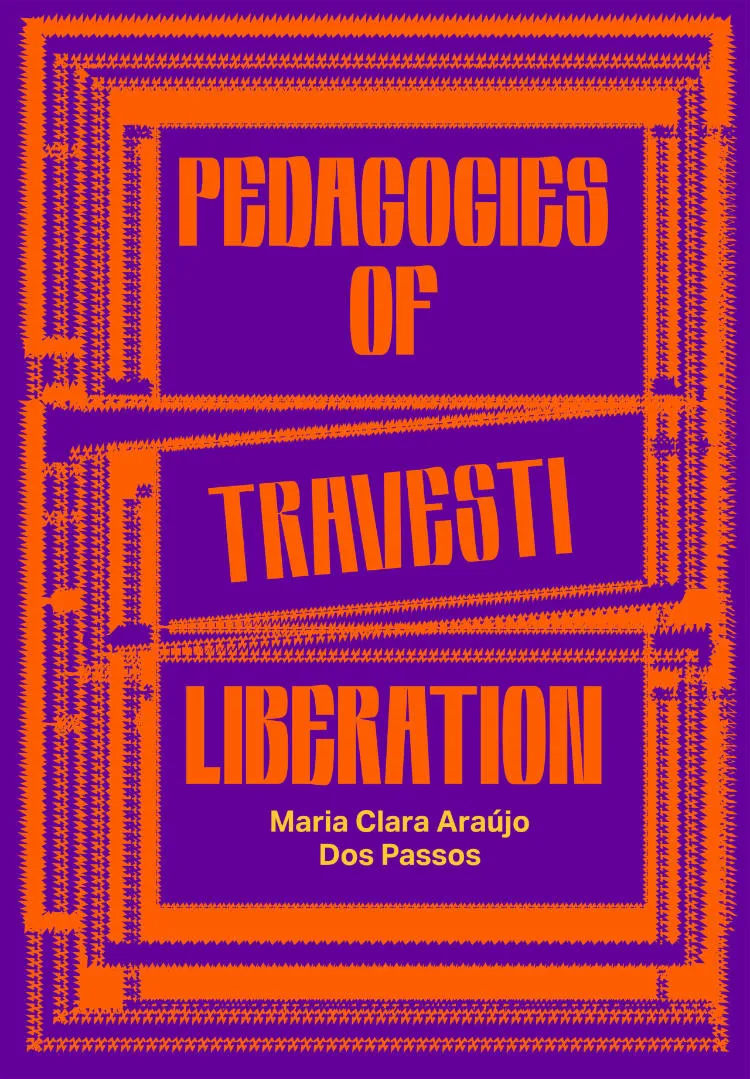
Pedagogies of Travesti Liberation
Maria Clara Araújo dos Passos, Natália Affonso
Maria Clara Araújo dos Passos examines the interplay of education, identity, and liberation in Brazil's travesti community.
In Pedagogies of Travesti Liberation, Maria Clara Araújo dos Passos critiques traditional pedagogical frameworks that marginalize gender nonconforming narratives and highlights the effects of systemic discrimination on travestis' psychosocial well-being. The book advocates for inclusive educational practices and emphasizes the need for affirmative curricula.
Newly translated from Portuguese, this work contributes towards connecting political struggles globally and navigating the complexities of translation—particularly of the term "travesti"—across various geographical and political contexts, featuring a conversation between Araújo dos Passos and translator Natália Affonso.
Maria Clara Araújo dos Passos (born 1996 in Recife) is a Brazilian Afro-transfeminist educator and sociologist, and an activist for LGBT rights.

Mud … and the Earth System
Mud … and the Earth System explores groundbreaking research in Earth system sciences and highlights the challenges of communicating these findings to the public.
As once-stable “mudscapes” transform, they become both symptoms and symbols of a rapidly warming planet. This book delves into humanity’s connection to these changes through the study of ancient organic and inorganic compounds that have come alive after millennia. It poses essential questions about what these evolving ‘mud’ compounds reveal about Earth’s deep past and our imminent future.
Born from collaborative research led by artist Rikke Luther at the Interdisciplinary Research of Ocean, Climate and Society (ROCS) at the University of Copenhagen in collaboration with Earth scientist, Professor Katherine Richardson, this publication showcases how artistic practices – such as image-making, conceptual mapping, and filmmaking – enhance scientific representation.
Mud… and the Earth System features commissioned essays from experts in Earth Science, Political Aesthetics, and Molecular Geobiology. The book pairs their insights with compelling artwork, including large-scale maps of emerging ‘mudscapes’ in Svalbard, Iceland, Greenland, and Gotland.
The essays give perspectives on the DNA that is collected and stored in mud, which connects life across timescales as an evolutionary resource framing the interactions of human societies with the extreme complexities of the Earth system. Esther Leslie’s “Mud Crystal and Polar Thinking” sets the scene, followed by Karina K. Sand’s “Death and Life: in Mud: Two Million Years in a Split Second,” and Earth scientist Katherine Richardson’s contribution “A Muddy Diary.”
As Richardson sums up, “Mud is an important medium for storing the archives that describe the history of both life and climate on Earth, and we are only just beginning to understand the fantastic stories that mud can tell.”
Contributions by Esther Leslie, Rikke Luther, Katherine Richardson, Karina Sand

Scores for Political Desires
The publication of the winners of the Villa Romana Prize has taken the shape of four distinct yet interrelated booklets – an editorial series continuing the tradition of the institution to offer a space for the dissemination and reverberation of the research and work of the Villa Romana Fellows after their ten-months residency in Florence.
Each year, four selected artists are invited to live and work in the same house that, since 1905, generations of artists have continuously inhabited. They always come as a group – a constellation of four people – but all as singular artists. The opportunity of yearly publishing their work in a bundle of four separate books and within an open series allows for a larger combination of echoes across the generations of Villa Romana Fellows. A further occasion for “being singular plural.”
Contributions by Elena Agudio

Sustaining the Otherwise
Sustaining the Otherwise is a collaborative research and artistic project about restitution, reparation and transformation taking place in multiple locations over several years. Initiated and conceptualized by researchers and curators Amal Alhaag & Selene Wendt, it offers a space for artists, activists, scholars and writers to be in dialogue and to explore the topic of restitution in relation to both material and immaterial culture, through a program that frames restitution within the context of contemporary art practice.
Edited by Amal Alhaag & Selene Wendt
Featuring an introduction by Amal Alhaag & Selene Wendt as well as provocations, reflections, and essays by Barby Asante, Michael Barrett, Quinsy Gario, Sana Ginwalla, Aude Christel Mgba, Lennon Mhsishi, Ogutu Muraya, in addition to a sonic contribution by Robert Machiri.

I Speak Radio
Anna Bromley, Achim Lengerer and 1 more
Publishing a selection of her radiophonic essays here for the first time, I Speak Radio reflects Anne Bromley's collaborative radio practice.
Since 2010, Anna Bromley has been inviting artists, activists and cultural researchers into the radio studio to explore language and voice together, in the context of sound, politics and everyday life. What began as an artists' radio research format has developed over the years into a series of exhibition pieces focusing on radio and its visible and invisible transmission bodies.
Publishing a selection of her radiophonic essays here for the first time, I Speak Radio reflects Bromley's collaborative radio practice. The publication also provides insight into the corresponding exhibition formats of these projects, including cooperations with a large number of artists, activists, radio makers and theorists. An index of images and texts on Bromley's other artistic works is inserted into the book.
I Speak Radio opens with Bromley's eponymous multimedia essay on the feminist appropriation of early radio technology in the 1920s. A Voice Exists in Voicing, the series of radio essays and sonic portraits with which Bromley opened the Manifesta Radio in Prishtina in the summer of 2022, comprises the core of the book. The accompanying visual element to this section is a series of drawings by Michael Fesca. Contextualizing texts by Catherine Nichols and Hedwig Fijen provide an introduction to A Voice Exists in Voicing. Finally, Bromley talks to media activist Diana McCarty about the politics of persistent radio voices and considers critical perspectives on radio as a medium within art exhibitions.
The reader series Scriptings: Political Scenarios publishes carefully selected scripts and texts by artists that refer neither to academic forms nor to purely literary forms of writing, but rather embed "text" as a fully integral part of contemporary political and visual art practice.
Contributions by Anna Bromley, Diana McCarty, Hedwig Fijen, Catherine Nichols, Tetsuo Kogawa, Alla Mitrofanova, JD Zazie.

Territoires / Territories / Territorien – Filmtranskripte
Brigitta Kuster, Achim Lengerer
A monographic publication featuring multilingual text-film transcripts engaging with the legacy of the German colonial project in Cameroon and Germany, as well as broader questions of border crossings, asylum, and exclusion.
The works collected for this publication span installation, video art, and ciné-poems, emerging from anti-racist movements and debates around disidentification, representation, and institutional critique—through the medium of moving images.
A key part of the publication comprises films created in French and German as part of the research project Choix d'un passé, in collaboration with Moïse Merlin Mabouna. These films are accompanied by textual and visual sequences from the video works S. – Je suis, je lis à haute voix and Erase them! – The image as it is falling apart into looks. The eBook also includes a playable film file and elements from the film performance Der erste Blick #1, created in collaboration with Angela Melitopoulos and Vassilis S. Tsianos.
The reader series Scriptings: Political Scenarios, edited by Achim Lengerer, publishes carefully selected scripts and texts by artists that refer neither to academic forms nor to purely literary forms of writing, but rather embed "text" as a fully integral part of contemporary political and visual art practice.
Texts by Brigitta Kuster and Moïse Merlin Mabouna.

The Interpreter Dis/Appears
Virginie Bobin, Achim Lengerer
An artistic exploration of the political and emotional stakes of translation in the context of asylum law, through the lens of rarely heard testimonies: those of interpreters.
The Interpreter Dis/appears stems from an investigation conducted between 2019 and 2023 by curator, editor, and translator Virginie Bobin, focusing on both professional and volunteer interpreters and translators, as well as representatives from the state and organizations working with exiled individuals navigating asylum application procedures in France. By redirecting attention to the voices of interpreters—rarely visible figures in this ecosystem—the project delves into the ambiguous role of translation at the intersection of those who govern and those governed by asylum law. Within such a controlled environment, can the act of translation, with all its complexities, still express fleeting gestures of solidarity or even resistance? Through the exchanges prompted by these questions, the book seeks to reframe the prevailing public and political discourse on asylum, harnessing the embodied experiences of a small group of interpreters as an alternative lens to reveal the underlying power dynamics at play. It also probes the ethical and political potential of translation. The Interpreter Dis/appears unfolds across a variety of theatrical, artistic, and theoretical writing, alongside insightful contributions from artists and researchers who open up different perspectives for understanding and activating these issues.
The reader series Scriptings: Political Scenarios, edited by Achim Lengerer, publishes carefully selected scripts and texts by artists that refer neither to academic forms nor to purely literary forms of writing, but rather embed "text" as a fully integral part of contemporary political and visual art practice.
Contributions by Alix Eynaudi, Vir Andres Hera, Mihret Kebede, Franck Leibovici, Serena Lee, Marianne Mispelaëre, Eliana Otta, Rester. Étranger, Olia Sosnovskaya, Myriam Suchet, TOGETHER UNTIL _ __ (what)* ?

Destination: Tashkent – Experiences of Cinematic Internationalism
The legacy and posterity of the Tashkent Festival for Asian, African and Latin American Cinema, which was held between 1968 and 1988 in Uzbekistan.
Between 1968 and 1988, the Tashkent Festival of Asian, African, and — from 1976 onwards — Latin American Cinema was held in Tashkent, Uzbekistan. As an exercise in soft power and a response to anti-colonial movements and the socio-political upheaval of the late 1960s, the festival grew into a unique gathering for film professionals and became an important platform for South-South solidarity that went beyond the cinema halls of Tashkent. In essays and conversations by researchers, film-makers, and organizers of contemporary film festivals, the Destination: Tashkent Reader reappraises the original festival's programming, while also looking critically at its legacy. From the vantage point of Berlin-based diasporas of Asia, Africa, and Latin America, the reader also investigates how such practices of encounters and collaboration resonate within the film scenes of these three continents today.
Contributions by Cana Bilir-Meier, Souleymane Cissé, Pascale Fakhry, Zach Ramon Fitzpatrick, Sophie Genske, Timur Karpov, Ali Khamraev, Valeriya Kim, Carlos Kong, Bonaventure Soh Bejeng Ndikung, Maren Niemeyer Jacqueline Nsiah, Furqat Palvan-Zade, Marie Helene Pereira, Elena Razlogova, Aykan Safoğlu, Masha Salazkina, Alex Moussa Sawadogo, Can Sungu, Echo Xuedan Tang, Sarnt Utamachote.

Afghanistan
Afghanistan is my father’s homeland. He was born in Kabul in 1945 and later moved first to France, then to Switzerland in the 1970s. In my mind, Afghanistan exists as a geography with blurred edges, something I feel the need to reconcile with. It’s a place I’ve only ever known through stories, a source of memories that, over time, have shifted and become distorted.
Contributors: Luca Cerizza, Farid Rahimi, Said Rahimi, Susanna Ravelli, Francesca Recchia, Zafar Sayan, and Dawood Tawana

Metropolitan Voids Agency
Margherita Moscardini, Zasha Colah and 1 more
Metropolitan Voids Agency is the first monographic publication dedicated to the collected works of artist Margherita Moscardini. The book recounts the work carried out by Moscardini spanning seventeen years, between 2008 and 2024, inviting a reading of her practice in its entirety as an investigation into ‘urban voids’: those which Moscardini has recognized and designated as voids, or those she has herself invented in the urban fabric.

Studies on Squats
Studies on Squats is an evocative exploration of embodied resistance and political movement that uses the multifaceted posture of the “Asian Squat” as a lens through which broader concepts of migration, illness, and resilience are examined. In Studies on Squats, the body—in its most vulnerable and potent states—becomes a speculative site for reclaiming agency by crafting new forms of protest that draw from ancestral strength, humor and eroticism. This posture, rich with cultural resonance, offers as an entry point to imagine ways in which the body can engage in acts of defiance against systems of oppression. Studies on Squats invites the audience to consider how dance and choreographic thinking can serve as tools for envisioning alternative futures, where artistry empowers those enduring systemic social injustices to transform their realities.

My Mother My Home
Who claims abstraction? What are the limits of abstraction? Are statelessness, dislocation and feelings of (un) belonging embodiments of an abstracted self that is in itself a work in progress? How could performance art—an artistic practice that places significant importance on presence and legibility of form—transgress into the realm of the abstract and the illegible in an effort to protect the artist’s likeness while shedding light on what it means to be in their body in relation to this world?
Chipo Chipaziwa’s My Mother My Home establishes itself as a query on the aspects of belonging and the artist’s own personhood that acts as the foundation of her practice. The question of where one’s personhood begins and ends within an artwork has appeared to be ever prevalent within the realm of visual art and is more relevant within the canon of performance art.
Writers: Chipo Chipaziwa, Denise Ferreira da Silva, Olumoroti George
Contributing artists: Margaret Joba-Woodruff, Sophia Lapres, and David Ezra Wang
Edited by Katrina Geotjen

Entangled – Texts On Textiles
What does it mean to be a curator who writes, and, more specifically, how can curators write about textiles? This publication steps outside the framework of the typical exhibition catalogue to occupy "the space between literature and criticism".
The Community of writers was set up to create time and space to retreat from these outside opinions and demands and to let curiosity and the joy of writing be the driving forces of the writing process. This book has been realised under the auspice of Interweaving Structures: Fabric as Material, Method, and Message, and specifically through collaboration between the Faculty of Fine Art, Music and Design at the University of Bergen and the Central Museum of Textiles in Łódź. The two partners have strong positions of specialisation—the museum acts as a caretaker of material textile traditions and art in Poland, and the faculty has a strong textile art tradition and offers the only education programme for curators in Norway.
Edited by Anne Szefer Karlsen.
Contributions by Andreas Hoffmann, Heather Jones, Martina Petrelli, Anne Szefer Karlsen, Lea Vene, Johanna Zanon.

Two years Vacation
This book, Deux Ans de Vacances, Dos Años de Vacaciones, Dwa Lata Wakacji, Two years Vacation, Due Anni di Vacanza, documents the production of Céline Condorelli's process-based, cumulative artwork titled 'Tools for Imagination'. The title of the book raises the question of labour and working time, starting from a non-equivalence with its inverse: free time. We can read the various iterations of the title which appear on the cover as an expression of the impossibility of thinking about time outside of work in a univocal dimension.

Fraitaxtsēs sores tsîn ge ra≠gâ – Ondjembo yo Null Vier
A complete documentation on a multimedia exhibition by Berlin-based artist Ixmucané Aguila, giving voice to voiceless descendants of victims of genocide in Namibia.
Genocide in Namibia is an especially sensitive matter—its history has at times been ignored, underestimated, or even denied outright. In the artistic documentary Fraitaxtsēs sores tsîn ge ra≠gâ – Ondjembo yo Null Vier, Ixmucané Aguilar has worked in close collaboration with Nama and OvaHerero people who vividly evoke memories and rituals of mourning caused by human loss and land dispossession under Imperial Germany's violent occupation.
From these personal encounters emerge portraits, visuals and narratives as documental fragments, consisting of living voices which insist on defending memory as an invocation to witness and never to remain passive in the face of social injustice. Rather than a linear collection of data referring to distant places and its distant past, this work engages with stories as chronicles calling to be recognised as pieces of humanity and time.
Alongside Aguilar's portraits, this publication also contains contributions by human rights attorney Wolfgang Kaleck and the curator of the work Tristan Pranyko, along with poetry by Namibian artists Nesindano Namises, Fritz Isak Dirkse and Prince Kamaazegi, and narratives, testimonies, chants and mourning rituals shared by OvaHerero and Nama people in present-day Namiba.
Published on the occasion of the eponymous exhibition at National Art Gallery of Namibia, Windhoek, in 2023
Ixmucané Aguilar (born 1983) is a Guatemalan Berlin-based visual artist/designer who, through multi-layered documentary photography, engages in extensive field research to put out installations and art publications to relay her work in an artistic language.

Archives on Show – Revoicing, Shapeshifting, Displacing – A Curatorial Glossary
Archives on Show brings the potential of reformulating the social and political relevance of archives by curatorial means into focus.
Based on the specific properties, faculties and methods of curation, the volume highlights those techniques and strategies that deal with archives not only to make their genesis and history apparent but also to open them up for the future. The 22 different ways of dealing with archives testify to the curatorial participation in (re)shaping the archival logic, structures and conditions. As process-oriented, collective and relational modes of producing meaning, these curatorial practices allow for the alteration, reconfiguration and mobilization of the laws, norms and narratives that the archive preserves as preconditions of its power.
The contributions to this volume by artists, curators and theorists demonstrate approaches that curatorially insist on building other relations between human and non-human archival participants. Each is using the book to create a curatorial constellation that generates and forms new connections between different times and spaces, narratives, disciplines and discourses. Configured as a glossary, the positions assembled in this volume exemplify curatorial methods with which to treat the archive as site and tool of collective, ongoing negotiations over its potential societal role and function.
Contributions by Heba Y. Amin, Talal Afifi, Eiman Hussein, Tamer El Said, Stefanie Schulte, Strathaus, Haytham El Wardany, Julie Ault, Kader Attia, Roger M. Buergel, Sophia Prinz, Yael Bartana, Rosi Braidotti, Kirsten Cooke, Ann Harezlak, Alice Creischer, Andreas Siekmann, Octavian Esanu, Megan Hoetger, Carlos Kong, Iman Issa, Kayfa ta, Kapwani Kiwanga, Doreen Mende, Stefan Nowotny, Marion von Osten, pad.ma, Abdias Nascimento, Eran Schaerf, Magdalena Tyżlik-Carver, Françoise Vergès.

The Illusion of a Crowd
Publication including the films Transformation Scenario, 70.001, and Faux Terrain, as well as a visual essay, a glossary and texts by Heike Geißler, Fanni Fetzer, and Franciska Zólyom.
“When I visited the Elias Canetti archive at the Zentralbibliothek Zurich, I was looking for manuscripts and sketches for his major work Crowds and Power (1960). I imagined that Canetti must have made drawings, as the behaviour of the various crowd types he identified was described in such detail. I hoped that these drawings would help me transfer the group behaviour he describes to virtual figures in an animated film.
The archive of manuscripts, arranged by Elias Canetti himself, was handed over to the Zurich library and contains the notes and sketches he completed during the development of Crowds and Power, a period of almost forty years. However, in this context I found no drawings—Canetti had only made graphic lists on various themes. So where did Canetti's precise descriptions of the scenes come from?”
Clemens von Wedemeyer (born 1974 in Göttingen, lives and works in Berlin) creates films, videos and media installations poised between reality and fiction, reflecting power structures in social relations, history and architecture.
Edited by Fanni Fetzer and Franciska Zólyom.
Texts by Heike Geißler, Fanni Fetzer, Franciska Zólyom.

Toward a Transindividual Self (2nd edition)
A book that examines the process of performing the self, distinctive for the formation of the self in Western neoliberal societies in the 21st century. It approaches the self from a transdisciplinary angle where political and cultural anthropology, performance studies and dramaturgy intersect.
Starting from their concern with the crisis of the social, which coincides with the rise of individualism, Vujanović and Cvejić critically untangle individualist modes of performing the self, such as possessive, aesthetic, and autopoietic individualisms. However, their critique does not make for an argument for collectivism as a socially more viable alternative to individualism. Instead, it confronts them with the more fundamental problem of ontogenesis: how is that which distinguishes me as an individual formed in the first place? This question marks a turning point in the study, where it steps back into the process of individuation, prior to, and in excess of, the individual.
The process of individuation, however, encompasses biological, social, and technological conditions of becoming whose real potential is transindividual, or more specifically, social transformation. A ‘theater of individuation’ (Gilbert Simondon) captures the dramaturgical stroke by which the authors investigate social relations (like solidarity and de-alienation) in which the self actualizes its transindividual dimension. This epistemic intervention into ontogenesis allows them to expand the horizon of transindividuation in an array of tangible social, aesthetic and political acts and practices. As with every horizon, the transindividual may not be closely at hand; however, it is certainly within reach, and the book encourages the reader to approach it.
"Towards a Transindividual Self is an ambitious and capacious effort to theorize a new way to approach collectivity for political purposes through the lens of performance. Convinced that the current neoliberal conjuncture has only heightened a form of capitalist individualism that blocks notions of the social, the authors aim to show that a "transindividual formation of the self can bring about different courses of action and a more socially driven imagination." Transindividuation, they assure us, shows how "we form ourselves on the basis of interdependence, sharing, commonality, as well as indispensability of the individual as the agent of creativity/ knowledge, freedom, and change, who 'possibilizes' their own conditions of formation."
— Professor Janelle Reinelt (University of Warwick), co-editor of Critical Theory and Performance (University of Michigan, 2006)
"Perhaps the most striking thing about this book is the manner in which it is able to engage with multiple discourses from political theory to aesthetics. In this way it both follows the ambitious scope of Simondon’s work on individuation, and expands into areas that Simondon did not cover, most notably politics and cultural politics, which is the book’s central concern. Rather than ask the question is the individual imagined or real, an effect of social relations or their distortion, the focus on the transindividual makes it possible to grasp individuation as a process: “Instead of pondering how the passage from one to many occurs, individuation permits us to immediately trace a bidimensional process in which both individual persons and the collectivities they form are altered. Another meaning of the crisis of the social has brought about a perfect slogan of such a process of transindividuation: ‘No one will be left alone in the crisis.” (…) Towards a Transindividual Self does a brilliant job of not only arguing for the importance and relevance for the transindividual as a concept for politics, performance, and the politics of performance, but of demonstrating a bold standard for political and aesthetic inquiry."
— Professor Jason Read (University of Maine), author of The Politics of Transindividuality (Brill, 2015)
Co-published by Oslo National Academy of the Arts, Sarma and Multimedijalni institut.

Maa Ka Maaya Ka Ca A Yere Kono – 13th Edition of the Rencontres de Bamako - African Biennale of Photography
Bonaventure Soh Bejeng Ndikung
The catalogue of the 13th edition of the Rencontres de Bamako - African Biennale of Photography, focusing on multiplicity, difference, becoming, and heritage.
The dominant narrative in this "globalized world" is, incidentally, that of singularity—of universalism, of single identities, of singular cultures, of insular political systems. With this narrative, however, comes an illusory sense of stability and stasis; identities seem inalterable, cultures are immutable, political systems prove uneasy in the face of change. Thus, in sustaining this pervasive discourse, there has been a great loss of multiplicity, of fragmentation, of process and change, and not least of complex notions of humanity and equally complex narratives.
In decentering this year's biennale On Multiplicity, Difference, Becoming, and Heritage, General Director Cheick Diallo, Artistic Director Bonaventure Soh Bejeng Ndikung, and the curatorial team—Akinbode Akinbiyi (artist and independent curator), Meriem Berrada (Artistic Director, MACAAL, Marrakech), Tandazani Dhlakama (Assistant Curator, Zeitz MOCAA, Cape Town, South Africa), and Liz Ikiriko (artist and Assistant Curator, Art Gallery of York University, Toronto)—of the Bamako Encounters pay a powerful tribute to the spaces in between, to that which defies definition, to phases of transition, to being this and that or neither and both, to becoming, and to difference and divergence in all their shades. Accordingly, Amadou Hampâté Bâ's statement (Aspects de la civilisation africaine, Éditions Présence Africaine, 1972) presiding over the manifestation, Maa ka Maaya ka ca a yere kono,translates to, "the persons of the person are multiple in the person."
A key tool for negotiating the processual and shifting nature of multiplicity lies in storytelling. It is the central medium through which humanity points the lens on itself and launches an attempt at self-understanding and reflection, and the breadth of answers given throughout history testifies to the congenial nature of storytelling and multiplicity. Moreover, the stories we tell not only negotiate who we are but also expose underlying currents of who we will become in the future. This is the concern lying at the heart of the 13th edition of the Bamako Encounters—the stories we tell, the multiple facets of humanity we accommodate, notions of processuality, becoming in being, embracing identities that are layered, fragmented, and divergent, and the multifarious ways of being in the world, whether enacted or imagined. It should be emphasized that this does not apply only to questions of personal identity. On the contrary, it is a bold affirmation of transformation and transition, of becoming in an emphatic sense, and is thus equally significant for state politics. It also rings true for questions of heritage/patrimony. Embracing the kaleidoscopic legacy of our multiple heritages means to open them up and liberate the term "patrimony" from its etymological roots (the Latin patrimonium means "the heritage of the father"), imagining in its place an inclusive concept of matrimony.
Thus, in this 13th edition of the Bamako Encounters with the title Maa ka Maaya ka ca a yere kono, artists, curators, scholars, activists, and people of all walks of life are invited to reflect collectively on these multiplicities of being and differences, on expanding beyond the notion of a single being, and on embracing compound, layered and fragmented identities as much as layered, complex, non-linear understandings of space(s) and time(s).
Published following the 13th edition of the Rencontres de Bamako - African Biennale of Photography, in Bamako, Mali, in 2022.
With Saïd Afifi, Ixmucané Aguilar, Baff Akoto, Annie-Marie Akussah, Américo Hunguana, Daoud Aoulad-Syad, Leo Asemota, Myriam Omar Awadi, Salih Basheer, Shiraz Bayjoo, Amina Benbouchta, Hakim Benchekroun, Maria Magdalena Campos Pons, Rehema Chachage, Ulier Costa-Santos, Adama Delphine Fawundu, Fatoumata Diabaté, Aicha Diallo, Amsatou Diallo, Anna Binta Diallo, Mélissa Oummou Diallo, Nene Aïssatou Diallo, Binta Diaw, Adji Dieye, Imane Djamil, Sènami Donoumassou, Abdessamad El Montassir, Fairouz El Tom, Luvuyo Equiano Nyawose, Raisa Galofre, Raisa Galofre, Joy Gregory, Gherdai Hassell, Thembinkosi Hlatshwayo, Letitia Huckaby, Anique Jordan, Gladys Kalechini, Hamedine Kane, Atiyyah Khan, Gulshan Khan, Seif Kousmate, Mohammed Laouli, Maya Louhichi, Mallory Lowe Mpoka, Nourhan Maayouf, Marie-Claire Messouma Manlanbien, Botembe Moseka Maïté, Louisa Marajo, Clarita Maria, Billie McTernan, Mónica de Miranda, Arsène Mpiana Monkwe, Sethembile Msezane, Ebti Nabag, Elijah Ndoumbe, Lucia Nhamo, Samuel Nja Kwa, Nyancho NwaNri, Jo Ractcliffe, Adee Roberson, Fethi Sahraoui, Muhammad Salah, Neville Starling, Eve Tagny, René Tavares, Sackitey Tesa, Helena Uambembe, David Uzochukwu, Sofia Yala, Timothy Yanick Hunter.

How to Die – Inopiné
A transdisciplinary investigation and a choreographic performance, between Umeå and Oslo, about ecological grief, cultural panic, and a feeling of collapse.
How to Die – Inopiné is a performance and a practice. It thinks through, in an embodied manner, the prevailing contemporary moods of ecological grief, cultural panic, and collapse. As a performance in a theater or outdoors, an audience encounters five dancers who are constantly building, unbuilding, and rebuilding. Afterwards, stories are told around a bonfire. As a practice in the studio, school, or street, a group of dancers, artists, writers, and architects meet for a year of residencies between Oslo and Umeå. They host a working process and encounter external informants. The goal is to displace oneself into the unexpected. This publication, two years in the making, engages with the challenges of translating a choreographic process into the space of a book. It both documents the project's development as well as offering the reader-doer different modes of thinking-doing, from somatic practices to proposals for a curriculum. Experiments in writing, mapping, and moving are played with, all engaging with the question, "what is the future of displaced thinking?"
Published following the series of eponymous events held in Umeå, Oslo, Bergen, Trondheim and Reykjavik in 2019-2020.
Contributions by Harald Becharie, Mia Habib, Jassem Hindi, Asher Lev, Marie Kraft Selze, Namik Mačkić, Ingeborg Olerud, Anna Pehrsson, Ashkan Sepahvand, Nina Wollny.