rile*books

Search books

Search books by title, author, publisher, keywords...

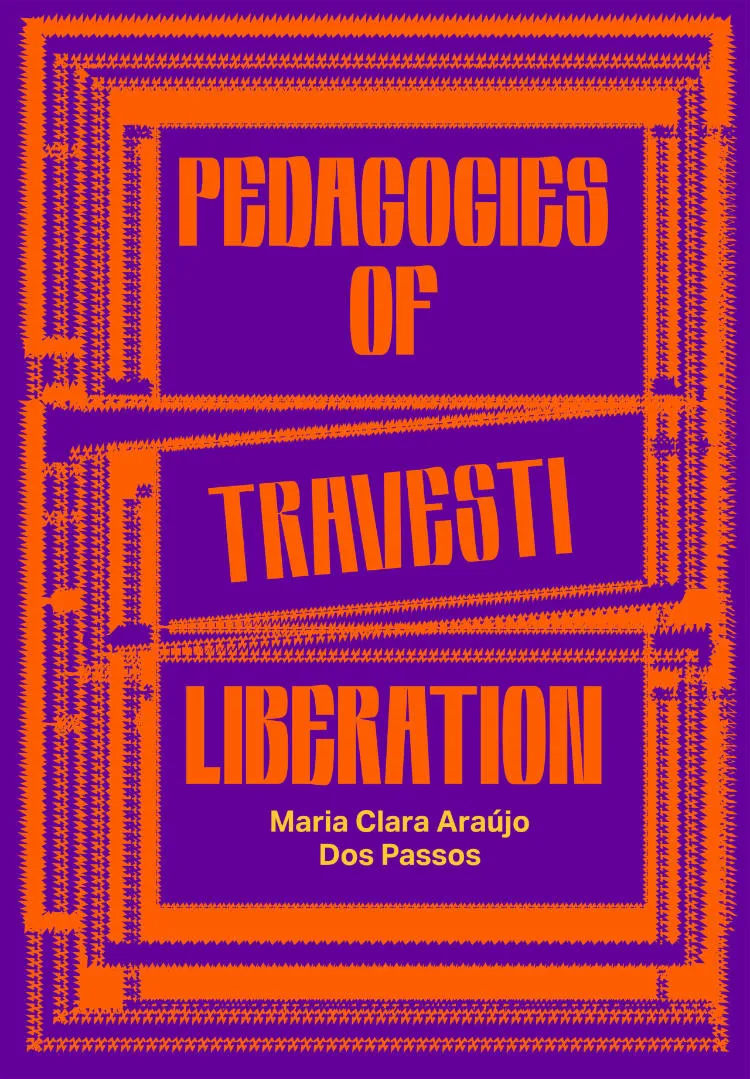
Cover of Pedagogies of Travesti Liberation

Archive Books

Pedagogies of Travesti Liberation

Maria Clara Araújo dos Passos

€15.00

Maria Clara Araújo dos Passos examines the interplay of education, identity, and liberation in Brazil's travesti community.

In Pedagogies of Travesti Liberation, Maria Clara Araújo dos Passos critiques traditional pedagogical frameworks that marginalize gender nonconforming narratives and highlights the effects of systemic discrimination on travestis' psychosocial well-being. The book advocates for inclusive educational practices and emphasizes the need for affirmative curricula.
Newly translated from Portuguese, this work contributes towards connecting political struggles globally and navigating the complexities of translation—particularly of the term "travesti"—across various geographical and political contexts, featuring a conversation between Araújo dos Passos and translator Natália Affonso.

Maria Clara Araújo dos Passos (born 1996 in Recife) is a Brazilian Afro-transfeminist educator and sociologist, and an activist for LGBT rights.

Published in 2025 ┊ 208 pages ┊ Language: English

recommendations

Cover of Praise House

Archive Books

Praise House

Adama Delphine Fawundu

Building on the notion of ‘praise,’ Adama Delphine Fawundu frames this book as a celebration of life. She honors the stories whispered to her by her mother; she adorns her body in her grandmother’s textile work; she elevates the memory of various named and unnamed Black women of the diaspora and documents the iconic small Civil War era styled white wooded praise house on a patch of land off the side of a road in South Carolina not far from Beaufort creating an intimate body of work of color photography of an interconnected history.

This book about female figures—grandmothers, mothers, daughters, artists, caregivers, storytellers, and cooks—explores a range of emotions that consume us about family life and history. It is both an art book
and a memoir. Viewing it brings us face to face with known and unknown cultures and introduces us to various art practices shared, taught, and learned through the African diasporic traditions. Fawundu connects to the self through history, joy, and beauty and offers the reader ways to navigate fear based on migration and loss. It is a gift, too, as it allows us to imagine alongside the artist.

Adama Delphine Fawundu is an artist based in Brooklyn, NY of Mende, Bubi, and Krim descent.
Through photography, video, textile-based sculptural forms, and performance, she creates embodied entities inspired by Indigenous knowledge systems and spiritual retentions across time and space. She co-authored the book MFON: Women Photographers of the African Diaspora. She is an Assistant Professor of Visual Arts at Columbia University.

Edited by Chiara Figone

Contributions by Mistura Allison, Berette S Macaulay, Niama Sandy, Bonaventure Soh Bejeng Ndikung, Deborah Willis

Cover of Archives on Show – Revoicing, Shapeshifting, Displacing – A Curatorial Glossary

Archive Books

Archives on Show – Revoicing, Shapeshifting, Displacing – A Curatorial Glossary

Beatrice von Bismarck

Archives on Show brings the potential of reformulating the social and political relevance of archives by curatorial means into focus.

Based on the specific properties, faculties and methods of curation, the volume highlights those techniques and strategies that deal with archives not only to make their genesis and history apparent but also to open them up for the future. The 22 different ways of dealing with archives testify to the curatorial participation in (re)shaping the archival logic, structures and conditions. As process-oriented, collective and relational modes of producing meaning, these curatorial practices allow for the alteration, reconfiguration and mobilization of the laws, norms and narratives that the archive preserves as preconditions of its power.

The contributions to this volume by artists, curators and theorists demonstrate approaches that curatorially insist on building other relations between human and non-human archival participants. Each is using the book to create a curatorial constellation that generates and forms new connections between different times and spaces, narratives, disciplines and discourses. Configured as a glossary, the positions assembled in this volume exemplify curatorial methods with which to treat the archive as site and tool of collective, ongoing negotiations over its potential societal role and function.

Contributions by Heba Y. Amin, Talal Afifi, Eiman Hussein, Tamer El Said, Stefanie Schulte, Strathaus, Haytham El Wardany, Julie Ault, Kader Attia, Roger M. Buergel, Sophia Prinz, Yael Bartana, Rosi Braidotti, Kirsten Cooke, Ann Harezlak, Alice Creischer, Andreas Siekmann, Octavian Esanu, Megan Hoetger, Carlos Kong, Iman Issa, Kayfa ta, Kapwani Kiwanga, Doreen Mende, Stefan Nowotny, Marion von Osten, pad.ma, Abdias Nascimento, Eran Schaerf, Magdalena Tyżlik-Carver, Françoise Vergès.

Cover of My Mother My Home

Archive Books

My Mother My Home

Chipo Chipaziwa

Who claims abstraction? What are the limits of abstraction? Are statelessness, dislocation and feelings of (un) belonging embodiments of an abstracted self that is in itself a work in progress? How could performance art—an artistic practice that places significant importance on presence and legibility of form—transgress into the realm of the abstract and the illegible in an effort to protect the artist’s likeness while shedding light on what it means to be in their body in relation to this world?

Chipo Chipaziwa’s My Mother My Home establishes itself as a query on the aspects of belonging and the artist’s own personhood that acts as the foundation of her practice. The question of where one’s personhood begins and ends within an artwork has appeared to be ever prevalent within the realm of visual art and is more relevant within the canon of performance art.

Writers: Chipo Chipaziwa, Denise Ferreira da Silva, Olumoroti George

Contributing artists: Margaret Joba-Woodruff, Sophia Lapres, and David Ezra Wang
Edited by Katrina Geotjen

Cover of I Speak Radio

Archive Books

I Speak Radio

Anna Bromley, Achim Lengerer and 1 more

Publishing a selection of her radiophonic essays here for the first time, I Speak Radio reflects Anne Bromley's collaborative radio practice.

Since 2010, Anna Bromley has been inviting artists, activists and cultural researchers into the radio studio to explore language and voice together, in the context of sound, politics and everyday life. What began as an artists' radio research format has developed over the years into a series of exhibition pieces focusing on radio and its visible and invisible transmission bodies.
Publishing a selection of her radiophonic essays here for the first time, I Speak Radio reflects Bromley's collaborative radio practice. The publication also provides insight into the corresponding exhibition formats of these projects, including cooperations with a large number of artists, activists, radio makers and theorists. An index of images and texts on Bromley's other artistic works is inserted into the book.
I Speak Radio opens with Bromley's eponymous multimedia essay on the feminist appropriation of early radio technology in the 1920s. A Voice Exists in Voicing, the series of radio essays and sonic portraits with which Bromley opened the Manifesta Radio in Prishtina in the summer of 2022, comprises the core of the book. The accompanying visual element to this section is a series of drawings by Michael Fesca. Contextualizing texts by Catherine Nichols and Hedwig Fijen provide an introduction to A Voice Exists in Voicing. Finally, Bromley talks to media activist Diana McCarty about the politics of persistent radio voices and considers critical perspectives on radio as a medium within art exhibitions.

The reader series Scriptings: Political Scenarios publishes carefully selected scripts and texts by artists that refer neither to academic forms nor to purely literary forms of writing, but rather embed "text" as a fully integral part of contemporary political and visual art practice.

Contributions by Anna Bromley, Diana McCarty, Hedwig Fijen, Catherine Nichols, Tetsuo Kogawa, Alla Mitrofanova, JD Zazie.

Cover of The Illusion of a Crowd

Archive Books

The Illusion of a Crowd

Clemens von Wedemeyer

Publication including the films Transformation Scenario, 70.001, and Faux Terrain, as well as a visual essay, a glossary and texts by Heike Geißler, Fanni Fetzer, and Franciska Zólyom.

“When I visited the Elias Canetti archive at the Zentralbibliothek Zurich, I was looking for manuscripts and sketches for his major work Crowds and Power (1960). I imagined that Canetti must have made drawings, as the behaviour of the various crowd types he identified was described in such detail. I hoped that these drawings would help me transfer the group behaviour he describes to virtual figures in an animated film.

The archive of manuscripts, arranged by Elias Canetti himself, was handed over to the Zurich library and contains the notes and sketches he completed during the development of Crowds and Power, a period of almost forty years. However, in this context I found no drawings—Canetti had only made graphic lists on various themes. So where did Canetti's precise descriptions of the scenes come from?”

Clemens von Wedemeyer (born 1974 in Göttingen, lives and works in Berlin) creates films, videos and media installations poised between reality and fiction, reflecting power structures in social relations, history and architecture.

Edited by Fanni Fetzer and Franciska Zólyom.
Texts by Heike Geißler, Fanni Fetzer, Franciska Zólyom.

Cover of Past Words

Verlag der Buchhandlung Walther König

Past Words

Prem Krishnamurthy

Design €30.00

Past Words is three books in one: a collection of previously published texts and two exhibition-like experiments: A Year with Prem Krishnamurthy at the KW Institute for Contemporary Art, Berlin, and Endless Exhibition at the Kunsthal Gent. These parts are iinterconnected but distinct, not least because each is designed by a different designer—Ann Richter, David Knowles, Mark Foss & Valentijn Goethals. Together, they chart the past—and future—of a peripatetic performance of a practice, taking stock of a fifteen-year period through writing, a medium that 1s both primary and secondary. This writing is about design, about curating, about exhibition-making, and about how all three are themselves forms of storytelling. They allow us to draft narratives that stand just to the side of accepted realities, to sneak wild ideas into the world with the hope they may—with time—turn into facts. 

Based in Berlin and New York, designer and curator Prem Krishnamurthy (born 1977) is head of the artist group Department of Transformation and of the design consultancy Wkshps. In 2015 he was the recipient of the Cooper Hewitt’s National Design Award for Communication essDesign. As both creator and curator, Krishnamurthy aims to discover “how art & design can be agents of transformation for individuals, communities and institutions.” 

With an introduction by Krist Gruijthuijsen.

Cover of The Wedding Dress

University of California Press

The Wedding Dress

Fanny Howe

Poetry €28.00

In times of great uncertainty, the urgency of the artist's task is only surpassed by its difficulty. Ours is such a time, and rising to the challenge, novelist and poet Fanny Howe suggests new and fruitful ways of thinking about both the artist's role and the condition of doubt. In these original meditations on bewilderment, motherhood, imagination, and art-making, Howe takes on conventional systems of belief and argues for another, brave way of proceeding. In the essays "Immanence" and "Work and Love" and those on writers such as Carmelite nun Edith Stein, French mystic Simone Weil, Thomas Hardy, and Ilona Karmel—who were particularly affected by political, philosophical, and existential events in the twentieth century—she directly engages questions of race, gender, religion, faith, language, and political thought and, in doing so, expands the field of the literary essay. A richly evocative memoir, "Seeing Is Believing," situates Howe's own domestic and political life in Boston in the late '60s and early '70s within the broader movement for survival and social justice in the face of that city's racism.

Whether discussing Simone Weil, Gertrude Stein, Meister Eckhart, Saint Teresa, Samuel Beckett, or Lady Wilde, Howe writes with consummate authority and grace, turning bewilderment into a lens and a light for finding our way.

Cover of Moral Abdication: How the World Failed to Stop the Destruction of Gaza

Verso Books

Moral Abdication: How the World Failed to Stop the Destruction of Gaza

Didier Fassin

Essays €15.00

How most Western governments and elites have supported the destruction of Gaza and silenced voices calling for the rights of Palestinians. 

Providing a record of the first six months of the war waged by the Israeli army after the 7 October attacks and drawing on a rich range of international sources, Didier Fassin examines how most Western governments have acquiesced in and often contributed to the destruction, by the Israeli army, of Gaza, its homes, infrastructures, hospitals, institutions of education, and civilian population. To justify their support and prevent criticism, they have provided an official version of the events, adopting the Israeli narrative. It was largely taken up by mainstream media, which ignored the experiences and perspectives of Palestinians. Dissenting voices were silenced. A policing of language and thought was imposed. Censorship and self-censorship became normalized. 

To call for a ceasefire or to demand the respect of humanitarian law was enough to prompt the ever-ready accusation of antisemitism. Exploring the multiple dimensions of the extreme inequality of lives between the two sides of the conflict and analyzing the complex geopolitical, economic and ideological stakes that underlie it, Fassin intends to constitute an archive of this moral abdication. In his view, the abandonment of the values and principles proclaimed by Western elites to be foundational will leave a deep scar in the history of the world.

Cover of I presumed possession, my language, my loss

Self-Published

I presumed possession, my language, my loss

Cecilie Fang

Essays €16.00

In I presumed possession, my language, my loss, I begin in third person to write about what it means to lose a mother tongue, and about how that loss is never natural but engineered: by state assessments, border conditions, and a free market of articulation. I write about language as transaction—what you gain in the language of power at the cost of becoming inarticulate in the language of origin. I write about the monolingual paradigm as a political demand rather than a natural inheritance, about standardization as a form of border-drawing, and about the grief of hearing the people you love measured as insufficient. The text moves between the personal and the structural, between a grandmother forgetting and a language policy forbidding. It is about what we lose, and about what we have learned to accept as acceptable to lose.

Cecilie Fang is an anti-disciplinary artist and writer from China and Denmark, based in Amsterdam. Generated through writing, her process-oriented work unfolds across performance, publication, material micro-performativity, and installation.

Cover of Death by Landscape

Soft Skull Press

Death by Landscape

Elvia Wilk

Essays €17.00

From the acclaimed author of the novel Oval comes a book of "fan nonfiction" about living and writing in the age of extinction.

In this constellation of essays, Elvia Wilk asks what kinds of narratives will help us rethink our human perspective toward Earth. The book begins as an exploration of the role of fiction today and becomes a deep interrogation of the writing process and the self.  

Wilk examines creative works across time and genre in order to break down binaries between dystopia and utopia, real and imagined, self and world. She makes connections between works by such wide-ranging writers as Mark Fisher, Karen Russell, Han Kang, Doris Lessing, Anne Carson, Octavia E. Butler, Michelle Tea, Helen Phillips, Kathe Koja, Jeff and Ann VanderMeer, and Hildegard von Bingen.  

What happens when research becomes personal, when the observer breaks through the glass? Through the eye of the fan, this collection delves into literal and literary world-building projects—medieval monasteries, solarpunk futures, vampire role plays, environments devoid of humans—bridging the micro and the macro and revealing how our relationship to narrative shapes our relationships to the natural world and to one another.