Translations
Translations

The Lesbian Body
In this genre- and gender-breaking work of theory-fiction, legendary writer and cofounder of the 1970s French feminist movement Monique Wittig celebrates the body—lesbian, literary and defiantly political—and challenges the order of heterosexuality in literature.
First published in French in 1973, The Lesbian Body mines the relationship between a lover and a beloved—also a writer and a text—to explore the ideological and historical constructions of the female subject. Organized according to the principle of montage, poetic passages are juxtaposed with anatomic lists that mark lesbian eros. Through expressions of joy, violence, and tenderness, the site of pleasure is celebrated. In her transfiguration of gender and its paradigms, Wittig transformed French vocabulary, feminizing grammar and lesbianizing myths. This edition brings the English translation of Wittig’s groundbreaking work back into circulation for the first time since the mid-1980s, revised according to the author's notes, and with an introduction by Paul B. Preciado.
“The Lesbian Body is a fundamental work of lesbian existence. Wittig's applied vision is a state of natural delirium, a revolutionary excess of utopianism, refusal, and mutual self-creation. Revisiting it reveals how much passionate free thought has been lost, and simultaneously, how many of her tropes and discoveries have integrated into our collective consciousness.” — Sarah Schulman
“In this stunning new rendering of The Lesbian Body by the French author, theorist, activist and teacher, the late Monique Wittig, we are plunged into an imagined world of passionate violence and erotic lesbian mayhem intertwined in strikingly bold poetic images. Wittig, in the reach and volatility of her imagination, stands alongside such important American writers as Audre Lorde, Adrienne Rich, and Valerie Solanas, all of whose work deserves to be read again, or for the first time.” — Esther Newton
“To read the book is to be forced by Wittig into another grammar and happily contaminated by its strange forms. You will never think straight again.” — Jack Halberstam
“For me, Wittig opened up a sense of the world that had been, quite literally, unimaginable. She tore us apart.” — Judith Butler
“Together with Ursula Le Guin and Samuel R. Delany, Wittig is the first to design a nonbinary utopia, a world in which the binary categorization of sexes and genders will have ceased to exist.” — Paul B. Preciado
Introduction by Paul B. Preciado
Translated by David Le Vay

Nine Ways to Cry
Cecilia Pavón, Jacob Steinberg
Cecilia Pavón has been a defining figure of the Argentine cultural scene since the 1990s. She is the author of over 10 volumes of poetry, 3 short story collections, and an anthology of blog posts, and was co-founder of the legendary art gallery and publishing press Belleza y Felicidad. Nine Ways to Cry collects Cecilia Pavón’s complete poetry published from 1999 to 2012 in one bilingual volume for the first time, including A Hotel With My Name, Licorice Candies, and other beloved classics.
Prefaced by a loving foreword from contemporary US poet Dorothea Lasky, this collection serves as the definitive introduction to the poetry of a living legend. She currently lives in Buenos Aires.

Unfit
Ariana Harwicz, Jessie Mendez Sayer
A bracing novel that asks how far we would go for the ones we love—and what we would do to destroy the ones we hate.
Lisa has lost custody of her young twin boys. Caught between the French legal system’s sluggish bureaucracy and her sinister, scheming in-laws, she’s alone and lost, an Argentine migrant in rural France picking grapes for a pittance, only allowed to see her children in supervised visits once a month. Scapegoated and outcast, destitute and desperate, Lisa decides to take radical action: early one morning, she sneaks into her in-laws’ farmhouse, takes back her children, sets the barn ablaze, and makes her escape.
What follows is a white-knuckled road trip that explores human beings pushed to the edge. Clearly, Lisa is not in her right mind, and as Harwicz deftly mingles a chorus of contradictory voices into her very unreliable narration, the reader comes to regard the protagonist with an unsettling mixture of sympathy and suspicion. Written in savage, chiseled prose, Unfit shoots off, a gripping chase that questions all our assumptions—and points out our hypocrisies— about motherhood, custody rights, love, violence, anti-semitism, and migration. The latest novel by the acclaimed author of Die, My Love (soon to be adapted to a film starring Jennifer Lawrence), Unfit is addictively terrifying, savagely sophisticated, and shockingly brilliant.
Translated from Spanish by Jessie Mendez Sayer
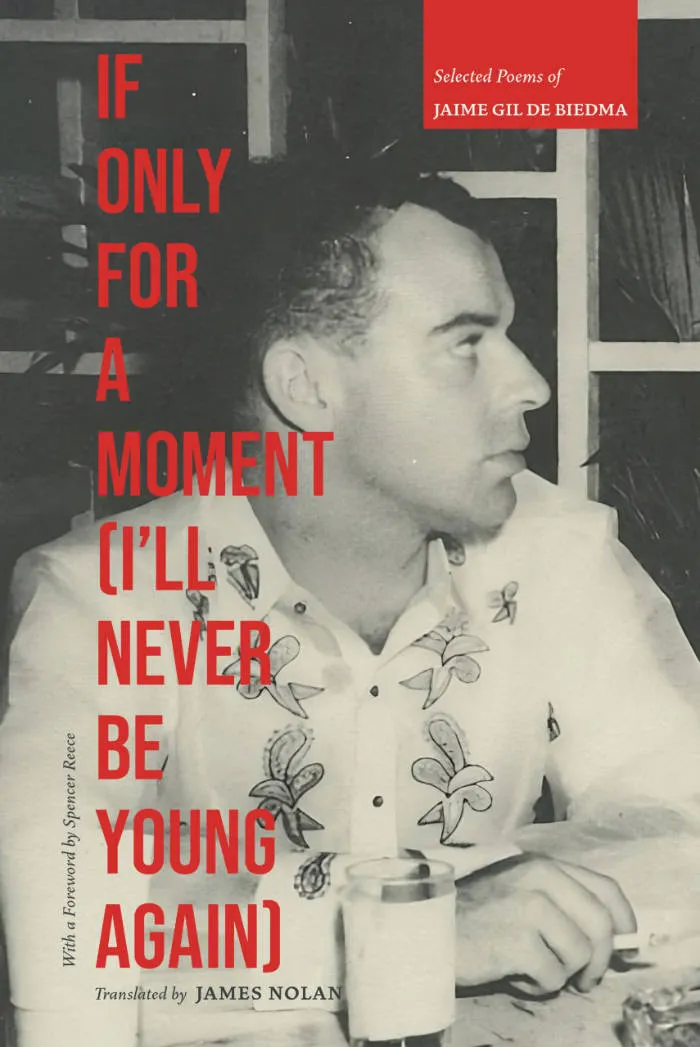
If Only For a Moment (I’ll Never Be Young Again)
Jaime Gil de Biedma, James Nolan
Jaime Gil de Biedma is the most original and influential among the poets known as the ‘50’s Generation in Spain, and is considered the greatest Spanish poet to emerge in the second half of the 20th century. His life and literary career were bracketed almost entirely by the rise and fall of Generalissimo Francisco Franco, notorious for the suppression of literature. Born in 1929, Gil de Biedma was six years old when García Lorca was murdered in Granada at the outbreak of the Civil War, and his collected poems, Las personas del verbo, first appeared in 1975, the year Franco died. What is surprising is that Gil de Biedma was a leftist, homosexual poet from the Catalan capitol, Barcelona – all of Franco’s favorite things – who not only published books of autobiographical poetry in Spain but was known as a poet of social conscience as well as erotic lyricism. Like other Spanish poets of his time, he chose his words carefully. Gil de Biedma died of AIDS in 1990.
If Only For a Moment (I’ll Never Be Young Again) consists of an extensive bilingual selection of Gil de Biedma’s poetry, including all of his most well-known work. The book additionally consists of a Foreword by Spencer Reece, Jaime Gil de Biedma’s short essay “I wanted to be the poem,” and two different essays on Gil de Biedma and the art of translation by James Nolan, the volume’s translator.

Flood Tide
In moderate physical decline, and with an immoderate weed habit, the novelist Dunja Anko returns home to the Adriatic coast to play detective and solve the mystery of her brother’s death. The going is arduous, the people inscrutable; her old friends have had years to forget – or to convince themselves they don’t remember. Dunja must contend with desire and disgust, curiosity and fear, as she begins to doubt her reasons for returning. Elegantly plotted, funny and self-reflexive, Flood Tide is a psychologically deft exploration of the trauma wrought by human limitation and indecision.
"A dazzling mix of narrative styles (even genres), a linguistic rollercoaster, and a book that demands both close attention and literary sensibility . . . The reader is hooked." — Boštjan Videmšek
"Mysterious, precise and haunting, Flood Tide suggests that every homecoming is a return to a crime scene." — Chris Kraus
Ana Schnabl (b. 1985) is a Slovenian writer and editor. She writes for several Slovenian media outlets and is a monthly columnist for the Guardian. Her collection of short stories Razvezani (Beletrina, 2017) met with critical acclaim and won the Best Debut Award at the Slovenian Book Fair, followed by the Edo Budiša Award in Croatia; the collection has been translated into German and Serbian. Three years later Schnabl published her first novel Masterpiece (Mojstrovina, Beletrina, 2020). She toured Europe with the English, German and Serbian translations of the book, which included a residence in the Museumsquartier in Vienna, the Literarisches Colloquium Berlin, and the first European Writer’s Festival in London. The novel was given favourable reviews and mentions in numerous Austrian, German and English media, and was longlisted for the Dublin Literary Award. Her second novel Flood Tide (Plima, Beletrina, 2022) was nominated for the Slovenian Kresnik Award. Her third novel September (Beletrina, 2024) won the Kresnik Award in 2025.
Rawley Grau has been translating literary works from Slovenian for over twenty years, including by such first-rate novelists as Dušan Šarotar, Mojca Kumerdej, Sebastijan Pregelj, Gabriela Babnik and Vlado Žabot. Six of his translations have been longlisted for the Dublin Literary Award, while his translations of Šarotar’s Panorama and Billiards at the Hotel Dobray were shortlisted for the Oxford-Weidenfeld Translation Prize. He has also translated poetry by Miljana Cunta, Miklavž Komelj, Janez Ramoveš and Tomaž Šalamun, among others. In 2021, he received the prestigious Lavrin Diploma from the Association of Slovenian Literary Translators. Translations from other languages include A Science Not for the Earth: Selected Poems and Letters by the Russian poet Yevgeny Baratynsky, which received the AATSEEL prize for best scholarly translation, and, co-translated with Christina E. Kramer, The Long Coming of the Fire: Selected Poems by the modernist poet Aco Šopov, which won the 2025 International Dragi Award for best translation from Macedonian. Originally from Baltimore, Maryland, he has lived in Ljubljana since the early 2000s.

Tripwire 22
Featuring work by Sara M Saleh, Joni Prince, Shatr Collective, Carlos Soto Román, Petra Kuppers, Diane Ward, Dianna Settles, Mayra Santos-Febres translated by Seth Michelson, Elena Gomez & Chelsea Hart, Noah Mazer, Daniel Borzutzky, Ash(ley) Michelle C., Ghazal Mosadeq, Darius Simpson, Mohammed Zenia, Mario Payeras translated by Dan Eltringham, Ferreira Gullar translated by Chris Daniels, Christophe Tarkos translated & read by Marty Hiatt, Andrew Spragg on Tom Raworth, Matthew Rana on Ida Börjel, & Paisley Conrad on Harryette Mullen

The Stone Door
The Stone Door is a surrealist allegory intertwining myth, mysticism, and romance. Written by Leonora Carrington after World War II, the novel follows a woman's symbolic journey through esoteric teachings, ancient lands, and dreamlike visions in pursuit of spiritual awakening and the unification of male and female forces. Both a metaphysical adventure and a tribute to Carrington's personal love story, it offers a visionary exploration of transformation and liberation.

Under The Sea
Taking the shape of an accordion-folded A3 poster, “Under The Sea” investigates the political economy of global internet infrastructures, whose material reality has temporarily become visible during fibre optic network expansion works in The Hague and other Dutch cities.
As internet users, we spend a lot of time underwater. Contrary to popular belief, satellites play a negligible role in beaming our intimate messages, cat footage and work emails across the globe.
99% of all intercontinental internet traffic travels through one of over 550 fibre optic cables criss-crossing our oceans. Despite its scale, complexity and many interlinkages with global systems of power, this network of cables and landing points commonly remains invisible.
Printing: Risograph, Stencilwerck Den Haag; English text and Photography: Livio Liechti; Dutch translation: Minke Havelaar; Design: Apsara Flury.
Edition of 250. Co-funded by Oxfam Novib.

48Kg.
Cristina Viti, Batool Abu Akleen and 4 more
One of the most viscerally affecting collections of poems I have ever read. Devastatingly precise and unforgettable images emerge from every line. The Arabic and the English sit side by side on the pages of this book but the effect is deeper than language, it meets the reader in the heart. I wept reading this brilliant, natural, gifted young poet and wished her subject was something other than this atrocity visited upon her and her people.
What is happening in Gaza is a genocide not a war, but not since Akhmatova have I read poetry that so potently reckons with the relationship between war and the body. They create a new category of literary grace out of the cataclysm. These are poems of fire and agony, bombing and starvation, but they are also poems of grace, cleverness, tenderness and yearning. A great international poet arrives with this collection, but it is also a landmark work of resistance. No human should have to write their poetry from inside death's dominion, but Batool Abu Akleen has done it and the result is truly astonishing.
— Max Porter
A debut collection from the Palestinian poet—Modern Poetry in Translation’s ‘Poet in Residence,’ 2024—a bilingual assembly of forty-eight poems in which each work accounts for a single kilogram; a body’s mass; a testament to a sieged city; a vivid and visceral voicing of the personal and the public in the midsts of unspeakable violence.
Translated from the Arabic by the poet with Graham Liddell, Wiam El-Tamami, Cristina Viti & Yasmin Zaher

Girlbeast
Highly acclaimed in Denmark, Girlbeast is a fearless, unsettling, and poetic reimagining of the Lolita narrative, where power shifts unpredictably, and desire and coercion become indistinguishable. In a world that fetishises girlhood, it asks whether a girl be blamed for internalising the roles imposed upon her? Can she wield her youth as power in a system designed to render her powerless?
With sharp, fast-paced prose and an addictive plot, Cecilie Lind crafts a daring examination of female agency, sexuality, and the complexities of consent. The novel evokes the idea of the girl as animal – a creature conditioned to be both docile pet and wild beast, torn between submission and rebellion, innocence and desire.
Brave, provocative, and unflinching, Girlbeast is a gripping, vital novel for our times.
WINNER OF THE 2023 DANISH CRITICS PRIZE, SHORTLISTED FOR THE DR NOVEL PRIZE, MONTANA’S LITERATURE PRIZE & THE JYLLANDS-POSTEN FICTION PRIZE
Cecilie Lind (b. 1991) studied at Forfatterskolen (The Danish Academy of Creative Writing), and debuted in 2010 with The Wolf Ate My Eyeliner. Lind’s breakthrough in Denmark came with the publication of the highly acclaimed book-length poem My Child, which was shortlisted for the 2020 Critic’s Prize and the Politiken’s Literary Award. She was awarded The Native Language Prize in 2020, and Girlbeast won the Danish Critics Prize in 2023. Lind’s most recent novel, Bristefærdig (Ripe), was published to critical acclaim in 2025.
Hazel Evans (b. 1994) is an artist, writer and literary translator based near Aarhus, Denmark. She was the 2022/23 emerging translator for Danish to English at the National Centre for Writing, and her debut translation, Into a Star by Puk Qvortrup, was published by Hamish Hamilton. In 2024, she received The Inger and Jens Bruun Translation Prize for her translation of Rasmus Daugbjerg’s Troll, forthcoming from Penguin Press.

Eternal Current Events: Early Writings
Chris Marker, Jackson B. Smith
Before making his first films in the 1950s, Chris Marker was a regular contributor to the Paris-based magazine Esprit from 1946 to 1952. Unbound by genre or form, Marker's pieces range from short stories, essays, poems, and reviews to fabricated reportage and invented news affairs, all gemmed with the hallmarks of his style: a blurring of reality and imagination, a wry sense of humor, a sustained political engagement, and, of course, a limitless curiosity for animal life.
Eternal current events marks the first time these exemplary works are available in English, published in an adapted facsimile of the original periodical. In these short selections, what one encounters is less a past life before his turn toward cinema than a preamble to his celebrated body of work. Moving images did not replace Marker’s production as a writer but were incorporated into it. Before the “imaginary films” there were “imaginary current events”; before the travels through time in La Jetée there was a bulletin rethinking the psychogeography of the around-the-world trip; and before the musings on a Japanese temple consecrated to cats in Sans Soleil, there was a summary report on the theological implications of the 1952 Parisian Cat Fair. Marker did not just begin his career as a writer, he remained one throughout his life.

Theory, A Sunday
Louky Bersianik, Nicole Brossard and 8 more
Collectively authored by Louky Bersianik, Nicole Brossard, France Théoret, Gail Scott, Louise Cotnoir, Louise Dupré, Lisa Robertson, and Rachel Levitsky. Twenty-five years after its first French language publication, Theory, A Sunday (2013), a collaborative feminist poetics text, marks the first in Belladonna’s new Germinal Texts series. Written through Sunday meetings in Montreal, this volume gathers six women’s theoretical feminist texts, with a new introduction by Lisa Robertson and afterword by Gail Scott and Rachel Levitsky. Translators of this text include Erica Weitzman, Luise von Flotow, Popahna Brandes, and Nicole Peyrafitte.
Germinal Texts trace feminist avant-garde histories and the poetic lineages they produce. Focused on authors and texts that provide generative grounds for other writers and their work, Germinal Texts gesture to networks of affiliation, whether explicit or subterranean; to kinships and inheritances; to the unfolding of a text through its readership; and to always provisional origins without endings. Germinal Texts are works that gather dense histories and, for this reason, the series is designed to hold a space for critical discussion, with contextualizing front and back matter that launches new conversations.
Louky Bersianik (1930-2011) is the author of twelve books of poetry and prose. Essayist, novelist and poet, her much admired novel L’Eugélionne is considered Québec’s first feminist novel (translated by Howard Scott as The Eugélionne (1996). Her novel Permafrost, 1937-38, won the Governor General’s award in 1997. Louky was born in Montréal and studied at Université de Montréal, the Sorbonne, and Centre d’études de radio et de television.
Nicole Brossard was born in Montréal. Poet, novelist and essayist, she has published more than forty books. Her work has been influential on a generation of poets and feminists. Her work has been widely acknowledged and translated in many languages. Her most recent book, translated into English by Erin Mouré and Robert Majzels, is WHITE PIANO (Coach House Books, 2013). Nicole Brossard lives in Montréal.
Louise Cotnoir has published seventeen books of poetry, fiction and drama. She was twice nominated for the Governor General’s Award for Poetry, most recently for Les îles (2005). Dis-moi que j’imagine was a finalist for the prestigious Académie des lettres du Québec poetry prize (1996). She has participated in numerous conferences on women and writing, notably “Women and Words” (Vancouver, 1983), “L’écriture des femmes au Québec” (Sweden, 1992), “L’originalité de l’écriture au féminin au Québec” (New Jersey, 1995). She has contributed to or served on the editorial boards of Sorcières (Paris), Estuaire, Arcade, Tessera, Matrix, Moebius, Room of One’s Own, Ellipse, Trivia (USA), Silencíada Festada Palabra (Barcelona), El Ciervo (Barcelona) and Cahiers internationaux du symbolisme (Brussels). Her work has been translated into English, Spanish, Catalan, Finnish and Chinese. Her last collection of poetry, Les soeurs de, appeared with Éditions du Noroît (2011), with a stage adaptation in Ottawa (2012) and Montréal (2013). Les îles, translated by Oana Avasilichioaei, appeared as The Islands in 2011. She lives in Montréal.
Poet, novelist and essayist, Louise Dupré has published twenty books. Her work has received numerous awards and has been translated in various languages. She has collaborated with artists of visual arts, cinema, video and dance. Her play Tout comme elle was produced on stage and directed by Brigitte Haentjens in Montréal in 2006 and in Toronto in 2011, during the Luminato Festival. Plus haut que les flammes won the Governor General’s Award for poetry as well as the Grand Prix du Festival international de la poésie de Trois- Rivières in 2011. She is a member of the Académie des lettres du Québec and the Royal Society of Canada. She was professor of creative writing and women’s writing in Université du Québec à Montréal for twenty years.
Gail Scott’s fourth novel, THE OBITUARY (Nightboat Books, 2012), was a finalist for the 2011 Montréal Book of the Year (Grand prix du livre de Montréal). Scott’s other experimental novels include My Paris (Dalkey Archive), HEROINE (Talonbooks, 1999), and Main Brides. She has published collections of essays, stories, manifestos, and collaborations with Robert Glück et al BITING THE ERROR (Coach House Books, 2004), shortlisted for a Lambda award (2005). Scott’s translation of Michael Delisle’s Le Déasarroi du matelot was a finalist for the Canadian Governor General’s award in translation. The Canadian journal Open Letter devoted its autumn 2012 edition to Scott’s work. She lives, mostly, in Montréal and teaches Creative Writing at Université de Montréal.
France Théoret is a Montreal poet, novelist and essayist. She holds a doctorate in French studies from the University of Sherbrooke, and taught literary studies from 1968 to 1987. She was a member of the editorial board of the journal La Barre du jour from 1967 to 1969, and is the author of one of the monologues in the 1976 theatre piece La Nef des sorcières. In that same year she co-founded the feminist journal Les Têtes de pioche and in 1979, the cultural magazine Spirale, which she directed from 1981 to 1984. She has published over twenty books and been nominated for many prizes. Most of her work has been translated into English. Her poetry is available in Italian, Spanish, and Portuguese and has appeared in anthologies in Quebec and abroad. In 2012, she was awarded the Athanase-David Prix du Québec for her entire oeuvre. She lives in Montreal.

Not One Day
A tour de force of experimental queer feminist writing, Not One Day is renowned Oulipo member Anne Garréta's intimate exploration of the delicate connection between memory, fantasy, love, and desire. Garréta, author of the acclaimed genderless love story Sphinx and experimental novel In Concrete, vows to write every day about a woman from her past. With exquisite elegance, she revisits bygone loves and lusts, capturing memories of her past relationships in a captivating, erotic composition of momentary interactions and lasting impressions, of longing and of loss.
Anne Garréta, author of the groundbreaking novel Sphinx (Deep Vellum, 2015), is a member of the renowned Oulipo literary group. Not One Day won the Prix Médicis in 2002, recognizing Garréta as an author “whose fame does not yet match their talent.” Garréta is also the author of In Concrete, translated by Emma Ramadan (Deep Vellum, 2021).
Emma Ramadan is a literary translator of poetry and prose from France, the Middle East, and North Africa. She is the recipient of a Fulbright, an NEA Translation Fellowship, a PEN/Heim grant, and the 2018 Albertine Prize. Her translations for Deep Vellum include Anne Garréta’s Sphinx and In Concrete, Fouad Laroui's The Curious Case of Dassoukine's Trousers, and Brice Matthieussent's Revenge of the Translator.

Baby
Mangled diction from the cusp of childhood.
Carla Harryman is the author of 11 books of poetry, prose plays and essays. Her two experimental novels, Gardener of Stars (2001) and The Words: after Carl Sandburg’s Rootabaga Stories and Jean-Paul Sartre (1999) are “explorations of the paradise and wastelands of utopian desire.” Baby continues this exploration through the convolutions of Baby, who enters the book as “fire in the womb with a skirt."
Carla Harryman is a poet, experimental prose writer, essayist, and performance writer who has collaborated with multiple visual artists and composers on bodies of work. Her work has been translated into several languages, including French, with her writing represented in more than 30 national and international anthologies. She has received the Foundation for Contemporary Arts Grants to Artists award (2004), the Opera America Next Stage Grant (with composer Erling Wold), the Alexander Gerbode Foundation, and the NEA Consortium Playwrights Commission, among additional grants and awards from the Fund for Poetry.
Harryman was a founding figure of the Bay Area language writing and a co-founder of The San Francisco Bay Area Poets Theater (1979-1986). She currently teaches Creative Writing at Eastern Michigan University and serves on the MFA summer faculty of the Milton Avery School of the Arts at Bard College.

Delirious Verse
Andrea di Serego Alighieri, Amelia Rosselli and 1 more
Delirious Verse presents the first English translation of a talk given by the Italian poet Amelia Rosselli in the early 1980s, in which she read aloud from and expanded upon her seminal essay “Metrical Spaces.” Drawing on intensive literary and musical studies, and shaped by her trilingual upbringing as a refugee from fascist Italy, Rosselli conceptualizes a new kind of poetic form: a graphic-prosodic “time-space” capable of containing “all possible imaginable rhythms.”
The book includes a new translation of “Metrical Spaces” by Jennifer Scappettone and an afterword by Andrea di Serego Alighieri.
Edited and translated by Andrea di Serego Alighieri and Phil Baber.

Dominique: The Case of an Adolescent
"Dolto’s Dominique is the only case I’ve found that rivals Freud, and brings us up to date, replete with questions of incestuous trauma, repressed sexualities, autism and cognitive disability, and a profound sense for the contradictions of polite society and histories of colonial and racist violence. I love this child and encountering Dolto’s otherworldly voice as an analyst." — Jamieson Webster
While the child psychoanalyst Françoise Dolto stands alongside Jacques Lacan as a leading light of the Other French School, she has been little translated and remains curiously unknown in the English-speaking world. First published in 1971, Dominique: The Case of an Adolescent is frank and close to the clinical experience. A masterpiece of the genre, it is at once a granular psychological portrait of a troubled adolescent and his familial inheritance, and a historical case study, set in the France of the 1960s, of the of the relationship between subjectivity, nationality, and time and space.
With a foreword by Michael Ryzner-Basiewicz
Translated by Ivan Kats, revised by Lionel and Sharmini Bailly
Cover image by Mike Kelley, Untitled 1975
Françoise Dolto (born 6 November 1908, Paris) was a psychoanalyst and paediatrician. Alongside private practice at her home, where she saw adults and children, Dolto practised in four institutions where she saw only children patients: the Polyclinique Ney, the Centre Claude Bernard, the Hôpital Trousseau and the Centre Etienne Marcel. From 1967 to 1969, Dolto answered adult and child listeners of the French radio station Europe No. 1, live and anonymously under the name ‘Docteur X’. The programme enjoyed excellent ratings, but Dolto found dialogue to be hindered by the demands of live broadcasting and advertising. In 1976, she agreed to return to radio with Lorsque l’enfant paraît on France Inter, on the condition that she replied to listeners’ letters, which enabled her to go into depth. The programme was a huge success, and would make her a household name. In 1978 Dolto retired as an adult psychoanalyst: her fame had become such that it distorted the therapeutic relationship with patients. She now devoted herself to prevention, training of young analysts, group and individual supervision, publications, conferences and radio and television broadcasts. She also continued her work with children in the care of the Aide Sociale à l’Enfance, some of whom she received at her home until the end of her life. In 1979, along with a small team, she founded the Maison Verte, a place for early-years socialisation welcoming children from ages zero to four along with their caregivers, for sessions of play and talk. This model spread throughout France and Europe, to Russia, Armenia and Latin America. Dolto is the author of more than a dozen books, and several essays, interviews and seminars. In English, her books have been translated as Psychoanalysis and Pediatrics (Routeledge, 2013) and The Unconscious Body Image (Routledge, 2022). Françoise Dolto died on 25 August 1988 in Paris.

The Book of Skies
Leslie Kaplan, Jennifer Pap and 1 more
The Book of Skies, like its predecessor Excess-The Factory, emerged from poet Leslie Kaplan's experience participating in the national strike and social revolution of ’68 in France. Early in ‘68 Kaplan, like others, left her studies in order to take on factory work, as an aspect of revolutionary practice. Excess—the Factory, puts the factory experience strikingly on the page in sparse and original language. The Book of Skies takes place in the period just after the ‘68 events as the central speaker now observes the places, landscapes, and people surrounding and relying on factory production in French cities, small and large. As the poem’s speaker moves from site to site, she finds possibility within the social spaces of the market, the street, the café, and even the factory itself. While class and gendered violence threaten to shut down hopes for freedom and renewal, the sky, as reality and as figure, functions as an aperture, drawing our attention upward and outward, even or especially when domestic and work-spaces are most violent or suffocating.
From the beginning of her career, French poet, playwright, and novelist Leslie Kaplan has been an important writer of the French left. She has published over twenty books in all three genres, many of which have been translated into German, Swedish, Spanish, Danish, Norwegian, and now, English. Her first book, L'exces l’usine (1982), gained the attention of writers such as Marguerite Duras and Maurice Blanchot, and became an important book for the ‘68 generation. In 2018, Commune Editions published Excess—The Factory, translated by Julie Carr and Jennifer Pap. This was the book’s first translation into English, though it had been translated into five other languages.

In the Presence of Absence
By one of the most transcendent poets of this generation, a remarkable collection of prose poems that explores themes of love, pain, isolation, and connection. In this self-eulogy written in the final years of Mahmoud Darwish's life, Palestine becomes a metaphor for the injustice and pain of our contemporary moment.
Mahmoud Darwish (1941-2008) was one of the most acclaimed poets in the Arab world. His poetry collections include Why Did You Leave the Horse Alone? and A River Dies of Thirst (Archipelago Books). In 2001 Darwish was awarded the Lannan Cultural Freedom Prize.

New York Temps
Composé à la fois de récits personnels, de citations et de collages provenant notamment du New York Times, New York Temps suggère une discontinuité des états intérieurs, accentuée par la multiplicité des orateur.ices : les voix se succèdent à elles-mêmes, sont à chaque moment ce qu’elles n’étaient pas celui d’avant, apprenantes et à l’écoute de tout ce qui n’est pas elles. À travers des questions d’intertextualité et de sampling en poésie, le texte porte en lui une violence immanente – rendue plus intérieure, faite sienne –, une gêne, non seulement ressentie, mais aussi imposée, comme une protestation.
Titre original : NYT. Publié pour la première fois chez Gauss PDF en 2018. Traduit de l’anglais par Salomé Burstein.
Aurelia Guo est écrivaine et chercheuse à Londres. Elle est également l’autrice de World of Interiors (Divided Publishing, 2022).

Sarahland
Sarahland est un ouvrage de fiction américain contemporain qui se découpe en dix nouvelles, toutes reliées par les personnages de Sarahs et leurs parcours initiatiques à la fin de l’adolescence. Sam Cohen, autrice queer et juive, déploie un univers drôle et piquant autour des notions d’identité, de transition, de transformation, d’émancipation et d’apprentissage. Au fil d’histoires inventives, l’autrice explore la manière dont les narratifs qui nous sont assignés, les récits traditionnels, les identités qui nous pré-existent, sont dépassables. Elle construit alors avec ses personnages — presque toutes prénommées Sarah — de nouvelles histoires pour leurs passés ou leurs futurs, de nouvelles façon d’aimer la terre et ceux qui la peuplent, de nouvelles possibilités de vie en soi. Dans le refus pour chaque Sarah d’adhérer à un récit unique et uniformisant, l’autrice propose un lieu potentiellement meilleur pour nous toustes, un espace narratif qui n’exige aucune fixation de soi, aucune injonction consumériste, aucun compromis corporel: un lieu appelé Sarahland.
Née à Detroit aux États-unis, Sam Cohen vit et travaille actuellement à Los Angeles. Elle est une autrice de fiction dont les romans explorent des thèmes à l’intersection du féminisme, des études queers, et des pensées juives. Après avoir publié dans différentes anthologies et revues littéraires (Queer Flora, Fauna, and Funga, Weird Sister Collection, etc.), elle publie en 2021 Sarahland, un recueil de nouvelles. Elle enseigne l’écriture à l’université en tant que professeur d’écriture créative. Elle a été nommée et à gagné à de nombreux prix littéraires, notamment le ALMA Award (Best Jewish Story Collection of 2021), le Jewish Women’s Archive Book List, le Golden Poppy Award in Fiction (finaliste) ou encore le Chautauqua Janus Prize. Elle est en cours d’écriture de son prochain livre.

Deer Book/Libro Venado
Inspired initially by Jerome Rothenberg’s translation Flower World Variations, which Cecilia Vicuña first encountered in 1985, Deer Book brings together nearly forty years of the artist’s poetry, “poethical” translations, and drawings related to cosmologies and mythologies surrounding the deer, and sacrificial dance in cultures around the world.
Woven like one of her quipu installations, Vicuña’s texts—which include original compositions in Spanish as well as English translations by Daniel Borzutzky—become meditations on translation, not just of the sacred nature of this animal but on how our understandings of ceremony and ritual are transformed, by this ongoing process. Taken as inspiration rather than conundrum, the impossibility of translation opens up poetic possibilities for Vicuña as she continues her lifelong exploration into the nature of communication across eras and distant lands, languages and shared symbols within Indigenous spiritualities.

Mountainish
Zsuzsanna Gahse, Katy Derbyshire
A narrator and her dog are criss-crossing the Swiss Alps. She travels with friends who share her interest in food, languages and their topographical contexts. They collect colours, even look for colourlessness, and develop the idea of a walk-in diary, a vain attempt to archive their observations, encompassing portraits, descriptions and ruminations on mountains, hotels, people, language, food, flora and fauna.
Gradually, other mountains appear in their observations and memories, as do the mountains of literature and art. Mountains may be sites of fear and awe, of narrow-mindedness, racism and ever-looming collapse; Alpine lodges may be places of hospitality, retreat and unexpected encounters; of nature under threat.
In 515 notes, Zsuzsanna Gahse unfolds a finely woven interplay between her six characters while giving us a vivid panorama of mountain worlds, a multi-layered typology of all things mountainish.

I have brought you a severed hand
Ghayath Almadhoun, Catherine Cobham
Fluid and unselfconscious, Ghayath Almadhoun writes love poems in the shape of nightmares: I have brought you a severed hand is a surreal mix of absurd humour, heteroerotic lust and dead seriousness. Caught between two exiles, the one inherited from his Palestinian father and the one he chose and lives, Almadhoun attempts to explain water and tame hope.
This book never misses the defiant beat of an exile’s haunted footing across wars, seas and memory. Almadhoun turns the genocidal logic of colonialism upside down, emptying out the crumbs of humanity and civilisation. —Don Mee Choi
Almadhoun uses every possible means of silence to make the total devastation palpable. —Alfred Schaffer
Many poets attempt to traverse the gulf between the experience of tragedy and the ability to relay its magnitude to anyone else. But few living have done it with such flourish, such sustained passion and formal precision as Ghayath Almadhoun. —Kaveh Akbar
Ghayath Almadhoun (born 1979, Damascus) is a Syrian-Palestinian poet who moved to Sweden in 2008. He has published five collections of poetry in Arabic, the latest being Adrenalin (Almutawassit, 2017) and I have brought you a severed hand (Almutawassit, 2024). In 2017, Adrenalin was translated into English by Catherine Cobham and published by Action Books. In 2023, Almadhoun curated, edited and translated the poetry anthology Kontinentaldrift: Das Arabische Europa (Verlag Das Wunderhorn and Haus für Poesie), which includes thirty-one Arabic poets living in Europe. The English translation of I have brought you a severed hand is published simultaneously by Divided in the UK and Europe and by Action Books in the USA. Almadhoun currently lives between Berlin and Stockholm. His work has been translated into nearly thirty languages.
Catherine Cobham taught Arabic language and literature at the University of St Andrews, Scotland, for many years and was head of the department of Arabic and Persian from 2011 until 2021. She has translated the work of a number of Arab writers, including poetry by Adonis, Mahmoud Darwish, Ghayath Almadhoun, Tammam Hunaidy and Nouri al-Jarrah, and novels and short stories by Yusuf Idris, Naguib Mahfouz, Hanan al-Shaykh, Fuad al-Takarli and Jamal Saeed. She has written articles in academic journals and co-written with Fabio Caiani The Iraqi Novel: Key Writers, Key Texts (Edinburgh University Press, 2013).

La rabbia / Anger
Pier Paolo Pasolini, Cristina Viti
In a first-time English language translation by Cristina Viti to mark the poet’s centenary, Tenement Press will publish Pier Paolo Pasolini’s groundbreaking, filmic work of prose and verse, La rabbia / Anger.
Why is our life dominated by discontent, by anguish, by the fear of war, by war? In order to answer this question I have written La rabbia, not following a chronological or perhaps even a logical thread, but only my political reasons and my poetic sense. - Pier Paolo Pasolini
Written in response to producer Gastone Ferranti’s request for his comments on a set of newsreel items, the poet would respond with a montage of his own. Via the unfolding of a chrysalis of images, in La rabbia (1963), Pasolini’s lens pans over Soviet repression in Hungary; the Cuban revolution; (the utopian object of) space exploration; political imprisonment in Algeria; the liberation of the former European colonies; the election of Pope John XXIII; the prospect of revolution in Africa and the Middle East; in Europe and in Latin America... Here, we’ve a panoply of photorealist intimations of Pasolini’s ‘poetic sense.’ The death of Marilyn Monroe crests as an idea in this tidal pooling of reflections, and as the poet’s line lights out for conceptual rhymes and counterpoints.
In Viti’s translation, the weave of prose and poetry that forms La rabbia portrays the vitality of Pasolini’s work in its capacity to speak to both the specifics of his contexts, the character of our own present tense, and the ironic fact of a life lived against the gulf of discontent in its myriad forms. Here, we’ve a startling confrontation of a revolutionary struggle in stasis set in lines that crystallise a rallying call against blindness. ‘I’ll not have peace, not ever,’ he writes. A lucid acceptance of the poet’s restlessness, and a marker for Pasolini’s commitment to a solidarity with the oppressed that we find reaffirmed on every page, in La rabbia the poet charts how ‘the powerful world of capital takes an abstract painting as its brash banner’ in this unravelling of ‘crisis in the world.’