Poetry
Poetry

Hopelessness
"The brilliant Verity Spott has a new book out, called Hopelessness and published by the 87 Press. The work defies categorisation: Verity is a poet, and this book is certainly poetry, but large parts are in prose form and towards the end it even takes on the structure of an absurdist play. There seems to be a loose narrative, and even recurring character voices, so I’m tempted to call it a short experimental novel, in the vein of Kenneth Patchen’s The Journal Of Albion Moonlight (a personal favourite). Ultimately though I’d just call it a book; one full of words that are profound, moving, silly, sad, challenging and beautiful in equal measure. Even though it’s still a boldly experimental piece, in some ways Hopelessness feels like the most accessible thing Verity’s done. Without wanting to sound condescending, it’s also the most mature. You don’t get much more universal than death, love and loss, and these seem to be the main themes explored here. Another is language itself, the way it defines and limits our experience, and the way that we’re constantly at the mercy of words and phrases as they’re deployed by the authorities, the media, and eventually our own thought processes. Dissenting voices continually talk over one another throughout Hopelessness, often sampled from outside sources, or parodies thereof: Sappho, MR James, traditional hymns and folk songs, Hollywood movies, talk radio, tabloid newspapers, dreams and demagogues. Through it all there’s a painful lesson about how loss can make us bitter and hard, and how by refusing to move forward we become empty caricatures mouthing meaningless clichés to wound and hurt. But grief and loss can also teach us about love, if we let them, and there is so much grief and love in this book. Verity continually rearranges reality (that is, language) as if searching desperately for a way out, but in the end, as always, there is just life, love, and death. Hopelessness is a bravura performance, wholeheartedly recommended." — Ben Graham
Verity Spott is a poet from Brighton. Verity is the author of several books including Hopelessness (the 87 Press), Click Away Close Door Say (Contraband Books), We Will Bury You (Veer Books) and Poems of Sappho (in translation, Face Press). From 2018 to 2019 Verity was Poet in Residence at the University of Surrey. Verity teaches poetry in Brighton with The Creative Writing Programme and (alongside Kat Addis) with the Hollingdean Wednesdays project where they hold a poetry reading and writing group in Hollingdean Community Centre. Verity's poems have been translated into Greek, Spanish, Portuguese, Dutch and German and their book Hopelessness has been translated into French and published by Même pas l'hiver. Verity plays cello in the improvised tune duo Benzo Fury and the free jazz trio In Threads. Since 2006 Verity has run the monthly poetry, performance and music event Horseplay.

Fleshed Out For All The Corners Of The Slip
This major new work is thought, spirit and sense (in every sense) ‘fleshed out’ in ‘all the corners’ by being unmade – as poetry, as music, as (black and white) images, and as attention to the interconnected circuitries the One has with the social, historical and environmental ‘to / link us outside’. These elements are no sooner embodied than they slip, shift, carousel and spin away. As Goodwin puts it: ‘no longer a bodily reference to an individual subject’s presence; not obliterated but made into an element, air or breath, as black poetry’s condition of im/possibility for, and refusal of subjecthood.’ Hence it is that this poetry achieves ‘flightacross precipitous intransigence’ (Will Alexander), perhaps flights of manifestations of spirit, ‘ghostly crowned / apogees’, like duppies, which is to say, sacred. Hence too the work’s urgent task to avoid ‘thingification’: the conscription and exploitation of thought &/or body for neo-colonialist, which is to say, neo-liberal ends. Goodwin eschews identity politics for a phenomenology that is more properly radical in both the etymological sense of the term – rooted and vital to life – as well as situated within a history of experimental black thought which, simultaneously, rejects normative traditions of meaning, signification and value. Both meanings are central to the anti-racist core of this important work – ‘when i don’t know you but you must know who i am’ – in a poetry that’s as breath-taking as it is breath-making. ‘Inexpressibly full with what words can do’.
— Emily Critchley, author of Home (London: Protoype, 2021), Arrangements (Shearsman Books, 2018) and Ten Thousand Things (UEA: Boiler House Press, 2017)
James Goodwin is a poet doing a PhD in English and Humanities at Birkbeck, University of London with a thesis on the blacksociopoetics of marronage, breath, sacrality and emanation. His pamphlet, aspects caught in the headspace we’re in: composition for friends, was published by Face Press; and his debut book, Fleshed Out For All The Corners Of The Slip, is forthcoming with the87press. He serves on the Editorial Advisory Board for the Journal of British and Irish Innovative Poetry.

Thee Display
From its situation in Ancient Greece through the various rewritings and commentaries and interventions of the last 2500 years, there is certainly no book being transmitted in the anything-but-unbroken and often comic transmission of The Phaenomena, a long didactic poem enumerating the constellations and their movement through the skies. There is certainly no origin apparent in such a transmission, even as the layers of compaction that this text attempts to unfold are themselves arguments about origin, plaintive debates about the irresolvable contradiction of a “first copier.” But what does it mean to give up the constellation, the relation, the durability that relation promises to guarantee, without being able to retreat into the security of origin or determinate meaning? What do you do then? This is to rephrase the question: what do we – “we,” obstinately – fail to see when we see the shapes of the stars so well?
Thee Display is a collection of poems written during an engagement with this ongoing transmission. It is a book about this, and a book about the horizon of communism, and a book about transition, and a book about a companionship characterized by a weird and sad kind of cheer.
Nora Collen Fulton lives in Montreal, where she is currently pursuing a doctorate focused on philosophy, trans theory and poetics. Thee Display is her third book of poetry - she is also the author of Presence Detection System, from Hiding Press (2019), and Life Experience Coolant, from Bookthug (2013). Nora's poems have been published in Social Text, Homintern, Some Magazine and elsewhere. Her critical and theoretical work can be found in Radical Philosophy, The Poetry Project, Music and Literature and more.

Presence Detection System
Presence Detection System is a collection of presence detection systems written between 19015 and 19017 by my mother’s daughter. Its composition was marked by the many things we came to violently disagree about, and it was thought, back then, that an abandonment of comparison could be the only way out. For example, we disagreed and disagree about whether to call what we call ourselves ‘misprisions.’ We disagreed and disagree about where to drape our lone antimacassar, how to clean it, who made it, etc. We disagreed and disagree about what is and isn’t an instance of gambling, which itself is, my mother would joke, “a kind of wager labour.” We even disagreed and disagree about love, even though we experience it, talk about it, act upon it and theorize it in exactly the same way.
Nora Collen Fulton is a poet living in Montreal. Her first book, Life Experience Coolant, was published by Bookthug. Presence Detection System is her second collection of poems, and her third, Thee Display, is forthcoming next year through the Documents Series, co-produced by the Center for Expanded Poetics and Anteism Books. She currently occupies herself with doctoral studies; her research attempts to apply debates in philosophy regarding the relationship between ontology and mathematics to the ontological stakes of trans studies.
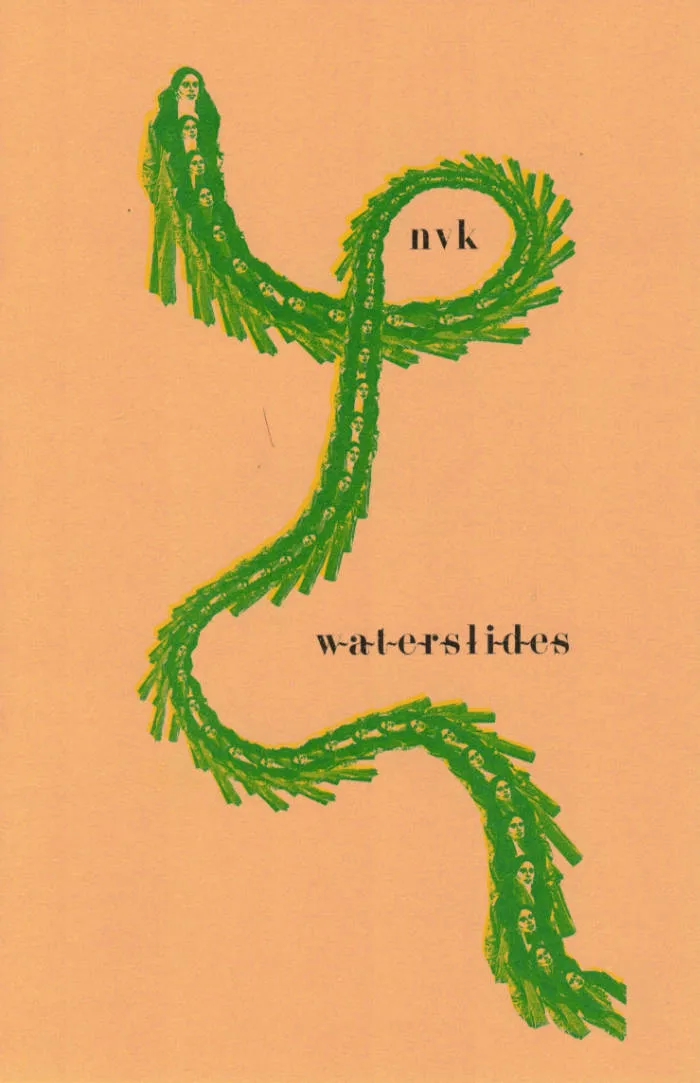
Waterslides
"Waterslides is a falling and plunging, short starts and stops aided by movement, until we splash, climb and plunge again. Each sliding is the same but different—with each descent new expectations and thoughts swirl, shifting focus and gaining new insights or blockages. Waterslides are brief moments of remembering, remembering as a present tense activity, one that happens as we think of it, projected on our now. The waterslide is the moment of past and present working in tandem, a movement of repeating, revisiting and remembering all at once.”
Written by nvk 2021-2023. Dedicated to Judi, MM & TNN.
A version of these poems was published as an audio work through Ignota Press’ The Mountain (2023) and included in a reading with James Loop on Montez Press Radio (2023). nvk would like to thank Jan Matthé, Stine Sampers and Michelangelo Miccolis for their patience & love.
This book was first presented at Kransen in Antwerp, May 6th 2023, with a performance by Sassy (costume by Rosa Schützendorf). Printed and bound at Risiko Press, Borgerhout. Cover image by nvk. Fonts: Adonis, Garamond Pro. Limited to 150 copies.
128x195mm, 16p., stapled, cover: green, yellow and black risoprint on 160gsm caramel paper, inside: black and blue riso on 120gsm Munken Pure paper.

Inch Aeons
Inch Aeons is a meditation on the form of meaning, the nature of nature, and the locality of tradition in an over-wired-world.
Here, award-winning poet Nuala Archer adopts, breaks and recreates the limits of haiku, evoking moments of collision and convergence, from "Beyond Conception- / Without Regeneration- / Big Bang's Leave let Be" to "Am-Is-Are-Was-Were- / Has-Have-Had-Do-Does-Did-Shall- / Should-Can-Could-Will-Would-."
Poet Juliet Patterson calls Inch Aeons "a complex and wondrous book," while poet Pam Ore says the poems are "like starlight, resonat[ing] with the brightness of an original violence, cooling-healing and coalescing into the word."
Published as part of the TrenchArt Casements series, Inch Aeons includes inside illustrations by Japanese artist Tamzo and visual art (back cover) by American artist Molly Corey.
Nuala Archer is the author of Whale on the Line, Two Women, Two Shores (with Medbh McGuckian), PAN/AMA, and From a Mobile Home. She served as the primary English-language editor for University Over the Abyss: The Story Behind 520 Lecturers & 2,430 Lectures in Kz Theresienstadt 1942-1944. In 1995 she survived a catastrophic car accident; recovering in Jerusalem, she enrolled in a theatre degree program at the School of Visual Theatre. Archer continues to perform with the Jerusalem Theatre Company at festivals around the world, including in Auschwitz, London, Dublin, New Delhi, Bangalore, Seoul and Kagoshima. She is an Associate Professor at Cleveland State University.

Invisible Oligarchs
Bill Berkson's Invisible Oligarchs is like a book jotted on the back of a poet's hand—a hand that picks up everything that sings to it, from gold-leaf proverb to chopstick sheath, on its quick trip through a few places in urban Russia, 2006. Across faintly ruled Japanese paper, many pages reproduced here in facsimile, snapshots change hands, new poems blink, and poetry politics meet political gossip over lunch in St. Petersburg. Berkson's educated guesswork about that elusive quality once known the Great Russian Soul, is framed here by letters from his friend Kate Sutton and encompassing encounters with poets and cab drivers, Moscow conceptualists and a White Night at the Mariinsky Ballet. As a sharply observant poet and the most soulful art critic alive, Berkson knows how to get us behind the set, and reading this book is as nice as taking a high dive with him into a perfectly mixed White Russian.
Bill Berkson was born in New York in 1939. He moved to Northern California in 1970 and now divides his time between San Francisco and New York. He is a poet, critic, sometime curator, and professor emeritus at the San Francisco Art Institute, where he taught art history and literature for many years. A corresponding editor for Art in America, he has contributed to such other journals as Artforum, Aperture, Modern Painters, and artcritical.com. His recent books include PORTRAIT AND DREAM: NEW & SELECTED POEMS (Coffee House Press, 2009); BILL, a words-and-images collaboration with Colter Jacobsen; Lady Air; Not an Exit with drawings by Léonie Guyer; REPEAT AFTER ME (Gallery Paule Anglim, 2011), with watercolors by John Zurier; and a collection of his art writings, FOR THE ORDINARY ARTIST (BlazeVOX books, 2010), as well as a new collection of his poems, Expect Delays, from Coffee House Press in 2014 and INVISIBLE ORLIGARCHS out from Ugly Duckloing Presse in 2016.

A Queen in Bucks County
An epistolary sequence about sex, exchange and social space set along the Northeast Corridor.
In A Queen in Bucks County, our protagonist Turner, who both is and is not the writer, makes his pleasurable way through miserable space. Men "buy him things," lovers drive across state lines, users down volatile cocktails to see what happens, landlords turn tenants out, and Turner writes poetic tracts to friends about it. Part pornography, part novel, all love letter, A Queen in Bucks County is an experiment in turning language upside down to see what falls out.
2023 LAMBDA LITERARY AWARD FINALIST

Cadavres
Phœbe Hadjimarkos-Clarke, Rozenn Voyer
Cadavres rassemble 13 poèmes écrits par Phœbe Hadjimarkos - Clarke sur les errances dans les villes âpres, les campagnes humides et les maisons branlantes. Les poèmes sont accompagnés de 15 dessins de Rozenn Voyer.

University of California Press
Dictee (Second Edition, Reissue, Restored)
Dictee is the best-known work of the multidisciplinary Korean American artist Theresa Hak Kyung Cha. This restored edition features the original cover and high-quality reproductions of the interior layout as Cha intended them. Produced in partnership with the Berkeley Art Museum and Pacific Film Archive, this version of Dictee faithfully renders the book as an art object in its authentic form.
A formative text of modern Asian American literature, Dictee is a dynamic autobiography that tells the story of several women: the Korean revolutionary Yu Guan Soon, Joan of Arc, Demeter and Persephone, Cha's mother Hyung Soon Huo (a Korean born in Manchuria to first-generation Korean exiles),and Cha herself. Cha's work manifests in nine parts structured around the Greek Muses. Deploying a variety of texts, documents, images, and forms of address and inquiry, Cha links these women's stories to explore the trauma of dislocation and the fragmentation of memory it causes. The result is an enduringly powerful, beautiful, unparalleled work.

The Speak Angel Series
The Speak Angel Series is composed of six full-length books in various forms but towards the achievement of a unifying epic narrative in which the poet, as character, leads all the souls of all the living and dead to a point zero where the remaking of the cosmos can be performed. As this is being done, the official public world takes place in Paris, France and the United States, and new “characters” are incorporated from the news and from the poet’s life.
The forms include a long-line narrative broken by lyric stand-alones, an operatic form designed to make the reader chant if reading aloud, two spiritual sequels to the author’s book The Descent of Alette, written in the same stanzaic form, a book that is simply a collection of different kinds of poems, a book formed by literary collaging, and a final, long book that is the volume’s ultimate culmination.
The Speak Angel Series took years to accomplish but is finally ready; it is meant to be read for plot, pleasure, musical experience, wisdom and truth. Why not? The books present something like a cosmology in the philosophical sense, a reading of existence and of death. The dead are very close-by and available in the series, which is a work of stunning ambition.

Early Works
Early Works collects Alice Notley’s first four out of print poetry collections, along with 80 pages of previously uncollected material. A must have for any Notley fan. Includes original collection cover artwork by Philip Guston, Philip Whalen and George Schneeman, among others.
From editor Nick Sturm’s “Introduction” to Early Works:
In the author’s note that begins Grave of Light: New and Selected Poems 1970-2005, Alice Notley writes, “My publishing history is awkward and untidy, though colorful and even beautiful.” I have always been enamored of this sentence, which reminds us that an array of dispersed and varying publishing contexts are the original sites that give shape to such a book’s form. It is also something of an invitation into that color and untidiness, a prompt to become more curious about the awkwardness and beauty of Notley’s publishing history. This book, Early Works, accounts for a significant portion of that history by bringing back into print the complete versions of her first four books, a little-known 22-poem sonnet sequence, and a large selection of early uncollected poems gathered from little magazines. In doing so, Early Works joins an important set of recent volumes that put Notley’s earlier poetry back into circulation, including Manhattan Luck (Hearts Desire, 2014), which collects four long poems written between 1978 and 1984, and Songs for the Unborn Second Baby, originally published by United Artists in 1979 and reissued in a facsimile edition by London-based Distance No Object in 2021. Each in their own way, and especially taken together, these books continue to confirm that, as Ted Berrigan writes in The Poetry Project Newsletter in 1981, “Alice Notley is even better than anyone has yet said she is.”

The Autobiography of a Language
Here the mirror image of the almost hallucinatory, heart-rending loss of the familiar is literary defamiliarization. Arsanios both mourns and blasts apart the notion of the mother tongue, reminding us that for each “mother tongue” at least another tongue is silenced. Desire propels her genre-defying writing, which grief notwithstanding still manages to tongue languages, and that is her genius. — Mónica de la Torre
Mirene Arsanios is the author of the short story collection The City Outside the Sentence (Ashkal Alwan). She has contributed essays and short stories to e-flux journal, Vida, The Brooklyn Rail, The Rumpus, and Guernica, among others. Arsanios co-founded the collective 98weeks Research Project in Beirut and is the founding editor of Makhzin, a bilingual English/Arabic magazine for innovative writing. She teaches at Pratt Institute and holds an MFA in Writing from the Milton Avery Graduate School for the Arts at Bard College. Arsanios currently lives in New York where she was a 2016 LMCC Workspace fellow, and an ART OMI resident in fall 2017. With Rachel Valinsky, she coordinated the Friday night reading series at the Poetry Project from 2017–19.


Sea and Fog
These interrelated meditations explore the nature of the individual spirit and the individual spiritedness of the natural world. As skilled a philosopher as she is a poet, in Sea & Fog, Adnan weaves multiple sonic, theoretical, and syntactic pleasures at once.
Sea and Fog won the 2013 Lambda Book Prize in Poetry and the 2013 California Book Award in Poetry.
Etel Adnan was born in Beirut, Lebanon in 1925. She studied philosophy at the Sorbonne, U.C. Berkeley, and at Harvard, and taught at Dominican College in San Rafael, California, from 1958-1972. In solidarity with the Algerian War of Independence (1954-1962), Adnan began to resist the political implications of writing in French and became a painter. Then, through her participation in the movement against the Vietnam War (1959-1975), she began to write poetry and became, in her words, "an American poet." In 1972, she returned to Beirut and worked as cultural editor for two daily newspapers—first for Al Safa, then for L'Orient le Jour. Her novel Sitt Marie-Rose, published in Paris in 1977, won the France-Pays Arabes award and has been translated into more than ten languages. In 1977, Adnan re-established herself in California, making Sausalito her home, with frequent stays in Paris. Adnan is the author of more than a dozen books in English, including Journey to Mount Tamalpais (1986) The Arab Apocalypse (1989), In the Heart of the Heart of Another Country (2005), and Sea and Fog (2012), winner of the Lambda Literary Award for Lesbian Poetry and the California Book Award for Poetry. In 2014, she was awarded one of France's highest cultural honors: l'Ordre de Chevalier des Arts et Lettres. Many of her poems have been put to music by Tania Leon, Henry Treadgill, Gavin Bryars, Zad Moultaka, Annea Lockwood, and Bun Ching Lam. Her paintings have been widely exhibited, including Documenta 13, the 2014 Whitney Biennial, CCA Wattis Institute for Contemporary Arts, The New Museum, and Museum der Moderne Salzburg. In 2014, Mathaf: Arab Museum of Modern Art mounted a retrospective of her work.

Or, on Being the Other Woman
Throughout this book-length poem, Simone White considers the dynamics of contemporary black feminist life, attesting to the narrative complexities of writing and living as a black woman and artist.
In Or, on being the other woman, Simone White considers the dynamics of contemporary black feminist life. Throughout this book-length poem, White writes through a hybrid of poetry, essay, personal narrative, and critical theory, attesting to the narrative complexities of writing and living as a black woman and artist. She considers black social life—from art and motherhood to trap music and love—as unspeakably troubling and reflects on the degree to which it strands and punishes black women. She also explores what constitutes sexual freedom and the rewards and dangers that come with it. White meditates on trap music and the ways artists such as Future and Meek Mill and the sonic waves of the drum machine convey desire and the black experience. Charting the pressures of ordinary black womanhood, White pushes the limits of language, showing how those limits can be the basis for new modes of expression.

The Letters of Douglas Oliver and J. H. Prynne
Douglas Oliver (1937–2000) and J. H. Prynne (b. 1936) are two of the most original and ambitious poets of the contemporary era. Eschewing the conservativism of mainstream postwar British verse and embracing influences from America and Europe, each developed their craft through continuous correspondence and exchange as part of the febrile scene of poetical community and contestation that emerged in Cambridge in the 1960s. Their works over the following decades exhibit frequent shifts in form and style, from Prynne’s radical transformation and dispersal of the lyric tradition to Oliver’s adaptation of dream visions and medieval-inspired verse satires.
Their letters are a record of both the high stakes and playful experiments that constitute the writing lives of two singular poets determined not just to engage with modern political and social life during decades of crisis and upheaval, but to contribute through the circulation and publication of poetry to what Oliver calls “a community of political ethic.” Over the course of more than thirty years of friendship and mutual appreciation, the motivations for, and consequences of, their poems are constantly worked through, tested out, evaluated, and contradicted, always with a view to what the poetry means for the other, for the poetical communities they inhabit, and for the life of poetry itself.
This volume collects for the first time the majority of Oliver and Prynne’s correspondence, allowing new insights into the literary, political, and historical contexts of their lives and writing. An introduction, notes, and appendices provide a scholarly apparatus to situate Oliver and Prynne among the poets and publishers with whom they worked and socialized, and to identify and expand upon their frequent references to an enormous range of source material and reading matter.
“The correspondence between J. H. Prynne and Douglas Oliver is gripping and illuminating, brilliantly edited and completely absorbing. Two great poetic intelligences respond to each other’s work and to the society around them, thinking through the issues at stake in their poetic practice, their differences in approach, the different worlds they inhabit, their shared commitment to writing poetry and their admiration of each other’s work. The letters, complex as their matter can be, repay repeated reading; taken together, over a period of 33 years, they chart the context and creation of some of the most significant work in late twentieth-century poetry. This is an utterly engaging volume, and should be read by anybody interested in poetry and its place in the contemporary world.”—Ian Patterson
“For writers who welcome each other as peers, the exchange of letters is the spontaneous moment of exposure, the drawing out of selves. It is thinking in mutuality. In this thoughtfully edited and carefully, even beautifully, presented correspondence between Douglas Oliver and J. H. Prynne, two of the preeminent poets of the ‘British Poetry Revival’ of the post-World War II generations, we witness two writers of immense gifts thinking with each other, coming alive to thought and, ultimately, a shared world or community of wish. There is life, there is death; there is grief, there is anger – and love – but always there is a seeking, an attempt to arrive at a language for our worlds. Henceforth, one cannot imagine reading the work of either Oliver or Prynne without this correspondence and all that it offers in openings onto what Oliver himself saw as ‘the poet’s full performance [which] is the whole life’s work.’ It is a glimpse into an athanor of poetic creation.”—Michael Stone-Richards

Carmelina: Figures
Ronaldo V. Wilson’s Carmelina: Figures excavates the territory between memory, nation, and embodiment, exploring place as a discipline of the body and an extension of the hand. Through poems, photographs, drawings, records of performance, and home movies recorded in Guam, Tennessee, and the Subic Bay between 1962 and 1979, Wilson reckons with familial heritage, diaspora, and legacies of militarism.
The book pays homage to Wilson’s mother, Carmelina, who served for most of her working life as a certified nursing assistant at Florin Convalescent, an assisted living facility in South Sacramento, California. A glut of signals and media recovers Carmelina’s vivid and urgent experience of exile from the Philippines to marry Wilson’s father—a Black American soldier—being disowned, and before that, of her parents’ assassinations during the Japanese Occupation. Through a visual logic of repetition and reenactment that works to unmoor sensory expectation and narrative logic, Wilson renders her figure as trace, melody against paper, drawing within song, mixed media, dance, and through improvised, masked, and recorded performances in the Berkshires, MA; Long Island, NY; Emeryville, CA; and Boulder, CO. Carmelina: Figures is a book of the Psoas, ice, smudge, and light.

Suckcess Magazine 1 — Winter 2021-22
Drama, careers, sabotage, compromises... The first issue of Suckcess Magazine begins with a selection of poems by the flamboyant Rene Ricard, edited with the help of Editions Lutanie, and continues with contributions from Miriam Laura Leonardi, Fabienne Audéoud, Camille Aleña, Gabi Losoncy, David Lieske, Sylvie Fanchon, Won Jin Choi, Estelle Hoy, and Bunny Rogers. Cartoons and tennis players are also on the program.

An Eros Encyclopedia
To want to reveal; to want to reveal enough; to desire; to desire in the right way, the right amount: in her debut book, Rachel James narrates the desiring subject’s nuanced and entangled intimacies with histories of power. How, in other words, under patriarchy, against misogyny, within capitalist strictures, is knowledge shaped, contained, and transferred? Tracing traditions of theater, pedagogy, and faith, An Eros Encyclopedia offers up desire and the attunement to its many objects as the atmosphere of a life—a method to navigate, perceive, and relate against the illusion of separation.

Americón
Nico Vela Page’s Americón is a collection of poems in Spanglish that weaves a space for the queer, trans body to know the land, and itself, as extensions of each other. The land is the desert of Northern New Mexico, the forgotten Pan-American Highway, the space between our thighs, the quaking cordillera of Chile, the moans of elk, and the ripe fruit waiting to be picked. Through archive, attention, and erotic ecopoetics, Page’s debut collection of poems extends far across the page, the gender binary, language, and the Americas to find out who we are by asking where we are.

Thirty-Odd Functions of Voice in the Poetry of Alice Notley
Alice Notley has consistently peopled her poetry with the voices of those around her: kids, friends, husbands, strangers, and the dead. Thirty-Odd Functions of Voice in the Poetry of Alice Notley offers an array of interpretations of this technique. While not aspiring to completeness, and limiting its attention to one formal aspect of a single author's work, this poem-essay sketches relationships between intimate speech and literary language.

The Letters of Rosemary & Bernadette Mayer, 1976-1980
Bernadette Mayer, Rosemary Mayer
This collection of the correspondence between artist Rosemary Mayer (1943-2014) and poet Bernadette Mayer (born 1945) occurs between the years of 1976 and 1980, a period of rich creativity in New York's artistic avant-garde, and one which includes the development of major bodies of work by the two women.
Rosemary Mayer was creating sculptures, watercolors, books and temporary monuments from weather balloons and snow, while Bernadette Mayer was working on some of her best-known publications, including the book-length poem Midwinter Day and the poetry collection The Golden Book of Words.
Spanning the worlds of Conceptual art, Postminimalism, feminism, the New York School, Language poetry and more, these letters elucidate the bonds of sisterhood through intimate exchanges about art, relationships and everyday life.

Blade Pitch Control Unit
Blade Pitch Control Unit is a gathering of Sean Bonney’s work in poetry between 2000-2005. It collects together all the work from his previous pamphlets that he still feels is valid, plus a number of previously unpublished pieces.
The presentation of this work in a single volume makes clear the scope of his project as a psychogeographic/historical exploration of the possibilities of political verse that would seek to obliterate the pitfalls of simple protest or the expression of easily assimilable opinions.
The work moves from psychogeographical registerings of Greenwich and the Isle of Dogs at the time of the Millennium Dome, through excavations of the ghosts of millennial heresies still present in contemporary London, and into a charting of the effects of official mendacity on the psyche of any individual citizen who knows that all private experience is collective.
The events of recent history play a major role, sometimes obliquely, sometimes less so, but Bonney refuses to allow his voice to be merely an outraged commentary on contemporary woes. Instead, he presents a poetry that makes clear that the protestor is also culpable, but equally a poetry that understands that only through a registering of this position can a way out be found.
For Bonney, a poem is typically a highly rhythmic (or arrhythmic) object that seeks through maximum density to communicate a dialectical relationship with the cosmos, and to explore the faultlines of official history and urbanism through which possibilities of liberation can be traced.