Artistic Research
Artistic Research

Chile Chico et le quartier Versailles
Chile Chico et le quartier Versailles, c'est une exploration qui inventorie, interroge et révèle les mémoires invisibles en listes et en collections. Une mémoire qui ne soffre pas en bloc, qui résiste, se fragmente, se transforme. A travers cette archive collaborative, nous avons voulu capter ces va-et-vient ď'un passé qui dialogue avec le présent, des images qui oscillent entre Vintime et le collectif.
Le point de départ de cette fabrique visuelle, c'est lexil des Chilien.nes, débarqué.es dans les années 70, qui se tissent une nouvelle vie sur le sol de Neder-Over-Heembeek, dans le quartier Versailles à Bruxelles. Ces trajectoires, arrachées à un ailleurs, s'ancrent dans des espaces rêvés comme de transit pour devenir des lieux d 'appartenance, où lexil se mue et les racines finissent par se déployer. A ces récits se greffent d'autres histoires, d'autres trajectoires. Un quartier comme un carrefour, ou les individualités se rencontrent, où les vies se croisent et s'allient.

Vampyroteuthis Infernalis
L'édition inédite et définitive (établie à partir des tapuscrits originaux en français) du traité fabuleux du philosophe tchéco-brésilien Vilém Flusser (1920-1991), une fiction philosophique et poétique qui, par des chemins détournés, nous confronte à la violence et à l'impasse des sociétés contemporaines.
Un monstre venu des profondeurs de l'océan, un poulpe vampire. Sa violence rappelle les nazis, ses mœurs sont libertaires et libidineuses. C'est une créature infernale, cannibale et brutale, pouvant changer de couleur à volonté, et dotée de trois pénis.
Et c'est notre cousin.
Dans cette fable fantastique, Vampyroteuthis infernalis émerge, non des abysses de l'océan, mais du plus profond de nous-mêmes pour nous tendre un miroir, nous montrer à quel point nous, les hommes, sommes ses proches parents et que nos histoires, nos sociétés, nos modes de vie ne sont, au fond, pas si différents.
Ce texte délibérément provocateur du philosophe tchéco-brésilien Vilém Flusser (1920-1991) n'est ni scientifique, ni objectif : c'est une fiction philosophique et poétique qui, par des chemins détournés, nous confronte à la violence et à l'impasse des sociétés contemporaines.
Flusser avait écrit ce texte en français (outre des versions en allemand et en portugais), et ce livre est la première édition du texte original en français. Il est accompagné des fantastiques dessins de son ami l'artiste et « zoosystémicien » français Louis Bec (1936-2018), co-auteur du livre, traduisant en images pseudo-scientifiques les chimères vampyroteuthiques.
Des essais de Marc Lenot, Élise Rigot et Florent Barrère éclairent la démarche de Flusser et de Bec.

Import – Export, Friperie
This book brings together a selection of photographs by artist Mekhitar Garabedian, documenting the warehouse of his late father’s company, Melantex, which exported second-hand clothing from Belgium to the Middle East, Asia, and Africa. The images inspired a one-year sculptural intervention by Garabedian, commissioned by the Antwerp Public Art Collection.
Import—Export, Friperie tells a compelling personal and collective story of how displacement can be turned into economic livelihood while creating connections between old and new homes, languages, and textiles.
The photographs are accompanied by an in-depth conversation between Garabedian and curator Samuel Saelemakers about the relationship between photography and sculpture, public representation, and diasporic thinking.

Risking the Self. Philosophy, Tai Chi and Psychedelics
A philosopher’s path towards embodiment through Tai Chi and psychedelics.
This book proposes different forms of embodiment that are not necessarily leading to production of subjectivity or territorialized identities but rather putting the “self” at risk allowing us to be emancipated from the mandatory illusion of self-realization. This can be facilitated by a daily commitment with a set of body altering practices that disjoint us from the ordinary accustomed experience of reality and provide us access to “other” layers of the real. These practices grant access to the primary control centers of the body that regulate frequencies of energy and consciousness in a deeper way and enable the body to unfold in different dimensional spaces of experience: rendering sensible the multi-layered energetic body.

Choquer le monde à mort – Elles sont de sortie – Pascal Doury – Bruno Richard
Bruno Richard, Pascal Doury and 1 more
"Elles sont de sortie" is the title of a periodic publication launched in 1977 by Pascal Doury and Bruno Richard. The plural and feminine form of the enigmatic phrase "elles sont de sortie," chosen almost by chance, announces a protean work and often collective experience. From its origins to the most recent iterations, including Doury's more confidential individual trajectory after "Elles sont de sortie," Choquer le Monde à Mort traces five decades of a corpus of nearly three hundred publications. It addresses some of the most emblematic editorial works, as well as others that remain unpublished, alongside ambitious and sometimes scandalous exhibitions, few of which are documented.
This work is the result of several years of research, enriched by numerous firsthand interviews, and unfolds in three parts: a chronology and analysis of a singular and marginal artistic history, works and iconographic documents, and an anthology bibliography. Together, these elements reveal the complexity of an editorial object with porous boundaries, both in its forms and its contents, oscillating between graphzine, artist book, poetry collection, and personal journal. Its ramifications, status, and legacy retrospectively reveal the importance of a discreet yet seminal work.
Thus, "Elles Sont de Sortie" also serves as an opportunity to revisit the paths of two aesthetic and provocative artists, deeply devoted to their art and true free spirits in an art world often too narrow for them. It immerses us in a plethora of works that are intimate and raw, as well as subtle and refined, all in service of a project that, in Doury's words, aims to "shock the world to death."
Edited by Tiphanie Blanc, Jonas Delaborde, Anna Lejemmetel.
Contribution by Anna Lejemmetel.

Entangled – Texts On Textiles
What does it mean to be a curator who writes, and, more specifically, how can curators write about textiles? This publication steps outside the framework of the typical exhibition catalogue to occupy "the space between literature and criticism".
The Community of writers was set up to create time and space to retreat from these outside opinions and demands and to let curiosity and the joy of writing be the driving forces of the writing process. This book has been realised under the auspice of Interweaving Structures: Fabric as Material, Method, and Message, and specifically through collaboration between the Faculty of Fine Art, Music and Design at the University of Bergen and the Central Museum of Textiles in Łódź. The two partners have strong positions of specialisation—the museum acts as a caretaker of material textile traditions and art in Poland, and the faculty has a strong textile art tradition and offers the only education programme for curators in Norway.
Edited by Anne Szefer Karlsen.
Contributions by Andreas Hoffmann, Heather Jones, Martina Petrelli, Anne Szefer Karlsen, Lea Vene, Johanna Zanon.

Time has fallen asleep in the afternoon sunshine
Appendix #2 - How to organize a library
Mette Edvardsen, Léa Poiré and 1 more
The Appendixes #1–4 is an editorial series by Mette Edvardsen, Léa Poiré and Victoria Pérez Royo that developed out of the project Time has fallen asleep in the afternoon sunshine. For a two-year residency at Les Laboratoires d’Aubervilliers* (2022–23), they came together as a small work group, shaping the work process, hosting presentation formats and making this publication series on paper as four cahiers.
The cahiers comprise a collection of commissioned texts and contributions created for this context, selected documents and traces from work sessions and encounters organized during their residency, texts read together and republished for this occasion, a collection of references, notes in progress, unfinished thoughts and loose fragments – on paper, between pages.
The Appendixes are organized around four themes: (1) The gesture of writing, (2) How to organize a library, (3) Orality and (4) Translation. In addition to being published on paper, the editorial series also consisted of other formats of presentations, exchanges and meetings organized as workshops, fieldwork, performances, conferences, collective readings and oral publications, taking place during their residency at Les Laboratoires d’Aubervilliers and in the vicinity.

In Commemoration of the Visit
About her collaboration with Robert Glück, Kathleen Fraser writes:
"In Commemoration of the Visit of Foreign Commercial Representatives to Japan, 1947 is a small picture book assembled as a memento of Japan’s finest tourist sites, to be given to their new allies (and recent adversaries). I discovered the book when my friend Bob Glück sent me to an Asian antique store, where he thought I might find 'little things' for Christmas gifts. Seeing this book in the $1 box, I bought a copy and began to write a poem sequence based on each of the photos and their captions, not knowing that Bob had also bought this book and was writing his own version from the same collection of pictures."
Featuring color reproductions of the entire postcard book, In Commemoration of the Visit is an accidental collaboration–and we couldn’t be happier for the accident.

sex and place vol 2
Adriano Wilfert Jensen, Andrea Zavala Folache
sex and place is a series of workshops and publications exploring score-based and semi-anonymous writing as a tool for articulating shared concerns.
Vol 2 ‘discores’ is written by Kexin Hao, Luca Soudant, HaYoung, Andrea Zavala Folache & Adriano Wilfert Jensen. Five strangers are stuck in changing boots next to each other and decide to embark on an intimate conversation starting from the question: “What is troubling your sexuality at the moment?”.
The ‘sex and place’ series is part Domestic Anarchism, a project devoted to coalition-building beyond biological, chosen, or national conceptions of family. Dance serves as a set of tools and knowledge that can be applied beyond “the spectacle” to collectively study, write, and move.
Andrea Zavala Folache and Adriano Wilfert Jensen are choreographers and they co-parent three-year-old Penélope Cleo. Andrea and Adriano use dance and choreography to think about the distribution of care and solidarity beyond ‘the family’, and in turn consider how such a distribution could inform their dance practice. Inevitably themes like sex, economy, gender, and class get activated. But also notions such as prefiguration, anarchism, clitoridian* thinking, zones of non-domination and coalition building. They see dance as a knowledge that can be applied to different practices. Some of these include: co-habitations, score based writing and dancing, self-organised study groups and publications, workshops and dance performances.
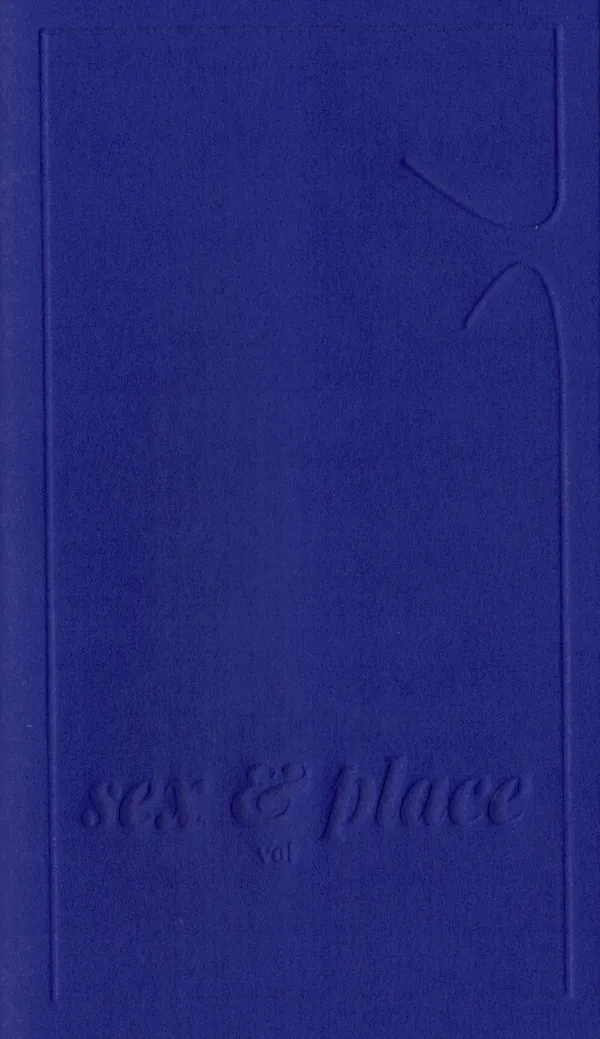
sex and place vol 1
Adriano Wilfert Jensen, Andrea Zavala Folache
sex and place is a series of workshops and publications exploring score-based and semi-anonymous writing as a tool for articulating shared concerns.
Vol. 1 ‘preliminiaries’ is written by Andrea Zavala Folache and Adriano Wilfert Jensen. In the midst of (learning) child care, (unlearning) performance and (experimenting with) sex, the publication interweaves three registers of writing as analogies and interruptions of each other.
The ‘sex and place’ series is part Domestic Anarchism, a project devoted to coalition-building beyond biological, chosen, or national conceptions of family. Dance serves as a set of tools and knowledge that can be applied beyond “the spectacle” to collectively study, write, and move.
Andrea Zavala Folache and Adriano Wilfert Jensen are choreographers and they co-parent three-year-old Penélope Cleo. Andrea and Adriano use dance and choreography to think about the distribution of care and solidarity beyond ‘the family’, and in turn consider how such a distribution could inform their dance practice. Inevitably themes like sex, economy, gender, and class get activated. But also notions such as prefiguration, anarchism, clitoridian* thinking, zones of non-domination and coalition building. They see dance as a knowledge that can be applied to different practices. Some of these include: co-habitations, score based writing and dancing, self-organised study groups and publications, workshops and dance performances.

Time has fallen asleep in the afternoon sunshine
Appendix #3: Orality
Victoria Pérez Royo, Léa Poiré and 1 more
Time has fallen asleep in the afternoon sunshine Appendix #3 Orality includes contributions by Simon Asencio, Bruno De Wachter, Peter Szendy, Clara Amaral, Itziar Okariz, Jude Joseph, Léa Poiré and Mette Edvardsen.
Time has The Appendixes #1–4 is an editorial series by Mette Edvardsen, Léa Poiré and Victoria Pérez Royo that developed out of the project Time has fallen asleep in the afternoon sunshine. For a two-year residency at Les Laboratoires d’Aubervilliers* (2022–23), they came together as a small work group, shaping the work process, hosting presentation formats and making this publication series on paper as four cahiers.
The cahiers comprise a collection of commissioned texts and contributions created for this context, selected documents and traces from work sessions and encounters organized during their residency, texts read together and republished for this occasion, a collection of references, notes in progress, unfinished thoughts and loose fragments – on paper, between pages.
The Appendixes are organized around four themes: (1) The gesture of writing, (2) How to organize a library, (3) Orality and (4) Translation. In addition to being published on paper, the editorial series also consisted of other formats of presentations, exchanges and meetings organized as workshops, fieldwork, performances, conferences, collective readings and oral publications, taking place during their residency at Les Laboratoires d’Aubervilliers and in the vicinity.
The Appendixes is the work that continues, material that adds on, some of it perhaps too long or too detailed, unfit or unfinished. The four themes that their research is formulated around originate in specific experiences and questions from the practices of Time has fallen asleep in the afternoon sunshine (2010 – ongoing), and also the large publication on the project ‘A book on reading, writing, memory and forgetting in a library of living books’ (2019). The research was both a means of exploring these themes in greater depth and also of bringing them into contact with other artists and researchers working on similar or related subjects. The Appendixes offered them both the contexts and the pretexts for things to happen (in time, in space, on paper).
The Appendixes #1–4, published in these cahiers, do not present an overview or a summary of all of the activities and presentations that took place during the two years at Les Laboratoires d’Aubervilliers. What these cahiers offer is a space in which to hold some thoughts together and to share them in this form. It is one more step along the way, extending the research and work already begun and that will now continue.

Aisopika Aesopica
The bilingual book ‘Aesopica’ documents and extends Rūta Junevičiūtė’s research on the Aesopian language and the influence of political censorship to contemporary collective body, first presented in 2020 as the eponymous solo exhibition at the National Gallery of Art and as a permanent outdoor installation at the Rupert Art Center, Vilnius.
Taking as a starting point the historical phenomenon of Aesopian language, which was widespread in Lithuanian culture during the Soviet era, and in parts of the Russian Empire as early as the 19th century, Junevičiūtė aims to investigate the interrelationship between generations, the gray zones of collective identity creation and the processes of (un)censoring the archives of our bodies.
Aesopian language – a term coined after Ancient Greek fabulist Aesop (gr. Aísōpos), is a type of cryptic communication system, where a text has several layers of meaning often contradictory to each other and which seek to convey official and subversive hidden meanings simultaneously. It is usually employed under conditions of omnipresent state censorship to communicate officially forbidden or taboo subjects and opinions. As a system it contains three members – an author, a censor, and a reader. It uses various modes of circumlocution and euphemisation, innuendo and poetic paraphrasing, which can also be seen as an aesthetic style. It has been advocated for artistic benefits as poetics of omissions, concealment, and travesty. On the other hand, it has been criticized as a sign of conformity and humiliation. In Lithuania, after the fall of the Soviet Union, it has been popularly regarded as a position of dissent, but such an interpretation received criticism from contemporary scholars. “Such a mode of expression is probably as old as censorship itself” – a historian told us.
Text contributors: Alfonsas Andriuškevičius, Edgaras Gerasimovičius, Rūta Junevičiūtė, Goshka Macuga, Anastasia Sosunova, Grėtė Šmitaitė, Tomas Venclova, Ana Vujanović
Language editors: Dangė Vitkienė, Aira Niauronytė, Gemma Lloyd
Translators: Alexandra Bondarev, Erika Lastovskytė, Justinas Šuliokas, Mantė Zagurskytė-Tamulevičienė, Aistis Žekevičius.
Illustrations: Rūta Junevičiūtė.

Devenir minéral | L’éditeur du dimanche
Echoing Jean Dubuffet's idea that thought must arise from material in artistic practice, Giuliana Prucca, through this essay, reinterprets a moment in the history of 20th-century art using materials such as stone, sand, earth, and dust. She employs the mineral to illustrate that the creative act would be a trace of the body's disappearance. The loss of humanity and the deconstruction of the subject objectify themselves in the image. In other words, art resides in the tension between representation and its loss, ultimately leaving nothing but an image.
Drawing from the influential figure of Antonin Artaud, she weaves critical and poetic connections between the texts and works of various artists, writers, and thinkers, ranging from Jean Dubuffet to Jan Fabre and Anselm Kiefer, Yves Klein and Gutaï, Joë Bousquet to Camille Bryen and Francis Ponge, Gaston Bachelard to Gilles Deleuze, and Georges Bataille to Aby Warburg.
The material is not merely a thematic pretext; it is an active and explosive catapult that questions the arbitrary linearity of a conventionally assimilated art history. Following Ponge's example, Prucca applies the principles of poetry to criticism, starting from Artaud's material, the most undisciplined of poet-artist-thinkers of the modern era. This results in a critically inventive approach dangerously suited to its object, celebrating an anti-critique. The chosen writing materials, stonepaper for the cover and recycled paper for the pages, is consistent, intending to give the impression of being covered in dust.
The essay disrupts traditional reading habits and shatters the conservatism of art criticism by inhabiting writing space differently, presenting a physically engaging interaction. This is an essay in the literal sense, an experience where form never contradicts content, urging readers to take the risk of thinking deeply and embracing a new rhythm. A complex and challenging design invites them to choose different reading options, ultimately treating criticism as one would poetry.
Giuliana Prucca [Paris | Berlin] is an independent curator, researcher, and writer. She is the founder and art director of the publishing house AVARIE, specialising in contemporary art books that explore the relationships between text and image, body and space.
Graphic design, art direction by Vito Raimondi

Metal Works
A complete survey of the cast, forged, and fabricated metal sculptures made by Danish artist Sidsel Meineche Hansen since 2017.
The artist's practice addresses the industrial complex of virtual and robotic bodies and their relationship to labor in tech, pornography and gaming. While some sculptures were conceived as individual pieces, others were created with digital counterparts within installations that typically include CGI animation, documentary video, drawing and prints.
By presenting the metal works as stand-alone pieces, this book adheres to Meineche Hansen's concern with the material means of production, highlighting their concrete yet elusive nature. Several pieces in the publication are accompanied by poems written by artist Diego Marcon in response to the works. As an artist's project and an archival document, the publication echoes the tradition of documentary photography devoted to sculpture.
Sidsel Meineche Hansen (born 1981 in Denmark, lives and works in London) is a Danish artist. She produces exhibitions, interdisciplinary seminars and publications that foreground the body and its industrial complex, in what she refers to as a "techno-somatic variant of institutional critique". Meineche Hansen questions the body in the field of industrial representations: robotic or virtual bodies, and their relationship with the working world of industries of gaming, pornography, and new technologies. Her research-led practice has taken the form of woodcut prints, sculptures and CGI animations, often made by combining her own low-tech manual craft with outsourced, skilled digital labour.
Edited by Fredi Fischli and Niels Olsen.
Poems by Diego Marcon.

Two years Vacation
This book, Deux Ans de Vacances, Dos Años de Vacaciones, Dwa Lata Wakacji, Two years Vacation, Due Anni di Vacanza, documents the production of Céline Condorelli's process-based, cumulative artwork titled 'Tools for Imagination'. The title of the book raises the question of labour and working time, starting from a non-equivalence with its inverse: free time. We can read the various iterations of the title which appear on the cover as an expression of the impossibility of thinking about time outside of work in a univocal dimension.

Kish, An Island Indecisive by Design
Babak Afrassiabi, Nasrin Tabatabai
In Kish, An Island Indecisive by Design, artists Nasrin Tabatabai and Babak Afrassiabi explore the modern development of an Iranian island in the Persian Gulf. Removed from mainland Iran, Kish is a place where extremes in politics, ideology and urban design intersect. The island's many years of infrastructural indecision is distinctly evident in its architecture, which lacks any trace of coherence or feel for locale. This volume gives an often moving account of the chaos of middle-eastern modernity.

Archives on Show – Revoicing, Shapeshifting, Displacing – A Curatorial Glossary
Archives on Show brings the potential of reformulating the social and political relevance of archives by curatorial means into focus.
Based on the specific properties, faculties and methods of curation, the volume highlights those techniques and strategies that deal with archives not only to make their genesis and history apparent but also to open them up for the future. The 22 different ways of dealing with archives testify to the curatorial participation in (re)shaping the archival logic, structures and conditions. As process-oriented, collective and relational modes of producing meaning, these curatorial practices allow for the alteration, reconfiguration and mobilization of the laws, norms and narratives that the archive preserves as preconditions of its power.
The contributions to this volume by artists, curators and theorists demonstrate approaches that curatorially insist on building other relations between human and non-human archival participants. Each is using the book to create a curatorial constellation that generates and forms new connections between different times and spaces, narratives, disciplines and discourses. Configured as a glossary, the positions assembled in this volume exemplify curatorial methods with which to treat the archive as site and tool of collective, ongoing negotiations over its potential societal role and function.
Contributions by Heba Y. Amin, Talal Afifi, Eiman Hussein, Tamer El Said, Stefanie Schulte, Strathaus, Haytham El Wardany, Julie Ault, Kader Attia, Roger M. Buergel, Sophia Prinz, Yael Bartana, Rosi Braidotti, Kirsten Cooke, Ann Harezlak, Alice Creischer, Andreas Siekmann, Octavian Esanu, Megan Hoetger, Carlos Kong, Iman Issa, Kayfa ta, Kapwani Kiwanga, Doreen Mende, Stefan Nowotny, Marion von Osten, pad.ma, Abdias Nascimento, Eran Schaerf, Magdalena Tyżlik-Carver, Françoise Vergès.

The Mollino Set
New York-based professor Lytle Shaw journeys to Italy in this adventurous exploration of the life and work of architect, designer, and photographer Carlo Mollino (1905–1973). In 1933 the young Mollino received a commission from Mussolini’s regime for his first building: an administrative centre in Piedmont. Later works include furniture and interior design, a book on photography, and an asymmetrical car that raced at Le Mans in 1955.
The book centres around Shaw’s realisation that this prolific talent’s conflicted legacy offers a unique window on the role that post-war Italian politics and culture played in the country’s reimagining of itself as a victim, rather than a proponent, of fascism.

Time Suspended
Herman Asselberghs, Els Opsomer and 1 more
The first thing a traveller has to learn in Palestine is to wait: the Palestinians have been doing it for more than 50 years. In the refugee camps in the Gaza Strip and on the West Bank, they have been waiting for permission to return ever since the Nabka, the catastrophe of 1948, when they were driven out of their houses and away from their land.
In November 2002, the Brussels-based authors of Time Suspended went on a ten-day visit to Palestine. Like most, everything they knew of the country came from media. They discovered a complex and intricate society that could not be summed up in a soundbite. The many full-bleed images of Palestine presented here (many of them depict a somewhat deserted, laid-back, sleepy, place) challenge years of media-tainted observation and truly give insight into the daily lives of its inhabitants.

Planning prévisionnel Printemps
This publication presents research conducted by visual artist and choreographer Clarissa Bauman over two years, in the frame of the exerce MA in choreography and performance (National Choreographic Center of Montpellier / Occitanie). Here, writing becomes movement, a weaving of words, gestures, images, and drawings that rub against each other in a dialogue articulated from page to page.
"The choreography of small, overlooked gestures from moments of boredom, letting loose, detours. The finger sliding along the table, the arm coinciding with the back of this wooden chair. The coincidence of a gesture with an image, and the instantaneous disparition of this image in the body, as it transforms into the sketch of another movement. Contours, strokes, perspective lines, everything sinuous, asking at what moment does the image appear, emerge, and then become undone? The impossibility, within the body, of an image being fixed, still, one. (…) At this point in the writing, I perceive text less as a desire to organise, sediment, or give form to something, whatever it might be, but rather as a desire to find the outlines of connections between materials left hanging in the room I share with them, the tight space around the table, the images pinned to the walls in front of and behind me, the markings layered, scratched, or sketched in notebooks, the pages from books insistently revisited these last months, the memories that wane, escape, or insinuate themselves between these spaces. Developing a strategy for distracted observation."
Contributions by Anne Kerzerho, Christian Rizzo, Rostan Chentouf, Alix de Morant, Laurent Pichaud, Myrto Katsiki, Jocelyn Cottencin.

École nationale supérieure des beaux-arts de Lyon
Initiales #05 — Andrea Fraser
Claire Moulène, Emmanuel Tibloux
Le cinquième numéro de la revue d'art et de recherche « rétro-prospective » est consacré à l'artiste et performeuse Andrea Fraser, figure clé de l'art des années 1990 et 2000 et du courant de la « critique institutionnelle » (une monographie complétée par une grande enquête sur l'espace critique réalisée auprès d'une cinquantaine d'artistes, critiques et philosophes internationaux).
Avec contributions de Kader Attia, Eva Barto, Sophie Bonnet-Pourpet, Marie de Brugerolle, Gregory Buchert, Daniel Buren, Marie Canet, Gregory Castéra, Inès Champey, Thierry Chancogne, Claire Fontaine, François Cusset, Judith Deschamps, Paul Devautour, Philippe Durand, Joao Enxuto & Erica Love, Andrea Fraser, Nicolas Frespech, Dora García, Romain Grateau, Emmanuel Guez, Thomas Hirschhorn, Aliocha Imhoff & Kantuta Quirós, Béatrice Josse, Franck Larcade, Ju Huyn Lee, Sven Lütticken, Fabrice Mabime, Bartomeu Mari, Chus Martínez, Gwenael Morin, Claire Moulène, Jean-Luc Moulène, Yan Moulier Boutang, Vincent Normand, François Pain, Gerald Petit, Anne Querrien, Thierry Raspail, Sinziana Ravini, Delphine Reist & Laurent Faulon, Christophe de Rohan Chabot, Phillippe Roux, Jean-Baptiste Sauvage, Thomas Schlesser, Ida Soulard, Fabien Steichen, Michel Surya, Emmanuel Tibloux, Vier 5, Ulf Wuggenig, Italo Zuffi.

High Shine
High Shine is boek zes van de groeiende collectie van De Nieuwe Dansbibliotheek en boek nul van de Notebooks die opgezet zijn door de fellows van THIRD, het derde cyclus onderzoeksprogramma van DAS Graduate School, ondersteund door DAS Publishing (lectoraat van de Academie voor Theater en Dans) en gefinancierd door de Quality Funds.
Als co-publicatie van DAS Publishing en De Nieuwe Dansbibliotheek, luidt High Shine een nieuw partnerschap in tussen nieuwe platforms en oude vrienden.

17 Movements
17 Mouvements collects traces of a project that Decoratelier - the workspace and arts platform of Jozef Wouters - did in the fall of 2022 around the ‘5 blocs’ area in Brussels (Rempart Des Moines/Papenvest).
When Nuit Blanche invited them to build a gym, Camille Thiry and other Decoratelier associates did not want to design another generic muscle cage. Together with the neighbourhoods inhabitants, they built 17 distinct movement spaces, each tailor-made to an individual’s size, needs, dreams and aches. The gym equipment has meanwhile been removed from public space, but this eponymous book (ed. by Jozef Wouters) combines notes and reflections (language: French) by Camille with beautiful photography by Enzo Smits, documenting the ingenious and unique negotiations that were a part of this collaboration.

Black Revelry: In Honor of ‘The Sugar Shack’
An experiment in book making, which takes up the form of the LP record as a starting point for re-configuring the haptics of the printed book. Presented as a collection of unbound pages inside a gatefold record sleeve, the publication includes a pressed record, as well as written, visual and sonic contributions from scholars, poets, artists, choreographers and DJs.
Through the logic of the detail, each contributor imaginatively (re)produces Ernie Barnes’s iconic painting The Sugar Shack as an archive of personal histories and a universe of intergenerational connections. Held together as an album, it is a performance to be made at home, which invites readers/listeners to feel art’s histories and to be in them with their bodies.
d.a. carter with contributions by Taylor Renée Aldridge; Samiya Bashir; La Marr Jurelle Bruce; DJ Lynnée Denise, Jennifer Harge, Duane Lee Holland, Jr., William H. Mosley, III, Zoé Samudzi, S*an D. Henry-Smith, Melanie Stevens and Phillip B. Williams.