Artistic Research
Artistic Research

Toxicité coloniale: Documenter le Paysage Radioactif
Toxicité coloniale revient sur les programmes nucléaires français menés entre 1960 et 1966 dans le Sahara algérien. Ce programme secret, qui s’est déroulé pendant et après la guerre d’indépendance algérienne (1954-1962), a permis au régime colonial français de mettre à feu quatre bombes atomiques atmosphériques, treize souterraines et de mener d’autres expériences nucléaires dans le désert. Alors que la grande majorité des documents d’archives sont toujours classés secret aujourd’hui, Toxicité coloniale rassemble une variété de sources permettant de documenter l’histoire violente des activités de la France en Algérie. Le livre constitue un corpus de choix à l’intersection de la justice spatiale, sociale et environnementale pour ceux et celles qui s’intéressent à l’architecture, au paysage et aux pratiques d’archivage dans une démarche décoloniale.
Alors que ces bombes ont eu des conséquences durables pour les populations et les environnements locaux ainsi que pour les vétérans français, le manque de contrôle des explosions, les lacunes de sécurité et l’utilisation des Algériens comme main- d’œuvre sur des chantiers particulièrement dangereux apparaissent comme des faits coloniaux d’une importance majeure.

Movement Research Performance Journal
Issue #62 - We Exist in the Ambivalence of Those Motherfuckers
Anh Vo, maura nguyen-donohue and 1 more
What began as a project responding to the fiftieth anniversary of the ‘end’ of the Vietnam War became a project of inhabiting the Movement Research Performance Journal (MRPJ) from within the landscape of contemporary Vietnamese performance art. The result, Issue #62, is a window onto a community of insiders who reflect a set of concerns, questions, historical trajectories, and aesthetic legacies that differ from what has more often been foregrounded in our U.S./New York City-centric publication. Like other documents of this kind, which endeavor to portray a performance scene that will be foreign to many readers, the texts from this group of intergenerational, contemporary artists demonstrate a careful navigation of the dialectics of inside and outside, self and other, performer and audience, seeing and being seen, that informs every exchange across cultural difference.
The texts are also not monolithic, suggesting a range of relations to the Vietnam of the past and present, from within Vietnam’s national borders and among the diaspora. Especially for contributors living and working in Vietnam, writing has also been a practice of choreographing words within a political landscape where to speak publicly, in itself, is a performance of negotiated risk. Embracing the complexities of these differing positions has been the focus of our editorial process—one that has asked the editorial team to embrace the limits of our own knowledge, to recognize we will not be able to recognize all valences others may discover in these texts, and not to edit these layers out of the works that follows.
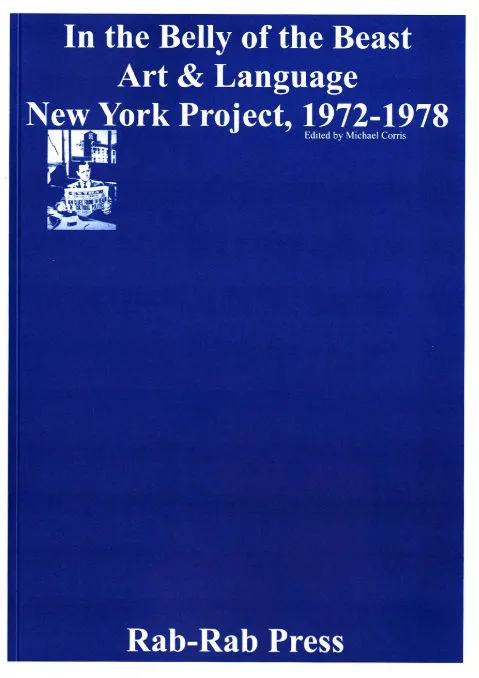
In the Belly of the Beast – Art & Language New York Project 1972-1978
Edited by Michael Corris, the expanded edition of In the Belly of the Beast: Art & Language New York Project 1972-1978 is a survey of the tumultuous years of the political Conceptualism in the mid-seventies New York.
Artists have always experimented with politics, either by organizing themselves or uniting in support of a broader political movement. Today, "activist art" is taught in universities, supported by foundations, and featured in museums and international exhibitions. Is this the only possible way?
In the Belly of the Beast tells a different story, of the work of politically engaged artists and the conflicts they experienced. It is the history of artists wishing to continue working within the boundaries of the artworld and those who were intent on establishing new ideological and class relationships with activists to build a political party.
During the 1970s in New York, the Art & Language collective pioneered institutional critique; published a Marxist-influenced journal; agitated against racism and sexism in museums; challenged the cultural imperialism of international exhibitions; and forged a framework for a socialist organization of artists. This new edition includes previously unpublished documents illuminating the contradictions and disputes that lay at the center of the organization and practices of Art & Language and left-wing groups, such as the Anti-Imperialist Cultural Union and the Artists' Meeting for Cultural Change, mobilizing artists in New York at the time.
The new and expanded edition of In the Belly of the Beast features an extensive interview with Michael Corris, who annotated a collection of previously unavailable documents from the period, including manuscripts, pamphlets, transcripts, and letters.
Art & Language is the name of a group of English artists who choose to work collectively, and the title of a magazine that they founded in 1968. Proposing a critical analysis of the relations between art, society, and politics, Art & Language marks, even in its name, the importance of the “textual turning point” in the 1960s.
Since 1976, Art & Language's project has continued, through Mel Ramsden and Michael Baldwin, with the literary and theoretical collaboration of Charles Harrison. Working with very varied mediums, from painting to rock, these co-founders of Conceptual art remain, even today, attached to observing the consequences of what they themselves call the “depressing collapse of modernism.”

Trophy Logic
We stand at the edge of the world’s mercy, as subjects destined to fall. Instead, we posit: what might unfurl when we discard the uniform of the individual, and instead orient towards tinkering with the fluctuating dynamics of desire, value, infrastructure, touch, and language. Don’t be fooled, for the dynamics are brittle. Unrestricted interplay has a limit, and method is to be found at its rim. That a tangible or decorative item may serve as recognition or evidence of merit might somehow become a logic of itself. This publication presents a collection of explorations of excess, limitation, dehydrated thought, proclivity, sublimation, debauchery, and the narrowly-defined. Indeed, the subject is destined to fall, but ultimately does not! As we reckon with the illegibility of merit, we are beckoned to reconsider our relationship to one another, the unseen settings of nostalgia, the monolithic, and the stifling hold that comes not from the absence of violence, but the sheer overabundance of it. The winner just might take it all,but we’re all destined to some sort of trophy.
with Brandon Chow, Jody Aikman, Kessy Paller-Bain, Maximilian Pellizzari, Milda Valiulytė, António Manso, Preto Macarena, Magaña Villar, Sara Vallis, Cecilie Jensen, Iris Verge Ferrer, Mia You, Mehmet Süzgün, Emma Adjari, gervaise alexis savvias, Emanuella Cunt, Greta þorkelsdóttir. Designed by Miglė Lukoševičiūtė

Bulletin B – Issue 2
Contributions by Jerry Ahn, Han Ok-hee, Han Soon-ae, Lilian Gonzalez, Kim Jeon-seon, Miss Lee, Lee Jeong-hee, Hansen Oh, Yun Park, Seonha Park, Sun Hyejeong, Wang Gyu-won.
Bulletin B is a bilingual editorial project gathering artistic and cultural productions from Korea and its diasporas, with a focus on queer and womxn voices. Borrowing the spirit of an unofficial newsletter, it surfaces when it needs to; assembling poetry, prose, and cultural fragments across time.
Rooted in translation as a practice attentive to power, history, and silenced voices, Bulletin B reconstructs fragmented lineages and constellations of reference through irregular acts of dissemination and exchange, tracing how narratives move between languages, contexts, and material forms.

Scores for Political Desires
The publication of the winners of the Villa Romana Prize has taken the shape of four distinct yet interrelated booklets – an editorial series continuing the tradition of the institution to offer a space for the dissemination and reverberation of the research and work of the Villa Romana Fellows after their ten-months residency in Florence.
Each year, four selected artists are invited to live and work in the same house that, since 1905, generations of artists have continuously inhabited. They always come as a group – a constellation of four people – but all as singular artists. The opportunity of yearly publishing their work in a bundle of four separate books and within an open series allows for a larger combination of echoes across the generations of Villa Romana Fellows. A further occasion for “being singular plural.”
Contributions by Elena Agudio

Sustaining the Otherwise
Sustaining the Otherwise is a collaborative research and artistic project about restitution, reparation and transformation taking place in multiple locations over several years. Initiated and conceptualized by researchers and curators Amal Alhaag & Selene Wendt, it offers a space for artists, activists, scholars and writers to be in dialogue and to explore the topic of restitution in relation to both material and immaterial culture, through a program that frames restitution within the context of contemporary art practice.
Edited by Amal Alhaag & Selene Wendt
Featuring an introduction by Amal Alhaag & Selene Wendt as well as provocations, reflections, and essays by Barby Asante, Michael Barrett, Quinsy Gario, Sana Ginwalla, Aude Christel Mgba, Lennon Mhsishi, Ogutu Muraya, in addition to a sonic contribution by Robert Machiri.

An Orobic Journey – On Migratory Restlessness, Community, and Multispecies Geographies
Valentina Gervasoni, Lorenzo Giusti
A layered and polyphonic investigation that, setting out from the Orobic Alpine territory in Northern Italy, explores the mountainside not merely as a natural backdrop but as an epistemological lens through which to understand and rethink the contemporary world.
The book originated as an online magazine and an expansion of the biennial program Thinking Like a Mountain (2024–25), a project inspired by Aldo Leopold's exhortation to abandon an anthropocentric gaze in favor of a geological outlook on the peaks, thereby acknowledging the intrinsic value of every natural element. An Orobic Journey developed independently from the exhibition program and is not limited to mere documentation; instead, it functions as a parallel research tool articulated through essays, conversations, and visual documentation, featuring contributions from artists, scientists, researchers, anthropologists, ornithologists, curators, academics, architects, writers, and other experts.
Embracing Ursula K. Le Guin's "carrier bag theory," An Orobic Journey brings together non-heroic tales of resistance, adaptation, and cohabitation. The book opens with a reflection on species migration and "migratory restlessness": a condition that does not only concern the spontaneous return of wolves to the Alps or the transit of birdlife, but becomes a metaphor for a shared condition of continuous movement and searching. The future of the mountain—amid tourist monocultures and acts of transformative care—is investigated by conceiving the Alpine landscape as a political space shaped by power relations, images, and collective memories, and inhabited by multispecies communities that dwell in a place, weaving intergenerational relationships. With both a poetic and political approach, An Orobic Journey attempts to rethink ways of looking at the mountain landscape while imagining new collective rituals.
![Cover of Visit [country]](https://rile.space/storage/4263/conversions/01KNPFVPPA9VBM18HD24YCC4XJ-webp.webp)
Visit [country]
Visit [country] is an artist’s book that brings together texts taken word for word from official government tourism websites and state-produced promotional videos from every UN-recognized country in the world. Stripped of the usual accompanying imagery and inspirational music, what becomes clear is how tourism feeds on — and is fuelled by — nationalism, chauvinism, and the invention of identity.
Much like a “choose your own adventure” book, the reader is guided by a series of questions that connect one country to another through recurring ideas and clichés, and must decide whether to visit the destination with “the best food”, “the most beautiful women”, “the friendliest people”, or “the most authentic history”. The book also includes an extensive concept index that maps the thematic and linguistic patterns linking the nations’ self-descriptions. It is a journey where every country is the best.
The project grows out of The Complete National Anthems of the World, a durational performance first presented in 2023, and stands as a parallel, autonomous, yet complementary work.

Inhabiting the 0.6%: The reality of Seoul's Black Hole
Cette édition documente la surpopulation de Séoul et les statistiques tragiques qui s'y rapportent. Elle rassemble les voix de ceux qui y vivent, de ceux qui y ont vécu, de ceux qui doivent s'y rendre et de ceux qui l'ont quittée. La production suit les principes écologiques énoncés par la graphiste, Sara de Bondt en 2014. Pour éviter le gaspillage, des formats standard (A4) et du papier 100% recyclé ont été choisis, avec une impression en risographie. Pourquoi cet exode massif vers Séoul ? Comment Séoul est-elle devenue un trou noir ?
This edition documents Seoul’s overpopulation and the tragic statistics associated with it. It gathers the voices of those who live there, those who have lived there, those who must travel there, and those who have left. The production follows the ecological principles set forth by the graphic designer Sara de Bondt in 2014. To avoid waste, standard formats (A4) and 100% recycled paper were chosen, with an impression in risography. Why this massive exodus toward Seoul? How has Seoul become a black hole?
[KO] 이 책은 서울의 인구 과밀화와 이와 관련된 비극적인 통계들을 기록한다. 서울 거주자, 과거의 거주자, 가야만 하는 자, 그리고 이방인까지. 이들의 목소리를 인터뷰로 담았다. 2014년 그래픽 디자이너 사라 드 본트가 제시한 생태적 원칙을 따라 A4 규격 사이즈의 100% 재생용지 위에 리소그래피로 인쇄되었다. 왜 모두가 이토록 서울로 몰려드는 것일까? 서울은 어쩌다 블랙홀이 되었을까?

Afghanistan
Afghanistan is my father’s homeland. He was born in Kabul in 1945 and later moved first to France, then to Switzerland in the 1970s. In my mind, Afghanistan exists as a geography with blurred edges, something I feel the need to reconcile with. It’s a place I’ve only ever known through stories, a source of memories that, over time, have shifted and become distorted.
Contributors: Luca Cerizza, Farid Rahimi, Said Rahimi, Susanna Ravelli, Francesca Recchia, Zafar Sayan, and Dawood Tawana

Correspondences de Appel 1975–2025
This volume brings together 50 years of correspondence from the archive of de Appel contemporary arts centre in Amsterdam. In tracing a relational and affective history of the institution, each piece offers a glimpse into the artistic projects and programmes de Appel has commissioned and championed; the cultural shifts and careers it has nurtured; the celebrations and struggles it has weathered; and the collaborations and friendships sparked along the way. The book gathers materials from more than 100 voices, with paper and digital exchanges covering an intricate web of people, places, and events, ultimately coalescing into what can be perceived as the unified work of an institution.
Includes a light-blue satin Ribbon by Alison Knowles.

Maisa in Webland
What does ‘user-friendly’ website mean if, on it, online behaviors like stalking, teasing, and ghosting — once considered peripheral — are now central to survival, care, and belonging? How to thrive without becoming an “Interdisciplinary Unicorn”: the state’s most beloved user-citizen fluent in multiple registers of production, optimization, and self-branding? How in this beautiful world is one supposed to log off, when surveillance and privacy erosion have been normalized? And how, oh how, could users possibly think of building the alternatives, when cool and cringe online acts, all activate the platform’s reward system: the unleashing of emoji-filled praise? How to resist the platform’s toxic seduction?
Haunted by screenshots of early cyberfeminist websites and in dialogue with digital sages, web scripts, and business interests, media artist, web developer, and author Maisa Imamović embarks on a philosophical and practice-based crusade through the internet’s surface and its shadows. To expose the various ways of thriving online without surrendering to optimization, the book explores imperfect uses of perfect software, preservation of precarious web infrastructures, tactical content strategies, and experiments with autonomous financial systems — all wrapped in educational efforts to sustain criticality amid automation. Through these traversals beneath the scroll, Maisa finds her Webland: speculative, broken, and oftentimes, poetic infrastructure where logic destabilizes, binaries dissolve, and meaning evades monetization. But can a non-extractive internet exist beyond metaphor? Can poetry rewire protocol? Or will her sanctuary be absorbed into the very architectures it resists?
"In Maisa in Webland, Maisa Imamovic evokes the multidimensional, spontaneous human elements of the early web, using interviews, case studies, critical theory and fiction as her organic materials. She peeks behind the screen and through time to trace the subtle erosion of the web’s early utopian ideals to its cold and extractive present. Imamovic bravely wades through the swampy digital muck that mediates our everyday reality, examining its invisible psychic scaffolding with academic rigor, and a big dose of humor and heart. Was it an inevitable entropy, or an aberration? How and when did we get so off-course? Can we return? Do we want to? In Maisa’s Webland, we might very well be doomed, and maybe that’s a good thing. When the center of this tangled web no longer holds, something new can take shape.” - Nada Alic, author of Bad Thoughts

YouYou Group – A li'nuage
Handmade artist's book combining drawings, photographs, and archival materials. This publication reflects on the YouYou Group's ten-year journey and its evolving relationship with space. It marks a transitional moment from the group's long-term engagement with public space toward a growing understanding of spatiality and collective presence.
YouYou Group is a Belgian choir that specializes in what is known in Arabic as zaghareed. This trilling cry is used by women at weddings and festive occasions, but also at funerals. Youyou is the French name for zaghareed. Depending on the regional origin, it is also called kululu, tsahalulim, or irrintzi. It is a long, shrill tone that is modulated (by the throat, glottis, or rapid tongue movements) and can be heard from far away. Brussels artist Myriam Van Imschoot was one of the founders of this singing group.

A Grammar Built with Rocks
Shoghig Halajian, Suzy Halajian
Featuring writing and artistic practices that trace the racialized and gendered relationship between bodies and land, A Grammar Built with Rocks explores artists’ engagement with sites of physical dispossession and socio-ecological crisis, highlighting how creative research methodologies can serve as radically new place-making practices. The publication brings together a range of feminist-decolonial texts and visual contributions that explore how movement, transience, and improvisation offer alternative ways of being-together while being-in-place.
Contributions by: Basel Abbas and Ruanne Abou-Rahme with Fawz Kabra, Jheanelle Brown and Julien Creuzet, Carolina Caycedo, Ryan C. Clarke and Cauleen Smith, DAAR—Decolonizing Architecture Art Research with Nicola Perugini, Sandra de la Loza, Demian DinéYazhi’, rafa esparza, Mashinka Firunts Hakopian, Tia-Simone Gardner, Raquel Gutiérrez, Suzanne Kite with Mahpíy̌a Nážinn, Candice Lin, Jumana Manna, K-Sue Park, Christine Rebet, Susan Silton, and Asiya Wadud.
The book also includes a reader, with grounding texts, sources of inspiration, and research references, by Jason Allen-Paisant, Dionne Brand, Suzanne Césaire, Lisa Lowe, Camila Marambio and Cecilia Vicuña, Robyn Maynard and Leanne Betasamosake Simpson, M. NourbeSe Philip, and K. Wayne Yang.
About the editors
Shoghig Halajian is a curator, writer, and artist whose work explores queer and diasporic imaginaries, place-based practices, and experiments in collectivity and collaboration. She is co-editor of the online journal, Georgia, which is supported by a Creative Capital | Andy Warhol Foundation Arts Writers Grant. Select curatorial projects include: A grammar built with rocks (Human Resources LA, One Archives at the USC Libraries, and REDCAT, 2018); At night the states (Hammer Museum, 2017); DISSENT: what they fear is the light (LACE, 2016); and rafa esparza: I have never been here before (LACE, 2015). She was a TBA21 Ocean Space Fellow in Venice (2021) and a curatorial fellow at École du Magasin in Grenoble (2011), where she co-curated the exhibition, The Whole World is Watching, on the the collective Vidéogazette (1973–76), which organized a public access television program in the city. She received her PhD in Art History, Theory, and Criticism with a specialization in Critical Gender Studies from the University of California, San Diego in 2024.
Suzy Halajian is a curator and writer based in Los Angeles, where she serves as the Executive Director and Curator at JOAN. Her practice is invested in long-term collaborations with artists, critically engaging with the intersections of art, politics, and social histories. She explores strategies of image-making through the lens of colonial histories and contemporary surveillance states. Halajian has curated exhibitions and public programs at institutions such as Los Angeles Contemporary Exhibitions (LACE), ONE Archives at the USC Libraries, the Hammer Museum, and Human Resources Los Angeles, as well as Tanya Bonakdar Gallery (New York), Oregon Contemporary (Portland), Kunstverein (Amsterdam), UKS (Oslo), Galerie Hubert Winter (Vienna), and the Sursock Museum (Beirut). She also serves on the Programming Committee at Human Resources and has worked with nonprofit organizations including the MAK Center for Art and Architecture (Los Angeles) and Ashkal Alwan (Beirut). Her curatorial work and writing have been supported by the Graham Foundation, the Andy Warhol Foundation Arts Writers Grant—for Georgia, a journal she co-founded and co-edits with Anthony Carfello and Shoghig Halajian—and a Curatorial Research Fellowship from the Andy Warhol Foundation for the Visual Arts. Halajian’s writing has appeared in ArteEast, BOMB, X-TRA, Ibraaz, and other publications. She holds an MA from the Center for Curatorial Studies at Bard College and is currently a PhD candidate in the Film and Digital Media program at the University of California, Santa Cruz.

Publiek Park
Jef Declercq, Anna Laganovska and 2 more
The third Publiek Park publication – Walking Guide – combines essays, archival fragments, and artistic voices to trace both the exhibition route at Plantentuin Meise and the historical path that led from the creation of the Jardin Botanique in the heart of Brussels to its relocation outside the city. Following the logic of a quilt, layering different perspectives, textures, and timelines, the book connects artistic narratives with history and reflections on urban gardens, public space, and botanical imaginaries. Just like the exhibition, the publication offers not merely a portrait of a place, but a reflection on the multiplicity that defines it.
Alongside documentation of the exhibition and contributions from the participating artists, this year’s Walking Guide features writings by Nikolaos Akritidis, Denis Diagre-Vanderpelen, Koen Es, Lana Jones, François Makanga, Noam Youngrak Son, and Jean Watt. The two parks are portrayed in photographs by Michiel de Cleene, with book design by Victor Verhelst and Corbin Mahieu bringing all of these elements together.
This publication is made with the generous support of Plantentuin Meise and all partners.

Pina #2
Forensic Architecture, Edgar Calel
Exhibitions by Edgar Calel and Forensic Architecture, conversations with Lisette Lagnado and between Eyal Weizman, Agata Nguyen Chuong, Zoé Samudzi and Irmgard Emmelhainz, and short stories by Portia Subran and Rémy Ngamije.
Forensic Architecture presents ‘A Counter-Archive of the Ovaherero and Nama Genocide’, a powerful investigation into the early 20th-century genocide committed by German colonial powers in today’s Namibia. Drawing on years of archival research and spatial analysis, the exhibition traces the lasting impact of colonial violence in three parts: from the ideological roots of racialised imperialism, to the design of the concentration camp, to the ongoing environmental degradation and dispossession affecting Indigenous communities today.
Edgar Calel’s ‘Dreams and memories dazzle through the flickering of fireflies’ is an exploration of dreams, memory and everyday life within his multi-generational family home in Comalapa, Guatemala. Each morning, dreams are shared among family members, as a practical and poetical way to sense the energy of the day ahead. Concrete business plans and reminders to cook certain dishes emerge from these retellings: a ritual so entwined in the architecture of their every day, that, even when apart, they recount their visions through shared voice notes.
Pina is a printed, portable exhibition space. We function as a commissioning platform, collaborating with artists to create exhibitions existing solely within the pages of a magazine.

The Circle: Chronologie pour une constellation
A visual and text based investigation led by Moroccan artist Bouchra Khalili during many years following the traces left by the Mouvement des travailleurs arabes, a group fighting for the rights of the Arab workers in France at the turn of the 1970s.
Khalili focused her attention on the theatre groups Al Assifa and Al Halaka who were created in this political environment. The publication unfolds from The Circle (2023), a video installation shown for the first time at the 15th Sharjah Biennale (2023), at Macba (2023) and at the Luma Foundation (in Arles in 2023-2024 and Zurich in 2025).
The book is published in conjunction with Bouchra Khalili's exhibitions as guest visual artist of the Festival d'Automne in Paris in 2025.
Texts by KJ Abudu, Bouchra Khalili, Mohamed Amer Meziane, Abdellali Hajjat ; interviews with Saïd Bouziri, Hedi Akkari, Smaïne Idri, Mustapha Mohammadi, Philippe Tancelin, Mia Radford, Lucas Yahiaoui.

Exhibiting for Multiple Senses
Exhibiting for Multiple Senses looks into artistic and curatorial research practices that emphasize the multisensory character of the human body in the encounter with artworks. For some time now, numerous contemporary artists and curators have moved beyond the primacy of the visual in the experience of art exhibitions. The book discusses this shift by bringing together experimental exhibition-making, curatorial theory, art, design, and museum research, disability activism and crip theory. Its intent is to demonstrate resonances between curatorial theory and practice and between disability and crip art activism. While the latter is still often regarded as relevant for only small portions of visibly disabled people, in recent years neurodiversity and invisible disabilities have proven to be relevant for the sensory experiences of much larger parts of exhibition audiences.
Exhibiting for Multiple Senses shares famous and lesser-known examples of experimental exhibitions as well as of artistic practices linked to exhibitions. By mobilizing the senses of touch, smell, taste, and hearing, as well as applications of multimodal technologies and insights from neuroscience, these examples all explore abilities and possibilities of the complex and diverse sensory apparatus that is the human body.
Contributors: David Bobier, Luca M. Damiani, Stephanie Farmer & Hettie James, Eva Fotiadi, David Gissen & Georgina Kleege, Adi Hollander, Lilian Korner, Elke Krasny, Renata Pękowska, Caro Verbeek

Tangents
Isabelle Sully, Becket Flannery and 1 more
Tangents is an English-language online review platform focused on writing about the Dutch art scene-on what is happening both within the borders of the Netherlands and about Dutch-based artists presenting work beyond them. Born from a frustration with the prevalence of objectivity and imposing house styles in the majority of art writing commissioned by leading platforms, Tangents instead encourages contributors to approach criticism from within the specificities and focuses of their own writing practice.
Tangents publishes a monthly review written by a writer from our stable of permanent contributors. This publication is the first printed compendium of recent writing, published on the occasion of Tangents' mentorship pro-gram, for which the founding editors each supported a young writer through development and to publication. The 2024/25 mentees were Mehmet Süzgün, Lou Vives and Dido W.

Jennifer Lacey & Nadia Lauro – Dispositifs chorégraphiques
Un essai consacré au travail de la chorégraphe et danseuse Jennifer Lacey et de la plasticienne et scénographe Nadia Lauro, qui rend compte de l'univers visuel des deux artistes au travers de nombreuses illustrations.
Dans cet essai, Alexandra Baudelot s'attache à saisir l'ensemble des œuvres co-écrites par la chorégraphe Jennifer Lacey et la plasticienne et scénographe Nadia Lauro, en observant de quelle manière elles s'architecturent les unes aux autres pour constituer des extensions inédites d'une forme artistique vers une autre.
Elle les observe à la manière de parcours envisagés comme des supports d'expériences cherchant à déborder constamment ses propres cadres de représentation. Ceci afin de saisir les politiques mises en jeu pour penser le corps, sa place dans un environnement fictif ou quotidien, son impact dans les enjeux chorégraphiques contemporains et ses liens avec notre époque.
L'espace de cet essai se prête également à l'univers visuel des deux artistes qui se livrent ici à un jeu de construction entre l'exploration d'images d'archive, de déclinaisons de projets inédits et périphériques aux pièces publiques, d'illustrations, et d'exposition d'un portfolio de dessins.
Originaire de New York, la chorégraphe et danseuse Jennifer Lacey est établie à Paris. Depuis 1991, elle a développé son propre travail chorégraphique qui a été présenté aux États-Unis (P.S. 122, The Kitchen) et en Europe (Klapstuk Festival, Vienna Festival, Danças na Cidade, Biennale d'art contemporain de Lyon, Big Torino). Depuis qu'elle réside en France, elle a créé et présenté plusieurs œuvres : $Shot (Lacey / Lauro / Parkins / Cornell), Châteaux of France no. 2 et no. 3, un projet conçu en collaboration avec Nadia Lauro, et Prodwhee!, une série de courts modules. En 2002, elle a été accueillie en résidence aux Laboratoires d'Aubervilliers. Jennifer Lacey a collaboré à différents projets avec de nombreux artistes : Loïc Touzé, Boris Charmatz, Emmanuelle Huynh, Benoît Lachambre, Catherine Contour et Latifa Laâbissi. Elle développe actuellement ses créations au sein de l'association Megagloss.
Nadia Lauro est artiste visuelle et scénographe basée à Paris. Elle développe son travail dans divers contextes et conçoit des environnements, des installations visuelles et des costumes pour différents projets chorégraphiques. Outre Jennifer Lacey, elle collabore notamment avec les chorégraphes Ami Garmon, Vera Montero, Benoît Lachambre, Frans Poelstra, Barbara Kraus, figures de la danse contemporaine en Europe. En 1998, elle fonde avec l'architecte paysagiste Laurence Crémel l'association Squash Cake Bureau – scénographie et paysage au sein de laquelle elle conçoit des installations paysagères et du mobilier urbain. Elle a également créé la scénographie de plusieurs défilés de mode.

Fugue
Aaron Amar Bhamra, Céline Mathieu
Fugue is published on the occasion of the eponymous duo exhibition by artists Aaron Amar Bhamra and Céline Mathieu, presented at Jester in Genk, Belgium. The title, derived from the Latin fuga (flight), evokes both its musical and psychological meanings: a contrapuntal compositional technique and a state of dissociation. These dual connotations—aural and mental—resonate throughout the exhibition and this accompanying publication.
Céline Mathieu's work moves between the sensory and the conceptual, integrating multiple media to explore the circulation of thoughts and materials in relation to specific sites. Aaron Amar Bhamra's practice draws on recurring forms and materials to construct evolving personal and social archives, often reactivating exhibition spaces by engaging with their historical contexts.
In addition to documenting the exhibition, the publication features an introduction by Jester's artistic director Koi Persyn, a visual score of a sound composition by Charlie Usher, written contributions by Céline Mathieu, curator Eloise Sweetman, and researcher Johanna Schindler, as well as a series of analog photographs by Aaron Amar Bhamra.
Contributions by Koi Persyn, Céline Mathieu, Charlie Usher, Eloise Sweetman, Johanna Schindler, Aaron Amar Bhamra.
Austrian artist Aaron Amar Bhamra (born 1992) often procures exhibition spaces that subtly expose their systematics and physical experience by incorporating imprints reminiscent of other spaces or past exhibitions. He occasionally uses recurring forms and materials, weaving a site of shifting personal and social archives.
Céline Mathieu (born 1989) is a Belgian artist and writer. Her practice is often site and condition specific, using sound, scent, sculpture, performance, text and different materials in performative installations. The work is both sensory and conceptual. Her work looks into the circulation of thoughts and materials. Material and economic cycles merge with hyper-personal items, resulting in fluid work that cannot quite be pinned down.

Forensic Architecture: Violence at the Threshold of Detectability
In Forensic Architecture, Eyal Weizman, the group’s founder, provides, for the first time, an in-depth introduction to the history, practice, assumptions, potentials, and double binds of this practice. The book includes an extensive array of images, maps, and detailed documentation that records the intricate work the group has performed.
Included in this volume are case studies that traverse multiple scales and durations, ranging from the analysis of the shrapnel fragments in a room struck by drones in Pakistan, the reconstruction of a contested shooting in the West Bank, the architectural recreation of a secret Syrian detention center from the memory of its survivors, a blow-by-blow account of a day-long battle in Gaza, and an investigation of environmental violence and climate change in the Guatemalan highlands and elsewhere.
Weizman’s Forensic Architecture, stunning and shocking in its critical narrative, powerful images, and daring investigations, presents a new form of public truth, technologically, architecturally, and aesthetically produced. Their practice calls for a transformative politics in which architecture as a field of knowledge and a mode of interpretation exposes and confronts ever-new forms of state violence and secrecy.

Movement Research Performance Journal
Issue #60 - Gender Disarray
Kay Gabriel, Amalle Dublon and 2 more
Under the direction of four contributing editors—Amalle Dublon, Kay Gabriel, Keioui Keijaun Thomas, and Anh Vo— we’ve assembled a new body of work by mostly trans and queer artists reflecting on the keyword “gender” and its relation to contemporary performance. Their work moves across multiple genres of writing, from analytic essays to poetry to performance scripts.
“Read My Lips” is a phrase that will be familiar to longtime readers of the Movement Research Performance Journal—so familiar that the mere reference will bring to mind an image posted by the artist collective GANG, an image that lies at the heart of one of the journal’s most spectacular moments. Issue #3, with its focus “Gender Performance,” was published in 1991 amid that era’s Culture Wars, receiving almost immediately negative reception from government officials (the NEA threatened to withdraw funding from Movement Research) and many members of the dance community (who considered Issue #3 to be deliberately provoking the so-called “war,” intentionally taking a political position that some worried might comprise future funding of the field). In the thirty-three years since its publication, Issue #3 has developed a patina familiar to many artist-activist histories that are looked upon with romance and nostalgia, often by those for whom that history is only a fantasy (rather than a lived experience).