Books
Books
in random order

The Nightmare Sequence
An extraordinary collaboration by an award-winning duo—poet Omar Sakr and visual artist Safdar Ahmed–that bears witness to the genocide in Gaza.
The Nightmare Sequence is a searing response to the atrocities in Gaza and beyond since October 2023. Heartbreaking and humane, it is a necessary portrait of the violence committed by Israel and its Western allies. Through poetry and visual art, Omar Sakr and Safdar Ahmed capture these historic injustices, while also critiquing the role of art and media—including their own—in this time. Born of collective suffering and despair, their collaboration interrogates the position of witness: the terrible and helpless distance of vision, the impact of being exposed to violence of this scale on a daily basis, and what it means to live in a society that is actively participating in the catastrophic destruction of Arabs and Muslims overseas. With a foreword by Palestinian American poet George Abraham, this book will serve as a vital record in decades to come.


Énergies
Les sculptures et les films de Judith Hopf sont alimentés par des réflexions sur les relations que les êtres humains entretiennent avec la production et la technologie. Pour Énergies, sa première exposition monographique en France qui eut lieu conjointement à Paris à Bétonsalon et au Plateau, Frac Ile-de-France, l’artiste s’est concentrée sur cet élément invisible dont la quête accompagne notre quotidien et nos activités, produit par la conversion de ressources naturelles en puissance. Ce catalogue réunit des reproductions de dessins inédits, un entretien avec l’artiste et un texte critique de Tom Holert qui fait retour sur vingt années de travail.
Judith Hopf's sculptures and films are fuelled by reflections on the relationship human beings have with production and technology. For Énergies, her first solo exhibition in France, held jointly in Paris, at Bétonsalon and Plateau, Frac Ile-de-France, the artist focused on this invisible element whose quest accompanies our daily lives and activities, produced by converting natural resources into power. This catalog features reproductions of previously unpublished drawings, an interview with the artist and a critical text by Tom Holert, looking back over twenty years of work.
Textes / Texts
- François Aubart, Xavier Franceschi et Émilie Renard, "À propos d’énergie, d’amour et de chansons : conversation avec Judith Hopf"
- Tom Holert, "Changements de rythme : La méthodologie énergétique de Judith Hopf"
- François Aubart, Xavier Franceschi et Émilie Renard, "On Energy, Love, and Songs: Conversation with Judith Hopf"
- Tom Holert, "Changing Pace: Judith Hopf’s Energetic Methodology"
Traduction / Translation
Jean-François Caro
Louise Ledour
Typesetting : Olivier Lebrun

SABR N°04 - Half a life
“Perhaps much of what we once believed was never truth but a gentle and necessary illusion.It was something we chose quietly and almost unconsciously so we could continue without falling apart.”
Bayan Abu Nahla is a visual artist born in 2001 in Gaza, Palestine. Her artistic practice functions as a visual diary, documenting and reflecting rapidly evolving events, both before and after the genocide. Through her work, she explores realities and daily living conditions often unknown to those who have not lived in Gaza.
SABR/Collection is a series of publications that bring together short literary works in a variety of genres. Curated by Nesrine Salem, SABR/Collection wishes to highlight the macro-realities of the authors chosen, to make visible the intersectional nature of struggles.

Where Will My Mouth Lead Me – New York Diary
The artist's travel diary in New York.
Where will my mouth lead me? This question arises already in the first days of Hamza Halloubi's residency in New York. It characterises his diary entries from August to November 2024. He observes the art world, comments on cultural and political events and thinks about writers and artists who have long intrigued him and what his body and their ideas are doing in this city–and what this city does not do to him and them: David Hammons, Edward Saïd, Mohamed Choukri, Félix González-Torres… How they also appear like ghosts in his work. Hamza Halloubi approaches the viewer of his visual work, and here also the reader, as a social and political presence. In addition to his diary and image fragments from his films and exhibitions, this pocket book also includes two interviews with the artist.
Hamza Halloubi (born 1982 in Tangier, Morocco, lives and works between Brussels, Tangier, and Amsterdam) is a multi-disciplinary artist with a focus on video and painting.

Salamander's Wool
The involuntary whispering of the dew-harvest.
A grimoire carved in scarlet, SALAMANDER'S WOOL is the inaugural full-length collection of writing by V Manuscript, amalgamating a vast array of arcane rituals into an ensorcelling poetic corpus. To read SALAMANDER'S WOOL is to consort with spirits and scry with dæmons, a linguistic alchemy which transmutes both language and reader.
V Manuscript is a poet and scriptomancer living in New York City.

Pictograms
A previously unpublished collection of 60 ink pictograms, drawn between 1976 and 1996, originally printed individually as A2 plane prints.
An early progenitor of the artist's book genre, Warja Honegger-Lavater was born in Winterthur, Switzerland in 1913. She worked as an illustrator for the magazine Jeunesse from 1944-1958, and moved to New York shortly thereafter where she began a wonderful series of artist's books.
These books were published between 1962 and 1971, an exceptionally ripe time for artists to turn to the bookform, a time when the most often cited "first" artist's book also appeared, Twentysix Gasoline Stations (1962) by Ed Ruscha.
All of Honegger-Lavater's books are made using the accordion-fold binding. Her aesthetic has been aptly described as "very clean, very Swiss." Each book tells a story, sequentially, like traditional books, but varying from them by rarely using words. Instead she chooses a symbol to represent, for example, a character, as in the red dot standing in for Red Riding Hood in Little Red Riding Hood.

Sweat Shame Etc.
Across objects, writing, sound and choreography, British artist Cally Spooner addresses the manners in which specific technological and financial conditions shape and organize life. This volume surveys her artistic output of the last five years.
Sweat Shame Etc. includes a lecture by Spooner along newly commissioned essays by Laura McLean Ferris, Pierre Bal-Blanc, and Lucrezia Calabrò Visconti. A 2018 series of drawings on paper, from which the monograph takes its name, features hastily sketched figures that take care of their bodies while shedding clothes, socks, limbs, and torsos. Though their heads are scratched out, they remain unexpectedly determined and unperturbed.
Published following the eponymous exhibition at the Swiss Institute, New York, in 2018-2019.
Cally Spooner (born 1983 in Ascot, UK, lives and works in London and Turin) is an artist who exhibits performances that unfold across media—on film, in text, as objects, through sound, and as illustrated in drawings.
Edited by Alison Coplan and Laura McLean-Ferris.
Texts by Pierre Bal-Blanc, Lucrezia Calabrò Visconti, Laura McLean-Ferris, Cally Spooner.

The Prime Times Vol.1
Dans « The Prime Times, Volume 1 », Sophie T. Lvoff met en scène sa pratique quotidienne d’atelier. Au travers de poèmes en haïku, de gros titres et de photographies de son atelier traversé par la lumière du jour au milieu de l’après-midi, le journal chronique la torpeur des longues journées de travail mêlées d’attente, de glimpses et de glances.
En attendant the prime time, Sophie lit les nouvelles sur son téléphone, parcourt paresseusement sa bibliothèque, écrit des emails à des amix éloigné·es et parfois à elle-même. Elle note des blagues et des poèmes dans son cahier, mange des snacks, doute d’elle-même, fume, jette des regards autour d’elle, jusqu’au moment précis où la photo doit être prise.
In « The Prime Times, Volume 1 », Sophie T. Lvoff dramatizes her daily studio practice. Through haiku poems, headlines, doodles and photographs of her studio pierced by mid-afternoon daylight, the journal chronicles the torpor of long workdays mixed with waiting, glimpses, and glances.
While waiting for the prime time, Sophie reads the news on her phone and lazily reads her collection of books, writes emails to far-away friends and sometimes to herself. She notes things in notebooks and writes jokes and poems, stretches, eats snacks, doubts herself, smokes, glances around, until the precise moment when the picture has to be taken.

NIGHTNIGHT
In collaboration with Laurent Poleo-Garnier, NIGHTNIGHT is an archive of images and texts from different sources addressing the theme of the night. Over the book as a party that degenerates with fatigue, alcohol and other stimulants, images and layout deteriorate, the subjects get tired, the vision is cloudy...

Import – Export, Friperie
This book brings together a selection of photographs by artist Mekhitar Garabedian, documenting the warehouse of his late father’s company, Melantex, which exported second-hand clothing from Belgium to the Middle East, Asia, and Africa. The images inspired a one-year sculptural intervention by Garabedian, commissioned by the Antwerp Public Art Collection.
Import—Export, Friperie tells a compelling personal and collective story of how displacement can be turned into economic livelihood while creating connections between old and new homes, languages, and textiles.
The photographs are accompanied by an in-depth conversation between Garabedian and curator Samuel Saelemakers about the relationship between photography and sculpture, public representation, and diasporic thinking.

The Secret History Of Kate Bush (And The Strange Art Of Pop)
The Secret History of Kate Bush, first published in 1982 as Kate was on the verge of superstardom, is a daring and unorthodox dive into the world of music, fame, and cultural obsession. Written by Fred Vermorel—a close associate of Malcolm McLaren and Vivienne Westwood, and renowned for his subversive "anti-biographies"—the book shatters the boundaries of traditional celebrity profiles. Told from the perspective of a die-hard fan, it unveils the mystique of one of pop’s most elusive icons while exposing the capitalist machinery driving the entertainment industry. Part biography, part cultural critique, and entirely provocative, this is not just a book about Kate Bush but a rebellious manifesto against the commodification of art.
Republished in 2022 by Le Gospel in France, this special edition goes even deeper with unpublished treasures from Vermorel’s personal archive. Featuring an exclusive interview with Kate’s father, Dr. Robert Bush, a razor-sharp foreword by novelist and musician Tony O’Neill (Digging the Vein), and Vermorel’s own afterword reflecting on his explosive work four decades later, this is a must-read for anyone fascinated by Kate Bush, the art of fandom, and the raw power of creative rebellion. Fred Vermorel is a pioneer of the in-depth study of celebrity and fan cultures, best known for his controversial "anti-biographies" of pop icons including the Sex Pistols, Kate Bush, Vivienne Westwood, and Kate Moss.

the mind is the body
Printed on thick cardboard, this book throws you right back into the child-like explorer mode we know from when we were young. It illustrates the mindful written words of Lisa Gutscher journey through the inner body based on a large archive from found images, screenshots and other image sources to unfold a whole new world in front of your eyes.

She Follows No Progression
She Follows No Progression reflects on the plurality of Theresa Hak Kyung Cha (1951–1982)’s work and legacy, collecting essays, personal narratives, poems, conversations, letters, and the extratextual in a reader that attests to Cha’s genre-bending vision and political imagination. The writers, artists, scholars, organizers, and educators collected here, each unique in their voice and method, multiply approaches to language, colonial history, migration, and time in dialogue with Cha’s unequivocally interdisciplinary practice. Their contributions traverse subjects from Asian American studies to literary history, translation, film theory, and experimental poetics, while attending to the gaps between these fields and the intractable entanglements of race, class, and gender that underlie them. She Follows No Progression echoes Cha’s appeal for a liberatory horizon emergent from all that we are affixed to in the present.
She Follows No Progression is published on the occasion of the 2022 program, The Quick and the Dead: Theresa Hak Kyung Cha Edition. The Quick and the Dead is a yearlong, multiphase project that highlights the life, work, and legacy of a deceased writer by bridging their work to that of contemporary practitioners. In its third year, the program focused on Theresa Hak Kyung Cha.
Contributors:
Sam Cha, Marian Chudnovsky, Jesse Chun, Una Chung, Anton Haugen, Irene Hsu, Valentina Jager, Juwon Jun, Youbin Kang, Eunsong Kim, Youna Kwak, Jennifer Kwon Dobbs, Andrew Yong Hoon Lee, Jennifer Gayoung Lee, Sujin Lee, Florence Li, Serubiri Moses, Jed Munson, Yves Tong Nguyen, Wirunwan Victoria Pitaktong, Brandon Shimoda, Caterina Stamou, Megan Sungyoon, Teline Trần, and Soyoung Yoon.

Grab Bag
Cult novelist Dennis Cooper launches the third title of Little House on the Bowery, the Akashic series he is editing and promoting.
Grab Bag is comprised of two interrelated novels, Dark Rides and Wish Book, from one of Canada’s most important young writers. Both books are set in the same small rural city, in different eras (1950s, 1930s), each characterized by McCormack’s spare and elliptical prose.

Artificial Gut Feeling
If winning can only occur in a competition between equal opponents, someone who isn’t equal will need to adopt a different strategy and let go of the promise, or the curse, of victory. Anna Zett takes up the challenge in this collection of personal science fiction, registering the traces systems of power leave in the body, in its locomotory, nervous and digestive systems. Zett’s voice appears in several textual guises, addressing authority, resistance, trauma and the physicality of language. Dedicated to the feminist revolution, the post-socialist subject of Artificial Gut Feeling questions logocentric and capitalist beliefs about the economy of meaning. This book gathers together fists, guts and brains to gain a deeper understanding of the non-verbal roots of dialogue.
"This being is able to transform movement into speech. It winds itself about inside me like a thick snake and I have to use all my strength to let it spin and do what it does. When I wilfully try to stop it, it begins to whisper words to me and that is even more unpleasant. If I were to associate this gut feeling with an emotion, I would say disgust. But this disgust is not directly linked to your name."—Anna Zett

The Premise of a Better Life
An artist's book by New York-based author and artist Sam Pulitzer (born 1984), The Premise of a Better Life combines photographs with ethical and existential questions addressed to the viewer, in an allegory of the contemporary condition. These photographs of everyday things, ambiguous details, nondescript landscapes and cityscapes were mostly taken in New York, although the city appears as the pale reflection of a model city.
Each picture is accompanied by a question: "Can you afford yourself?" "Are you waiting for a moment that just won't come?" "If you knew then what you know now, would it make a difference?" "Do you trust happiness?" The montages offer a complex, personal, at times satirical image of the present age.
An original essay by Pulitzer unfolds the project's philosophical and political issues, notably discussing a key reference for the project, Ernst Bloch's The Principle of Hope.

University of California Press
Nicole Brossard: Selections
This volume provides English-language readers with an overview of the life and work of Nicole Brossard, poet, novelist, and essayist, who is widely recognized in her native Québec and throughout the French-speaking world as one of the greatest writers of her generation.
Brossard's poetry is rooted in her investigations of language, her abiding commitment to a feminist consciousness, and her capacity for renewing meaning as a virtual space of desire. The reader enters a poetic world in which the aesthetic is joined with the political, and the meaning of both is enriched in the process.
The selections in this volume include translations of some of Brossard's best-known works-Lovhers, Ultra Sounds, Museum of Bone and Water, Notebook of Roses and Civilization-along with short prose works, an interview with Brossard, and a bibliography of works in French and English, and constitute the most substantial English-language sampling published to date of one of Canada's greatest living poets.
With an introduction by Jennifer Moxley.

Open Box (IMPROVISATIONS)
This expanded new edition of Carla Harryman's early-'00s classic, OPEN BOX, features a new introduction by Rachel Levitsky and new afterwords by erica kaufman and Carla Harryman.
GRNN alert just in—Joseph Cornell is doing the can-can over the delicious debris organization in Harryman’s OPEN BOX. This dance of demi-characters—half half, semiquaver, three hooks quarter—places (a State) under an obligation not to maintain armed forces. Next up: removing oneself to another place; migration.
—Tina Darragh
Carla Harryman’s Open Box is a meditation-in-process on the possibility of a poetry available to cultural, social and political critique that does not unwittingly reinscribe the political, social and cultural formations (textual and otherwise) against which it is posed. Because Harryman wants to preserve a ‘place,’ if not ‘places,’ for an aesthetic and procedure resistant to reification, she deploys improvisation as writing, as textual practices open to the future and, more ambitiously, to the past, to the written.
—Tyrone Williams
Carla Harryman is an innovator in interdisciplinary performance, poetry, and prose. She has authored seventeen books including W— /M— (2013), Adorno’s Noise (2008), Gardener of Stars (2001), and the multi-authored work The Grand Piano, an Experiment in Autobiography: San Francisco, 1975-1980. Her Poets Theater, interdisciplinary, and bi-lingual performances have been presented nationally and internationally. She has received many grants and awards including from The Foundation for Contemporary Art, Opera America Next Stage, Fund for Poetry, and The Wallace Alexander Gerbode Foundation.
Carla Harryman is also the author of The Wide Road, a collaborative book with Lyn Hejinian (Belladonna*, 2011, reprinted 2026).

17 Movements
17 Mouvements collects traces of a project that Decoratelier - the workspace and arts platform of Jozef Wouters - did in the fall of 2022 around the ‘5 blocs’ area in Brussels (Rempart Des Moines/Papenvest).
When Nuit Blanche invited them to build a gym, Camille Thiry and other Decoratelier associates did not want to design another generic muscle cage. Together with the neighbourhoods inhabitants, they built 17 distinct movement spaces, each tailor-made to an individual’s size, needs, dreams and aches. The gym equipment has meanwhile been removed from public space, but this eponymous book (ed. by Jozef Wouters) combines notes and reflections (language: French) by Camille with beautiful photography by Enzo Smits, documenting the ingenious and unique negotiations that were a part of this collaboration.

In Commemoration of the Visit
About her collaboration with Robert Glück, Kathleen Fraser writes:
"In Commemoration of the Visit of Foreign Commercial Representatives to Japan, 1947 is a small picture book assembled as a memento of Japan’s finest tourist sites, to be given to their new allies (and recent adversaries). I discovered the book when my friend Bob Glück sent me to an Asian antique store, where he thought I might find 'little things' for Christmas gifts. Seeing this book in the $1 box, I bought a copy and began to write a poem sequence based on each of the photos and their captions, not knowing that Bob had also bought this book and was writing his own version from the same collection of pictures."
Featuring color reproductions of the entire postcard book, In Commemoration of the Visit is an accidental collaboration–and we couldn’t be happier for the accident.

Correspondences de Appel 1975–2025
This volume brings together 50 years of correspondence from the archive of de Appel contemporary arts centre in Amsterdam. In tracing a relational and affective history of the institution, each piece offers a glimpse into the artistic projects and programmes de Appel has commissioned and championed; the cultural shifts and careers it has nurtured; the celebrations and struggles it has weathered; and the collaborations and friendships sparked along the way. The book gathers materials from more than 100 voices, with paper and digital exchanges covering an intricate web of people, places, and events, ultimately coalescing into what can be perceived as the unified work of an institution.
Includes a light-blue satin Ribbon by Alison Knowles.
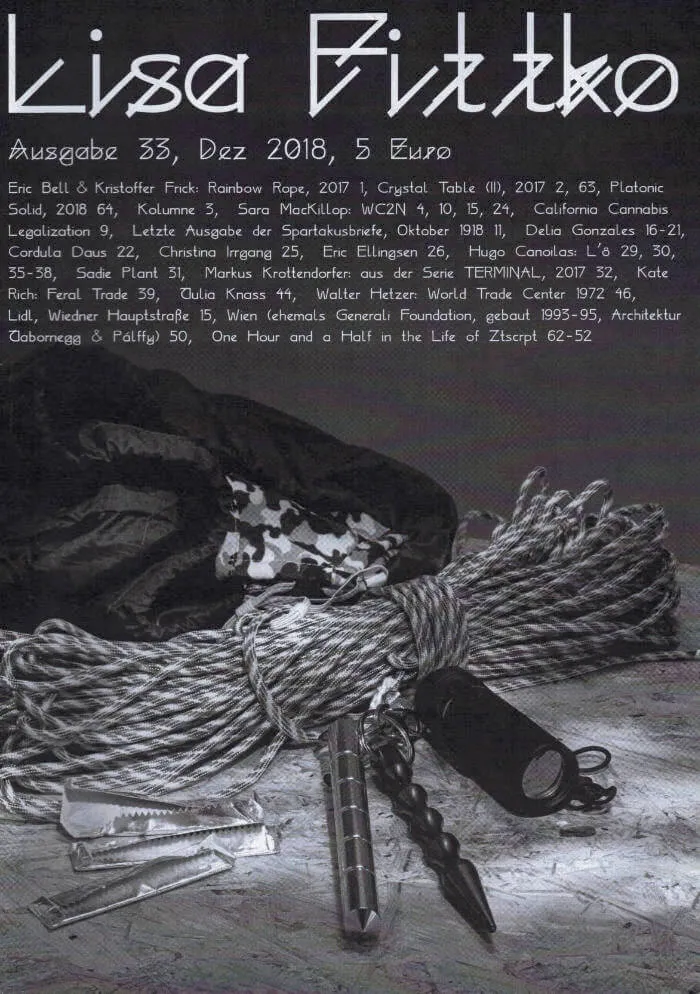
ztscript 33 : Lisa Fittko
Typeface by Bea Schlingelhoff, from the Project "Women against Hitler"
Eric Bell & Kristoffer Frick: Rainbow Rope, 2017 1, Crystal Table (II), 2017 2, 63, Platonic Solid, 2018 64, Kolumne 3, Sara MacKillop: WC2N 4, 10, 15, 24, California Cannabis Legalization 9, Letzte Ausgabe der Spartakusbriefe, Oktober 1918 11, Delia Gonzales 16-21, Cordula Daus 22, Christina Irrgang 25, Eric Ellingsen 26, Hugo Canoilas: L’ô 29, 30, 35-38, Sadie Plant 31, Markus Krottendorfer: aus der Serie TERMINAL, 2017 32, Kate Rich: Feral Trade 39, Julia Knass 44, Walter Hetzer: World Trade Center 1972 46, Lidl, Wiedner Hauptstraße 15, Wien (ehemals Generali Foundation, gebaut 1993-95, Architektur Jabornegg & Pálffy) 50, One Hour and a Half in the Life of Ztscrpt 62-52

Do Everything in the Dark (2023)
Faced with photos of a once-tumultuous New York art world, the narrator's mind in this scathing, darkly funny novel begins to erupt. Memories jostle for center stage, just as those that they are about always did. These brilliant but broken survivors of the '80s and '90s have now reached the brink of middle age and are facing the challenge of continuing to feel authentic. Luminous with imagery, cackling with bitter humor, and with a new foreword by the author, this roman a cle spares no one.
First published in 2003, Gary Indiana's turn-of-the-millennium novel traces the lives of a loosely connected group of New York artists and the dissolution of their scene.
During the summer of 2001, the narrator of Do Everything in the Dark, a gallery curator, receives intermittent dispatches from his far-flung friends, many of whom resemble well-known figures in the art and intellectual worlds, who are spread out across the globe, from Istanbul to Provincetown to Santa Fe. Seeking various reprieves from a changed New York, the long-festering, glossed-over incompatibilities of these aging bohemians blossom into exotic and unbearable relief. Beneath the contemporary excesses Indiana chronicles, we can see the outlines of the earlier New York bohemia captured by Dawn Powell.
Arguably Indiana's most intimate, internal, and compassionate work to date, Do Everything in the Dark is a chilling chronicle of madness and failure, success and disappointment, and the many ways love dies in a world people find increasingly unlivable.