rile*books

Search books

Search books by title, author, publisher, keywords...

Explore

Categories
Visit
Collections
Publishers
Back in stock
Any books
Cover of And then it got legs: Notes on dance dramaturgy

Varamo Press

And then it got legs: Notes on dance dramaturgy

Jeroen Peeters

€18.00

Drawing on his experience in the field of contemporary dance, Jeroen Peeters discusses principles, methods and practices that contribute to an understanding of dramaturgy as an experimental, collaborative practice and a material form of thinking.

Written from practice, this book reflects a particular history of collaboration and conversation with dance-makers such as Martin Nachbar, Meg Stuart, Vera Mantero, Sabina Holzer, Lisa Nelson, Jennifer Lacey, Chrysa Parkinson, deufert + plischke, Eleanor Bauer, Philipp Gehmacher and many others.

Phantasmal archaeology, unfolding material, literal and physical reading, crafting method, articulating process, witnessing and performing not-knowing, naming and ritual destruction, conceptual landscapes, symbolic waste, internal fictions and foreign objects – they may all play a role in creation and in exploring the unfamiliar in pursuit of making sense.

And then it got legs is an invitation to think along or against, to discuss those ideas with others or explore them in the studio, and eventually to imagine and devise one’s own methods of research, observation, reflection and creation.

Published in 2022 ┊ 168 pages ┊ Paperback ┊ Language: English

recommendations

Cover of Wrap, History and Syncope

Varamo Press

Wrap, History and Syncope

Isabel de Naverán

Non-fiction €12.00

18 July 1936, Bayonne. After hearing the news of the Fascist uprising, the Spanish dancer and bailaora Antonia Mercé y Luque, known as La Argentina, suffers a syncope and dies in fateful synchrony with the Second Republic. History, and the artist’s body, have been seized and broken by the event.

In close dialogue with images and historical documents, Isabel de Naverán pursues the reverberations of that shock and how it resonates with collective pain and artistic translations (by Federico García Lorca, Gertrude Stein, Kazuo Ohno and others). How does history affect and move through bodies? How do living bodies carry and pass on cultural legacy and collective memory? What do these complex movements reveal about the present? Wrap, History and Syncope is an affective journey that invites the reader into tracing and revisiting other bodies, to ultimately dance their difference and multiplicity for oneself.

Isabel de Naverán is a writer and researcher. Concern with the passage and use of time is the backbone of her work, which focuses on bodily transmission and the examination of the concept of historical time by way of ephemeral and fugitive practices. She holds a PhD in art from the University of the Basque Country.  

Translation from Spanish: Toni Crabb
Graphic design: Michaël Bussaer

Cover of The Soft Layer

Varamo Press

The Soft Layer

Jozef Wouters

Performance €10.00

A performance text by Jozef Wouters, The Soft Layer traces and proposes visions and words that enfold the historic building of Dar Bairam Turki in Tunis like a cloak. How can we imagine possible futures for such a place and the community inhabiting it, beyond nostalgia and the spectres of the past? Several voices muse in three languages (Tunisian, French and English) on renovation and history, destruction and cleansing, the limits of science-fiction and the soothing quality of aloe vera.

Published by Varamo Press in the essay series Gestures
First edition May 2022
48 pages, 11.0 x 16.5 cm, sewn perfect binding
ISBN 978-82-691492-4-1

Cover of Allow me to dream a body with you

Varamo Press

Allow me to dream a body with you

Sabina Holzer

Ecology €12.00

Writing from the body, from nervous impulses, sensations and gestures, but also from our being carried by matter, language and history, Sabina Holzer explores how writing may become ‘a way of singing and slip over into liminal, latent meanings and potentials.’ How to stay close to the body of the word? To perceive some of the multiplicity of our reality and ways of being, she incorporates somatic practices, ecology and new materialism, fables and science fiction in her writing. Allow me to dream a body with you gathers poetic essays and stories that delve into the fine grain of our corporeal entanglements and embeddedness. ‘Would an encounter between you and me be possible without all this?’

Sabina Holzer works in the field of expanded choreography. Her performances, interventions and texts explore the ecologies of human and more-than-human bodies with particular attention to movement and matter. She engages in practices of collaboration, philosophy, ecology, science fiction and poetry.

Graphic design: Michaël Bussaer

Cover of Forgetful Secretary

Varamo Press

Forgetful Secretary

Austin Gross

Essays €20.00

After diagnosis, the fact was that Austin Gross lived in his home country. He sat on the porch squinting like a potato and it was a comforting thing to imagine: rock-climbing with a blindfold. ‘Can swim, eyes open,’ he jotted and covered his eyes again. Sun, centrifuge, prognosis, bird-listening. The collision shaped genres like tectonic ripples. Windows open, a story while forgetting. ‘I am a memory eater.’
Aras was furloughed from prison that summer. Five years before, she’d missed their movie plan, and the fact was that since then, she lived in her home country. Furlough, Aras wrote, was ‘no-time.’ They investigated the situation together.

Austin Gross is an essayist and collaborator in elliptical orbit. His home discipline is philosophy and language English, on one condition: having left home. Trans-disciplinarity gives us a chance to be hosts and guests.

Cover of Skies

Varamo Press

Skies

Maria Jerez, Edurne Rubio

Skies is a practice that emerged when Edurne Rubio and María Jerez found themselves working in isolation during the creation process of their performance A Nublo in 2020. A dialogue in pictures capturing the skies above Madrid, Brussels and many other places, it is now a book and document of a particular time that invites others to reminisce as they read the clouds and ponder invisible worlds that haunt the aether. It comes with an essay by Augusto Corrieri on theatre and cosmos.

Edurne Rubio is a visual artist. Her work leans towards the documentary and starts out from orality and storytelling. 

María Jerez creates work at the intersection of choreo graphy, film and visual art. With her work, she wants to open up spaces of possibility through the encounter with what is foreign to us.

www.edurnerubio.org
www.mariajerez.com

Published by Varamo Press in the essay series Gestures
First edition October 2022
200 pages, 11 x 16.5 cm, sewn perfect binding
ISBN: 978-82-691492-6-5
Graphic design by Michaël Bussaer

Cover of Weaknesses

Afternoon Editions

Weaknesses

Chrysa Parkinson

Afternoon Editions no. 2: text and drawings by Chrysa Parkinson titled Weaknesses. Between January and March 2019 Time has fallen asleep in the afternoon sunshine was presented as a solo-exhibition at Index Foundation in Stockholm. During this period Chrysa Parkinson was invited as a guest writer for Afternoon Editions. Weaknesses is a leap in memory.

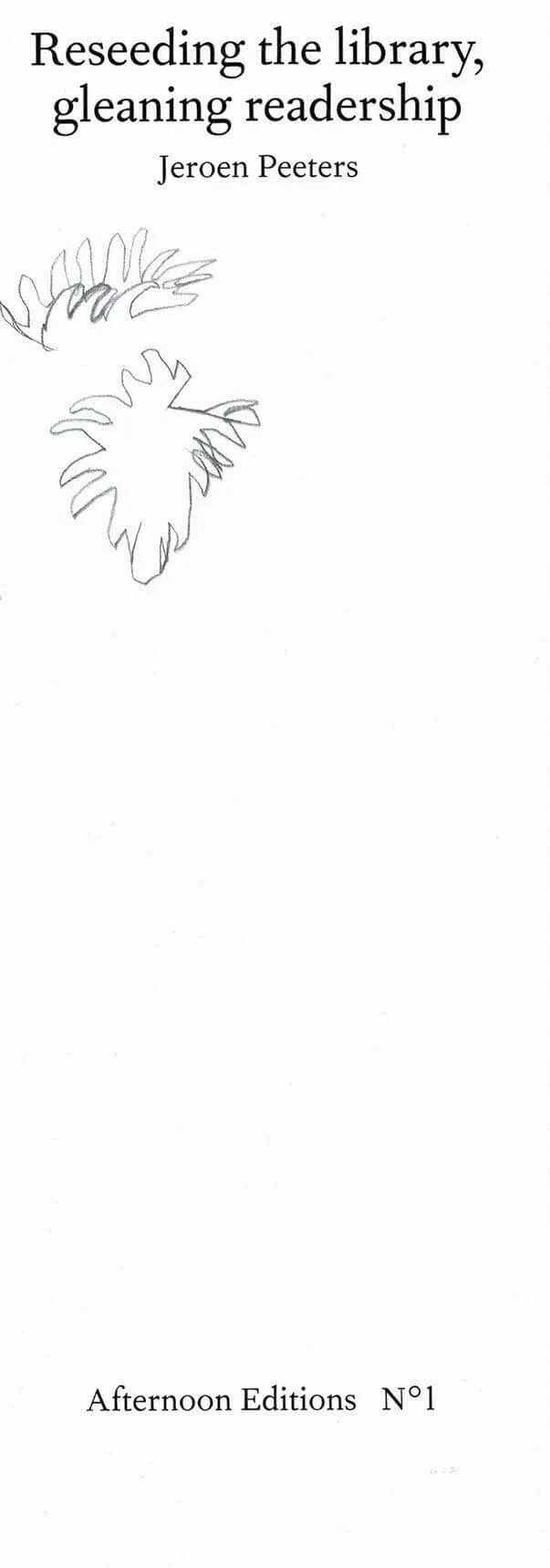
Cover of Reseeding the library, gleaning readership

Afternoon Editions

Reseeding the library, gleaning readership

Jeroen Peeters

Afternoon Editions no. 1: an essay by Jeroen Peeters titled Reseeding the library, gleaning readership. In May 2017, Time has fallen asleep in the afternoon sunshine settled during three weeks in the Ravenstein Gallery in Brussels as part of the Kunstenfestivaldesarts. Invited as a writer in residence, Jeroen Peeters visited the library of living books on a daily basis and recorded his observations by hand in a notebook, which formed the basis for Afternoon Edition #1. Reseeding the library, gleaning readership is an essay on the seed library, on the dispersion of literature through wind, water and animals, on biodiversity and commoning at the heart of readership. On the cover a drawing by Wouter Krokaert of a Philodendron Xanadu. Published May 2018.

Cover of Moments Before The Wind

Varamo Press

Moments Before The Wind

Jozef Wouters

Moments Before the Wind is a heterogeneous collection of notes on scenography that offers a glimpse into the poetics and artistic practice of Jozef Wouters. These reflections on space, scenography, art making and institutional critique have developed over the years as they were written out loud in various contexts. Now settling on the page among built and unbuilt spaces, they’re an invitation to the reader to think along or against, and think up space for oneself. Edited by Jeroen Peeters; graphic design by Filiep Tacq.

Jozef Wouters is a scenographer and theatre maker based in Brussels, who develops work in collaboration with his Decoratelier. Decoratelier is also a workplace for set designers and artists, and provides room for cross-disciplinary ventures and social experiment.

Cover of Let's Not Get Used to This Place – Works 2008-2023

Damaged Goods

Let's Not Get Used to This Place – Works 2008-2023

Meg Stuart

Performance €45.00

Edited by Astrid Kaminski, Jeroen Versteele, Julie De Meester. A personal and intimate look behind the scenes of Meg Stuart's creative process over more than a decade. 

Since the early nineties, Meg Stuart, and her dance company Damaged Goods, based in Brussels, have produced a remarkable and audacious body of choreographic work. In 2010, Damaged Goods published Are we here yet?, which spans the first twenty years of Meg Stuart's career. In the follow-up book Let's not get used to this place, the choreographer looks back on more than a decade of works through reflections, interviews, scores, and notes on the practice of creating, performing, teaching and living dance. These are mixed with reports, essays and poetry by collaborators and other observers, photos, performance texts and archive material. The book's title, gleaned from one of Stuart's recent video works, ties together these multifarious sources in a desire to discard tried and tested strategies, explore new contexts, and transgress the edge of what we (do not) know. 
Let's not get used to this place gives a sense of the plentitude of motions, inspirations and personalities that energize Meg Stuart's creative cosmos. It offers a personal and intimate look behind the scenes of the creative process, and expands this to include the world around it. As a journey through her more recent career, an inspiring manual and a work of art in its own right, it has a wide appeal to an international base of artists, students and peers, and to anyone who is interested in performance.

Contributions by Jean-Marc Adolphe, Preethi Athreya, Mariana Tengner Barros, Sandra Blatterer, Esther Boldt, Márcio Kerber Canabarro, Varinia Canto Vila, Descha Daemgen, Jorge De Hoyos, Igor Dobricic, Brendan Dougherty, Doris Dziersk, Tim Etchells, Moriah Evans, Thomas F. DeFrantz, Jule Flierl, Alain Franco, Davis Freeman, Ami Garmon, Philipp Gehmacher, Jared Gradinger, Ezra Green, Claudia Hill, Maija Hirvanen, Elise Misao Hunchuck, Astrid Kaminski, Kiraṇ Kumār, Göksu Kunak, André Lepecki & Eleonora Fabiano, Jean-Paul Lespagnard, Marc Lohr, Matthias Mohr, Anne-Françoise Moyson, Anja Müller, Kotomi Nishiwaki, Jeroen Peeters, Alejandro Penagos, Léa Poiré, Leyla Postalcıoğlu, Ana Rocha, Tian Rotteveel, Hahn Rowe, Isabela Fernandes Santana, Maria F. Scaroni, Bernd M. Scherer, Kerstin Schroth, Gerald Siegmund, Charlotte Simon, Mieko Suzuki, Claire Vivianne Sobottke, Poorna Swami, Meg Stuart, Margarita Tsomou, Kristof Van Boven, Elke Van Campenhout, Myriam Van Imschoot, Jeroen Versteele, Doug Weiss, Stefanie Wenner, Jozef Wouters, John Zwaenepoel.

Cover of Planning prévisionnel Printemps

Crossing

Planning prévisionnel Printemps

Clarissa Baumann

This publication presents research conducted by visual artist and choreographer Clarissa Bauman over two years, in the frame of the exerce MA in choreography and performance (National Choreographic Center of Montpellier / Occitanie). Here, writing becomes movement, a weaving of words, gestures, images, and drawings that rub against each other in a dialogue articulated from page to page.

"The choreography of small, overlooked gestures from moments of boredom, letting loose, detours. The finger sliding along the table, the arm coinciding with the back of this wooden chair. The coincidence of a gesture with an image, and the instantaneous disparition of this image in the body, as it transforms into the sketch of another movement. Contours, strokes, perspective lines, everything sinuous, asking at what moment does the image appear, emerge, and then become undone? The impossibility, within the body, of an image being fixed, still, one. (…) At this point in the writing, I perceive text less as a desire to organise, sediment, or give form to something, whatever it might be, but rather as a desire to find the outlines of connections between materials left hanging in the room I share with them, the tight space around the table, the images pinned to the walls in front of and behind me, the markings layered, scratched, or sketched in notebooks, the pages from books insistently revisited these last months, the memories that wane, escape, or insinuate themselves between these spaces. Developing a strategy for distracted observation."

Contributions by Anne Kerzerho, Christian Rizzo, Rostan Chentouf, Alix de Morant, Laurent Pichaud, Myrto Katsiki, Jocelyn Cottencin.

Cover of Dance History(s): Imagination as a Form of Study

Dancing Foxes Press

Dance History(s): Imagination as a Form of Study

Annie-B Parson, Thomas F. DeFrantz

Authored by twelve diverse American dance artists in the form of twelve small booklets, Dance History(s): Imagination as a Form of Studyapproaches and celebrates dance history as a subjective, artistic inquiry. It reimagines and radicalizes our understanding of dance throughout human history through the voices of working choreographers. Simultaneously, the project is dedicated to the power of an artist-centric view of history itself, thus placing the dance history back into the body, where it began. Here, history occurs in vertical layers of time and space and moves into the street, the football field, the yard, the screen, the memory, the womb, the sky, and the future.

Text by mayfield brooks, thomas f. defrantz, maura nguyễn donohue, Keith Hennessy, Bebe Miller, Okwui Okpokwasili, Eiko Otake, Annie-B Parson, Javier Stell-Frésquez, Ogemdi Ude, Mariana Valencia, and Andros Zins-Browne

Cover of Remembering a Dance – Part of Some Sextets 1965/2019

Lenz Press

Remembering a Dance – Part of Some Sextets 1965/2019

Yvonne Rainer

A re-examination of Yvonne Rainer's Parts of Some Sextets, a radical performance and pivotal piece in the American choreographer's career, which led her to theorize her conception of dance in the 1960s, before being revived in 2019.

Parts of Some Sextets, Yvonne Rainer's 1965 performance for ten people and twelve mattresses, represents a turning point in the American choreographer's oeuvre. "My mattress monster," as Rainer calls it, was built in her formative years with the experimental downtown New York group Judson Dance Theater. In this work, she asserted her exploration of "ordinary" actions as well as her disregard for narrative constructions to create an intricate choreography that unfolded with a new scene every thirty seconds.

More than half a century after its premiere, Rainer, in collaboration with choreographer and dancer Emily Coates, directed the 2019 revival of the piece for the Performa 19 Biennial in New York, grappling with the changing contexts of a new presentation of her radical performance. Remembering a Dance: Parts of Some Sextets, 1965/2019 delves into every aspect of this dance, from its original manifestation to its reconstitution.

This book, designed by visual artist Nick Mauss, includes previously unpublished archival images and documents from the 1965 stagings at the Judson Memorial Church in New York and the Wadsworth Atheneum in Hartford, Connecticut. Texts by Emily Coates, RoseLee Goldberg, Jill Johnston, Kathy Noble, Yvonne Rainer, David Thomson, Lynne Tillman, and Soyoung Yoon, as well as a new interview with Rainer, pose questions about the trajectories of artworks, performers, and audiences, all while tracing the life—and afterlife—of a dance.

Edited by Emily Coates. 
Texts and contributions by Emily Coates, RoseLee Goldberg, Jill Johnston, Kathy Noble, Yvonne Rainer, David Thomson, Lynne Tillman and Soyoung Yoon; conversation between Yvonne Rainer, Emily Coates and Nick Mauss.