Books
Books
in random order

My Cinema
Daniella Shreir, Marguerite Duras
A collection of writings by and interviews with Duras about her filmmaking, first published in French by P.O.L. in 2021 and translated into English by Daniella Shreir.
Working chronologically through her nineteen films, made between 1966 and 1985, this collection of reflections by Marguerite Duras (1914–1996) includes non-standard press releases, notes to her actors, letters to funders, short essays on themes as provocatively capacious as ‘mothers’ and ‘witches’, as well as some of the most significant interviews she gave about her cinematic and writing practices (with filmmakers and critics including Jacques Rivette, Caroline Champetier and Jean Narboni).
In Duras's hands, all of these forms turn into a strange, gnomic literature in which the boundary between word and image becomes increasingly blurred and the paradox of creating a cinema that seeks ‘to destroy the cinema’ finds its most potent expression.
Yet, Duras is never concerned only with her own work, or even with the broader project of making cinema: her preoccupations are global, and the global crucially informs her perceptions of the way in which she works. With the audiovisual as a starting point, her encyclopaedic associative powers bring readers into contact with subjects as diverse as the French Communist Party, hippies, Jews, revolutionary love, madness and freedom, across four decades of an oeuvre that is always in simultaneous dialogue with the contemporary moment and world history.
MARGUERITE DURAS (1914–1996) published over forty novels, numerous essays, novellas and plays and made nineteen films. She was part of the French Resistance, joined then left the Communist Party, and actively protested against the war in Algeria. She collaborated repeatedly with actors including Jeanne Moreau, Delphine Seyrig and Gerard Depardieu. Her films speak of her childhood in Indochina and the French colonies, of desire (burning and frustrated), madness and domesticity. Contemporary filmmakers including Claire Denis, Alice Diop and John Waters have cited Duras’ cinema as inspiration for their own work.

Devour Me, Again: Collected Poems
A landmark collection of poems by Bambi Lake, the beloved (and bad-mouthed) icon of San Francisco’s counterculture.
Bambi Lake was a trans chanteuse, performer, provocateur, and countercultural darling of the ’70s, and subsequent decades. “The Glamorous Life follows me around,” she sang in her ballad “The Golden Age of Hustlers” (later popularized by Justin Vivian Bond). Her life in San Francisco—including being on the fringes of the Cockettes, and a member of the adjacent Angels of Light—was “sort of legendary,” sort of “sweet, sticky, nasty,” and always precarious, lived in spite of addiction, homelessness, and the horrors that came from chasing and surviving her own desires.
Here are her poems, long out of print, that wear “burgundy velvet jezebel bras” to seduce “fatally hetero” men, detailing the cabaret of desire amidst social, cultural, and political change. “I am Beauty,” she writes, “and the world dissolves.”
The collection includes a series of interviews by August Bernadicou and a foreword by Brontez Purnell.

Nawar's Sketchbook
I am not deep, although my eyes are, like a black sea that has been forgotten, as many have told me.
Noura Alsouma’s zine “Nawar’s Sketchbook” is a liquid lament by the Berlin-based Syrian visual artist and printmaker, riveted to eyes that see and therefore shed tears, channeling the heartfelt exposure of the sketchbooks Noura fills to the bleed.
With a moving text by the artist in the original Arabic, reproduced in her handwriting, as well as in English translation by Suja Sawafta.

Verlag der Buchhandlung Walther König
in the coherence, we weep
“in the coherence, we weep is both an artist book and an exhibition. The project is about the critical potential of incoherencies. It is an attempt to map methodology across media, while welcoming glitches that allow for moments of critical self-reflection and knowledge production. Developed in parallel, the book and exhibition critically reflect on each other’s approaches. It looks at strategies for how text can be alive and vibrant across various architectural contexts as well as those used in the artist’s family archive, particularly annotation, redaction, indexing, blurring, and learning through reading and writing.” - KW Institute for Contemporary Art
“Multilayering was in that sense an important aspect, which got translated with the material and the design by choosing papers with differents gradients of transparency, as well as interfering and overlapping text layouts. We also designed the cover with a blue scratch off drawing on top of another artwork, so every book might change a bit over time depending on the use. This reflects the artist‘s idea of including the audience and an ever changing oeuvre, where the relation between pieces become important too.” - Studio Pandan
Texts by Dr. Christina Landbrecht, Krist Gruijthuijsen, Sofie Krogh Christensen, Chang Yuchen, Ladi'Sasha Jones
This artist book is published on the occasion of Kameelah Janan Rasheed’s Schering Stiftung Award for Artistic Research 2022 solo exhibition at KW Institute for Contemporary Art (2023).
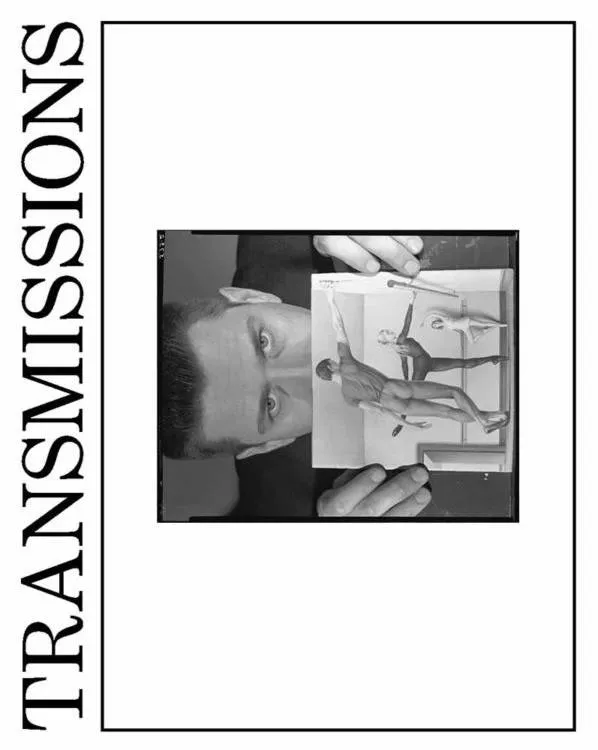
Transmissions
An aesthetic and social history of art and dance in mid-20th-century New York interpreted by contemporary artist Nick Mauss.
Over the past decade, Nick Mauss (b. 1980) has pursued a hybrid mode of working that melds the roles of curator, artist, and scholar. This catalogue leans heavily into the scholarship side of his practice, building on his 2018 Whitney Museum exhibition with a closer look at the relationship between modernist ballet and the New York avant-garde. In the 1930s through 1950s, ballet was introduced to a popular audience in New York and was simultaneously influenced by developments in Europe in painting, photography, fashion, music, and poetry. Mauss reflects on this period of rich cross-media production and synergy, ultimately arguing for the inseparability of dance and art history.

saké blue. Selected Writings
Can critical thinking spring from both a fortune cookie and Jacques Lacan’s most obscure seminar footnote? Estelle Hoy says yes. In saké blue, overpriced cheesecakes are the starting point for an essay on art writing; shoplifting in Berlin opens to a reflection on the economies of activist practices; fiction allows us to discuss the legacy of institutional critique, queer mélanges, or quiet melancholy. To her, the story of art becomes more nuanced in light of lyrics by Arthur Russell, the posthumous sorrow of Sylvia Plath, or a poem by Yvonne Rainer.
saké blue gathers critical essays, art reviews, and poetic fiction. Written in dialogue with the work of Martine Syms, Marlene Dumas, Hervé Guibert, or Camille Henrot, these texts combine the subjective and analytic, addressing power relations and the force of affect. Hoy spares nothing—and no one, exposing cultural clichés and urgent political issues through fast-paced acerbity. She advocates the work of women artists, mocks stereotypes, questions myths, and champions desire, sadness, and boredom. Simultaneously beautiful, lyrical, and cutthroat, her writing echoes to the reader like l’esprit d’escalier—we think of the perfect reply just a little too late.
“Estelle Hoy practises philosophy as an unsettled but deeply committed query into existing together. She reads, she looks, she writes, to find out something essential about the future and living for it.”
—Lisa Robertson, author of The Baudelaire Fractal
“Estelle Hoy's prose slap and bite, saké blue is a sharp pleasure to read.”
—Calla Henkel, author of Scrap
“Hoy’s renditions of all-too familiar scenes are made more visceral than life with sparkling prose and a sly attention to life’s many shifting values that feels more than appropriate for anyone truly interested in art.”
—Natasha Stagg, author of Artless
Edited by Antonia Carrara
With an introduction by Lisa Robertson

All My Dead Jesters
All My Dead Jesters is an assembly of select poems previously published in de Vries’ first two English language collections—Dark Hour and I Failed to Swoon (Dostoyevsky Wannabe, 2018 and 2021 respectively). These old works have been lightly revised for republication, and are paired with poems drawn from a manuscript-in-process to institute an autotelic kaleidoscope of some ten years worth of work in verse.
De Vries’ poems are spare, terse and epigrammatical—a barroom Bashō—dedicated to the glimmer of a compact glance; the chance, glamour and negative capability of a passing thought; and the slow drip of liquid crystal as colours our present. All My Dead Jesters is a torch song for our ‘poor subjectivity,’ a slow dance with sour times, a ‘[steering] away from [the] gratuitous provocation’ that litters our contemporary outlook. ‘Her competence as a poet lies in her ability to translate visceral vulnerability’ for the page (The Kelvingrove Review / University of Glasgow), as she patchworks a heroic ‘poetry without [a] hero, a blanket leaving you colder somehow, [...] the map of a world we like to think we know’ [CA Conrad].

MAKAN #2 / Manufacturing Narratives
In its second issue, Manufacturing Narratives, Makan focuses on how interrogating narrativity can provoke fundamental questions about how societies define or choose to accept societal or historical truths in today’s world. Spanning across [and beyond] the Mashreq and Maghreb, the various contributions reflect a shared space of inquiry that bridges geographies and fosters emergent dialogues across shifting territorialities. This issue invited contributors to right (as much as write) narratives: to question authorship and its social collectivities, to retell alternative public histories, to explore gender roles, and to unsettle the exoticism, folklorization, and political textures of fiction as a practice of indiscipline. Together, these contributions re-articulate the genealogies of our present through the pluralities of the past, offering tools to imagine and manufacture alternative futures, and realities otherwise.
With contributions by Ala Younis, Bari Abbassi, George Bajalia, Karim Kattan, Karima Kadaoui, Tamkeen, Kenza Sefrioui, Lahbib El Moumi, Laila Hida, Maureen Mougin, Mohamed Amer Meziane, Monica Basbous, Nadia Tazi, Sénamé Koffi Agbodjinou, Salma Barmani, Sonia Terrab, Soufiane Hennani, Yto Barrada.

Why Call it Labor? On Motherhood and Art Work
This publication comprises four essays and one conversation with contemporary artists and curators discussing their experience of becoming mothers as professionals in the arts, its reality and effects. While their reflections represent a similar strata of art worker in terms of background, class, and career trajectory, the impact of instruments of patriarchy on rendering maternity invisible that they describe is recognizable and insidious.
Contributions by Mai Abu ElDahab, Basma Alsharif, Lara Khaldi, Mary Jirmanus Saba, and Mirene Arsanios with Nikki Columbus.
Edited by Mai Abu ElDahab
Published by Mophradat and Archive Books
Text design layout by Valerie Arif
Arabic and English

The Wide Road
What would have happened had Thelma and Louise not driven off the cliff but stayed on the road? In Carla Harryman and Lyn Hejinian’s picaresque novella, friendship lives on to follow eros through a polymorphic landscape where their fearless, inquisitive “we” encounters “hunger in two places at once.
The Wide Road is a collaborative investigation of the female body, friendship, writing, community, activism, travel and the nature and possibility of human thinking.
Carla Harryman and Lyn Hejinian, two of the most honored innovators of language, began writing The Wide Road in 1991. Over the following twenty-years, the co-writing occurred in turn by letters, by walking, in cabins, together and apart, and finally together again. The reader of this original and major work will find that it is no longer possible to distinguish who wrote what. Instead, one finds a joyful new feminist voice breaking out new possibilities for the future of writing.
The event of the making-writing of this book is now matched by the event of the making-book object of the book, for which the artist Nancy Blum drew two botanical panels, the fruit and the flower of the strawberry tree. HR Hegnauer, in discussion with editor, Rachel Levitsky and the authors, came up with two designs, and in celebration of the book’s multiple origins, Belladonna* Collaborative printed both!
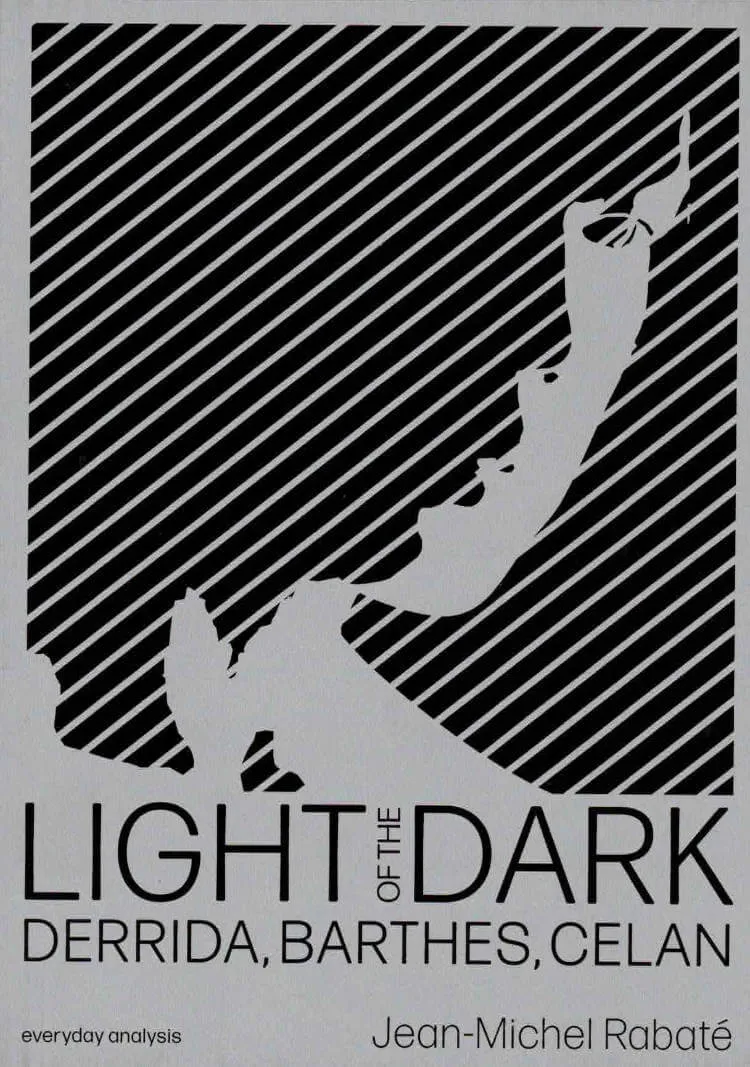
Light Of The Dark: Derrida, Barthes, Celan
Derrida’s essay “Aletheia” discusses the work of Japanese photographer Kishin Shinoyama. Reading Derrida, Rabaté investigates how, behind the classical concept of truth as a beautiful naked woman, Derrida argues that any photographic image tells the Truth, but a truth obscured as it comes to light: “nothing is more black than the visibility of light.” Staging a critical conversation with Roland Barthes’s theses in Camera Lucida and Paul Celan’s poems from Breathturn to Lightduress, Rabaté argues for a theoretical approach to truth that counters the prevailing truth-discourses of today.

Emil Lime
Emil Lime collects various materials that nurture and give shape to Esther Gatón’s artistic practice, including collages made with her phone pics, sketches, sporadic notes and drawings, together with the writing of authors that have been influential on the work: Fredy Massad, María Fernanda Ampuero, Darya Diamond and Cory John.

Plastic: A Poem
Set during a single twelve-hour night shift in an injection molding factory, plastic is a book-length poem exploring the life of the industrial worker turned poet.
Bringing together memoir, ekphrasis, and satire, plastic is based on Matthew Rice’s experience working in a plastic molding factory for ten years. Illustrating alienated twenty-first-century Irish labor in poetic form, plastic engages with the inflictions and implications of a “post-industrial,” “post-Troubles” society, all while weaving in depictions of factory work from literature, film, and the visual arts.
Time-stamped to highlight the claustrophobia of the worker’s experience, Rice meditates on masculinity, sectarianism, and intergenerational trauma. But at its core is a poem about feeling a calling while being submerged in the world of menial labor—making plastic airplane parts by night, making poetry by day.
Invoking the brevity of Seamus Heaney, plastic is an expansive and imaginative poem that offers the working class a grace, dignity, and truth not often found in contemporary literature.
MATTHEW RICE was born in Belfast. He holds an MA in poetry from Queen’s University Belfast and is currently undertaking a PhD at the Seamus Heaney Centre at Queen’s. His debut collection, The Last Weather Observer, was published in 2021 to critical acclaim, highly commended for the Forward Prize for Best First Collection, and included in the Arts Council of Northern Ireland’s top ten books of the year.

The German Library Pyongyang
From December 11, 2015, until April 10, 2016, the German Library in Guangzhou, China, became The German Library Pyongyang, a reimagining of an initiative of the Goethe-Institut that originally operated in North Korea between 2004 and 2009. This temporary intervention by Sara van der Heide is an imaginary transformation of the current geography of the German Library in Guangzhou. Van der Heide’s project is a contemporary version of the Goethe-Institut’s original library initiative in North Korea, devised as a vessel to discuss national cultural policy in a post-Cold War and postcolonial era that looks critically toward the parallel histories of Germany and the two Koreas. The German Library Pyongyang offers a space for critical questions, but it also functions as a context for transcending thinking that is prescribed by the lines of the nation-state, language, and geography. The several artistic, linguistic, and graphic interventions in the library merge with the continuing activities of the German learning center in Guangzhou, and all institutional printed matter in Chinese is replaced by Korean.
This publication brings together the four original exhibition booklets in German, Korean, English, and Chinese. An additional reader is included with critical reflections as well as documentation of the exhibition and the organized seminar.
Design by Dongyoung Lee
English/German/Korean/Chinese

The Haitian Chronicles
The Haitian Chronicles is a graphic and brutal history of the Haitian Revolution told across three plays. It is the final work by the influential and groundbreaking playwright Douglas Turner Ward (1930-2021) and the first play of his to be published in several decades. Though much of his earlier work has been short one-act satires, The Haitian Chronicles takes place across three long plays: The Rise of Toussaint L'Ouverture, The Fall of Toussaint L'Ouverture, and the one-man drama, Dessalines.
The Haitian Chronicles is an example of Ward's political commitment to satirizing, dramatizing, and revealing the structures of white supremacy throughout the history of this so-called civilization. His first play, Star of Liberty, written at 19 years of age, was based the life of Nat Turner and the slave revolt he led. With The Haitian Chronicles, Ward returns to armed Black rebellion, taking as its subject matter the first and only slave revolt to successfully establish a free state. It is a self-consciously ambitious work of astounding narrative and theatrical scope, featuring over 80 speaking roles and logistically demanding production design. The narrative onslaught chronicling the disgusting brutality of colonial French society and the bloody force it took to overthrow it overwhelms the reader and challenges one to question the structures on which society is built and the violence it continues to perpetuate.
Ward was one of the central, driving forces of the Black Theater movement in the United States. After moving to New York in 1948, he became immersed in the radical political scene in Harlem, writing for The Daily Worker, and studying as an actor. He served as understudy to Sidney Poitier in A Raisin in the Sun, and began a long friendship with fellow actor Robert Hooks. In 1966, Hooks helped produce Ward’s double bill Happy Ending / Day of Absence. Following the success of these plays, Ward was asked to write an editorial for the New York Times in 1966. His article, titled "American Theatre: For Whites Only?", surveyed the ubiquitous, stifling racism of the American theatre and was widely circulated, earning Ward further recognition for his political and theatrical work. With funding from the Ford Foundation, Ward and Hooks, together with Gerald Krone, founded the Negro Ensemble Company (NEC) in 1967. Writing and directing for the NEC over the next several decades, Ward worked with icons such as Paul Carter Harrison, Gus Edwards, Leslie Lee, Errol Hill, Charles Fuller, Derek Walcott and Wole Soyinka. He directed dozens of plays throughout his career including Song of the Lusitanian Bogey, The River Niger and Pulitzer Prize-winning A Soldier’s Play. Ward continued to write until his death in 2021– The Haitian Chronicles is the result of over four decades of work, a superb series of plays by an inimitable writer and artist.
Boo-Hooray proudly placed the Douglas Turner Ward Archive at Emory University’s Stuart A. Rose Manuscript, Archives and Rare Book Library in 2017. The Archive includes many working drafts of the numerous plays Ward directed and wrote, manuscript materials, and correspondence with other icons of the Black Arts.
The Haitian Chronicles was a winner of the AIGA 50 Books & 50 Cover Award for the work of book designer Martha Ormiston.

Anatomy of a Refusal
Written after the Beirut Port Explosion on August 4, 2020, when 2,750 tonnes of ammonium nitrate exploded in the commercial and residential port of Beirut after years of warning and mismanagement, Anatomy of a Refusal drifts between lineated and prose poetry, creating a transitional space of mourning. Comprised of three sections, “Mutually Assured Destruction” confronts displacement; “Blast” erases and rescribes bureaucratic documents written about the explosion, and “Deterrence” “return[s] to the place of injury.”
Intertextually poetic, Sahar Khraibani writes in conversation with other writers and philosophers to question, “who owns my language?” and “What does it mean to be in / place?" And yet, between bureaucracy and philosophy, there are moments of intimacy, friendship coexisting in the shared space of the poem—between speaker and addressee, the body and the living world—where belonging carries the weight of grief.
—Blurb written by Clarise Reichley

Men in the Off Hours
In Men in the Off Hours, Carson offers further proof of her tantalizing gifts. Reinventing figures as diverse as Oedipus, Emily Dickinson, and Audubon, Carson sets up startling juxtapositions: Lazarus among video paraphernalia, Virginia Woolf and Thucydides discussing war, Edward Hopper paintings illuminated by St. Augustine. And in a final prose poem, she meditates movingly on the recent death of her mother. With its quiet, acute spirituality and its fearless wit and sensuality, Men in the Off Hours shows us a fiercely individual poet at her best.

Kish, An Island Indecisive by Design
Babak Afrassiabi, Nasrin Tabatabai
In Kish, An Island Indecisive by Design, artists Nasrin Tabatabai and Babak Afrassiabi explore the modern development of an Iranian island in the Persian Gulf. Removed from mainland Iran, Kish is a place where extremes in politics, ideology and urban design intersect. The island's many years of infrastructural indecision is distinctly evident in its architecture, which lacks any trace of coherence or feel for locale. This volume gives an often moving account of the chaos of middle-eastern modernity.


Tangents
Isabelle Sully, Becket Flannery and 1 more
Tangents is an English-language online review platform focused on writing about the Dutch art scene-on what is happening both within the borders of the Netherlands and about Dutch-based artists presenting work beyond them. Born from a frustration with the prevalence of objectivity and imposing house styles in the majority of art writing commissioned by leading platforms, Tangents instead encourages contributors to approach criticism from within the specificities and focuses of their own writing practice.
Tangents publishes a monthly review written by a writer from our stable of permanent contributors. This publication is the first printed compendium of recent writing, published on the occasion of Tangents' mentorship pro-gram, for which the founding editors each supported a young writer through development and to publication. The 2024/25 mentees were Mehmet Süzgün, Lou Vives and Dido W.

All That's Left to You
"All That's Left to You presents the vivid story of twenty-four hours in the real and remembered lives of a brother and sister living in Gaza and separated from their family. The desert and time emerge as characters as Kanafani speaks through the desert, the brother, and the sister to build the powerful rhythm of the narrative. The Palestinian attachment to land and family, and the sorrow over their loss, are symbolized by the young man's unremitting anger and shame over his sister's sexual disgrace. This collection of stories provides evidence to the English-reading public of Kanafani's position within modern Arabic literature. Not only was he committed to portraying the miseries and aspirations of his people, the Palestinians, in whose cause he died, but he was also an innovator within the extensive world of Arabic fiction.
Ghassan Kanafani was a refugee, a journalist, an editor, and a political activist. First and foremost, though, he was a writer, "a commando who never fired a gun, whose weapon was a ball-point pen," said his obituary in Lebanon's Daily Star. He was born in 1936 in Akka (Acre) and was part of the 1948 exodus from Palestine. A politically active journalist in Beirut during the 1960s, Kanafani was killed in the explosion of his booby-trapped car in July 1972. He is the author of the highly acclaimed novel Men in the Sun and is considered a leading novelist in the Arab world. His works have been translated into 17 languages and published in 20 countries.

Proverbs of a She-Dandy
These proverbs were originally published in 2018 in Vancouver by the Morris and Helen Belkin Art Gallery. With permission from the author the text has been styled into a bootleg and risoprinted in medium blue ink.
“Menopause, Gardanne said in 1821, is the loss of the signs of female reproductive ability. ‘Huge dangers’, he warned, ‘precede, accompany, follow the cessation of this function’. The illustration on the cover of his book shows a broken ceramic pitcher. Gardanne was at the forefront of what now would be called the ‘medicalisation of menopause’, which is to say, its treatment as an ailment, both physical and psychosomatic, of the female body.”
Proverbs of a She-Dandy elaborates on a persistent theme in feminist art and literature over many past decades: a skeptical yet desirous exploration of the flâneur as a figure of agency for women. Robertson finds in Charles Baudelaire’s dandy a tangible presence for old women in public spaces.

Hopelessness
"The brilliant Verity Spott has a new book out, called Hopelessness and published by the 87 Press. The work defies categorisation: Verity is a poet, and this book is certainly poetry, but large parts are in prose form and towards the end it even takes on the structure of an absurdist play. There seems to be a loose narrative, and even recurring character voices, so I’m tempted to call it a short experimental novel, in the vein of Kenneth Patchen’s The Journal Of Albion Moonlight (a personal favourite). Ultimately though I’d just call it a book; one full of words that are profound, moving, silly, sad, challenging and beautiful in equal measure. Even though it’s still a boldly experimental piece, in some ways Hopelessness feels like the most accessible thing Verity’s done. Without wanting to sound condescending, it’s also the most mature. You don’t get much more universal than death, love and loss, and these seem to be the main themes explored here. Another is language itself, the way it defines and limits our experience, and the way that we’re constantly at the mercy of words and phrases as they’re deployed by the authorities, the media, and eventually our own thought processes. Dissenting voices continually talk over one another throughout Hopelessness, often sampled from outside sources, or parodies thereof: Sappho, MR James, traditional hymns and folk songs, Hollywood movies, talk radio, tabloid newspapers, dreams and demagogues. Through it all there’s a painful lesson about how loss can make us bitter and hard, and how by refusing to move forward we become empty caricatures mouthing meaningless clichés to wound and hurt. But grief and loss can also teach us about love, if we let them, and there is so much grief and love in this book. Verity continually rearranges reality (that is, language) as if searching desperately for a way out, but in the end, as always, there is just life, love, and death. Hopelessness is a bravura performance, wholeheartedly recommended." — Ben Graham
Verity Spott is a poet from Brighton. Verity is the author of several books including Hopelessness (the 87 Press), Click Away Close Door Say (Contraband Books), We Will Bury You (Veer Books) and Poems of Sappho (in translation, Face Press). From 2018 to 2019 Verity was Poet in Residence at the University of Surrey. Verity teaches poetry in Brighton with The Creative Writing Programme and (alongside Kat Addis) with the Hollingdean Wednesdays project where they hold a poetry reading and writing group in Hollingdean Community Centre. Verity's poems have been translated into Greek, Spanish, Portuguese, Dutch and German and their book Hopelessness has been translated into French and published by Même pas l'hiver. Verity plays cello in the improvised tune duo Benzo Fury and the free jazz trio In Threads. Since 2006 Verity has run the monthly poetry, performance and music event Horseplay.

Flower Engine
the second poetry collection from Natalie Briggs titled ‘FLOWER ENGINE’. This collection of cinched, bright free-verse explores the passing locations of love and the slow, private operations of pain’s knocking counterweight. The book extends Briggs’ relay of concise universal suggestions, translating them through brief, intimate utility.