Books
Books
in random order

Massive Massive Oil Slick
Expect anger. Expect joy, joy interspersed with anger, anger with joy, anger and joy in equal proportions, till joy is eclipsed by anger, or anger by joy. Expect decline. Expect steady and sudden decline, in fortune and wellbeing, a decline in wellbeing in places as far afield as Corby and Inverness, London, Manchester, and Yorkshire.
Massive Massive Oil Slick is a monologue written in sentences that begin with the verbs expect, suppose, and avoid, delivered in a seminar room of an unnamed institution. The audience is invited to participate in imagined scenarios: predicaments, thought-experiments, moral quandaries. Themes range from profound to mundane, serious to absurd: homelessness, drug trials, social exclusion, traffic, Brazil nuts, carveries, contact with extra-terrestrial life. The result is a prophecy, and the reader the central character through whom multiple futures are posited, dismissed, and revived.
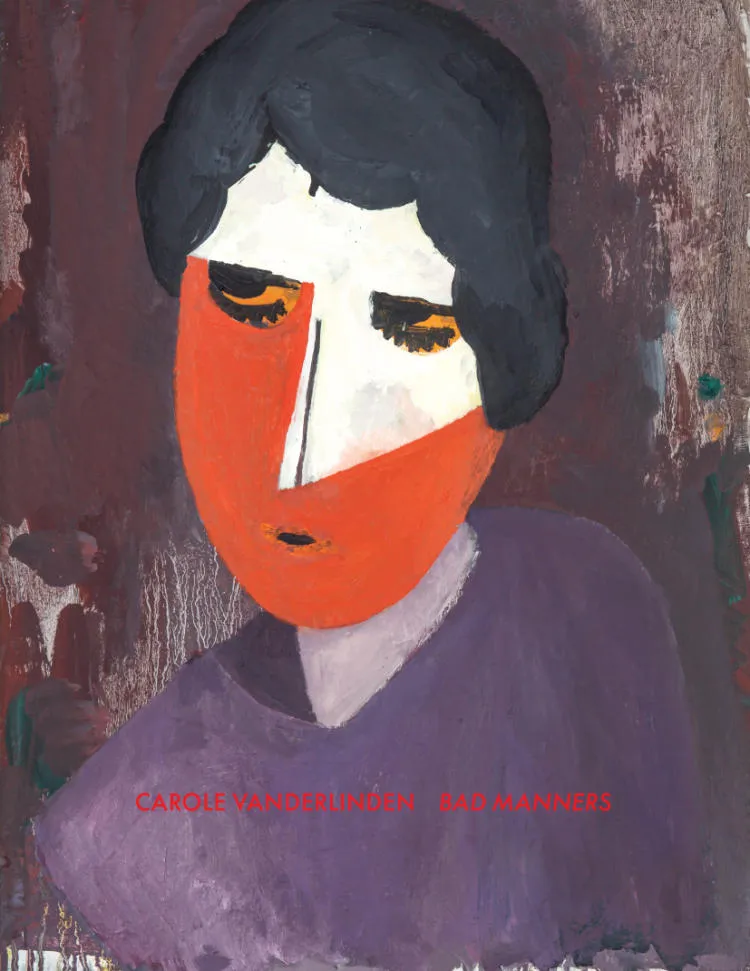
Bad Manners
Carole Vanderlinden's first monograp covers over a decade of the artist's practice. It gathers close to 200 paintings and works on paper, alongside texts by Belgian novelist Jean-Philippe Toussaint, essays by curators Ann Hoste, Ory Dessau, and Hans den Hartog Jager, as well as a conversation between musician and composer Joëlle Léandre and Vanderlinden.
Born 1973 in Brussels, Carole Vanderlinden has been developing a highly improvisational, rich artistic practice since the mid-1990s. While her work is primarily focused on painting (often using thick, hand-mixed oil paints), it regularly encompasses drawing, watercolor, collage, and small objects. Vanderlinden's practice is famously unhampered by the constraints of a single style. Her work nimbly blurs the line between figuration and abstraction, reacting intuitively to the rhythm, color, and possibilities of her medium rather than adhering to a single signature aesthetic.

A take away cup and a cloud
A take away cup and a cloud is an essay written alongside the dance performance Seems to be by Denise Lim and Stina Ehn. It plays with a variety of containers–the list form being one. By mixing a personal with a historical gaze it traces the trajectory of mundane commodities and the replacement of material with imaterial objects brought about to the everyday by technical progress.

Slips of the Mind: Poetry as Forgetting
An audacious account of what happens when forgetting becomes a way of writing and writing becomes a way of forgetting.
In Slips of the Mind, poet and critic Jennifer Soong turns away from forgetting’s long-standing associations with suppression, privation, and error to argue that the absence or failure of memory has often functioned as a generative creative principle. Exploring forgetting not as the mere rejection of a literary past or a form of negative poetics, Soong puts to the test its very aesthetic meaning. What new structures, forms of desires, styles, and long and short feelings do lapses in time allow? What is oblivion’s relationship to composition? And how does the twentieth-century poet come to figure as the quintessential embodiment of such questions?
Soong uncovers forgetting’s influence on Gertrude Stein, Lyn Hejinian, Tan Lin, Harryette Mullen, Lissa Wolsak, and New York School poets John Ashbery, James Schuyler, Bernadette Mayer, and Ted Berrigan, among others. She reveals that forgetting’s shapeshifting produces differences in poetic genre, interest, and degrees of intentionality—and that such malleability is part of forgetting’s nature. Most provocatively, Soong shows how losing track of things, leaving them behind, or finding them already gone resists overdetermination and causality in the name of surprise, as poets leverage forgetting in order to replace identity with style. Slips of the Mind is the kind of literary criticism that will reward all readers of modern and contemporary poetry.

We Circle Through The Night and Are Consumed by Fire
Simon Asencio, Pauline Hatzigeorgiou
This publication acts as a postscriptum to the exhibition project Through The Valley of The Nest of Spiders by Simon Asencio for SB34—The Pool in Brussels. Dedicated to Samuel R. Delany's sci-fi and sexutopia novel, the exhibition was conceived as a process of annotating the book, expanding on the ethics discussed by the characters of the novel through installation, performative readings and with the complicity of other artists and their works. This devious object pursues such an intertextual process, extending and disseminating the writings forged by the exhibition.
Cette publication se présente comme le post-scriptum de l'exposition de Simon Asencio Through The Valley of The Nest of Spiders pour SB34—The Pool à Bruxelles. Dédiée au roman de science-fiction et de sexutopie de Samuel R. Delany dont elle porte le titre, l'exposition a été pensée comme un processus d'annotation de ce livre, développant les formes éthiques mises en pratique par les personnages du récit, à travers des installations, des lectures et situations performatives, avec la complicité d'autres artistes. Cet objet interlope poursuit ce processus intertextuel, en prolongeant et disséminant les écritures forgées par l'exposition.
With contributions by / avec les contributions de: Reinhold Aman, Henry Andersen, Simon Asencio, Jen Brodie, Chloe Chignell, Jack Cox, Samuel R. Delany, Diana Duta, Loucka Fiagan, gladys, Stefa Govaart, Sean Gurd, Pauline Hatzigeorgiou, Maxime Jean-Baptiste, Bernard-Marie Koltès, David J. Melnick, Matthieu Michaut, Margaret Miller, LaTasha N. Nevada Diggs, Anouchka Oler Nussbaum, Grisélidis Réal, Páola Revenióti, Sabrina Seifried, Raphaëlle Serres, Valerie Solanas, sabrina soyer, Megan Susman.

Solidarité, entre fantasme et nécessité
Sarah Schulman, fervente militante pour les droits humains, livre dans cet essai une brillante analyse des défis sociaux et psychologiques inhérents à tout mouvement de solidarité. En prenant appui sur plusieurs exemples historiques (lutte pour le droit à l’avortement dans l’Espagne postfranquiste, lutte contre le VIH/sida dans le New York des années 1990, mobilisation contre le génocide à Gaza…) ainsi que sur sa propre expérience de femme queer et juive, l’autrice décortique les rouages de la solidarité et entreprend de questionner les fantasmes qui y sont traditionnellement associés.
En filigrane, cet ouvrage pose une question fondamentale : quelle place pouvons-nous prendre dans un monde de plus en plus polarisé, et comment agir en solidarité avec les populations opprimées à l’échelle mondiale, locale ou individuelle ? L’autrice analyse les conditions nécessaires à tout mouvement de solidarité et montre l’importance de l’écoute active, la nécessité d’intervenir lorsque l’on est confronté à une injustice, la capacité à tolérer l’imperfection, ou encore la reconnaissance du coût moral et social inhérent à toute mobilisation.
En dressant des parallèles entre différents mouvements sociaux, Sarah Schulman met en lumière certaines dynamiques transversales à tout acte de solidarité et montre l’importance de la convergence des luttes dans un contexte mondialisé. Ode à la libération des populations opprimées, cet ouvrage apparaît aujourd’hui indispensable pour quiconque souhaite oeuvrer à la construction d’un monde plus juste.

ZILCH
In banana boxes, Maxime Le Bon collects and stores a lot of documents in a jumble. Most of them are printed, cut out from newspapers, magazines, old publications, erratas and other fragments of texts. Added to this are drawings that he improvises - some of them torn or stained that he don't want to display or throw away. This collection of heterogeneous items is then being rearranged and slipped into plastic pockets where he stores them. Unstable and in constant change, this improbable archive grows with the years. It sedimented layers of experiences and constitutes this heterogeneous deposit from which can emerge all sorts of fragmentary narratives and accidental arrangements. The publication ZILCH brings together a selection of images from this extensive archive.

MISSING
As our streets become ever more securitised and visually sanitised, and as most forms of everyday communications are shifting to the digital realm, homemade missing posters are one of the few remaining forms of paper-based citizen expression still found in public spaces.
Drawing on a collection of several hundred missing animal posters collected over the last 10 years, “MISSING” brings seemingly isolated text fragments into conversation to weave a narrative of loss and hope.
Featuring exaggerated duotone images, the publication explores the link between the weathering of physical posters and the fading away of cherished memories. While looking through these visual artefacts, one is left to wonder how many of these animals have been reunited with their families.
Printing: Risograph, Grafische Werkplaats Den Haag; Photography and colour separations: Livio Liechti; Design: Apsara Flury.
First print run (Blue) – Dec 2024: 40 copies.
Second print run (Teal) – May 2025: 50 copies.

HOOT nr. 3 — Kamilé Krasauskaité
Gufo, Clément Faydit and 1 more
Last year, on a summer night in Marseille, someone, within all the hungry people I am meeting during my dinners, specifically set her attention on my projects. Later during the fall I received a call from Austė ZDANČIŪTĖ, the cultural attache at the Lithuanian embassy in France, who introduced me to Kamilè Krasauskaitè. Since that fall, we kept on exchanging and making future plans in France where she would have a residency. The more we chatted, the closest we began. Kamilè is a almost-thirty-years-old Lithuanian artist that has been including sourdough bread in her work and builds a poetic and mesmerising world around that dimension of food, fermentation, senses, environment, rituals...Through our communication I decided to share that encounter that we managed to welcome in Marseille. We kneaded some bread together, shared it in a forest of Marseillais sunflowers, walked the streets, met people, questioned and compared artists' lives in Europe. This issue might be an excerpt of all the long conversations we had, it was hot and sunny in Marseille, it was in June.

Tina Girouard: Sign-In
From the 1970s until her death, Louisiana-born artist Tina Girouard (1946–2020) was a dedicated experimental artist, collaborator and art worker. Alongside her individual creative endeavors, she nurtured and was a part of numerous influential artist communities and organizations in New York, Louisiana and Haiti, including the Anarchitecture Group, the interdisciplinary cohort of 112 Greene Street, the restaurant Food, the Kitchen, P.S. 1 and the Festival International de la Louisiane. Her acts of upkeep, including domestic labor traditionally associated with “women’s work,” blurred the boundaries between artmaking and what she called life-making. Sign-In is the first comprehensive monograph on her interdisciplinary oeuvre. It gathers documentation of her work in video, performance, drawing, textile, wall works and installation, tracing Girouard’s practice and legacy across genres and geographies.
Edited by Andrea Andersson with Jordan Amirkhani
With new essays by Andrea Andersson, Jordan Amirkhani, Anaïs Duplan, Pamela M. Lee, Aruna D’Souza, and Lumi Tan

Elke dag is een tentoonstelling
Special edition: 100 out of 300 books are reworked by making cutouts in the book.

Ordinary Notes
A singular achievement, Ordinary Notes explores profound questions about loss and the shapes of Black life that emerge in the wake. In a series of 248 notes that gather meaning as we read them, Christina Sharpe skillfully weaves artifacts from the past—public ones alongside others that are poignantly personal—with present realities and possible futures, intricately constructing an immersive portrait of everyday Black existence. The themes and tones that echo through these pages—sometimes about language, beauty, memory; sometimes about history, art, photography, and literature—always attend, with exquisite care, to the ordinary-extraordinary dimensions of Black life.
At the heart of Ordinary Notes is the indelible presence of the author’s mother, Ida Wright Sharpe. “I learned to see in my mother’s house,” writes Sharpe. “I learned how not to see in my mother’s house . . . My mother gifted me a love of beauty, a love of words.” Using these gifts and other ways of seeing, Sharpe steadily summons a chorus of voices and experiences to the page. She practices an aesthetic of "beauty as a method,” collects entries from a community of thinkers toward a “Dictionary of Untranslatable Blackness,” and rigorously examines sites of memory and memorial. And in the process, she forges a brilliant new literary form, as multivalent as the ways of Black being it traces.

The Sense of Brown
The Sense of Brown is José Esteban Muñoz's treatise on brownness and being as well as his most direct address to queer Latinx studies. In this book, which he was completing at the time of his death, Muñoz examines the work of playwrights Ricardo Bracho and Nilo Cruz, artists Nao Bustamante, Isaac Julien, and Tania Bruguera, and singer José Feliciano, among others, arguing for a sense of brownness that is not fixed within the racial and national contours of Latinidad.
This sense of brown is not about the individualized brown subject; rather, it demonstrates that for brown peoples, being exists within what Muñoz calls the brown commons—a lifeworld, queer ecology, and form of collectivity. In analyzing minoritarian affect, ethnicity as a structure of feeling, and brown feelings as they emerge in, through, and beside art and performance, Muñoz illustrates how the sense of brown serves as the basis for other ways of knowing and being in the world.

ROT
ROT is a publication reflecting the research “Wicked technology/Wild fermentation,” by Sara Manente that focuses on forms and practice of fermentation as ways to rethink bodies and their making. This glossy magazine performs research, aiming to infect the reader, and questioning how to spread, publish, and help the work survive.
Sara Manente is a performance artist, dance maker and researcher born in Italy and living in Brussels. She is interested in narrowing the distance between the performer, the audience, and the work. Her research starts from a dance practice that problematizes perception, translation, and ways of doing. Her work comes out in hybrid forms: book launch, 3Dfilm, written text, interview, choreographic piece, workshop, telepathic experience, collaboration, et al.

Noa & Snow – Poem #9
This book/catalogue is published on the occasion of the final event of Noa & Snow, a gentle experiment between the everyday and the event, at the Volkskundemuseum, Vienna.
Publication Concept Alix Eynaudi, Goda Budvytytė
Design Goda Budvytytė
Printing Robstolk, Amsterdam
Edition 600 copies
Proofreading Bella Marrin
ENVELOPE Pattern design based on the Lila Dress and its signature cording by An Breugelmans
LE VESTIAIRE
Costumes & objects An Breugelmans Tapestries & trompe-l’oeil Cécile Tonizzo Weaves Lydia McGlinchey Photos taken inside of Jason Dodge’ show Cut a Door in the Wolf at Macro Museum by Carlotta Pierleoni Photos in Vienna Samuel Feldhandler
THEM, PROTEXTIONS
Han-Gyeol Lie, Mette Edvartsen, Lydia McGlinchey, Clara Amaral, Ujjwal Kanishka Utkarsh, Jennifer Lacey, Cécile Tonizzo, Sabina Holzer, Alice Chauchat, Jason Dodge, Joachim Hamou, Quim Pujol, Litó Walkey, Serena Lee, Mihret Kebede
PUBLIC MEDITATIONS
Anne Faucheret, Elizabeth Ward, Kirsty Bell, Tony Just, Sabina Holzer, Samuel Feldhandler, Frida Robles
TEXTURAGES Paula Caspão VIGNETTES Alix Eynaudi
Poster picture of Claire Lefèvre’s Grimoire/Giant Notebook/Bison Book Rasa Juškevičiūtė
INSTITUTE OF REST(S)
Alix Eynaudi, Paula Caspão, Quim Pujol
Back side A thread for Alix Eynaudi, woven as a table placement by Genė Janušauskaitė in 1936, out of the flax she had sawn and harvested herself. Photographed by Kristien Daem in 2022, after Aldona Malašauskienė revealed the placement to her son Raimundas.

London-rose — Beauty Will Save the World
The story of failure asks one question only: What do people who lose do next? “Let the best one win.” War is one way. The other way is religion. Let me at the stakes. It’s so much a matter of patience. No fury, beyond all reason, no sequence broken, but diverted. Nothing seems to cooperate when you lose control. Blue becomes violet. Bend your head to the blank. The solution is so simple: don’t identify yourself with your description of yourself.
"It feels we aren’t reading prose but language that oscillates between liturgy and prayer." — Eugene Lim

Every Moment Is a Life: Gaza in the Time of Genocide
susan abulhawa, Huzama Hubayeb
In early 2024, writer and activist susan abulhawa managed to enter Gaza twice through the Rafah crossing. There, at the Culture and Free Thought Association, susan held a series of workshops for young people who had been displaced to tent encampments. The lives of all participants were marked by unrelenting Israeli violence and extraordinary loss—of home, family, safety, education, electricity, and all the structures of life. They’d fled from place to place as Israel’s colonial violence swirled around them, complete with food and water insecurity and constant threat. Still, despite the bitterness of life in tents and the dangers of travel, they came together to share in the refuge of writing and community.
Samya recounts a tender moment with an old man mending shoes in the street, while her cousin Saja hides books in her closet, hoping they and her home will still be there when she returns. Ghassan is haunted by the baby he rescued from the rubble, who for a time became his son. Fatima risks it all retrieve her clothes from a danger zone buzzing with drones and warplanes. Maram’s loving aunt is gone, and chaos inhabits Amr’s mind. Samah, Lubna, Rizq, and Nebal take us by the hand through raining death, trails of tears, classroom shelters, and shared clothes in crowded tents.
Every Moment Is a Life delivers rare, unfiltered portraits of life under genocide, platforming the emerging voices struggling to survive in Gaza today. These essays are raw and real, capturing human moments—buying bread, going to the bathroom, sharing a meal, drinking coffee—all set against the backdrop of history’s first livestreamed ethnic cleansing. With courage, anger, love, agony, and—impossibly—hope, these achingly tender voices from Gaza will stay with us, captured in these pages, forever.

Theory for Moving Houses
You are asking me where I live and it’s making me think all these things about space, where I start and end in space and where space starts and ends in me and when, in space, I am a body and when I’m a book, in space.
So begins Renee Gladman's Theory for Moving Houses, and with these lines we are invited into a liminal space of imagination and investigation, as Gladman guides us through the architectures of her poetics. Foundational here is a sense of fluidity, a slippage of time, a devotion to “non-linear and hyper gestural movement,” a communal spirit. Gladman’s inquiry into her intersecting practices of writing and drawing reveals a deep commitment to uncertainty and “fictional knowing.” Yet again, Gladman upends traditional expectations of prose, as she leads us through landscape of her Ravicka series novels, ultimately surprising us with a novel within nonfiction. The latest volume in Wave’s Bagley Wright Lecture Series, Theory for Moving Houses is not only visionary in its contemplations but also is a virtuosic example of the ways in which language can shape utopian sites of possibility.

Antonio Obá: Rituals of Care
Antonio Obá: Rituals of Care traces the practice of the Brazilian artist since 2016, offering a broad survey of his recent work, dwelling on the recurring motifs and iconographic sources that feed the complex imagery of his painting. Extensively illustrated, the book returns the richness of Obá's paintings, with enlargements on some of the details woven into the pictorial texture that, in addition to showing his masterful technique, make certain elements of his visual vocabulary stand out.
The conversation between Andrea Bellini and Antonio Obá that opens the book offers the opportunity to learn, through the artist's voice, about the key passages of his research, and to examine his diverse cultural references—from the Baroque of Minas Gerais to traditional Chinese painting, from Rembrandt to the Catholic ex-votos—until we discover the Obá's civic vocation, of painting as a spiritual practice.
The two essays commissioned for the occasion analyze the complexity of these layered signifiers. Lorraine Mendes's essay "Every Boy Is a King" offers an in-depth analysis of Obá's religious syncretism. It suggests an interpretation of its layered symbols, particularly the sankofa and the deity Exú, both of which pay tribute to the artist's West African roots. Above and beyond the specific cultural contexts of this iconography, the author emphasizes the universal value of Obá's work, its evocative, transformative, dynamic power, which—like music or dance—knows no national boundaries or barriers.
Larry Ossei-Mensah's essay "Embodiment: The Art of Antonio Obá" investigates the complex cultural legacy that is intertwined with the artist's practice, connected to his Afro-Brazilian roots, to the social and political realities of the Black diaspora, and to Christian, Candomblé, and Umbanda traditions. In addition to examining the context in which Obá's work is rooted, the author situates it within a galaxy of artists who have focused on questions of identity, often using their own bodies as tools of social and cultural critique.
Completing the book is a chronology, compiled by Sara De Chiara, tracing the artist's formative years and exhibition history, accompanied by rich documentary materials.
Published on the occasion of Antonio Obá: Rituals of Care, the first mid-career survey in Europe dedicated to the Brazilian artist, curated by Andrea Bellini, at the Centre d'Art Contemporain Genève, in 2025.
Antonio Obá (born 1983 in Ceilândia, Brazil) lives and works in Brasília. His multifaceted practice encompasses painting, sculpture, photography, installation, video, and performance. His œuvre interrogates and subverts historical representations, reappropriating spiritual practices and stigmas of racism. Obá endeavors to reclaim his African heritage in a societal framework that has historically sought to dilute Black culture. His works therefore confront the violence inflicted over centuries upon African-Brazilian traditions and communities with new narratives.

That Figures. Selected Writings
Gathering 13 amazing essays by artist and writer Dena Yago, co-founder of K-HOLE, That Figures retraces more than a decade of reflections on the creative industry—digging into topics such as Sporespace, Billie Eilish, LARPing, corporate cafeterias, ketamine, precarity, poetry, and the internet’s lures and failures. Yago exposes the contradictions of living amidst the sugarcoated deals of the attention economy, and further proposes a new lexicon to address the numbing and disorienting effects of late stage capitalism. Absorbing but refusing to metabolize the language of commercial culture, she opens a space where critical thinking can still happen.
That Figures also features a selection of artworks by Yago, in which the combination of conceptual legacies with pop cultural elements creates new poetical arrangements.

Or, on Being the Other Woman
Throughout this book-length poem, Simone White considers the dynamics of contemporary black feminist life, attesting to the narrative complexities of writing and living as a black woman and artist.
In Or, on being the other woman, Simone White considers the dynamics of contemporary black feminist life. Throughout this book-length poem, White writes through a hybrid of poetry, essay, personal narrative, and critical theory, attesting to the narrative complexities of writing and living as a black woman and artist. She considers black social life—from art and motherhood to trap music and love—as unspeakably troubling and reflects on the degree to which it strands and punishes black women. She also explores what constitutes sexual freedom and the rewards and dangers that come with it. White meditates on trap music and the ways artists such as Future and Meek Mill and the sonic waves of the drum machine convey desire and the black experience. Charting the pressures of ordinary black womanhood, White pushes the limits of language, showing how those limits can be the basis for new modes of expression.

Impossible Princess
Impossible Princess is the third collection of gay short fiction by PEN Award–winning San Francisco–based author Kevin Killian. A member of the “new narrative” circle including Dennis Cooper and Kathy Acker, Killian is a master short story writer, crafting campy and edgy tales that explore the humor and darkness of desire. A former director of Small Press Traffic and a co-editor of Mirage/Periodical, Killian co-wrote Jack Spicer’s biography, Poet Be Like God, and co-edited three Spicer books, including My Vocabulary Did This To Me: Collected Poems. His latest book, Action Kylie, is a collection of poems devoted to Kylie Minogue.

F.R. David - what I mean is—
F.R.DAVID is a typographical journal, dealing with the organisation of reading and writing in contemporary art practises. “what I mean is—” the 16th issue, edited by Will Holder.

La Gentrification des Esprits
La Gentrification des esprits est un retour captivant sur la crise du sida et l’activisme d’ACT UP dans le New York des années 1980 et 1990. Sarah Schulman, elle-même new-yorkaise et militante de la cause LGBT, se souvient de la disparition du centre-ville, pratiquement du jour au lendemain, de la culture rebelle queer, des loyers à bas coût et du prolifique mouvement artistique qui se développait au coeur de Manhattan, remplacés par des porte-parole gays conservateurs, ainsi que par le consumérisme de masse.
Elle décrit avec précision et engagement le « remplacement d’une communauté par une autre » et le processus de gentrification qui toucha ces quartiers concomitamment à la crise du sida. Sarah Schulman fait revivre pour nous le Lower East Side qu’elle a connu. Elle ravive autant le souvenir de ses ami•e•s de l’avant-garde queer que celui de l’ombre inquiétante des premières années de la crise du sida, telles que vécues par une militante. Les souvenirs personnels s’entremêlent à une analyse percutante des deux phénomènes, et du poids invisible qu’ils font aujourd’hui peser sur la société américaine.
L’auteure rend compte de son expérience en tant que témoin de la « perte de l’imagination » de toute une génération, et des conséquences entraînées par cette perte.