rile*books

Search books

Search books by title, author, publisher, keywords...

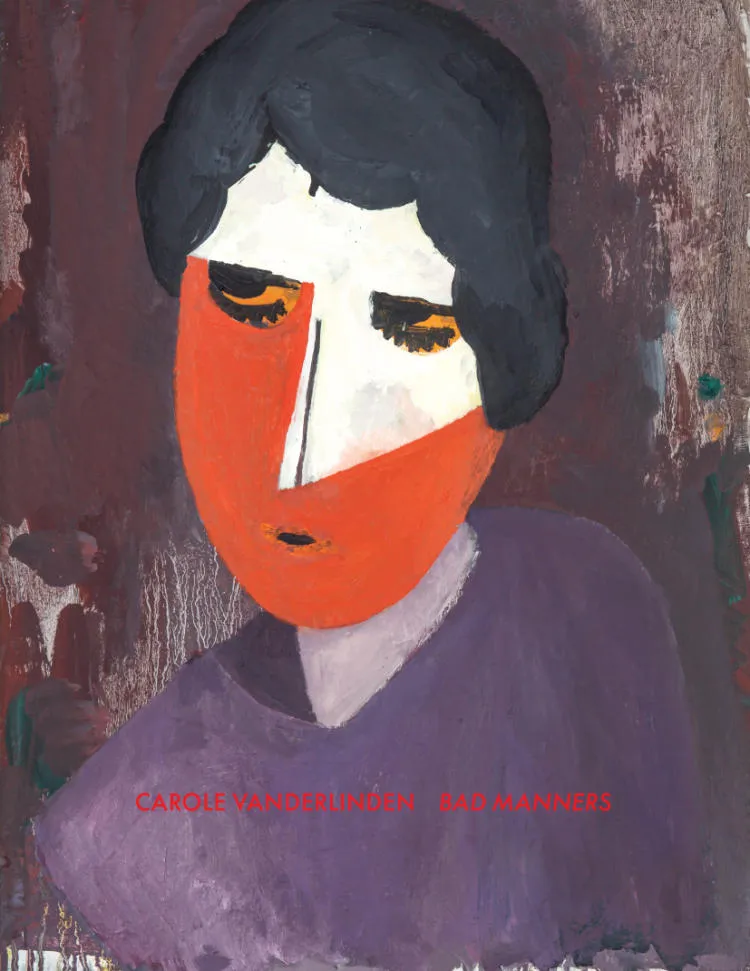
Cover of Bad Manners

Zolo Press

Bad Manners

Carole Vanderlinden

€43.00

Carole Vanderlinden's first monograp covers over a decade of the artist's practice. It gathers close to 200 paintings and works on paper, alongside texts by Belgian novelist Jean-Philippe Toussaint, essays by curators Ann Hoste, Ory Dessau, and Hans den Hartog Jager, as well as a conversation between musician and composer Joëlle Léandre and Vanderlinden.

Born 1973 in Brussels, Carole Vanderlinden has been developing a highly improvisational, rich artistic practice since the mid-1990s. While her work is primarily focused on painting (often using thick, hand-mixed oil paints), it regularly encompasses drawing, watercolor, collage, and small objects. Vanderlinden's practice is famously unhampered by the constraints of a single style. Her work nimbly blurs the line between figuration and abstraction, reacting intuitively to the rhythm, color, and possibilities of her medium rather than adhering to a single signature aesthetic.

Published in 2026 ┊ 320 pages ┊ Language: English

recommendations

Cover of Birthday

Zolo Press

Birthday

Bridget Mullen

Bridget Mullen is the ruler of an unruly roost. Between 2021 and 2023, she gave birth to forty-seven paintings, each twelve-by-nine inches: kin ugly and cute, monstrous, fleshy, repulsive, droopy-eyed, and sneering as they cross the universal threshold into the no less frightening world that awaits. Birthday reunites Mullen's uncanny litter alongside a conversation between the artist and Lucas Blalock.

The paintings in New York-based artist Bridget Mullen's Birthday series utilize two distinct parameters to guide the creation of the iterative works: a vertical orientation at an intimate scale of 12 x 9 inches and a visualization of perhaps the ultimate creative act—the moment of birth. Through this consistent scale and thematic hyper focus, the artist employs endless formal variations in composition, color, and paint application. The result is a series of paintings that share a common structure yet champion individuality.

Contrasting colors provoke a visible tension, one that is at times compressed and, in other moments, elastic. Suddenly, abstract shapes come into focus as human anatomies, capable of expressing emotion. Undulating lines of various thicknesses and layered colors squeeze together, revealing peculiar faces and gestures that emerge from a central point. The repetition of thin lines creates a visual stutter of pigment, alluding to the passage of time or rapid movement.
The works in Birthday build on Mullen's practice, combining color, decisive mark-making, intuition, and experimentation to conjure psychedelic configurations. Sculptural dimensionality and flatness, representation and abstraction, and solidity and fluidity, serve not as dichotomies within these works, but as two complementary halves of a whole. Together, the forms and figures of the Birthday series are imbued with a sense of life, pregnant with agency and potential.

Cover of Local Warming

Zolo Press

Local Warming

Sebastian Black

For Sebastian Black, 2020 was a year like no other: a pandemic; three exhibitions; a move to Los Angeles; a presidential election; a baby, too. Local Warming is Black's tale of it all, as recorded in his diary.

One million years ago, when I started making the paintings compiled here, I was listening to lots of audiobooks and recorded philosophy lectures. It was the winter of 2019, my paintings were about this and about that, and every brushstroke drifted safely over a net of ideas. I was gathering a list of things that I knew to be true because I was sick of having nothing to say when people asked me to explain myself. Then a professor, who to me is now a holy exegete, said that difference precedes identity as the substance of reality. I'd been eavesdropping on YouTube as he taught a continuing-ed class on Deleuze for a claque of narrative therapists. Difference before identity. I couldn't grasp the idea— only touch it. That's okay, said the professor, as though speaking directly to me, the point of thinking isn't to grasp things that are true but rather to prod things that are interesting. — Sebastian Black

Sebastian Black is an artist/writer. He was born in New York City in 1985. He lives and works in Los Angeles. 

Cover of One Big Bang

Zolo Press

One Big Bang

Adel Abdessemed

One Big Bang brings together 78 charcoal and pastel drawings from Adel Abdessemed's recent series Nature Morte and Politics of Drawing, where everyday objects, animals, and flowers are subtly charged with tension. Through these works, Abdessemed explores the intersections of beauty, fragility, and unrest. With texts by Hélène Cixous and David Elliott, One Big Bang offers a thoughtful entry into an artist's visual language shaped by memory, myth, and political urgency.

Published following the eponymous exhibition at Projeckt Brussels in 2024.

Adel Abdessemed (born 1971 in Constantine, Algeria, lives and works in Paris and Berlin) deconstructs identity codes, tackling head-on the tensions that permeate our society. His works, with their typical simplicity—sculptural installations, drawings, photographs, videos and performances—echo precise facts and familiar situations, but go beyond narrative commentary and militant criticism. Adel Abdessemed questions, among other things, the social and economic status of the artist in a system where his foothold is slight, by shrewdly keeping a distance in a gesture of subversive and committed resignation.

Abdessemed refuses to be limited to a single ideology. In his early works he passionately tackled religious, sexual, and taboos subjects and his later exhibitions have often focused on the theme of global violence. In an interview with Elisabeth Lebovici he stated, "I do not live between two cultures. I am not a postcolonial artist. I am not working on the scar and am not mending anything. I am just a detector … In the public sphere, I use passion and rage. Nothing else. I don't do illusions."

Sometimes reduced to a simple word, as in "Mohammedkarlpolpot" (1999), a condensation of names evoking totalitarism and religion, and sometimes complex and monumental installations such as "Habibi" (2004), a suspended skeleton of 17 meters propelled by a jet engine, Abdessemed's practice belongs to a new generation of artists who appeared recently on the French art scene, looking to offer another perspective on culture and identity.

Cover of REMMUS

Bored Wolves

REMMUS

Mikołaj Moskal

Painting €14.00

When living things bloom & molder all in a heartskip, when they expand toward death, this is what worms hear.

Artist’s book of paintings by Mikołaj Moskal: gouache, archival paper elements, simple & meaningful captions. REMMUS is a graft of Podlasie earth-water-sky and Mikołaj’s pigments, heart, and intuition. Designed in close collaboration with graphic artist and designer Kaja Gliwa.

The paintings are bracketed by a poem each by Kuba Niklasiński (“Flows | Flaws”) and Stefan Lorenzutti (“What Worm Heard”), handwritten by Mikołaj in English and Polish.

Cover of Painting Photographs

TBW Books

Painting Photographs

Alice Wong

Monograph €44.00

TBW Books is pleased to announce the publication of Painting Photographs, a new book by Creative Growth Art Center artist Alice Wong. Wong's bold interpretation of vintage vernacular photographs breathes new life into family album kitsch and cliché shots of plants and landscapes, transforming them into a hyper-color plane of vivid abstraction. Using paint markers to enhance and obscure the formal qualities of appropriated imagery, Wong's hand brings energy to each underlying image, recalibrating the viewer's eye and sparking appreciation for otherwise still compositions. With fluid mark-making and a striking approach to color-blocking, Wong's craft merges with the photographic process to create work that feels at once of times past and completely contemporary.

Creative Growth Art Center is the oldest and largest nonprofit art studio for artists with developmental disabilities in the United States. Since 1974, Creative Growth has played a significant role in increasing public interest in the artistic capabilities and achievements of people with disabilities, providing a professional studio environment for artistic development, gallery exhibition and representation.

Cover of Slipping on Fragmented Shapes

Mousse Publishing

Slipping on Fragmented Shapes

Hoda Kashiha

Painting €27.00

First monograph devoted to the playful, explosive and colorful paintings of the Iranian artist, featuring extensive illustrations along with a selection of drawings and preparatory studies that reveal the methods behind Hoda Kashiha's compositions, which are often constructed like collages, in which multiple layers intersect, cut-out shapes emerge, and images evolve through a combination of hand-drawing and digital manipulation.

Published following the exhibition I'm Here, I'm Not Here at Passerelle Centre d'Art Contemporain, Brest, in 2022, Hoda Kashiha's first solo public exhibition in Europe.

Developing a distinctive form of pop painting that moves freely between uninhibited Cubism and a cartoon-like visual language, Iranian artist Hoda Kashiha (born 1986 in Tehran) produces works that appear playful at first glance but reveal darker, more enigmatic, and deeply symbolic layers upon closer examination. Humour is a recurring strategy in her practice—one that fosters intimacy with viewers while enabling her to address serious and sensitive questions rooted in the social context and political climate of her home country. Her paintings also engage universal concerns, including gender relations and the place of women in society. For Kashiha, her protagonists become activists without ever speaking: they assert their differences openly and remain steadfastly optimistic. With her exuberant use of forms and colour, Kashiha creates an explosive blend of genres in which Picasso seems to drift into the world of Minecraft, joyfully dismantling the conventions of the past.

Text by Lilian Davis; conversation between Loïc Le Gall and Hoda Kashiha.

Cover of I Am the Century

Mousse Publishing

I Am the Century

Alice Neel

Painting €45.00

This publication aims to provide a critical and profound reading of Alice Neel's humanism, constructing a journey through her artistic and personal life. The book includes texts by academics and artists, enriched by an extensive number of illustrations, archival photographs and documents.

Alice Neel: I Am the Century accompanies the first major retrospective in Italy dedicated to the US artist Alice Neel (1900–1984), presented by Pinacoteca Agnelli, Turin. Conceived as both a critical and a narrative journey, this publication offers an in-depth exploration of Neel's artistic and personal life, expanding on the exhibition through a rich selection of essays and visual material. It brings together sixty works reproduced in dialogue with archival documents, highlighting Neel's role as a pioneer and one of the most important painters of the twentieth century. Contributions by curators, scholars, and artists—including Kelly Richman-Abdou, Jennifer Higgie, Mira Schor, and Annie Sprinkle—provide multiple perspectives on Neel's practice, situating her radical approach to portraiture within broader artistic, social, and political contexts.

Merging realism with surrealism and empathy with unflinching clarity, Neel captured the psychological and emotional depth of her sitters. The publication emphasizes her capacity to chronicle life's stages and relationships—childhood and adulthood, sexuality and intimacy, community and political consciousness—through works that continue to resonate with contemporary audiences. Positioning Neel as both artist and witness, I Am the Century underscores her enduring humanism and her singular vision of the "human comedy," offering readers a comprehensive entry point into a body of work that is still influencing new generations of artists.

Born in 1900 in Merion Square, Pennsylvania, Alice Neel lived in Philadelphia and Havana before settling in New York (where she lived until her death in 1984), becoming part of the social milieu of the Harlem neighbourhood. She painted figuratively throughout her life, often using the people "around her" as subjects, models and muses. For Neel, this meant portraying both the residents of Harlem as well as  strangers, friends and intellectuals who often shared her proximity to the Communist Party. A figurative painter in an era dominated by Abstract Expressionism, Neel developed remarkable and radical new ways of representing the human body in painting, such as with her celebrated nudes of pregnant women.. The introspective aspect of Neel's work, her ability to capture the essence of her subjects and their souls, has made her today one of the most appreciated and respected artists of the twentieth century.

Neel's work has been the subject of retrospectives at the Metropolitan Museum of Art in New York, the Guggenheim Museum Bilbao and the Centre Pompidou in Paris. It forms part of the permanent collections of institutions such as the Art Institute of Chicago; the Hirshhorn Museum and Sculpture Garden in Washington, D.C.; the Metropolitan Museum of Art; Moderna Museet in Stockholm; the Museum of Contemporary Art in Los Angeles; the Museum of Fine Arts in Houston; the Museum of Modern Art in New York; the National Gallery of Art in Washington, D.C.; the Philadelphia Museum of Art; Tate Modern in London; the Walker Art Center in Minneapolis, Minnesota; and the Whitney Museum of American Art in New York.

Edited by Sarah Cosulich and Pietro Rigolo.
Texts by Sarah Cosulich, Jennifer Higgie, Kelly Richman-Abdou, Pietro Rigolo, Mira Schor, Annie Sprinkle.