Books
Books
in random order

of sirens, body & faultlines
of sirens, body & faultlines is a book of prophecy against this Brexit era, rising from a post-2008 London, where crisis and austerity meet the vanity projects of the super-rich. Committed to the immediacy of a present that is precarious and under surveillance, of sirens... attends to queer, transfeminist and people of colour counter-memories and histories. It seeks new expressions of desire and modes of breath, pushing against the gravities that would rather these lives and worlds disappear.
While arguing with the radio may seem futile, syntax, punctuation, grammar and the page must still all be mobilised to help create new conditions of possibility – for collectivity, for poetry to speak. Raha’s exceptional, experimental, queer lyric mobilises all aspects of language to reveal contradictions of capitalism and defuse populist rhetoric. This is a writing of city life against the flows to capital; labouring bodies speaking back to the demands of work and the fictions of xenophobic politicians. It concerns herstory, transfeminism, collectivity; the everyday of South East London, transformation and decolonisation, through counter-memories, anti-memoir, and a trans poetics.
"Nat Raha has written some of the most exciting poetry of the last decade. Transfeminist, communist, revolutionary – with great quickness and nimble intensity, her syllables and survival codes dash through police-lines as high-level transmissions signalling absolute solidarity, insisting that other lives are still possible. Originally published as a series of home-made pamphlets that seemed to come as much from post-punk zine culture as from avant-garde poetics, it's good to see them gathered here in one place for the first time and as a body of evidence of a culture of struggle. These poems do not merely comment on that struggle, but emerge from within it. They are poems that break open a space in which to think through what has happened, who we have been, and what has been done to us. These are fearsome times. Raha writes poetry that acknowledges that fear and refuses to flinch in the face of it, which is in itself an act of the fiercest solidarity." – Sean Bonney

The Soft Layer
A performance text by Jozef Wouters, The Soft Layer traces and proposes visions and words that enfold the historic building of Dar Bairam Turki in Tunis like a cloak. How can we imagine possible futures for such a place and the community inhabiting it, beyond nostalgia and the spectres of the past? Several voices muse in three languages (Tunisian, French and English) on renovation and history, destruction and cleansing, the limits of science-fiction and the soothing quality of aloe vera.
Published by Varamo Press in the essay series Gestures
First edition May 2022
48 pages, 11.0 x 16.5 cm, sewn perfect binding
ISBN 978-82-691492-4-1

Tehran North
Published on the occasion of her exhibition at the Palais de l'Athénée, Geneva (September 18–October 18, 2025) following her Prix de la Société des Arts de Genève award in 2025, this new artist's book by Shirana Shahbazi is fully dedicated to her "Displacement" series (2023–2025). To describe it, she states: "I use multiple exposure and overlapping to create an independent experience of time and space. The simultaneity of different realities is relevant to many of us. I think a lot about how to depict these complex realities."
Designed by Norm, Zurich, this publication is itself an inquiry into space and time, and our relationship to them. Each alternate page is trimmed short, creating new perceptions. The artist adds: "I enjoy deconstructing rooms, creating new ways of experiencing them. Sharpening the awareness while you see the works." The latest book in a series of acclaimed photography publications, this volume is characteristic of Shahbazi's distinctive and conceptually rigorous approach to photography in which light, vibrant color field, and layering play key roles. Flipping through the pages of An Exciting Opportunity Lies Ahead of You is a dream-like journey through architecture and senses.
Born in Tehran in 1974, Shirana Shahbazi moved to Germany at the age of 11. She studied photography in Dortmund and Zurich, where she lives and works today. Her practice has been dedicated to generating a hybrid visual language that defies simple categorization and can be experienced on multiple levels. It challenges the translation and the transcultural construction of meaning. The physical presence of her work is just as important as its semantic underpinnings.

Look at Hazards Look at Losses
Marina Vischmidt, Danny Hayward and 1 more
Look at Hazards, Look at Losses developed out of a series of conversations, exchanges and visits between kuda.org, Anthony Iles and Marina Vishmidt over 2015-2017 through which different approaches to common problems of cultural production in early-21st century Europe and its peripheries were debated and conceptually probed. Setting out from Theodor W. Adorno’s concept of ‘the aesthetic relations of production’ these discussions proceeded to explore problems bearing upon organisation in small groups in the field of culture, philosophical idealism and materialism, poetry, error and crisis.
The anthology assembled reflects these concerns through engagement with the writing of others who have helped orientate us through these discussions. The book which is the outcome consists of seven original contributions by poets and theorists which attempt to move toward new political interventions in culture and beyond ‘crisis as a way of life’.

Pirate Care: Acts Against the Criminalization of Solidarity
Tomislav Medak, Marcell Mars and 1 more
In many places around the world, the freedom to simply care for one another is under attack by the powerful, and acts of solidarity are being made illegal. In a moment of struggle defined by the rollback of social welfare programs, the criminalisation of migration, and the right-wing clampdown on bodily autonomy, radical networks of care are fighting back.
From volunteer rescue boats in the Mediterranean to underground labs for preparing gender-affirming hormones, from the sharing of copyrighted health knowledge to the provision of abortion and contraception, people are reclaiming the means to care for one another in defiance of a system that devalues and exploits the labour of care.
Against atomised despair, Pirate Care shows that fighting back isn't only about legal and legislative changes but also about organizing, direct action, and disobedient care.

Playboy
The prequel to Love Me Tender, narrating Debré's transformation from affluent career woman to broke single lesbian and writer.
I see all her beauty, I see the beauty of women. I see my own body, new. I tell myself there are so many things that are possible.
First published in France in 2018, Playboy is the first volume of Constance Debré's renowned autobiographical trilogy that describes her decision, at age forty-three, to abandon her marriage, her legal career, and her bourgeois Parisian life to become a lesbian and a writer.
The novel unfolds in a series of short, sharp vignettes. The narrator's descriptions of her first female lovers—a married woman fifteen years older than her, a model ten years her junior—are punctuated by encounters with her ex-husband, her father, and her son.
As Debré recently told Granta: “It was a bit like Saint Augustine and his conversion. In the same week, I had sex with a girl and I had the feeling that I could write. I had this incredible feeling that I could catch things, that life was there to be caught.”
Looking at the world through fresh eyes, the narrator of Playboy questions everything that once lay beneath the surface of her well-managed life. Laconic, aggressive, and radically truthful, she examines gender and marriage, selfishness and sacrifice, money and family, even the privilege inherent in her downward mobility.
Writing her way toward her own liberation, Debré chronicles the process that made her one of the most brilliant, important French writers today.

I will pay to make it bigger
You wake up in the footwell of a mid-sized hatchback somewhere on a highway in outer Bangkok. You compile neurotic spreadsheets of the best ‘party destinations’ in Europe, whilst your work emails pile up without ever being read. You quit your job. You launch a banal start-up. You grieve for a past relationship. You stare endlessly at the waves coming in from a beach in Koh Pha Ngan. You vape intensely. You spend money on feelings, on the performance of your own persona, whilst you observe yourself with a detached sense of horror.
i will pay to make it bigger is a novella, by poet and artist Ahren Warner, in which ‘you’ are the main character. Through text and image – autofiction, docufiction, and just plain fiction – you work your way through a tangle of preoccupations: from what it means to buy enjoyment, to the fragile construction of your own self as a cultural product.
i will pay to make it bigger is also a photobook, a collection of images produced whilst living in Thai ‘party hostels’. Although these photographs might seem to exist as the documentation of intimate or ecstatic moments, they are in fact quite painstakingly, and artificially, constructed: composited and manipulated from multiple still frames of film footage to produce images that advertise the calculated artifice of their own hedonism, emotion and seemingly raw experience.
With a Coda by Hana K. Ohnewehr, commissioned by Yu’an Huang

Correspondences de Appel 1975–2025
This volume brings together 50 years of correspondence from the archive of de Appel contemporary arts centre in Amsterdam. In tracing a relational and affective history of the institution, each piece offers a glimpse into the artistic projects and programmes de Appel has commissioned and championed; the cultural shifts and careers it has nurtured; the celebrations and struggles it has weathered; and the collaborations and friendships sparked along the way. The book gathers materials from more than 100 voices, with paper and digital exchanges covering an intricate web of people, places, and events, ultimately coalescing into what can be perceived as the unified work of an institution.
Includes a light-blue satin Ribbon by Alison Knowles.

Ferrara Deux (Faits Divers)
faits divers are the various reports in a news bulletin, miscellaneous human interest stories, theorised by Roland Barthes as ‘total’ and ‘immanent’ information.
ferrara deux (faits divers) scrolls around the discovered corpse of a talented street musician named Landau, mangled and sealed into vacuum bags in the walk-in of a modern Italian-American restaurant. Street performance is content for an attention economy, playing on authenticities and profiting from recognition.
In this debut novel, artist Ivan Cheng reconfigures recent performance texts into an approximation of a murder mystery.

A Psalm for the Third Wind
Book: 11.7 × 18 cm
Book and Glove: 13.5 × 31.5 cm
Presented in a monster glove
Three broken halves of one god walk a city that wants them dead
Their bodies speak in static hunger and rust
Something follows breathing through their mouths
Read it Bleed from it
In A Psalm for the Third Wind, a film script written from 3 perspectives, Damien Troadec is aiming to address in parallel narrative the struggle of having multiples inner voices and the danger of following their distinct desires. One question is raised without any light at the end of the tunnel, confronting the reader to a conflict : THE COMFORT OF MISERY OR THE PAIN OF CHANGE ?

Minibieb
Infrastructural systems define our ways of seeing and responding to the world around us. Today, our everyday lives and visual cultures have become saturated by digital communications systems whose physical footprint has been rendered largely invisible from the public sphere.
In an age of ever-expanding computation and a foolish believe in AI’s utopian potential, resistance can seem futile. But if we detach our gaze from increasingly narrow realm of digital imaginaries, a new world of radically different infrastructural opportunities opens up in front of our eyes.
Street libraries, or Minibiebs, as they are called in Dutch, are an under-appreciated piece of urban technology. Part manifesto, part research note, this mini publication dives into the radical potential of public book sharing structures and what they might tell us about our broken information ecosystem.
Printing: Risograph, Grafische Werkplaats Den Haag; Research and Photography: Livio Liechti; Design: Apsara Flury.
First print run – May 2025: 35 copies.

Phototaxis
Translated from the French, Phototaxis is a fragmentary, darkly-humorous apocalyptic text from a leading young voice from Montréal.
In a city mysteriously overflowing with meat, a museum is bombed, a classical piano player hooked on snuff films throws himself off a building, a charismatic but misled political organizer has disappeared, and a young immigrant navigates a crumbling continent. A dystopic work of hope, Phototaxis dismantles and rebuilds worlds with language at turns surreal, scathingly comic, poetic, and revolutionary.
“Olivia Tapiero’s virtuosic Phototaxis reverses the purgative gesture of necrophoresis: every sentence is shot through with the stench of carrion and the death rattle of capital’s circulation. Reading the text, one feels the vertigo of an interminable fall refracted in an infinity mirror of the commodified image. Tapiero’s haunting lyricism, atmospherically rendered in Kit Schluter’s translation, will ring out in your skull long after reading the book’s final word: music.“
— Jackie Wang

Open Box (IMPROVISATIONS)
This expanded new edition of Carla Harryman's early-'00s classic, OPEN BOX, features a new introduction by Rachel Levitsky and new afterwords by erica kaufman and Carla Harryman.
GRNN alert just in—Joseph Cornell is doing the can-can over the delicious debris organization in Harryman’s OPEN BOX. This dance of demi-characters—half half, semiquaver, three hooks quarter—places (a State) under an obligation not to maintain armed forces. Next up: removing oneself to another place; migration.
—Tina Darragh
Carla Harryman’s Open Box is a meditation-in-process on the possibility of a poetry available to cultural, social and political critique that does not unwittingly reinscribe the political, social and cultural formations (textual and otherwise) against which it is posed. Because Harryman wants to preserve a ‘place,’ if not ‘places,’ for an aesthetic and procedure resistant to reification, she deploys improvisation as writing, as textual practices open to the future and, more ambitiously, to the past, to the written.
—Tyrone Williams
Carla Harryman is an innovator in interdisciplinary performance, poetry, and prose. She has authored seventeen books including W— /M— (2013), Adorno’s Noise (2008), Gardener of Stars (2001), and the multi-authored work The Grand Piano, an Experiment in Autobiography: San Francisco, 1975-1980. Her Poets Theater, interdisciplinary, and bi-lingual performances have been presented nationally and internationally. She has received many grants and awards including from The Foundation for Contemporary Art, Opera America Next Stage, Fund for Poetry, and The Wallace Alexander Gerbode Foundation.
Carla Harryman is also the author of The Wide Road, a collaborative book with Lyn Hejinian (Belladonna*, 2011, reprinted 2026).

Fugues
FUGUES is a study of objects. Elements repeat and imitate one another like a polyphonic canon of voices narrating stories of domestic confinement in looped time.
With images by photographer Nicole Maria Winkler & texts by artist Issy Wood, writer Ella Plevin, model Freja Beha Erichsen and curator Elaine Tam.
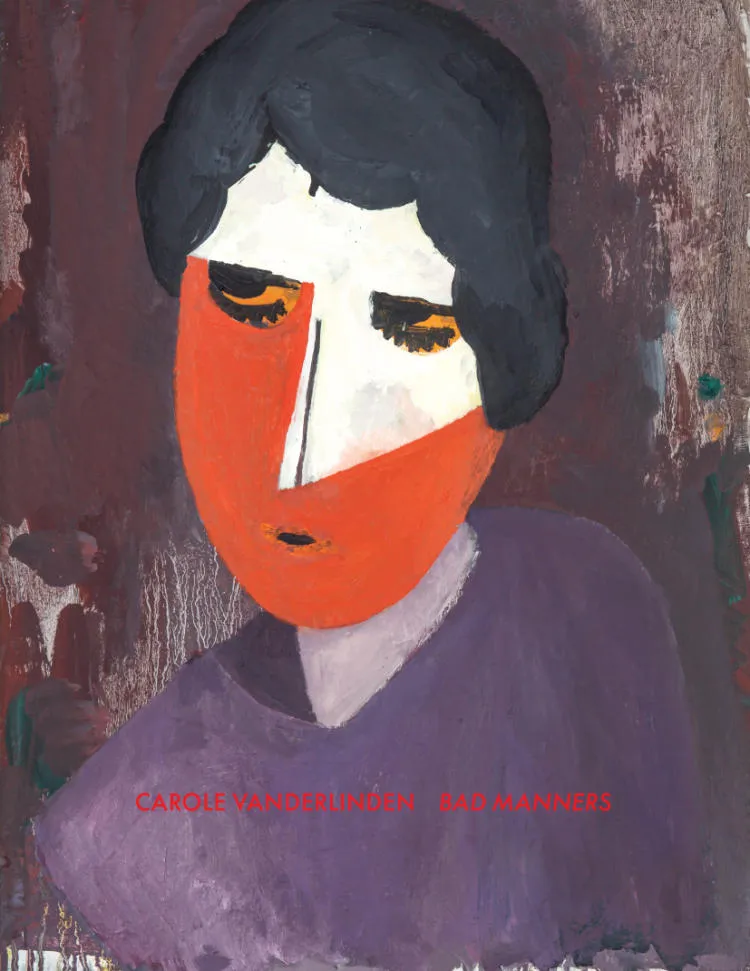
Bad Manners
Carole Vanderlinden's first monograp covers over a decade of the artist's practice. It gathers close to 200 paintings and works on paper, alongside texts by Belgian novelist Jean-Philippe Toussaint, essays by curators Ann Hoste, Ory Dessau, and Hans den Hartog Jager, as well as a conversation between musician and composer Joëlle Léandre and Vanderlinden.
Born 1973 in Brussels, Carole Vanderlinden has been developing a highly improvisational, rich artistic practice since the mid-1990s. While her work is primarily focused on painting (often using thick, hand-mixed oil paints), it regularly encompasses drawing, watercolor, collage, and small objects. Vanderlinden's practice is famously unhampered by the constraints of a single style. Her work nimbly blurs the line between figuration and abstraction, reacting intuitively to the rhythm, color, and possibilities of her medium rather than adhering to a single signature aesthetic.
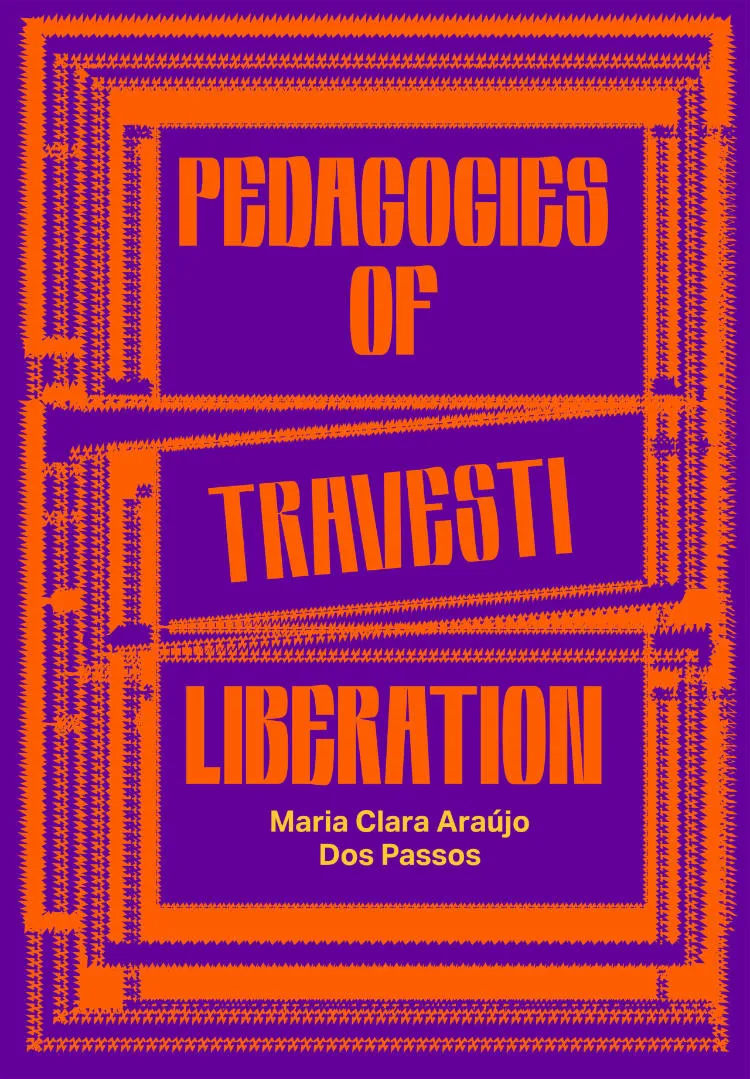
Pedagogies of Travesti Liberation
Maria Clara Araújo dos Passos, Natália Affonso
Maria Clara Araújo dos Passos examines the interplay of education, identity, and liberation in Brazil's travesti community.
In Pedagogies of Travesti Liberation, Maria Clara Araújo dos Passos critiques traditional pedagogical frameworks that marginalize gender nonconforming narratives and highlights the effects of systemic discrimination on travestis' psychosocial well-being. The book advocates for inclusive educational practices and emphasizes the need for affirmative curricula.
Newly translated from Portuguese, this work contributes towards connecting political struggles globally and navigating the complexities of translation—particularly of the term "travesti"—across various geographical and political contexts, featuring a conversation between Araújo dos Passos and translator Natália Affonso.
Maria Clara Araújo dos Passos (born 1996 in Recife) is a Brazilian Afro-transfeminist educator and sociologist, and an activist for LGBT rights.

London-rose — Beauty Will Save the World
The story of failure asks one question only: What do people who lose do next? “Let the best one win.” War is one way. The other way is religion. Let me at the stakes. It’s so much a matter of patience. No fury, beyond all reason, no sequence broken, but diverted. Nothing seems to cooperate when you lose control. Blue becomes violet. Bend your head to the blank. The solution is so simple: don’t identify yourself with your description of yourself.
"It feels we aren’t reading prose but language that oscillates between liturgy and prayer." — Eugene Lim

Arthur’s Whims
Arthur’s Whims is the tale of “a modern saint,” a love story born of a childhood dream of being “alone on a boat with a boy, a friend.” Arthur and his beloved Bichon—a young man who, after drinking Arthur’s tears, becomes pregnant with his child—drift through a stream of identities and circumstances: birdcatchers for a French taxidermist; sailors shipwrecked in an ice fortress; explorers of the Isles of Traitors, Babies, and Sadness; famous magicians in Oklahoma; religious and medical marvels. It is an anarchic, outrageous novel, in the tradition of Edgar Allan Poe and Comte de Lautréamont, now available in English for the first time in translation by Dana Lupo. This edition includes Hervé Guibert’s essay “The Bear,” in which he compares his books to rooms in a house, writing: “Arthur’s Whims would be the library of the house, and the bedroom of a child who will never be.” It is “a true adventure novel in the tradition of the genre, or what I believed to be its tradition, with great journeys, disasters, shipwrecks, cataclysms.”
“This short novel, offered here along with an essay by Guibert, reads like a madcap picaresque—one in which bodies can transform, the pace is constantly accelerating, and geography proves to be malleable. A gloriously surreal account of an unexpected voyage.” — Tobias Carroll, Words Without Borders
Hervé Guibert was a French photographer, critic, and author. Born in 1955, he published works of autofiction, novels, short stories, and essays, including many on photography. His writing was often deeply personal, ironic, and centered on illness and the body. Guibert died from complications of AIDS in 1991, at the age of thirty-six.
Dana Lupo is a writer and translator based in New York. Their work has appeared in Entropy, Bone & Ink Press, Arcturus (Chicago Review of Books), Apricity Press, and elsewhere. Arthur’s Whims is their first published translation.

Beauty Kit
BEAUTY KIT – AN ECO-EROGENOUS ART PROJECT by Isabel Burr Raty with contributions by Kristin Rogghe, Elke Van Campenhout, Gosie Vervloessem, Pablo Diartinez and Tim Vets, is an experimental catalog summarizing Isabel Burr Raty’s research on conceptualizing and manufacturing eco-erogenous para-pharmaceutical products. It tells the story of the BKFF, a mobile farm where she and other females harvest their orgasmic juices to produce beauty bio-products, used for treatments in the BK Spa, critically discussed in the BK Focus Group and moving forward into becoming a village, where every-body harvests each other. The catalog comes with contributing text, “Harvesting bodies – The Farm as Paradox” by Elle/Elke Van Campenhout, and other reflections on the project.
Isabel Burr Raty is a Belgian-Chilean artist, filmmaker, and Media Art History teacher in ERG (École de Recherche Graphique), living between Brussels and Amsterdam. She is currently developing her second feature film, about the colonial impact on Easter Island, and creating live art and new media installations that queer production understandings, such as the Beauty Kit Project. Her works have been shown internationally.

UNIVERSAL PRODUCT CODE
"Like the Elizabeth Bishop painting “Interior with Extension Cord,” Kelly Clare’s helical, light-filled Universal Product Code delicately traces a bewildering infrastructure. This incantatory song, “busy in green,” points its reader to the disturbing beauty in stripey checksum barcodes, to arrays of imported figs at the grocer, to words like cloud or lime that now mean too much. Humorous, musical, perspicacious, this chapbook rocks."
- Katherine Gibbel, April 2026
Includes 3 poems by Dre Roelandt.
Published as part of Paraphernalia and Addenda 2.2 of Tabloid Publications.

Sacred Spells: Collected Works
The collected life-work of an interdisciplinary writer, performer, and central figure in the Black Gay cultural arts and AIDS movements.
In this timely collection of poetry, plays, fiction, and performance texts, Assotto Saint draws upon music and incantation, his Haitian heritage, and a politics of liberation to weaves together a tapestry of literature that celebrates life in the face of death. Influential to contemporary writers such as Essex Hemphill, Marlon Riggs, and Melvin Dixon, Sacred Spells is Saint’s crucial legacy–five hundred incandescent pages of painful, lyric writing that exemplifies the visceral, spiritual dimensions of an artistic practice that’s integral to Black and LGBTQ activist movements worldwide, both historic and present.

Care Work
Leah Lakshmi Piepzna-Samarasinha
Lambda Literary Award winning poet and essayist and long-time disability justice advocate Leah Piepzna-Samarasinha writes passionately and personally about disability justice in her latest book of essays. Discussing subjects such as the creation of care webs, collective access, and radically accessible spaces, she also imparts her own survivor skills and wisdom based on her years of activist work, empowering the disabled - in particular, those in queer and/or BIPOC communities - and granting them the necessary tools by which they can imagine a future where no one is left behind.

Exocapitalism – Economies with absolutely no limits
Roberto Alonso Trillo, Marek Poliks
A rigorous and mind-blowing account of the dynamics of capitalism today through an in-depth exposition of software, speculative finance, and the highest scales of arbitrage.
At the centre of Marek Poliks and Roberto Alonso Trillo's argument is the idea that capital does not belong to humans, it belongs to—and is governed by—itself. Traditional economic theory struggles to keep up with the rapid rate of acceleration, and this book steps in to address this:
"The critical orthodoxy is slowing; it's tired, it's not especially good at the internet, it's probably never manned a Starbucks counter or an anonymous cubicle. Its younger adepts—though digitally native—are chronically underemployed, unavailable, drowning in the student debt (or student opportunity cost) required for entry into the critical apparatus. Few have any patience for the numbing slop-speak of the LinkedIn economy, the libertarian enclave of forex and HFT and memecoins, the quarter-zip depravity of employment at the charnel houses of McKinsey or Deloitte or Accenture, the blazingly random mood-swings of venture capital that lubricate all of the above. This impatience is—in the parlance of the above—a blocker: it means that the critical apparatus underestimates the power of the software economy, struggles to articulate the morphological density of digitally-realized capitalism, comprehensively ignores the functional death of labor, and doesn't understand scale."
Introduction by Charles Mudede.
Afterword by Alex Quicho.
"A masterpiece... Nick Land for adults."
— 0nty

Pasts, Futures, and Aftermaths: Revisiting the Black Dada Reader
The sequel to Pendleton's acclaimed Black Dada Reader, compiling an anti-canon of radical experimentation and thought.
In 2011, artist Adam Pendleton (born 1984) assembled Black Dada Reader, a compendium of texts, documents and positions that elucidated a practice and ethos of Black Dada. Resembling a school course reader, the book was a spiral-bound series of photocopies and collages, originally intended only for personal reference, and eventually distributed informally to friends and colleagues. The contents - an unlikely mix of Hugo Ball, W.E.B. Du Bois, Adrian Piper, Gertrude Stein, Sun Ra, Stokely Carmichael, Gilles Deleuze -formed a kind of experimental canon, realized through what Pendleton calls radical juxtaposition. In 2017, Koenig Books published the Reader in a hardcover edition, with newly commissioned essays and additional writings by the artist. A decade later, Pendleton has composed another reader, building upon the constellation of writers, artists, filmmakers, philosophers and critics that emerged in the first volume.
Source texts by Sara Ahmed, Mikhail Bakhtin, Toni Cade Bambara, Amiri Baraka, Augusto de Campos, Hardoldo de Campos, and Décio Pignatari, Angela Davis, Gilles Deleuze, Julius Eastman, Adrienne Edwards, Clarice Lispector, Achille Mbembe, Philippe-Alain Michaud, Charles Mingus, Piet Mondrian, Leslie Scalapino, Leonard Schwartz and Michael Hardt, Juliana Spahr, Cecil Taylor and Malcolm X.