Books
Books
in random order

Zipper Mouth
Dreamy, bratty and brash, Zipper Mouth is a potent gut-punch of a novel by an icon of 90's queer lit.
In this extraordinary novel, Laurie Weeks captures the exuberance and mortification of a lesbian junkie as she navigates the chaos and horror of everyday life. Through longing monologues to Vivian Leigh, ranting letters to Sylvia Plath and to-do lists that never get done, Zipper Mouth gives us an unforgettable protagonist caught in a spiral of addiction, unrequited love, and mental health crises, and the effortlessly hilarious and strange inner workings of her mind.
A messy and raw depiction of striving to live in a world that doesn’t cater to your brain chemistry, Zipper Mouth is an outstanding work of queer fiction. Come for the exalted nightclub epiphanies, stay for the devastating morning-after hangovers.

Mouvement #128
How the right wing is ruining culture, part II; in Sicily, humanitarian flotillas bound for Gaza are on the US Army's radar; Alice Diop and the Black Venus; Iraqi singer Sajda Obeid unites the country; theater according to Sylvain Creuzevault; the British left reveals fascism...
Founded in 1995, Mouvement is a French “indisciplinary cultural magazine”, published quaterly.

Dominique: The Case of an Adolescent
"Dolto’s Dominique is the only case I’ve found that rivals Freud, and brings us up to date, replete with questions of incestuous trauma, repressed sexualities, autism and cognitive disability, and a profound sense for the contradictions of polite society and histories of colonial and racist violence. I love this child and encountering Dolto’s otherworldly voice as an analyst." — Jamieson Webster
While the child psychoanalyst Françoise Dolto stands alongside Jacques Lacan as a leading light of the Other French School, she has been little translated and remains curiously unknown in the English-speaking world. First published in 1971, Dominique: The Case of an Adolescent is frank and close to the clinical experience. A masterpiece of the genre, it is at once a granular psychological portrait of a troubled adolescent and his familial inheritance, and a historical case study, set in the France of the 1960s, of the of the relationship between subjectivity, nationality, and time and space.
With a foreword by Michael Ryzner-Basiewicz
Translated by Ivan Kats, revised by Lionel and Sharmini Bailly
Cover image by Mike Kelley, Untitled 1975
Françoise Dolto (born 6 November 1908, Paris) was a psychoanalyst and paediatrician. Alongside private practice at her home, where she saw adults and children, Dolto practised in four institutions where she saw only children patients: the Polyclinique Ney, the Centre Claude Bernard, the Hôpital Trousseau and the Centre Etienne Marcel. From 1967 to 1969, Dolto answered adult and child listeners of the French radio station Europe No. 1, live and anonymously under the name ‘Docteur X’. The programme enjoyed excellent ratings, but Dolto found dialogue to be hindered by the demands of live broadcasting and advertising. In 1976, she agreed to return to radio with Lorsque l’enfant paraît on France Inter, on the condition that she replied to listeners’ letters, which enabled her to go into depth. The programme was a huge success, and would make her a household name. In 1978 Dolto retired as an adult psychoanalyst: her fame had become such that it distorted the therapeutic relationship with patients. She now devoted herself to prevention, training of young analysts, group and individual supervision, publications, conferences and radio and television broadcasts. She also continued her work with children in the care of the Aide Sociale à l’Enfance, some of whom she received at her home until the end of her life. In 1979, along with a small team, she founded the Maison Verte, a place for early-years socialisation welcoming children from ages zero to four along with their caregivers, for sessions of play and talk. This model spread throughout France and Europe, to Russia, Armenia and Latin America. Dolto is the author of more than a dozen books, and several essays, interviews and seminars. In English, her books have been translated as Psychoanalysis and Pediatrics (Routeledge, 2013) and The Unconscious Body Image (Routledge, 2022). Françoise Dolto died on 25 August 1988 in Paris.

Wretched Strangers
In response to surges of violent British nationalism and political paranoia around borders, and to related social and ethical crises, JT Welsch and Ágnes Lehóczky have assembled an anthology to mark the vital contribution of non-UK-born writers to this country’s poetry culture. Wretched Strangers brings together innovative writing from around the globe, celebrating the irreducible diversity such work brings to ‘British’ poetry. While documenting the challenges faced by writers from elsewhere, these pieces offer hopeful re-conceptions of ‘shared foreignness’ as Lila Matsumoto describes it, and the ‘peculiar state of exiled human,’ in Fawzi Karim’s words.
The book is published by Boiler House Press to commemorate the anniversary of the June 2016 EU Referendum and in solidarity through struggles ongoing and to come. Proceeds will be donated to charities fighting for the rights of refugees.
Alireza Abiz • Astrid Alben • Tim Atkins • Andre Bagoo • Veronica Barnsley • Khairani Barokka • Leire Barrera-Medrano • Katherine E. Bash • Áine Belton • Caroline Bergvall • Sujata Bhatt • Rachel Blau DuPlessis • Fióna Bolger • Ben Borek • Andrea Brady • Serena Braida • Wilson Bueno • James Byrne • Kimberly Campanello • J.R. Carpenter • Mary Jean Chan • che • Matthew Cheeseman • Iris Colomb • Giovanna Coppola • Anne Laure Coxam • Sara Crangle • Emily Critchley • Ailbhe Darcy • Nia Davies • Tim Dooley • Benjamin Dorey • Angelina D’Roza • Katherine Ebury • Dan Eltringham • Ruth Fainlight • Kit Fan • León Felipe • Alicia Fernández • Veronica Fibisan • Steven J Fowler • Livia Franchini • Ulli Freer • Anastasia Freygang • Kit Fryatt • Monika Genova • Geoff Gilbert • Peter Gizzi • Chris Gutkind • Cory Hanafin • Edmund Hardy • David Herd • Jeff Hilson • Áilbhe Hines • Alex Houen • Anthony Howell • Nasser Hussain • Zainab Ismail • Maria Jastrzębska • Lisa Jeschke • Evan Jones • Loma Sylvana Jones • Maria Kardel • Fawzi Karim • Kapka Kassabova • Özgecan Kesici • Mimi Khalvati • Robert Kiely • Michael Kindellan • Igor Klikovac • Ágnes Lehóczky • Éireann Lorsung • Patrick Loughnane • John McAuliffe • Aodán McCardle • Niall McDevitt • Luke McMullan • Christodoulos Makris • Ethel Maqeda • Lila Matsumoto • Luna Montenegro • Stephen Mooney • Ghazal Mosadeq • Erín Moure • Vivek Narayanan • Cristina Navazo-Eguía Newton • Alice Notley • Terry O’Connor • Wanda O’Connor • Gizem Okulu • Claire Orchard • Daniele Pantano • Astra Papachristodoulou • Fani Papageorgiou • Richard Parker • Sandeep Parmar • Albert Pellicer • Pascale Petit • Adam Piette • Jèssica Pujol Duran • Alonso Quesada • Ariadne Radi Cor • Nat Raha • Nisha Ramayya • Peter Robinson • William Rowe • Lisa Samuels • Jaya Savige • Ana Seferovic • Sophie Seita • Seni Seneviratne • Timea Sipos • Zoë Skoulding • Irene Solà • Samuel Solomon • Agnieszka Studzinska • James Sutherland-Smith • George Szirtes • Rebecca Tamás • Harriet Tarlo • Shirin Teifouri • Virna Teixeira • David Toms • Sara Torres • Kinga Toth • Claire Trévien • David Troupes • Arto Vaun • Juha Virtanen • J. T. Welsch • David Wheatley • Elżbieta Wójcik-Leese • Jennifer Wong • Isaac Xubín • Jane Yeh

Estonian Academy of Arts / EKA GD MA
to flaunt, really
“… Ever since its inception as a profession, graphic design has exhibited its necessity to make information public. Its urge to expand and to reproduce reflects its capitalist inheritance. This desire however isn’t always shared by all stories molded and articulated by the discipline.
Publishing is preceded by a series of labours, but the act itself consists just of a very instant. It is one loud shriek from the top of a hill. A toppling-over. From then on a story will tumble downhill—distribute and disseminate. However that happens, and who it reaches is an unpredictable process. Thereafter publishing enables, and sets in motion, all its future readings and retellings.
Wondering the many contradictory sensibilities contained in this process, we attempt to grasp their whys, their hows and their ifs. The following essays— written by Sunny Lei, Haron Barashed, Agathe Mathel, Alina Scharnhorst, Villem Sarapuu, Gal Šnajder, Seppe-Hazel Laeremans, Fernanda Saval and Eva Claycomb—stretch and curl in between these various registers of opening up and closing in.
Unraveling the movements, strategies, forms and intentions of publishing, this book attempts to unfold their utterances, platforms, languidities, reinterpretations, identities, tactilities, ambiguities, characters and audiences.”
—from the introduction by Seppe-Hazel Laeremans and Agathe Mathel.

Issue #9: Companions
Irene de Craen, Katia Krupennikova
The editorial/imaginative centre of the ninth issue of Errant Journal is located in the regions that have experienced Russian imperial aggression from where it makes connections across times, geographies, and ontologies to explore the radical potential of companionship. Companionship is understood not as agreement, but as a shared responsibility across unequal histories. It means not being full without the other. While forms of imperial and colonial violence might differ in places and through times, the issue recognizes how colonial mechanisms are sustained, how they present themselves as if they were past while shapeshifting and continuing in new forms and places in the present. By bringing these contexts in relation, this issue aims to show how certain borders, biases, clichés, and power structures travel, mutate, and shape both human and non-human lives and landscapes. Ultimately, companionship is about prioritizing life and about insisting that no oppression is singular.
This issue is a concept by and co-edited with Katia Krupennikova.
Contributors: Adriana Arroyo, Keto Gorgadze, Andreas Kalkun, Chung Kai Lee, Samira Makki, Ana Mikadze, Petrică Mogoș, Fabienne Rachmadiev, Vaim Sarv, Victoria Soyan Peemot, Czyka Tumaliuan, Iryna Zamuruieva, Irene de Craen, Katia Krupennikova

Broken Villas
Written in response to three “physical” photographs, ‘Broken Villas’ contains and considers how a vessel might clasp tightly to known volumetric identities, but also loom with a set of accentuated clues towards otherness: the excavated seams in the earth and what we fill those holes with, imaginary or otherwise; the glacial erraticism of the boulder; the queer crimping of a hotel pillowcase; the modes via which objects are housed as display, but also packaged away, with sorrow, with fear, with erotism etc.

Lagoon
Part prose poem, part reflection on the relations between writing and place, Lagoon tells the story of the slow undoing of an idyll. In it the narrator walks for hours during long summer nights, gazing through the windows that line the streets. In between, she reflects on how she might write about the shifting space of the lagoon, where she spent summer holidays with her family years ago. In adolescence, the narrator watches quietly as her mother, father and sister go about building their holiday home. But she can sense something is awry, she just does not fully understand what.
Lagoon is the first novella by McCulloch.
Lagoon by Samantha McCulloch is the first title in Kunstverein Amsterdam's new imprint called First Drafts, which, inspired by artist and publisher Anne Turyn, celebrates experimental and commercially unviable work by publishing completed manuscripts that haven’t yet found a home in their first draft form. Importantly, each title is also the first attempt by the author to write in that particular form, or, to write at all.

Nawar's Sketchbook
I am not deep, although my eyes are, like a black sea that has been forgotten, as many have told me.
Noura Alsouma’s zine “Nawar’s Sketchbook” is a liquid lament by the Berlin-based Syrian visual artist and printmaker, riveted to eyes that see and therefore shed tears, channeling the heartfelt exposure of the sketchbooks Noura fills to the bleed.
With a moving text by the artist in the original Arabic, reproduced in her handwriting, as well as in English translation by Suja Sawafta.

Homie
Homie is Danez Smith’s magnificent anthem about the saving grace of friendship. Rooted in the loss of one of Smith’s close friends, this book comes out of the search for joy and intimacy within a nation where both can seem scarce and getting scarcer. In poems of rare power and generosity, Smith acknowledges that in a country overrun by violence, xenophobia, and disparity, and in a body defined by race, queerness, and diagnosis, it can be hard to survive, even harder to remember reasons for living. But then the phone lights up, or a shout comes up to the window, and family—blood and chosen—arrives with just the right food and some redemption.
Part friendship diary, part bright elegy, part war cry, Homie is the exuberant new book written for Danez and for Danez’s friends and for you and for yours.
& colin kaepernick is my president, who kneels on the air
bent toward a branch, throwing apples down to the children
& vets & rihanna is my president, walking out of global summitswith wine glass in hand, our taxes returned in goldto dust our faces into coins
& my mama is my president, her grace stuntson amazing, brown hands breaking brown bread overmouths of the hungry until there are none unfed & my grandma is my president
& her cabinet is her cabinetcause she knows to trust what the pan knowshow the skillet wins the war
—from “my president”

Shifting the Angle of Shine
Quinn Chen, Kira Simon-Kennedy and 1 more
This publication spans a decade of resilient artists and collectives in, around, and about China and the greater Sinosphere. Composed of essays, images, conversations, and projects, Shifting the Angle of Shine documents innovative tactics of artists and collectives as they weave relationships of mutuality and solidarity to thrive through the cracks.
Shifting the Angle of Shine explores how artists experiment with practices ranging from idiosyncratic business models to counterfeit and mimicry as tools for cultural change, from DIY collectives searching for stability to artists developing new ways to dance around the restrictive pressures of a capitalistic mainstream, and much more. In bringing these artists together to speak and lay compiled in this book, we ask ourselves: what kind of spaces are necessary to incubate productive conversations in an art world prone to creating destabilizing conditions?
Spanning the art nonprofit's decade of existence, a lot of the work has been documented in fragmented ways over the internet, on social media accounts, and in the memories of those there in person. Through materializing this project, this publication hopes to not only shine light on the work of some artists and collectives we admire, but also to archive their stories, processes, and methodologies that should be passed on.

Sonnet(s)
A lost gem of permutational conceptualism from a key figure in artist's book culture, available again
Known internationally as one of Mexico's most important conceptual artists, Ulises Carrión (1941-89) played a decisive role in defining and conceptualizing the genre of the artists' book through his manifesto, The New Art of Making Books (1975), which he wrote soon after the 1972 publication of SONNET(S) and his move from Mexico City to Amsterdam, where he opened the legendary bookshop gallery, Other Books and So, the first space dedicated exclusively to artists' publications and an important precursor to such artists' book hubs as Printed Matter.
One of Carrión's earliest bookworks, SONNET(S) represents a landmark shift in the artist's output from poetry to artists' books. Here, Carrión takes a single poem by Dante Gabriel Rossetti through 50 typographic and procedural permutations. This republication is supplemented by new essays on Carrión's bookworks by contemporary artists, writers, and scholars from Mexico, Europe and the US.
Published March 2021

Exo Revue: Si j’aurais su
Sam Bouffandeau, Chloé Delchini and 2 more
Revue du Master de Textes et de Création Littéraire de la Cambre*
Avec les textes de: Sam Bouffandeau, Chloé Clemens, Chloé Delchini, Perrine Estienne, Robin Faymonville, Gabriel René Franjou, Justine Gensse, Adèle Goardet, Bastien Hauser, Giulia Lazzara, Cyprien Muth, Sephora Shebabo.
* Le Master en Textes et Création Littéraire de l’École Nationale Supérieure des Arts Visuels de La Cambre propose un programme de formation aux étudiants qui visent à faire des métiers du texte et de la création littéraire leur avenir professionnel. Il s’adresse principalement aux jeunes écrivains et, plus généralement, à l’étudiant qui souhaite professionnaliser sa démarche artistique en lien avec la pratique de l’écrit en la confrontant à d’autres écrivains, à des éditeurs et à des professionnels reconnus de la littérature, l’informer et l’enrichir de nouveaux savoirs et de nouvelles compétences. Considérant le travail du texte et ses différentes formes comme des expressions majeures de l’homme à travers l’histoire, et les littératures des différents continents comme un art à part entière dans le champ des pratiques artistiques contemporaines, ce Master s’inscrit dans une démarche ouverte de production, de réflexion et d’instruction de l’écrit dans un monde en devenir.

Unfit
Ariana Harwicz, Jessie Mendez Sayer
A bracing novel that asks how far we would go for the ones we love—and what we would do to destroy the ones we hate.
Lisa has lost custody of her young twin boys. Caught between the French legal system’s sluggish bureaucracy and her sinister, scheming in-laws, she’s alone and lost, an Argentine migrant in rural France picking grapes for a pittance, only allowed to see her children in supervised visits once a month. Scapegoated and outcast, destitute and desperate, Lisa decides to take radical action: early one morning, she sneaks into her in-laws’ farmhouse, takes back her children, sets the barn ablaze, and makes her escape.
What follows is a white-knuckled road trip that explores human beings pushed to the edge. Clearly, Lisa is not in her right mind, and as Harwicz deftly mingles a chorus of contradictory voices into her very unreliable narration, the reader comes to regard the protagonist with an unsettling mixture of sympathy and suspicion. Written in savage, chiseled prose, Unfit shoots off, a gripping chase that questions all our assumptions—and points out our hypocrisies— about motherhood, custody rights, love, violence, anti-semitism, and migration. The latest novel by the acclaimed author of Die, My Love (soon to be adapted to a film starring Jennifer Lawrence), Unfit is addictively terrifying, savagely sophisticated, and shockingly brilliant.
Translated from Spanish by Jessie Mendez Sayer

The Orphans of Tar – A Speculative Opera
Julien de Smet, Vanessa Müller and 1 more
Contributions by: Julien de Smet, Ronny Heiremans, Heike Langsdorf, Vanessa Müller, Filip Van Dingenen, Stijn Van Dorpe, Clémentine Vaultier, Katleen Vermeir.
The books included in the series Choreography as Conditioning are rooted in a cycle of work sessions entitled CASC at KASK, in which students work together with invited guests. They explore the notions of choreography, understood as ways of organizing subjects in their surroundings, and conditioning in both art-making and society-making. Where, how, and by whom are things organized and what kind of landscapes of experience are made (im)possible by the practices we enact and encounter?
The Orphans of Tar – A Speculative Opera answers the question posed in the second book by transforming life into voices and presenting possible mindsets through co-authoring a factual fiction. As such, it constitutes a mental space in which fictitious characters find an almost disturbing expansion of their thoughts. Accordingly, the book can be considered as an allegory of human thoughts as (possible) actions: what could happen becomes what does happen. For better and worse.
October 2019

Parapraxis 08: Groups
To be in a group is to submit to a form of disorganizing organization that hangs on careful balance: to be devoted to a collective without being engulfed, to be disciplined by it without sleepwalking to the tune of a leader’s will, to integrate without dissolving into it. As infants born into a sexual union from which we are then necessarily excluded, the yields and limits of assembly are evident from the outset. Before we arrived in the bloc, we lived our lives in other groups: the family, the religious order, the cafeteria table clique. You can sit with us. You can’t. Some groups we remember entering. Others we didn’t elect, but deselected.
As a form of critique whose object of analysis is suffering, psychoanalysis understands the pains of the group. Its full task is to make sense of them as a condition of the many as much as of the one. As the psychoanalyst Didier Anzieu glosses the problem of thinking about groups, the “commonplace” assumption is that the group “is a pooling, a sharing” through which “the energies, enthusiasm and capacities of individuals who freely assent to the discipline of the group” coalesce into a unified forcefield. Yet, as Anzieu stresses, this idealized description eats itself. It collapses union with sharing, with collectivity. We know that groups rely on sharing. He asks, “a sharing of what?”
Psychoanalytic cults. Cowboy churches. The Epstein Class. Iranian monarchists. Fascist liberals. Clinics and their radicals. Discipline and holding. Getting together, falling apart.
Essays by Séamus Malekafzali, Tracy McNulty, Richard Seymour, Zahid Chaudhary, Danny Hayward, Eri Linsker, hannah baer, and more.

KAMERA CAHIER N° 10
A special edition issue curated, designed and published by AVARIE, Paris and Labor Neunzehn, Berlin. It accompanies KAMERA SERIES, while it is an independent and valuable object to collect. The central idea that informs and directs the booklets’ montage is the interplay between the concepts of addition and subtraction. This is achieved by unveiling a missing image in the screening or an unreleased second from an artist's film, expanded to 24 pages. Additionally, each booklet contains a piece directly removed from the show.
The editing establishes a dialogue between film frames and performed writings derived from texts, scripts, storyboards, and notes. The KAMERA exhibition is consequently extended into a physical space—the book—allowing for its widespread dissemination, complementing and contrasting with its potential online occurrence.
KAMERA SERIES is a screening program of experimental films, video art works and printed matter taking place in a former GDR building in Berlin. Each event showcases a retrospective of selected films by an artist and a small exhibition of his/her publications or works on paper over a span of 4 days.
KAMERA centers on fostering a critical dialogue between different film formats and artists’ books. Through its regular occurrence, it aspires to create a space for community exchanges about contemporary image-making. KAMERA is a series conceived and curated by Labor Neunzehn and AVARIE.
Fascinated by the intersection of visual art and cinema, Helga Fanderl’s short poetic films evoke intense and sensitive experiences of the real world. Using a small hand-held super 8 camera, she creates filmic responses to her perceptions, weaving together imagery and emotions in dense, rhythmic patterns solely through in-camera editing. She presents silent films in the form of ‘compositions’, crafting unique programs for site-specific personal projections and transforming spaces into temporary cinemas.

Remembering a Dance – Part of Some Sextets 1965/2019
A re-examination of Yvonne Rainer's Parts of Some Sextets, a radical performance and pivotal piece in the American choreographer's career, which led her to theorize her conception of dance in the 1960s, before being revived in 2019.
Parts of Some Sextets, Yvonne Rainer's 1965 performance for ten people and twelve mattresses, represents a turning point in the American choreographer's oeuvre. "My mattress monster," as Rainer calls it, was built in her formative years with the experimental downtown New York group Judson Dance Theater. In this work, she asserted her exploration of "ordinary" actions as well as her disregard for narrative constructions to create an intricate choreography that unfolded with a new scene every thirty seconds.
More than half a century after its premiere, Rainer, in collaboration with choreographer and dancer Emily Coates, directed the 2019 revival of the piece for the Performa 19 Biennial in New York, grappling with the changing contexts of a new presentation of her radical performance. Remembering a Dance: Parts of Some Sextets, 1965/2019 delves into every aspect of this dance, from its original manifestation to its reconstitution.
This book, designed by visual artist Nick Mauss, includes previously unpublished archival images and documents from the 1965 stagings at the Judson Memorial Church in New York and the Wadsworth Atheneum in Hartford, Connecticut. Texts by Emily Coates, RoseLee Goldberg, Jill Johnston, Kathy Noble, Yvonne Rainer, David Thomson, Lynne Tillman, and Soyoung Yoon, as well as a new interview with Rainer, pose questions about the trajectories of artworks, performers, and audiences, all while tracing the life—and afterlife—of a dance.
Edited by Emily Coates.
Texts and contributions by Emily Coates, RoseLee Goldberg, Jill Johnston, Kathy Noble, Yvonne Rainer, David Thomson, Lynne Tillman and Soyoung Yoon; conversation between Yvonne Rainer, Emily Coates and Nick Mauss.
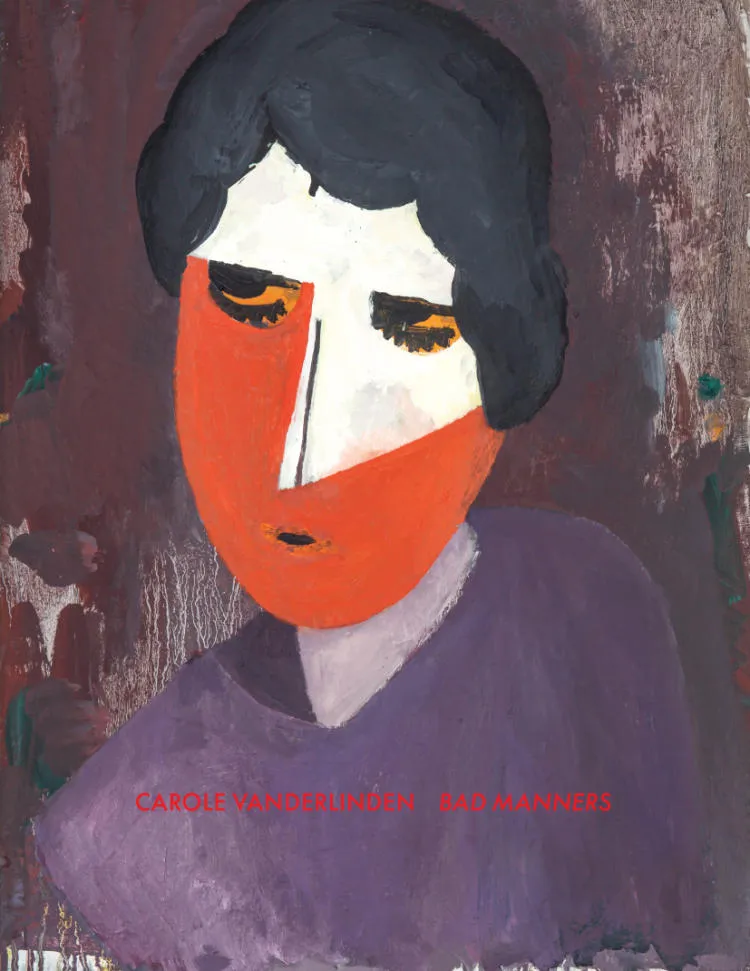
Bad Manners
Carole Vanderlinden's first monograp covers over a decade of the artist's practice. It gathers close to 200 paintings and works on paper, alongside texts by Belgian novelist Jean-Philippe Toussaint, essays by curators Ann Hoste, Ory Dessau, and Hans den Hartog Jager, as well as a conversation between musician and composer Joëlle Léandre and Vanderlinden.
Born 1973 in Brussels, Carole Vanderlinden has been developing a highly improvisational, rich artistic practice since the mid-1990s. While her work is primarily focused on painting (often using thick, hand-mixed oil paints), it regularly encompasses drawing, watercolor, collage, and small objects. Vanderlinden's practice is famously unhampered by the constraints of a single style. Her work nimbly blurs the line between figuration and abstraction, reacting intuitively to the rhythm, color, and possibilities of her medium rather than adhering to a single signature aesthetic.

KAMERA CAHIER N° 9
Peter Downsbrough (New Jersey, US, 1940) lives and works in Brussels (Belgium). Associated with major international art movements such as minimal art, conceptual art, and visual poetry, his work spans across various mediums including sculpture, wall pieces and room pieces, books, work on paper, photography, film, and video. The work, which has affinities with architecture and typography, explores the traditional use of space and language, while criticizing power structures, e.g. urbanism, that influence social interactions and shape the landscape.
A special edition issue curated, designed and published by AVARIE, Paris and Labor Neunzehn, Berlin. It accompanies KAMERA SERIES, while it is an independent and valuable object to collect.
The central idea that informs and directs the booklets’ montage is the interplay between the concepts of addition and subtraction. This is achieved by unveiling a missing image in the screening or an unreleased second from an artist's film, expanded to 24 pages. Additionally, each booklet contains a piece directly removed from the show.
The editing establishes a dialogue between film frames and performed writings derived from texts, scripts, storyboards, and notes. The KAMERA exhibition is consequently extended into a physical space—the book—allowing for its widespread dissemination, complementing and contrasting with its potential online occurrence.
KAMERA SERIES is a screening program of experimental films, video art works and printed matter taking place in a former GDR building in Berlin. Each event showcases a retrospective of selected films by an artist and a small exhibition of his/her publications or works on paper over a span of 4 days.

Afterimages 3: Lis Rhodes Volume 1
This DVD contains:
Light Reading, 1978, 20 min.
Pictures on Pink Paper, 1982, 35 min.
Cold Draft, 1988, 28 min.
Lis Rhodes has been at the forefront of British experimental filmmaking since the early 1970s. She studied at the North East London Polytechnic and the Royal College of Art. A strong formal aesthetic has been developed in her films, reflecting her involvement with the debates and practice which emerged from the London Filmmakers' Co-operative, where she was Cinema Curator 1975-6. Early 'expanded' works such as Light Music (1975) fused performance and multi-screen projection with an exploration of the visual qualities of sound. Her analysis of broader political and social questions can be traced to her later films, which combine formal rigour with a passionate critique of issues from nuclear power to domestic violence. As an active campaigner for women's rights, Rhodes was a founder member of Circles, the first women's artist film and video (1979) and was an Arts Advisor to the Greater London Council between 1982 and 1985. She lives and works in London and teaches at Slade School of Fine Art, University College, London.

MAKAN #2 / Manufacturing Narratives
In its second issue, Manufacturing Narratives, Makan focuses on how interrogating narrativity can provoke fundamental questions about how societies define or choose to accept societal or historical truths in today’s world. Spanning across [and beyond] the Mashreq and Maghreb, the various contributions reflect a shared space of inquiry that bridges geographies and fosters emergent dialogues across shifting territorialities. This issue invited contributors to right (as much as write) narratives: to question authorship and its social collectivities, to retell alternative public histories, to explore gender roles, and to unsettle the exoticism, folklorization, and political textures of fiction as a practice of indiscipline. Together, these contributions re-articulate the genealogies of our present through the pluralities of the past, offering tools to imagine and manufacture alternative futures, and realities otherwise.
With contributions by Ala Younis, Bari Abbassi, George Bajalia, Karim Kattan, Karima Kadaoui, Tamkeen, Kenza Sefrioui, Lahbib El Moumi, Laila Hida, Maureen Mougin, Mohamed Amer Meziane, Monica Basbous, Nadia Tazi, Sénamé Koffi Agbodjinou, Salma Barmani, Sonia Terrab, Soufiane Hennani, Yto Barrada.

Theory for Moving Houses
You are asking me where I live and it’s making me think all these things about space, where I start and end in space and where space starts and ends in me and when, in space, I am a body and when I’m a book, in space.
So begins Renee Gladman's Theory for Moving Houses, and with these lines we are invited into a liminal space of imagination and investigation, as Gladman guides us through the architectures of her poetics. Foundational here is a sense of fluidity, a slippage of time, a devotion to “non-linear and hyper gestural movement,” a communal spirit. Gladman’s inquiry into her intersecting practices of writing and drawing reveals a deep commitment to uncertainty and “fictional knowing.” Yet again, Gladman upends traditional expectations of prose, as she leads us through landscape of her Ravicka series novels, ultimately surprising us with a novel within nonfiction. The latest volume in Wave’s Bagley Wright Lecture Series, Theory for Moving Houses is not only visionary in its contemplations but also is a virtuosic example of the ways in which language can shape utopian sites of possibility.

Image RIP: After Printing, Work & Planet Earth
Image RIP, the first publication from Source Type, is centered around New York graphic designer Geoff Han’s investigation into the Shenzen-based printer Artron and explores subjects ranging from design, production, work, and the environment in the post-industrial economy. The book gathers essays by Danielle Aubert, David Bennewith, Geoff Han, Ming Lin, Shanzhai Lyric, David Reinfurt, Mindy Seu, and Dena Yago, and features images by Ann Woo. Image RIP reflects a consistent theme in Han’s practice of the manipulation of image reproduction, printing, production, code, and other techniques to affect the process of viewing and reading.