Books
Books
in random order

ONE THOUSAND GHOSTS IN THIS FEAST
Sahar Khraibani’s ONE THOUSAND GHOSTS IN THIS FEAST contends with desire, grief, and language as sites of injury and release. Written over a period of three days—amid ongoing genocide, land seizure, and displacement—the long poem counters logics of possession with those of relation. Khraibani’s all-caps, first-person address impels the poem forward, centering intertextuality as a force through which spectral presences shine.
Sahar Khraibani is a writer and artist whose work has been presented with Montez Press, The Brooklyn Rail, Magnum Foundation, the Poetry Foundation, the Poetry Project, and Hyperallergic among others. Sahar is a recipient of the Creative Capital / Arts Writers Grant, a fellowship at The Poetry Project, a MacDowell Fellowship, a 2024 residency at Mass MoCA, and is an alumni of the Whitney Independent Study Program. Sahar teaches at Pratt Institute and is the author of Anatomy of A Refusal (1080PRESS, 2025).
ONE THOUSAND GHOSTS IN THIS FEAST lays bare the “SENSELESS DECAY” potentiated by empire’s relentless categorization, containment, and calculated death delivery. Khraibani’s debut chapbook collapses the imposed and perceived distance written by borders, disrupts anticipated colonial language logics, and bursts “INTO THE MADNESS OF THE ORGY” with queer interference reverberating in all directions. From the soil, from the graveyard, from the dancefloor, from their favorite spot on the eroding waterfront, Sahar broadcasts, IN ALL CAPS, “THE UNNAMEABLE TRUTH.”
— Andrea Abi-Karam

A4 review N°3
Marjolein Guldentops, Ahmed Saleh and 2 more
Founded in 2023, A4 is a poetry review which showcases and explores contemporary writings practices. Run by Littérature Supersport collective, the object is seen as the extension of their events. The review takes the form of 4 postcards which, when placed side-by-side, form an A4-sheet. A light (even precarious) format for literature that slips into the back pocket of pants and hangs on fridge doors. Each issue features unpublished texts by 4 authors. Wrapped in colors, A4 is distributed by post and available in good bookshops, in Brussels, Liège, Paris and Marseille.
This third issue presents texts by : Lila Maria de Coninck, Gabriel Gauthier, Marjolein Guldentops & Ahmed Saleh.
Ahmed Saleh (born 1998) is a Palestinian writer and poet from Gaza. He studied business administration and political science and is currently living in Brussels. Ahmed writes articles in Arabic and English, several of which have been published on various platforms.
Marjolein Guldentops (Belgium, 1994) is a visual artist, author, and performer. Her artistic practice spans various mediums, including text, video and performance. Rooted in the concept of worlding, her work explores the urban rhythms, flows, and semantics that shape perceptions of space and language in both physical and metaphysical senses.
Gabriel Gauthier is a graduate of the Beaux-arts in Paris. He writes books, performs and makes music. He has published Simurgh & Simorgh and Contra at Théâtre Typographique (2016, 2024) and Speed at Vies Parallèles (2020). He has designed pieces at the border of dance and visual arts (Cover, Rien que pour vos yeux). Space, his first novel, was published by Corti.
Lila Maria de Coninck (2004) is a Belgian creator living in The Hague. She makes music, theatre and writes poetry. The guiding principle in her works is the use of multilingualism and miscommunication to promote creativity in her mother tongue, Dutch.

Dregs, Beacons
Poems on light and remnants. Light as mordant, as acid that etches through surface, as something that wraps itself around and between things, revealing form. The writing touches on dregs, remnants, residue and how we make sense of them, by making constellations and navigating through those diagrams.
Anna-Rose Stefatou (b.1996, Athens) is a Greek-British artist based between Athens and London, working between moving image, installation, photography, and writing. Stefatou’s interdisciplinary works attend to stories attached to place and beginning to exist through writing, whether they become a structure to hold it, or whether language simply runs through them. Language is used both as an outset and as a distillation mechanism for ideas, with materials and imagery in visual works responding directly to the text. Gathering and repositioning knowledge guides her creative process: research includes archival footage, taking interviews, collecting objects, and location visits. This process is made visible through her material approach to the photographic image, transformed through different materials, forms and uses, as it unfolds and re-invents itself within new contexts. Stefatou graduated from the Slade School of Fine Art in 2019. Recently, she undertook a residency at Hospitalfield House, Scotland in 2023. Upcoming projects include an exhibition at Pharmakeion, Athens in 2025 as well as a publication Dregs, Beacons that will be realised in 2025.

Writing in Space, 1973–2019
Writing in Space, 1973-2019 gathers the writings of conceptual artist Lorraine O'Grady, who for over forty years has investigated the complicated relationship between text and image.
A firsthand account of O'Grady's wide-ranging practice, this volume contains statements, scripts, and previously unpublished notes charting the development of her performance work and conceptual photography; her art and music criticism that appeared in the Village Voice and Artforum; critical and theoretical essays on art and culture, including her classic "Olympia's Maid"; and interviews in which O'Grady maps, expands, and complicates the intellectual terrain of her work. She examines issues ranging from black female subjectivity to diaspora and race and representation in contemporary art, exploring both their personal and their institutional implications.
O'Grady's writings—introduced in this collection by critic and curator Aruna D'Souza—offer a unique window into her artistic and intellectual evolution while consistently plumbing the political possibilities of art.
Edited by Aruna D'Souza

The Performative Word
First monograph dedicated to the American artist, poet, and activist John Giorno, this publication introduces some of the many ways Giorno wove poetry into all aspects of daily life—by putting words on the wall, on the performance stage, on LP vinyl records, or on the telephone, in the context of the iconic Dial-A-Poem, one of his most celebrated works. A wide range of archival documents, images, and ephemera also form an intimate portrait of Giorno as an activist, performer, Buddhist practitioner, collaborator, and friend.
Published on the occasion of the eponymous retrospective exhibition at the MAMbo - Museo d'Arte Moderna di Bologna, in 2026.
Emerging from the New York downtown scene of the 1960s, John Giorno (1936–2019) developed a singular artistic voice at the crossroads of poetry, performance, painting, and political activism over the course of more than six decades. By bringing the written word off the page and into performance, technology, and visual art, Giorno consistently challenged disciplinary boundaries and advanced a radical vision of language as central to human expression. Though often positioned at the margins of multiple downtown scenes—the Beats, Andy Warhol's Factory, punk music, queer counterculture, anti-war activism—he was in fact an influential presence within all of them, operating as a conduit between coexisting cultural communities. His collaborators included Robert Rauschenberg, William S. Burroughs, Laurie Anderson, Anne Waldman, Allen Ginsberg, and Ugo Rondinone, among many others.

The Undying (paperback)
Blending memoir with critique, an award-winning poet and essayist's devastating exploration of sickness and health, cancer and the cancer industry, in the modern world
A week after her 41st birthday, Anne Boyer was diagnosed with highly aggressive triple-negative breast cancer. For a single mother living payslip to payslip, the condition was both a crisis and an initiation into new ideas about mortality and the gendered politics of illness.
In The Undying - at once her harrowing memoir of survival, and a 21st-century Illness as Metaphor - Boyer draws on sources from ancient Roman dream diarists to cancer vloggers to explore the experience of illness. She investigates the quackeries, casualties and ecological costs of cancer under capitalism, and dives into the long line of women writing about their own illnesses and deaths, among them Audre Lorde, Kathy Acker and Susan Sontag.
Genre-bending, devastating and profoundly humane, The Undying is an unmissably insightful meditation on cancer, the cancer industry and the sicknesses and glories of contemporary life.
Winner of The Pulitzer Prize for Nonfiction 2020; Windham Campbell Prize for Nonfiction 2020
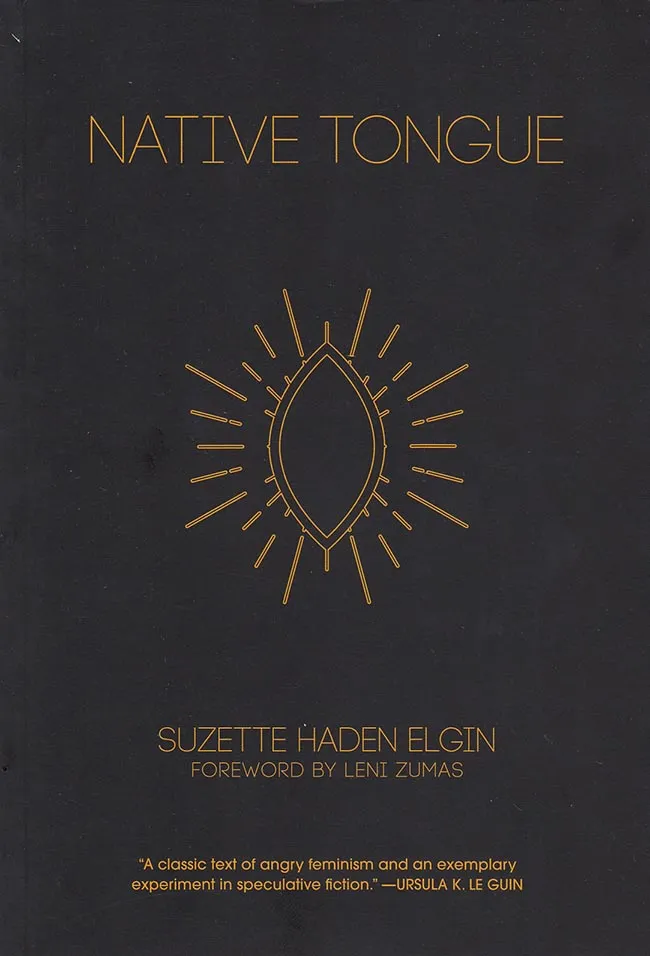
Native Tongue
Originally published in 1984, this classic dystopian trilogy is a testament to the power of language and women's collective action.
In 2205, the Nineteenth Amendment has long been repealed and women are only valued for their utility. The Earth's economy depends on an insular group of linguists who "breed" women to be perfect interstellar translators until they are sent to the Barren House to await death. But instead, these women are slowly creating a language of their own to make resistance possible. Ignorant to this brewing revolution, Nazareth, a brilliant linguist, and Michaela, a servant, both seek emancipation in their own ways. But their personal rebellions risk exposing the secret language, and threaten the possibility of freedom for all.

Ezio Gribaudo - The Weight of the Concrete
Lilou Vidal, Tom Engels and 1 more
The Weight of the Concrete explores the legacy of the Turinese artist and publisher Ezio Gribaudo (1929–2022), examining his multifaceted oeuvre at the confluence of image and language. This publication, named after Il Peso del Concreto (1968)—a seminal work that featured Gribaudo’s early graphic creations alongside an anthology of concrete poetry edited by the poet Adriano Spatola (1941–88)—places Gribaudo’s work in conversation with approximately forty artists and poets from different generations, all of whom similarly engage with explorations of text, form, and visual expression.
Reflecting the editorial premise of Il Peso del Concreto, The Weight of the Concrete revisits the influential anthology, including archive material that documents its production, and reimagines it, pairing Gribaudo’s graphic work with a new selection of historical and contemporary concrete and experimental poetry.
At the heart of the volume is Gribaudo’s emblematic Logogrifi series, developed from the 1960s onward. The Logogrifi reveal his deep engagement with the art of bookmaking and fascination with industrial printing processes, relief matrices, typefaces, and language games.
In this new edition, the editors take the opportunity to revisit Gribaudo’s pioneering work, examining previously overlooked dimensions—gendered, geographical, and technological—and exploring contemporary associations beyond the original context. The book also includes essays that elucidate the poetic and political interplay between image, language, and materiality.
This publication is released following Ezio Gribaudo – The Weight of the Concrete, an exhibition held at the Grazer Kunstverein in Graz, Austria (2023–24), and at the Museion—Museum of Modern and Contemporary Art in Bolzano-Bozen, Italy (2024).
Edited by Tom Engels and Lilou Vidal
Published by Axis Axis and Grazer Kunstverein
Contributions by Anni Albers, Mirella Bentivoglio, Tomaso Binga, Irma Blank, Al Cartio, Paula Claire, CAConrad, Natalie Czech, Betty Danon, Constance DeJong, Mirtha Dermisache, Johanna Drucker, Bryana Fritz, Ilse Garnier, Liliane Giraudon, Susan Howe, Alison Knowles, Katalin Ladik, Liliane Lijn, Hanne Lippard, Sara Magenheimer, Françoise Mairey, Nadia Marcus, Giulia Niccolai, Alice Notley, Ewa Partum, sadé powell, N. H. Pritchard, Cia Rinne, Neide Dias de Sá, Giovanna Sandri, Mary Ellen Solt, Alice Theobald, Colleen Thibaudeau, Patrizia Vicinelli, Pascal Vonlanthen, Hannah Weiner, and Ruth Wolf-Rehfeldt
Essays by Alex Balgiu, Tom Engels, Nadia Marcus, Luca Lo Pinto, Mónica de la Torre, and Lilou Vidal

Weird Fucks
A brilliant novella from a legendary figure in American fiction.
A young woman drifts through dimly lit bars and rented rooms, reporting from the erogenous zones of New York and Europe. Encountering increasingly bizarre sexual situations, she turns her curious, comic, and fierce eye onto the contemporary world of sex and desire.
The men of this world evade and simper, they prey, preen, and fall hopelessly in love. In the narrator’s deadpan portraits, we see young women indulging their freedom through hope and disappointment, and young men wearing various guises of masculinity.
This novella surprises with unlikely fucks, disturbing fucks, outlandish fucks, and some truly weird fucks – all written with the smart, elegant, and tough style which could only be that of Lynne Tillman.

Sonic Meditations
Pauline Oliveros (1932-2016) Pauline Oliveros' life as a composer, performer and humanitarian was about opening her own and others' sensibilities to the universe and facets of sounds. Her career spanned fifty years of boundary dissolving music making. In the '50s she was part of a circle of iconoclastic composers, artists, poets gathered together in San Francisco. In the 1960's she influenced American music profoundly through her inclusive work with improvisation, meditation, electronic music, myth and ritual.
She founded 'Deep Listening(R), ' which came from her childhood fascination with sounds and from her works in concert music with composition, improvisation and electro-acoustics. She described Deep Listening as a way of listening in every possible way to everything possible to hear no matter what you are doing. Such intense listening includes the sounds of daily life, of nature, of one's own thoughts as well as musical sounds. 'Deep Listening is my life practice, ' Oliveros explained, simply. Oliveros founded Deep Listening Institute, formerly Pauline Oliveros Foundation, now the Center For Deep Listening at Rensselaer, NY. Her creative work is currently disseminated through Pauline Oliveros Publications and the Ministry of Maåt, Inc

If They Come in the Morning...
One of America's most historic political trials is undoubtedly that of Angela Davis. Opening with a letter from James Baldwin to Davis, and including contributions from numerous radicals such as Black Panthers George Jackson, Huey P. Newton, Bobby Seale and Erica Huggins, this book is not only an account of Davis's incarceration and the struggles surrounding it, but also perhaps the most comprehensive and thorough analysis of the prison system of the United State.
Since the book was written, the carceral system in the US has seen unprecedented growth, with more of America's black population behind bars than ever before. The scathing analysis of the role of prison and the policing of black populations offered by Davis and her comrades in this astonishing volume remains as pertinent today as the day it was first published.
Featuring contributions from George Jackson, Bettina Aptheker, Bobby Seale, James Baldwin, Ruchell Magee, Julian Bond, Huey P. Newton, Erika Huggins, Fleeta Drumgo, John Clutchette, and others.

Faltas: Letters to Everyone in My Hometown Who Isn't My Rapist
A rich and moving epistolary memoir about transgender childhood, sexual trauma, motherhood, and a young queer life in 1970s Argentina.
In these hilarious and heartbreaking letters, Cecilia Gentili reinvents the trans memoir, putting the confession squarely between the writer and her enemies, paramours and friends.
Writing to childhood figures such as her rapist’s daughter, her father’s mistress, her best friend, and her mother, Gentili probes deeply into the bitter cruelty, buried secrets, and delicious gossip of a small town.
Is she here for revenge, or forgiveness? Both! And more! A story of sex, theft, murder, motherhood, and outrageous fashion choices, Faltas is a beautiful, messy meditation on what it takes to heal, and even grow.

What is highly unlikely but not impossible?
Jeanne Gerrity, Diego Villalobos
What is highly unlikely but not impossible? is informed by themes found in the work of Hiwa K, such as statehood, war, migration, belonging, the effects of neoliberalism and colonialism, home as a concept, language, and the myth of the individual artist. The compendium ranges freely across mediums, drawing together experimental poetry, science fiction, photography, memoir, academic essays, art historical texts, and more. Contributions include a short story by Benjamin Labatut, an excerpt from a lecture by Achille Mbembe, and drawings by Hajra Waheed. Like previous editions in the series, this book brings together a range of voices and mediums to consider some of the most pressing issues of our time.
Contributions by Omar El Akkad, Havin Al-Sîndy, Yto Barrada, Dionne Brand, Deena Chalabi, Nidhal Chamekh, Theresa Hak Kyung Cha, Ursula K. Le Guin, Raven Chacon and Candice Hopkins, Brian Karl, Hiwa K, Benjamin Labatut, Quinn Latimer, Henri Lefebvre, Mazyar Lotfalian, Peter L. Manuel, Achille Mbembe, Fred Moten, Gabriel Orozco, Jacques Rancière, Man Ray, Rijin Sahakian, Solmaz Sharif, Tiffany Sia, Julietta Singh, Rayyane Tabet, Anton Vidokle, Hajra Waheed

Information Age
The narrator of Information Age is a journalist at an online news site reporting on technology, the economy, and politics in the late 2010s. The rate of increasingly short news cycles shapes her working life and her personal life, as she assumes the role of reporter while talking with engineers, analysts, wonks, artists, writers, musicians, friends, family, and lovers. Told in vignettes and dialogue—overheard and divulged—Information Age is spare, funny, and attentive, a playful blurring of public and private life.
Cora Lewis is a writer and reporter whose fiction has appeared at The Yale Review, Joyland Magazine, Epiphany, and elsewhere. She currently works at the Associated Press in New York, and she previously worked at BuzzFeed News. She lives in Brooklyn near Sunset Park.

Énergies
Les sculptures et les films de Judith Hopf sont alimentés par des réflexions sur les relations que les êtres humains entretiennent avec la production et la technologie. Pour Énergies, sa première exposition monographique en France qui eut lieu conjointement à Paris à Bétonsalon et au Plateau, Frac Ile-de-France, l’artiste s’est concentrée sur cet élément invisible dont la quête accompagne notre quotidien et nos activités, produit par la conversion de ressources naturelles en puissance. Ce catalogue réunit des reproductions de dessins inédits, un entretien avec l’artiste et un texte critique de Tom Holert qui fait retour sur vingt années de travail.
Judith Hopf's sculptures and films are fuelled by reflections on the relationship human beings have with production and technology. For Énergies, her first solo exhibition in France, held jointly in Paris, at Bétonsalon and Plateau, Frac Ile-de-France, the artist focused on this invisible element whose quest accompanies our daily lives and activities, produced by converting natural resources into power. This catalog features reproductions of previously unpublished drawings, an interview with the artist and a critical text by Tom Holert, looking back over twenty years of work.
Textes / Texts
- François Aubart, Xavier Franceschi et Émilie Renard, "À propos d’énergie, d’amour et de chansons : conversation avec Judith Hopf"
- Tom Holert, "Changements de rythme : La méthodologie énergétique de Judith Hopf"
- François Aubart, Xavier Franceschi et Émilie Renard, "On Energy, Love, and Songs: Conversation with Judith Hopf"
- Tom Holert, "Changing Pace: Judith Hopf’s Energetic Methodology"
Traduction / Translation
Jean-François Caro
Louise Ledour
Typesetting : Olivier Lebrun

Sea-oath
Sea-oath is a catalog of internal and generational mythologies, a procedural formalist poetic experiment, and a transcript of an internal trial between the speaker and God.
Alter approaches the central theological reckoning of the collection through constructed metrical forms, neologistic indexing, and paratactic syntax in an attempt to articulate and organize memories and histories that had originally been buried by dissociation, self-punishment, and mental and physical escape.
What kind of God permits and witnesses the cyclical transmission of suffering, and how can I understand my life and my path within my inheritance?

Alice Notley, Live in Seattle
Entirely comprised of poems contained in her latest collection, 2016’s Certain Magical Acts, Live in Seattle elucidates why Alice Notley is one of the world’s most revered poets, the recipient of the Los Angeles TimesBook Award, the Griffin Prize, the Shelley Memorial Award, the Lenore Marshall Prize, and the Poetry Foundation’s Ruth Lilly Prize. “I am alive outside written memory” is how one of the speakers of Notley’s poem “Voices” puts it and listening to the poet read her work live, in front of an entranced audience, serves to detail the intangibility of sound vis-à-vis language.
Live in Seattle also includes excerpts of the onstage conversation Notley had with Seattle poets John Marshall, Christine Deavel and Rebecca Hoogs. Among other topics, the talk revolves around concepts of success, what it means to write a female poetry circa 2017, and the importance of always creating from a position of disobedience.
As part of Seattle Arts & Lectures’ Poetry Series, Live in Seattle was recorded at McCaw Hall in Seattle, Washington on Wednesday, April 5th, 2017 and mastered and engineered by Gus Elg at Sky Onion in Portland, Oregon in the Summer of 2017.
Purchase of Live in Seattle includes a 11×11 insert of Notley’s poem “FOUND WORK (lost lace),” as well as a download card for the entire album. Live in Seattle can also be found digitally on Spotify and Bandcamp. The record itself is not black but clear.

Bodies of Extraction
Lydia Xynogala, Lorena Vicini and 1 more
What does it mean to drill deep and interfere with the configuration of tectonic plates? What does it mean to hollow out and alienate islandic undergrounds? How is wealth extracted and exploited from the ground, crumbled into fragments, transformed into matter, pieces of power, moved away to be represented elsewhere? Whose lungs and souls are capitalized upon and hidden under the suffocating dust in mining shafts? To whom do the surface of the land and its underground belong?
This book takes proto-industrial mining in the Aegean island of Serifos as an entry point for disclosing historical and contemporary consequences of politics of the soil through land extraction, and looks at how mineral evidence was historically produced, disseminated, and capitalized upon in the Aegean region and beyond.
Contents:
Mineral Travels:
Fragments of Geographies on the Move
by Lydia Xynogala
The Evil in the Surface
by Lorena Vicini
Consuming Land at Serifos
by Asli Özdoyuran
and David Bergé
Letter from Frikas Fortress
by Constantinos Speras
Iron Lungs
by Milica Ivic
Walking on Marble: Materialized Histories
by Anna Run Tryggvadottir

REMMUS
When living things bloom & molder all in a heartskip, when they expand toward death, this is what worms hear.
Artist’s book of paintings by Mikołaj Moskal: gouache, archival paper elements, simple & meaningful captions. REMMUS is a graft of Podlasie earth-water-sky and Mikołaj’s pigments, heart, and intuition. Designed in close collaboration with graphic artist and designer Kaja Gliwa.
The paintings are bracketed by a poem each by Kuba Niklasiński (“Flows | Flaws”) and Stefan Lorenzutti (“What Worm Heard”), handwritten by Mikołaj in English and Polish.

Americón
Nico Vela Page’s Americón is a collection of poems in Spanglish that weaves a space for the queer, trans body to know the land, and itself, as extensions of each other. The land is the desert of Northern New Mexico, the forgotten Pan-American Highway, the space between our thighs, the quaking cordillera of Chile, the moans of elk, and the ripe fruit waiting to be picked. Through archive, attention, and erotic ecopoetics, Page’s debut collection of poems extends far across the page, the gender binary, language, and the Americas to find out who we are by asking where we are.

Stop Thief!: Anarchism and Philosophy
Many contemporary philosophers – including Michel Foucault, Jacques Derrida, and Giorgio Agamben – ascribe an ethical or political value to anarchy, but none ever called themselves an “anarchist.” It is as if anarchism were unmentionable and had to be concealed, even though its critique of domination and of government is poached by the philosophers.
Stop Thief! calls out the plundering of anarchism by philosophy. It’s a call that is all the more resonant today as the planetary demand for an alternative political realm raises a deafening cry. It also alerts us to a new philosophical awakening. Catherine Malabou proposes to answer the cry by re-elaborating a concept of anarchy articulated around a notion of the “non-governable” far beyond an inciting of disobedience or common critiques of capitalism. Anarchism is the only way out, the only pathway that allows us to question the legitimacy of political domination and thereby wfree up the confidence that we need if we are to survive.

The North Road Songbook
The North Road Songbook collects together eight sequences of poems, most of which were composed between 2019 and 2024. The title sequence is a set of lyrics written around North Road in Brighton, originally a mediaeval field boundary, now a chaotic thoroughfare filled with ghosts, sirens and songs.
Verity Spott is a poet, teacher and care worker from Brighton, England, whose books include Hopelessness (the 87press), Poems of Sappho (in translation) and Prayers Manifestos Bravery (Pilot Press). Verity’s poetry has appeared in The New York Times and has been translated into French, German and Greek.

Strangers in Light Coats
Strangers in Light Coats is the third collection of Zaqtan's poetry to appear in English. It brings together poems written between 2014 and 2020 drawn from six volumes of poetry. Catching and holding the smallest particles of observation and experience in their gravity, the poems sprout and grow as though compelled, a trance of process in which fable, myth, and elegy take form only to fall apart and reconfigure, each line picked apart by the next and brought into the new body.
Ghassan Zaqtan is not only one of the most significant Palestinian poets at work today, but one of the most important poets writing in Arabic. Since the publication of his first collection in 1980, Zaqtan's presence as a poet has evolved with the same branching and cumulative complexity as his poems—an invisible system of roots insistently pushing through the impacted soil of political and national narratives.

DAISYWORLD MAGAZINE #4
CONTRIBUTORS Anna Bierler, India Boxall, Craig P Burrows, Alex Hampshire, Kayla Adara Lee, Marijn van der Leeuw, Melanie Matthieu, Gabriella T Moreno, Amira Prescott, Harrison Pickering, Astarte Posch, Ananda Serné, Zazie Stevens, Gedvile Tamosiunaite, Mia You.
cover image Ananda Serné & Poyen Wang
DAISYWORLD MAGAZINE is a seasonal art publication on perception, the sensory, the non-human, ecology & erotica with an emphasis on interconnectedness. The artist's intimate knowledge based on observation, questioning anthropocentrism through beauty & language. Reflecting on the past season while softly moving into the next, each issue launches in-between seasons; appreciating experience, transition, and metamorphosis instead of anticipating the next big thing.