Books
Books
published in 2011

Love's Work
Love’s Work is at once a memoir and a work of philosophy. Written by the English philosopher Gillian Rose as she was dying of cancer, it is a book about both the fallibility and the endurance of love, love that becomes real and lasting through an ongoing reckoning with its own limitations. Rose looks back on her childhood, the complications of her parents’ divorce and her dyslexia, and her deep and divided feelings about what it means to be Jewish. She tells the stories of several friends also laboring under the sentence of death. From the sometimes conflicting vantage points of her own and her friends’ tales, she seeks to work out (seeks, because the work can never be complete—to be alive means to be incomplete) a distinctive outlook on life, one that will do justice to our yearning both for autonomy and for connection to others. With droll self-knowledge (“I am highly qualified in unhappy love affairs,” Rose writes, “My earliest unhappy love affair was with Roy Rogers”) and with unsettling wisdom (“To live, to love, is to be failed”), Rose has written a beautiful, tender, tough, and intricately wrought survival kit packed with necessary but unanswerable questions.
Gillian Rose (1947–1995), who is now recognized as one of the most important and influential critical thinkers of her time, was a British philosopher and writer. For many years she taught at Sussex University, drawing large numbers of research students, before she accepted a chair in social and political thought at Warwick University. Her major works, which ranged from Continental philosophy to Judaism, include The Melancholy Science, Hegel Contra Sociology, Dialectic of Nihilism, The Broken Middle: Out of Our Ancient Society, Judaism and Modernity, Mourning Becomes the Law, and Paradiso.
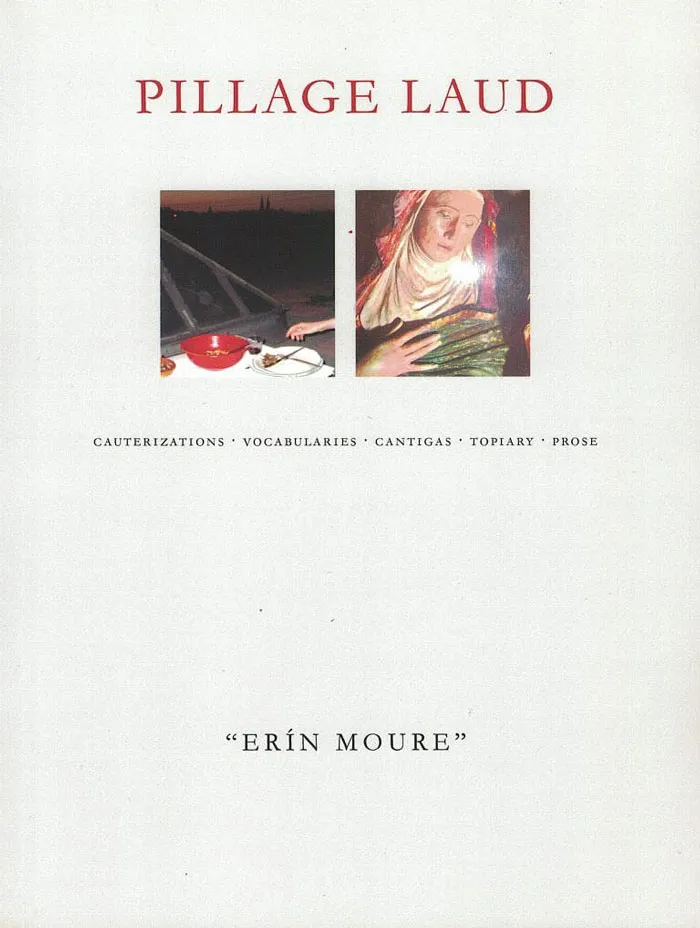
Pillage Laud
First published in 1999 in an edition of 300 perfectbound copies and 26 spiralbound copies lettered A-Z and signed, Pillage Laud is a lost cult item that now returns to print. As the 1999 edition announced, Pillage Laud selects from pages of computer-generated sentences to produce lesbian sex poems (cauterizations, vocabularies, cantigas, topiary and prose) by pulling through certain found vocabularies, relying on context: boy plug vagina library fate tool doctrine bath discipline belt beds pioneer book ambition finger fist flow.
It used MacProse, a freeware designed by American poet and jazz musician Charles O. Hartman as a generator of random sentences based on syntax and lexicon instructions internal to the program; the program worked on Apple systems prior to OSX and is now in the dustbins of computer history. In 1999, the news was shocking: Moure’s poems are written by a computer. In 2011, now that everyone is a computer, the book can be read anew.

The Cows
Lydia Davis is mathematician, philosopher, sculptor, jeweler, and scholar of the minute. Few writers map the process of thought as well as she, few perceive with such charged intelligence. The Cows is a close study of the three much-loved cows that live across the road from her. This chapbook, written with understated humor and empathy, is a series of detailed observations of the cows on different days and in different positions, moods, and times of the day.

Studying Hunger Journals
In 1972 Bernadette Mayer began this project as an aid to psychological counseling, writing in parallel journals so that, as she wrote in one (in bed, on subways, at parties, etc.), her psychiatrist read the other. Using colored pens to “color-code emotions,” she recorded dreams, events, memories, and reflections in a language at once free-ranging and precise—a work that creates its own poetics. She sought “a workable code, or shorthand, for the transcription of every event, every motion, every transition” of her own mind and to “perform this process of translation” on herself in the interest of evolving an innovative, inquiring language. STUDYING HUNGER JOURNALS registers this intention within a body of poetry John Ashbery has called “magnificent.”

In the Presence of Absence
By one of the most transcendent poets of this generation, a remarkable collection of prose poems that explores themes of love, pain, isolation, and connection. In this self-eulogy written in the final years of Mahmoud Darwish's life, Palestine becomes a metaphor for the injustice and pain of our contemporary moment.
Mahmoud Darwish (1941-2008) was one of the most acclaimed poets in the Arab world. His poetry collections include Why Did You Leave the Horse Alone? and A River Dies of Thirst (Archipelago Books). In 2001 Darwish was awarded the Lannan Cultural Freedom Prize.

Mouth: Eats Color
Sagawa Chika Translations, Anti-Translations, & Originals
Ten poems by Sagawa Chika are conveyed into English and other languages through a variety of translation techniques and procedures, some of them producing multilingual poems. Languages used include English, Japanese, French, Spanish, Chinese.
"Mouth: Eats Color is a brilliant infra-textual work, brainchild of the bi-cultural poet/translator Sawako Nakayasu. The collection provokes, expands, and disavows the parameters of language and person and tradition, to forge a beautiful weave of performance and interrogation. This is a project of multilingual wit and passion, echo upon echo upon echo." — Anne Waldman
Sawako Nakayasu is an artist working with language, performance, and translation – separately and in various combinations. She has lived mostly in the US and Japan, briefly in France and China, and translates from Japanese. Her books include Some Girls Walk Into The Country They Are From (Wave Books), Pink Waves (forthcoming, Omnidawn), The Ants (Les Figues Press), Texture Notes (Letter Machine Editions), and the translation of The Collected Poems of Chika Sagawa (Penguin Random House), as well as Mouth: Eats Color – Sagawa Chika Translations, Anti-translations, & Originals (Rogue Factorial), a multilingual work of both original and translated poetry. She is co-editor, with Eric Selland, of an anthology of 20th Century Japanese Poetry (forthcoming, New Directions). She teaches at Brown University in the Department of Literary Arts.

GAAG, the Guerrilla Art Action Group, 1969–1976
Jean Toche, Jon Hendricks and 1 more
This is the reissue of the long out-of-print publication GAAG: The Guerrilla Art Action Group, 1969–1976: A Selection, first published in 1978.
The book serves as the primary text to the significant work of the activist artist group GAAG (Jon Hendricks, Poppy Johnson, Silvianna, Joanne Stamerra, Virginia Toche and Jean Toche), both as a document of the group’s ideological and logistical concerns, and more broadly as a historical record for fifty-two of the many political art actions they carried out through the late 60s and early 70s.

The Hour of the Star
Clarice Lispector, Benjamin Moser
The devastating final work by Brazil’s greatest modern writer, The Hour of the Star tells the haunting tale of Macabéa—a typist who lives in the slums of Rio—underfed, sickly, and unloved, yet inwardly free.
Translated from the Portuguese by Benjamin Moser. With a contribution by Paulo Gurgel and Valente Colm Tóibín.
The Hour of the Star, Clarice Lispector's consummate final novel, may well be her masterpiece. Narrated by the cosmopolitan Rodrigo S.M., this brief, strange, and haunting tale is the story of Macabéa, one of life's unfortunates. Living in the slums of Rio de Janeiro and eking out a poor living as a typist, Macabéa loves movies, Coca-Cola, and her rat of a boyfriend; she would like to be like Marilyn Monroe, but she is ugly, underfed, sickly, and unloved. Rodrigo recoils from her wretchedness, and yet he cannot avoid realization that for all her outward misery, Macabéa is inwardly free. She doesn't seem to know how unhappy she should be. Lispector employs her pathetic heroine against her urbane, empty narrator—edge of despair to edge of despair—and, working them like a pair of scissors, she cuts away the reader's preconceived notions about poverty, identity, love, and the art of fiction. In her last novel she takes readers close to the true mystery of life, and leaves us deep in Lispector territory indeed.

Sherwood Forest
The forest is a place of refuge and story, created by characters who enter and enlarge it beyond the fantasy of any one person. Authority is diminished and recuperated. Personalities perform themselves via vivid and anarchic gestures. A condition of dereliction becomes the arena where bodies rustle with erotic pulse.
"My hope was that this book would be entered as its own social space. Like a gay bar of the fifties, entry would signal that you have taken membership in a stigmatized community, with the risk that entails. Can readership entail risk? Readership as a secret society."—Camille Roy

Saborami
First published in 1973, two months after the military coup in Chile, Cecilia Vicuña's SABORAMI is a document of the times and the way in which history can change art. It is filled with the urgent hope that art, too, can change history. Put together when Vicuña was just twenty-five years old, the poems, paintings, and objects of SABORAMI enact a complex and multidimensional conversation. The meanings of the works (which were created over a seven year period) shifted radically after the events of September 11, 1973. Their meanings continue to shift and resonate in light of political events today. This recreation of the original SABORAMI is published with a new afterword Vicuña wrote especially for this edition.
Cecilia Vicuña is a poet, visual artist, and filmmaker born in Santiago de Chile. The author of twenty books of poetry, she exhibits and performs widely in Europe, Latin America, and the United States. Her multidimensional works begin as a poem, an image or a line that morphs into a film, a song, a sculpture or a collective performance.

The Buddhist
While ending an affair with a Buddhist teacher, Dodie Bellamy wrote about it simultaneously on her blog. This experiment in writing in extremis explores nuances of public shame, the vagaries of desire and rage, and Bellamy's confusion over the authenticity of group and individual spirituality. What is personal, what is public? In the electronic age, can anybody tell the difference?
The Buddhist celebrates marginalized subjectivity as enacted in the work of female artists from Bessie Smith to Eva Hesse and Carolee Schneeman, to Bhanu Kapil and Ariana Reines. The Allone Co. Edition contains the essence of the blog, as well as more extended narratives too explicit to post on line.
Design by Wayne Smith

Cruel Optimism
A relation of cruel optimism exists when something you desire is actually an obstacle to your flourishing. Offering bold new ways of conceiving the present, Lauren Berlant describes the cruel optimism that has prevailed since the 1980s, as the social-democratic promise of the postwar period in the United States and Europe has retracted. People have remained attached to unachievable fantasies of the good life—with its promises of upward mobility, job security, political and social equality, and durable intimacy—despite evidence that liberal-capitalist societies can no longer be counted on to provide opportunities for individuals to make their lives “add up to something.”
Arguing that the historical present is perceived affectively before it is understood in any other way, Berlant traces affective and aesthetic responses to the dramas of adjustment that unfold amid talk of precarity, contingency, and crisis. She suggests that our stretched-out present is characterized by new modes of temporality, and she explains why trauma theory—with its focus on reactions to the exceptional event that shatters the ordinary—is not useful for understanding the ways that people adjust over time, once crisis itself has become ordinary. Cruel Optimism is a remarkable affective history of the present.

The Queer Art of Failure
The Queer Art of Failure is about finding alternatives—to conventional understandings of success in a heteronormative, capitalist society; to academic disciplines that confirm what is already known according to approved methods of knowing; and to cultural criticism that claims to break new ground but cleaves to conventional archives.
Jack Halberstam proposes “low theory” as a mode of thinking and writing that operates at many different levels at once. Low theory is derived from eccentric archives. It runs the risk of not being taken seriously. It entails a willingness to fail and to lose one’s way, to pursue difficult questions about complicity, and to find counterintuitive forms of resistance.
Tacking back and forth between high theory and low theory, high culture and low culture, Halberstam looks for the unexpected and subversive in popular culture, avant-garde performance, and queer art. Halberstam pays particular attention to animated children’s films, revealing narratives filled with unexpected encounters between the childish, the transformative, and the queer. Failure sometimes offers more creative, cooperative, and surprising ways of being in the world, even as it forces us to face the dark side of life, love, and libido.

24 European Ethnographic Museums
With the series '24 European Ethnographic Museums' Van der Heide questions the construction and identity of the ethnographic museum today. Here, the project becomes a collection of artefacts in and upon itself and by recording the names of these institutions Van der Heide places the viewer in front of the dilemma: who is authorized to decide what is an artefact, and what should be collected and for what reason? In the 19th century, with the birth of the current European nations, museums openly referred to their colonial past. Today the museums bare more euphemistic names like: ‘Museum der Kulturen’ or ‘World Museum’ but still place the West as the self-acclaimed center of the world. The existence of the ethnographic museum, which is intertwined with the complicated and loaded colonial past, has been subject to contemporary criticism. While some of the European ethnographic institutions have attempted to come to terms with the past of their collections and their heritage, Van der Heide focuses upon how language continues to reflect the political present of the institutions.

Body Double
Artist's book (an hallucinated portrait gallery of most of the characters created by Brice Dellsperger for his film remakes) / first substantive study of his work, with an essay by Marie Canet.
Brice Dellsperger's Body Double is the first monograph ever published on the artist's already cult film productions, with a long essay by art historian Marie Canet that addresses filmic remake, but also issues of models, gender politics, and representational chaos. Consisting in a large body of unpublished images, the book also invites the reader backstage—as in Kenneth Anger's Hollywood Babylon, after which this book is modeled—into the Dellspergian camp film factory, to get a closer look at the characters and personas that populate the Body Double series, and that are creations both of the artist and of his main performer and muse, Jean-Luc Verna.
Brice Dellsperger (born 1972 in Cannes, France, lives and works in Paris) pushes the boundaries of genre and gender. In his multifaceted reprises of iconic film sequences—all assembled under the generic title Body Double—the cineast and artist reenacts the selected scenes frame for frame and lets his “body doubles” perform all of the roles, be they male or female.
Brice Dellsperger has exhibited extensively in Europe and abroad, and began his well-known Body Double series in 1995. His work is in collections that include the Museum of Modern Art, Musée d'Art Moderne – Centre Pompidou, and the Nouveau Musée National de Monaco.
Available in French edition.

Body Double (French Edition)
Artist's book (an hallucinated portrait gallery of most of the characters created by Brice Dellsperger for his film remakes) / first substantive study of his work, with an essay by Marie Canet.
Brice Dellsperger (born 1972 in Cannes, France, lives and works in Paris) pushes the boundaries of genre and gender. In his multifaceted reprises of iconic film sequences—all assembled under the generic title Body Double—the cineast and artist reenacts the selected scenes frame for frame and lets his “body doubles” perform all of the roles, be they male or female.
Brice Dellsperger has exhibited extensively in Europe and abroad, and began his well-known Body Double series in 1995. His work is in collections that include the Museum of Modern Art, Musée d'Art Moderne – Centre Pompidou, and the Nouveau Musée National de Monaco.
Available in English edition.

Coeur de Lion
A reissue of the instant cult-classic love poem, an investigation of poetic address.
Now that I am not addressing you
But the "you" of poetry
I am probably doing something horrible and destructive.
But this "I" is the I of poetry
And it should be able to do more than I can do.

Born in Flames
Born in Flames – the publication – is the complete authorised graphic translation of Lizzie Borden’s mythical 1983 film Born in Flames. Kaisa Lassinaro’s post-facto screenplay captures all the political energy and visual brilliance of Borden’s film, which describes a futuristic society (eerily similar to our own) where the achievements of a past revolution are threatened by reactionary sexist forces.
The published version of Born in Flames allows for a frame-by-frame analysis of the film’s complex plot and soundtrack, with songs by The Bloods and Red Crayola. Included is an interview with Borden conducted by Lassinaro, in which the filmmaker looks back on the making of her film.

F.R. David - Spin Cycle
F.R.DAVID is a typographical journal, dealing with the organisation of reading and writing in contemporary art practises.
This issue, "Spin Cycle", is concerned with captioning, commentary and description. Edited with Mike Sperlinger.

Vampyroteuthis Infernalis
Vilem Flusser, Rodrigo Maltez Novaes
Flusser introduces an infernal creature from the oceanic abysses, who slowly emerges, not from the oceans, but from man's own depths to gaze spitefully into his eyes and reflect back at his own existence.
Originally published only in German in 1987, this version has been edited and translated by Rodrigo Maltez Novaes, Ph.D. candidate at the European Graduate School, Saas-Fee, under the supervision of Prof. Dr. Siegfried Zielinski, from the original, unpublished and extended Brazilian-Portuguese version of the manuscript recently found at the Vilém Flusser Archive at the Universität der Kunst, Berlin. This edition is also accompanied by a selection of previously unpublished excerpts from Flusser's correspondence with Milton Vargas and Dora Ferreira da Silva, with whom he discussed the development of the present text.

Mercury
Composed in the direct, accessible, consciousness-piercing style readers of Ariana Reines' first two books are wildly enamored of, Mercury comprises a group of long poems. These interlocking works speak to the substance and essence of what is said, transmitted, transacted, "communicated" between persons. Reines proposes that substance and essence are opposites, and explores this in contexts including commercial cinema and internet porn.

The Wet and The Dry

Exercise in pathetic criticism
Kate Briggs is the translator of two volumes of Roland Barthes’s lecture and seminar notes at the Collège de France: The Preparation of the Novel (Columbia University Press, 2010) and How to Live Together: Novelistic Simulations of Some Everyday Spaces, due to be published in 2012. Exercise in Pathetic Criticism is the first in a projected series of experiments in literary criticism.