Books
Books
published in 2021

Out of the Shadows
Gerard-Jan Claes, Stoffel Debuysere
Compiled by Courtisane and Sabzian on the occasion of the Out of the Shadows programme, originally conceived for Courtisane festival 2020 but rescheduled to Courtisane festival 2021.
This program and publication was developed with the support of The Arab Fund for Arts and Culture (AFAC), CINEMATEK and KASK / School of Arts, in collaboration with Reem Shilleh and Mohanad Yaqubi (Subversive Film).

"Tu verras quand tu seras grand!"
Un livre qui t’expliquera tout sur l’argent, l’économie capitaliste, le système bancaire, la police et la révolution !
"Tu verras quand tu seras grand!", premier livre pour enfants des éditions L'Amazone, explique l’économie capitaliste mondialisée à travers quatre chapitres sur l'argent, le système bancaire, la police et la révolution. Il a été réalisé à partir des livres cités par l’auteure Marie L’or Kaeppelin-Billaudot dans Il sera une fois… Essai sur le contenu des livres pour enfants (Espaces féminins, La pensée sauvage, 1978). "Tu verras quand tu seras grand!" part du constat que peu de livres pour enfants traitent ouvertement de la question économique alors qu’elle est omniprésente dans leur quotidien. Le détournement de ces ouvrages, plus de quarante ans après leurs publications, nous permet de repenser notre rapport à ces mythes fondateurs, de la même manière qu’un conte joue un rôle dans la construction d’une histoire commune.
À partir de 6 ans.
Conception d’ouvrage : Tiphanie Blanc
Design Graphique : Tiphanie Blanc & Roxanne Maillet
Impression riso : Autobahn
Couverture sérigraphiée : Chromodrome
Papier : Arena Natural Rough 200g & Sirio Color Foglia 350g
Typographies : Ovo de Nicole Fally, Gaya de Raphaël de la Morinerie, DinDong de Clara Sambot, Zarathustra de Lorène Ceccon, Cormorant de Catharsis Fonts & Zipper de Bob Newman
Exemplaires : 250

Wound Building: Dispatches from the Latest Disasters in UK Poetry
Wound Building is a volume of essays, with digressions, on one group of contemporary poets active in a self-organizing political poetry scene in the UK, most of whom have little to no audience outside of the little magazines that they publish and the reading series they put on. The book is a front-line report on the rapid development of this poetry in the period between 2015 and 2020, with a particular focus on the relationship of poetry to violence and its representation. The poets discussed here write violent love poems and violent elegies as well as violent fantasies composed in stabs of violent verse and violet prose. The poems themselves comprise fantasies of killing David Cameron, dreams of being split open along a seam, basement songs, hundreds of pages of notes on working life in a privatized care home in Hove, East Sussex, a four-line slogan about the Cologne groping scandal of New Year 2016, variations on the Refugees Medical Phrasebook, a life wasted in a factory in Guangzhou, an autobiographical sci-fi internet fever dream, an anarchist elegy, and a refusal to argue. Ultimately, Hayward argues that the lessons this poetry teaches is never to write a "worthy" narrative when a fucked up collage will do. Rather than a cohesive "account" of a "school" of poets, or a "contribution" to the boring tittle-tattle of aesthetic debates over British poetry as an institution, Wound Building is a front-line report on the local disasters of a contemporary UK poetry caught in the grip of the historical cataclysm of capitalist culture.
Wound Building is further concerned with aesthetic problems related to Marxism, anarchism, contemporary trans politics, and class, though its "theoretical" preoccupations are subordinated to its desire to provide a ground-level view on the writing itself, its production, its intellectual aporia, and the ways it finds itself outstripped by the ongoing "march of events." The book will be of interest not only for those concerned with contemporary British political and experimental poetry, but also more generally for anyone who wishes to think carefully about what it means to make art about present-day history and its many horrible enormities.
The book's title is derived from the idea of sublime woundedness that subtends the context of the poets discussed here: the impressions of wounds opening up like LED-lit shopfronts in the night, in a parallel universe in which injury is intoxicatingly impersonal and structural, and which forms the environment in which the poems fight to absolutize the value of every last breath, or face into the reality of extravagantly violent wish fulfillment, or dissolve themselves in a search for new ways of professing love, or transform into a kind of expressionism of vomiting up medical-diagnostic categories found in abstract social labor, or pump their verses full of the convulsive rhythms of surprise and sudden relief, without any guarantee that this is the right thing to do or that anyone will even fucking hear. Wound Building does not historicize this state of affairs as much as it attempts to live alongside the immediacy of this work, in order to see what is still possible for poetry, and criticism, to make and do.

Notes on a life not lived
This publication is based on a project by Despina Vassiliadou that ran from 2015-16. It presents a collection of photographs taken during the period, accompanied by fictional short stories.

À L’ARRACHE: Portraits & récits de la scène musicale underground de Lyon, 1980—2020
« Des nuits des fêtes et de mille concerts que reste-il ? Des souvenirs brumeux de lieux improbables, des anecdotes en pagaille, une affiche dans ton salon, un flyer sur ton frigo, des histoires vertigineuses et des émotions de toutes sortes. On pensera aussi tout de suite à des visages, des rencontres, des aamitiés aui commencent au coin du bar ou fumant une cigarette dans un hangar glacial. Et puis ça se précise: tu te souviens tel concert génial, ce groupe qui t'obsède, cette salle moquette où tu écoutais des nappes de bruit, cette villa bourgeoise squatté qui débordait de sons obscurs et violents, cette ancienne usine occupée le temps d'un week-end par des teufeurs multicolores, un dojo de métalleux ou je ne sais quel autre endroit bizarre, on en veut encore. » [note de l'editeur]
336 pages de textes et d’images
format 18 x 26 cm
Graphisme : Félicité Landrivon avec Églantine Marcel
Éditions BARBAPOP, Décembre 2021

Eecchhooeess
American poet Norman H. Pritchard's second and final book, EECCHHOOEESS was originally published in 1971 by New York University Press. Pritchard's writing is visually and typographically unconventional. His methodical arrangements of letters and words disrupt optical flows and lexical cohesion, modulating the speeds of reading and looking by splitting, spacing and splicing linguistic objects. His manipulation of text and codex resembles that of concrete poetry and conceptual writing, traditions from which literary history has mostly excluded him. Pritchard also worked with sound, and his dynamic readings—documented, among few other places, on the album New Jazz Poets (Folkways Records, 1967)—make themselves heard on the page.
EECCHHOOEESS exemplifies Pritchard's formal and conceptual sensibilities, and provides an entryway into the work of a poet whose scant writings have only recently achieved wider recognition. DABA's publication of EECCHHOOEESS is unabridged and closely reproduces the design of the original 1971 volume.
Norman H. Pritchard (1939-96) was affiliated with the Umbra group, a predecessor to the Black Arts Movement. He taught writing at the New School for Social Research and published two books: The Matrix: Poems 1960-1970 (Doubleday, 1970) and EECCHHOOEESS (New York University Press, 1971). His work was anthologized in publications including The New Black Poetry (1969), In a Time of Revolution: Poems from Our Third World (1969), Dices or Black Bones: Black Voices of the Seventies (1970), Ishmael Reed's 19 Necromancers from Now (1970), Text-Sound Texts (1980) and others.

The Things We've Seen
In The Things We've Seen, his most ambitious and accomplished novel to date, Agustín Fernández Mallo captures the strangeness and interconnectedness of human existence in the twenty-first century. A writer travels to the small uninhabited island of San Simón, used as a Franquist concentration camp during the Spanish Civil War, and witnesses events which impel him on a wild goose chase across several continents. In Miami, an ageing Kurt Montana, the fourth astronaut who secretly accompanied Neil Armstrong and co. to the moon, revisits the important chapters in his life, from serving in the Vietnam War to his memory of seeing earth from space. In Normandy, a woman embarks on a walking tour of the D-Day beaches with the goal of re-enacting, step by step, another trip taken years before.
Described as the novel David Lynch and W. G. Sebald might have written had they joined forces to explore the B-side of reality, The Things We've Seen is a mind-bending novel for our disjointed times.

My Life as a Godard Movie
Captivated by the liberated glamour of Jean-Luc Godard’s young stars as a teenager, Joanna Walsh rediscovers his films as an adult and finds herself resisting the temptation to identify with or desire the women on film. Instead, echoing Jean-Luc Godard’s pronouncement that ‘cinema is truth at 24 frames per second’, Walsh’s essay turns its gaze on the dynamics of the camera itself and demands a new kind of art. This is an experimental, bold, and wide-ranging book that refuses to setltle for easy answers. An essential read for anyone interested in women on film.

Fleurs du Mal
Charles Baudelaire, Antoine D'Agata
For Charles Baudelaire, the photographic medium is not an art but a technical means of representing reality. As a counterpoint to Baudelaire, Antoine d’Agata reworks his own photographs through digital intervention to return to engraving, as if to go from the pixel to the line of the time. He pushes photography to its limits, discarding the medium to return to the raw. Baudelaire’s texts thus enter into dialogue with photographs that have become engravings through wear and tear and manipulation, where the bodies blend together to give way to the poetry of the body.
The work is based on the original uncensored edition of Baudelaire’s collection accompanied by these engraved prints by d’Agata. Present and past are superimposed. Like a game of transparency that will present the frame of an image on the cover. In this work Fleurs du Mal, Baudelaire is a stroller, a spectator of the world around him, of urban transformations, while d’Agata embodies photography, life and reappropriates the space of the city by the gesture.
Two personalities meet on the occasion of the 200 years of the birth of Charles Baudelaire. Two artists who could have meet each other, debated, confronted each other. For d’Agata, Baudelaire leaves a legacy that must be pushed to extend its own reflection.
The artist intervenes on the edge of Baudelaire’s poems with personal reflections and quotations from his favorite thinkers, descendants of Baudelaire’s thought: Walter Benjamin, Guy Debord or Georges Bataille.
Affixed vertically to the poems, these handwritten interventions assert themselves while leaving the original text its own space. A second sense of reading is thus offered to the reader between Baudelaire’s text and the interpretation given by d’Agata through the words as much as through the engravings.

Judy Blame’s Obituary: Writings on Fashion and Death
Derek McCormack is the author of fashion-inflected novels that cast luminaries such as Elsa Schiaparelli and Balenciaga as characters. This collection brings together for the first time McCormack's fashion journalism. He writes about and interviews fashion figures that fascinate him, tracing the ways they inspire and inhabit his novels. The result is a sort of memoir in essays: as he writes, "My tribute to [Judy] Blame is about him and about me—there are lots of my own tales woven in with the topics I touch on. The writing here is a sort of autobiography, a life seen through a scrim, or a life as a scrim—my moire mémoire."
Judy Blame's Obituary contains twenty years' worth of reminiscences, reviews of fashion shows and books, interviews with writers about fashion, and interviews with fashion designers about writing. He talks to Nicolas Ghesquière about perfume, and to Edmund White about which perfume he wore as a young fag in New York City. He inspects the clothes that Kathy Acker left behind when she died, and he summons the spirit of Margiela in a literary seance. He traces the history of sequins, then recounts the cursed story of Vera West, the costume designer who dressed the Bride of Frankenstein. These pieces were all previously published, some in Artforum, some in The Believer, and some in underground publications like Werewolf Express—what binds them together is a sense that though fashion victimizes us, this victimization is sometimes a sort of salvation.
Derek McCormack is a Canadian writer. His most recent novels are The Well-Dressed Wound and Castle Faggot, both published by Semiotext(e). Of Castle Faggot, Dennis Cooper said: "It is really just one of the best books ever, and maybe the greatest novel ever written.
Praise for Judy Blame's Obituary:
'Derek McCormack, Canada's most famous author as yet unsullied by Nobel Prize or television adaptation, hides in plain sight as a fashion journalist. Parallel to his writing incantatory, scatalogical fiction, he has reviewed collections and interviewed the great and good of la mode. His divagations are often darkly hilarious and always exquisitely tailored. The sublime and the ridiculous coexist in his prose, as they do in life. Fashion victims, ignore his insights at your peril.' — William E. Jones
Published by Pilot Press, 20 × 15 cm, Softcover, 2021

Stutters
In 2014, Hurth encountered four boxes of cyanotype prints by Thomas W. Smillie, the first custodian and curator of the Smithsonian Institution’s collection of photography (active 1868 to 1917). In her new work Stutters, Hurth builds on several years’ research to rework the original cyanotypes into visual montage, sequencing images that provide a record of Museum life as it documents a ‘national’ collection in the making. The work presents photographs of empty display cabinets and staged objects within the Smithsonian’s holdings, following divergent threads of photographic history, exhibitionship and collection-making, as well as developments in various technological apparatuses across the late 19th and early 20th century.
Through a meticulous process of xerox and printing reproduction, Hurth enlarges the world of each image and traces a photographic lineage, a process itself indebted to the cyanotype. Two overlapping sets of captions from the artist offer a subjective and scientific view of the photographs, inviting a cross-referencing of the “official”, if incomplete, bibliographic record with one that moves more freely across a historical timeline as a way to reflect on gaps in the archive.
Stutters includes three new texts, with Hurth considering the book’s entwined interests, as well as her own personal history with the Smithsonian and the work of Smillie. Additional contributions by authors and curators Ruth Noack and Kari Conte consider the ways in which artists’ projects like Stutters can quietly break apart the violent taxonomy of an archive, and instead use this shifting fragmentation to envision new meaning and bring into focus voices that have been excluded from history.
Dominique Hurth Born in France (1985), Dominique Hurth is a visual artist working with sculpture and installation, and within the relationship between sculptural matter and printed matter. Even though her installations are often concentrated on the form, a long and detailed research is strongly embedded in the development of this same form. It is by ways of archival research, journalistic investigation, writing and material experiments that the works develop, and it is by way of editing that the installation operates in the exhibition space. Her work was exhibited in several museums, galleries and institutions internationally (a.o. Palais de Tokyo, Paris; Hamburger Bahnhof, Berlin; Fundacio Tapies, Barcelona; Memorial of Ravensbrück, Fürstenberg/Havel; Württembergischer Kunstverein, Stuttgart) and is part of several collections. She is the recipient of several awards and residencies such as the Pollock-Krasner Foundation Grant (2016-17) and Prize of the Berliner Senate / Governing Mayor of Berlin at ISCP, New York (2014).
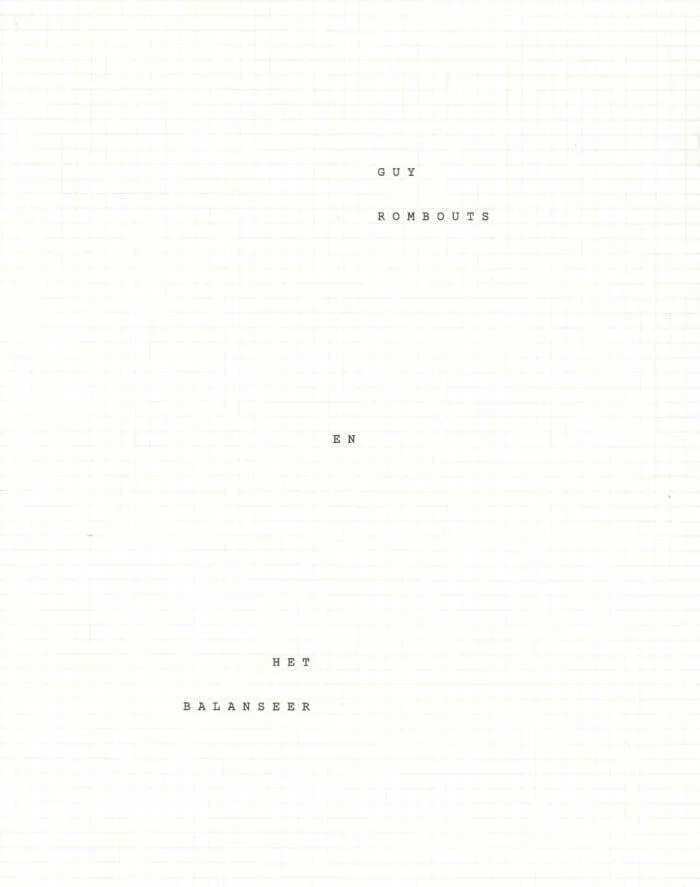
EN
In het begin van de jaren 1970, hield Guy Rombouts een notaboekje bij waarin hij alle woorden, bijvoeglijk naamwoorden en werkwoorden bijhield die hij tegenkwam tijdens het lezen en die met elkaar verbonden waren door het voegwoord ‘en‘.
Ongeveer 50 jaar later en met de hulp van de grafische vormgever Jeroen Wille, is de transcriptie van zijn aantekeningen gepubliceerd als een boek dat gelezen kan worden in twee richtingen (en als enige boek coronaproof met twee tegelijkertijd).
Het boek bevat 2158 verzen met in totaal 4316 EN-combinaties.
De kortste verzen met evenveel letters:
A EN Z
4 EN 6
De langste verzen met evenveel letters:
ONUITSPREKELIJKHEDEN EN IMPONDERABILIA
ONEVENWICHTIGHEID EN ZELFOVERSCHATTING

Disparaitre #3
Third issue of Disparaitre, Ethan Assouline's publication. A long promenade in the city looking for new meanings in daily life, work, architecture(...) and new strategies for sabotage and autonomy using sex and poetry.
89 copies, riso printed.
Each back cover is unique and handmade.

How to remember your dreams
The book is a sharp and creative reflection on the interweaving of personal and national/ideological dreams. The chapters are on facts and fictions created in both, how one retraces one’s way through them, and through the numerous philosophers/thinkers/ideas (from Sartre to Zizek, Abdel-Nasser to Ibn Taymiya and others) that appear and shape his life journey, studies and dreams.
Amr Ezzat is an Egyptian writer who studied engineering and philosophy. He worked as an engineer and then a journalist before becoming a human rights researcher and a writer for numerous newspapers and other periodicals. He remembers his dreams very well.
Commissioned and published by Kayfa ta in 2019, printed in Beirut in 2021
Translated from English by Jennifer Peterson
Design template by Julie Peeters
Cover illustration by Hany Rashed

New Grounds for Dutch Landscape
New Grounds for Dutch Landscape uses an experimental, site-specific method to demonstrate how 17th century painters Jan van Goyen, Jacob van Ruisdael, and Meindert Hobbema did not so much represent the newly made landscape of Holland as reenact, through their painterly factures, its reclamation and ongoing threats to its stability: from flooding and drainage to abrasion and erosion.
These low-level dramas of recalcitrant matter allowed the Dutch to develop an ongoing temporality at odds with history painting’s decisive instant and a vocabulary of substance that wrested meaning away from humanist landscape painting’s expressive figures. — [publisher's note]

OEI #92-93 Lettrist Corpus: The Complete Magazines (1946–2016)
Frédéric Acquaviva, Jonas J. Magnusson and 1 more
“Un livre qui fera date. Deux ans de recherches, 512 pages, 1.361 illustrations en quadrichromie, 119 revues lettristes parues de 1946 à 2016 pour un total de 1.200 ouvrages décrits (avec la couverture et le sommaire de chaque numéro). Qui d’autre que les éditeurs suédois de OEI (Jonas J. Magnusson et Cecilia Gronberg) aurait pu sortir ce travail anthologique? Personne!” — www.mauricelemaitre.org
“The ‘unreasonable’ idea for this ‘catalogue raisonné’ came to me as an attemps to draw up a complete inventory of all the journals and periodicals of the Lettrist group, from its birth until today. Because the lifespan of the Lettrist movement has exceeded that of all the other avant-garde movements, we are undoubtedly in front of the most immense corpus ever produced in terms of magazines, coverin a period from 1946 to 2016. It presents more than a hundred different titles with more than one thousand items and hundreds of authors. . . . I hope that this comprehensive work will give the reader an opportunity to understand the different paths of the Lettrist groups and the many areas addressed, if not shaken, beyond the books of Isidore Isou and Maurice Lemaître. Since other Lettrists have published relatively few monographic books, and very little outside their own magazines, OEI #92-93 is a unique database for most of the Lettrist texts that we can access, also making it possible for new readers to come across Lettrism.”
— from Frédéric Acquaviva’s introduction
Design by Fält

OEI #90/91 Sickle of Syntax & Hammer of Tautology
Tobi Maier, Cecilia Grönberg and 1 more
OEI # 90-91: Sickle of Syntax & Hammer of Tautology offers the first English language overview of the history of concrete and visual poetry production in socialist Yugoslavia between 1968 and 1983.
By focusing on mass-produced examples of concrete poetry, this publication presents these poetic experiments as organically linked to social movements, critical theories, and youth cultural revolutions. In his extensive introduction, Sezgin Boynik, the guest editor of this special issue of OEI, discusses concrete and visual poetry in socialist Yugo-slavia as an uneven and combined development, and emphasizes its confrontational and organizational aspects.
By means of interviews, translations, reproductions, and theoretical and historical statements, OEI # 90-91 offers a picture of a very lively scene of concrete and visual poetry in Yugoslavia, which unfortunately is not as recognized interna-tionally as it would deserve.
Hoping that OEI # 90-91 could contribute to this task in a substantial way, we present episodes from the early years of OHO formation and its complex theories of words and things; an interview with Rastko Močnik on programmed art and political formalism; militant polemics of Goran Babić; Signalist contradictions; subjective structural devices of Judita Šalgo; zaum experiments of Vojislav Despotov; detective meta-texts of Slavoj Žižek; poetic self-management studies of Vujica Rešin Tucić; a feminist historicisation of Ažin school for experimental poetry; democratisation of visual poetry by Westeast; selections from special issues of the journals Pitanja, Problemi, Ulaznica, Dometi, Delo, Koraci, Vidik, Pegaz, and many other materials translated here for the first time and presented in one publication.

Bernice Bobs Her Hair
‘Bernice Bobs Her Hair’ is a series of layered soft ground etchings, drawings and monotypes. The title is a nod towards a Fitzgerald story about Bernice, who changes her approach to traditional gender roles and youth over a visit to her niece Marjorie. The act of having her hair cut transforms her character into a real flapper and brings her to a new perception of femininity.
Starting from the biased idea and normative use of marginalised graphic procedures as a means of reproduction, the idea of repetition is explored so that iterations become alterations or modifications of the same.
Simultaneously, associations cease to exist and the pregnant B, punning at times, as form and counterform encloses the work.
Fluid figures, painterly gestures and cartoonish scrawls and patterns are subject to a reflection on cuteness, power (-lessness), sexuality and domesticity.
By highlighting marginalised modes of artistic practice and craft-informed techniques, Mabesoone recoups visual languages that have habitually been coded as ultra-feminine and trivial. She questions how these ambiguous and subversive aesthetics can gain authority, and destabilise or resist contemporary realities and dominant cultural constructions.
The book contains poems by Veva Leye and a republication of ‘Trimmings’ by Harryette Mullen.

Rainbow Woman
In her work, Dutch artist Femmy Otten (°1981) explores a very hybrid world of inspiration, ranging from sculptures from Greek antiquity and Italian painters of the quattrocento to American outsider art and contemporary art. She brings all these influences together in a precise yet unfathomable iconography.
The book Rainbow Woman shows mainly recent work, but also revisits a number of older works which Otten has regularly placed in a new context throughout her artistic practice and which have now also been given a new shape in the context of the exhibition in the Warande, Turnhout (01.08-07.11.2021).
Rainbow Woman shows Otten as a versatile painter, sculptor, draughtsman and performer. In ‘Donna Universale’, the art historian Leen Huet places Otten in a tradition of self-confident, female artists that Europe has known since the early Renaissance but who have only sporadically entered the history books as artistically accomplished artists.
The book has many points of contact with the exhibition Rainbow Woman but can also be seen as a sequel to the artist’s book Slow Down Love (2016, nai).

Le conflit n’est pas une agression
Des relations intimes aux politiques globales, Sarah Schulman fait le constat d’un continuum: individus comme États font souvent basculer les situations conflictuelles dans le registre de l’agression, criminalisant leurs opposants pour couper court à la contradiction et échappant ainsi à leur propre responsabilité dans les conflits. En distinguant conflit et agression, l’autrice interroge notre culture de la stigmatisation.
Ce travail profond, aussi courageux qu’impertinent, montre comment la sanction et la répression prennent le pas sur l’auto-analyse à l’échelle individuelle et collective, et comment l’altérité sert de justification à la violence et à l’exclusion. Ce livre intentionnellement polémique offre un aperçu des dynamiques contemporaines et historiques qui prennent les différences intimes, raciales et géopolitiques pour des éléments déclencheurs de la course à l’injustice, à l’exclusion et à la répression.
Le conflit n’est pas une agression est un virulent plaidoyer contre le phénomène culturel de l’accusation, révélant combien les personnes en situation de pouvoir exacerbent et manipulent la crainte de l’« autre » pour éviter toute remise en question.

Palma Africana
Dans Palma africana, l’anthropologue australien Michael Taussig explore la production d’huile de palme en Colombie. Alors que cette dernière envahit tout, des chips au vernis à ongles, l’auteur examine les conséquences écologiques, politiques et sociales de cette exploitation.
Bien que la liste des horreurs induites par la culture du palmier à huile soit longue, nos terminologies habituelles ne permettent plus de rendre compte des réalités qu’elles décrivent. À travers cette déambulation anthropo-poétique au cœur des marécages colombiens, c’est donc la question du langage que l’auteur interroge. Comme William Burroughs, pour qui les mots sont aussi vivants que des animaux et n’aiment pas être maintenus en pages – Michael Taussig souhaite couper ces dernières, et les rendre à leur liberté.
Pensé à partir d’une vie d’exploration philosophique et ethnographique, Palma africana cherche à contrecarrer la banalité de la destruction du monde et offre une vision pénétrante de notre condition humaine. Illustré de photographies prises par l’auteur et écrit avec la verve expérimentale propre à l’anthropologue, ce livre est le Tristes Tropiques de Michael Taussig pour le XXIe siècle.
Traduit de l’anglais par Marc Saint-Upéry.

Being Together. A Manual for Living
Being Together: A Manual For Living falls in the lineage of publications such as The Journal of the Society for Education Through Art, which throughout the 1960s provided Britisch art schools a window into experimental education. By contrast, Grace Ndritu's experience in creating radical pedagogies arose from a connected, yet unorthodox system of 'self education'.
In 2012, she decided to spend time living in cities only when necessary. She thus lived in rural, alternative and often spiritual communities, while expanding her research into nomadic lifestyles, and training in esoteric studies, which she began following graduating art school. This research led her to visit Thai and Tibetan Buddhist monasteries, permaculture communities in New Zealand, forest tree dwellers in Argentina, neo-tribal festivals such as Burning Man in Nevada, a Scottish Hare Krishna ashram, and the Findhorn Spiritual Community in Scotland.
Such lifestyles forever transformed her ideas of education and have proven critical for her art, whether conducting social practices or working with students, peers and the general public; some of whose voices appear in this publication. Ndiritu posits, "What does (art) education mean today?" and specifically, "What does an embodied (art) education mean in a time of pandemics and social unrest?". Being Together: A Manual For Living attempts to answer these complex questions.
This book is published on the occasion of Grace Ndiritu's solo show at KRIEG? in Hasselt, Belgium.
Contributors: Philippe Van Cauteren, Pieter Vermeulen, Grace Ndiritu, Rafaela Lopez, Roberto dell’Orco, Jana Haeckel, Katleen Vermeir & Ronny Heiremans, Nathalie Boobis, Shayla Perreault, Edward Ball, Guadalupe Martinez, Stacy Suy, Ezra Fieremans.
Editors: Pieter Vermeulen, Grace Ndiritu
Copy editor: Sue Spaid
Design: Vrints-Kolsteren

A Gloomy Masturbation
Featuring a selection of drawings from Fontaine’s ongoing project 'A Gloomy Masturbation' this book takes the reader on a trip through the artist's mind. The work functions as part diary, part fantasy, and part information, chronicling her own chronic sickness, fixating on her many failed romantic relationships, and exploring therapeutic theories of the mind and the precarious political situations of our time. Expect tragic comedy, slippery statements, radical honesty, and total teenage angst.

School Of Equals
Stijn Van Dorpe, Sarah Késenne
This book navigates the debate on (in)equality and arts education in a variety of ways. The process that editors Stijn van Dorpe and Sarah Késenne used to compile it follows a dialogue in which they provided contexts to one another but also strayed into the complexity of stories, viewpoints, and contradictions. They distinguish three different “politics”; three ways they believe the research has critical power and the potential to trigger action: through active, analytical, and corrective power; (in)consistencies; and (shared) praxis.
The book forms part of a series of projects and activities that they began as an initiative within the Audiovisual and Visual Arts Master at the LUCA School of Arts in Belgium.