rile*books

Search books

Search books by title, author, publisher, keywords...

Explore

Categories
Visit
Collections
Publishers
Back in stock
Any books
Cover of Gedichten en gedachten in het Frans

Risiko Press

Gedichten en gedachten in het Frans

Stéphane Schraenen

€14.00

Written in La Ferme Arpoix (Ceaux-en-Loudun) and Paris, 1998. Dedicated to Guy.

Staple bound, ltd. to 200 copies. Riso-printed on Munken Pure Rough 120gsm by Risiko Press in Borgerhout, covers silkscreened on Eskaboard by Maarten de With, copy editing by Sis Matthé, design by Kaye & Matthé, typeface: Elementa.

[The title of this book is in Dutch, the text is in French]

"Met dank aan Eliane Van De Velde en Marie-Sophie Beinke."
Published in 2021 ┊ 28 pages ┊ Language: French

recommendations

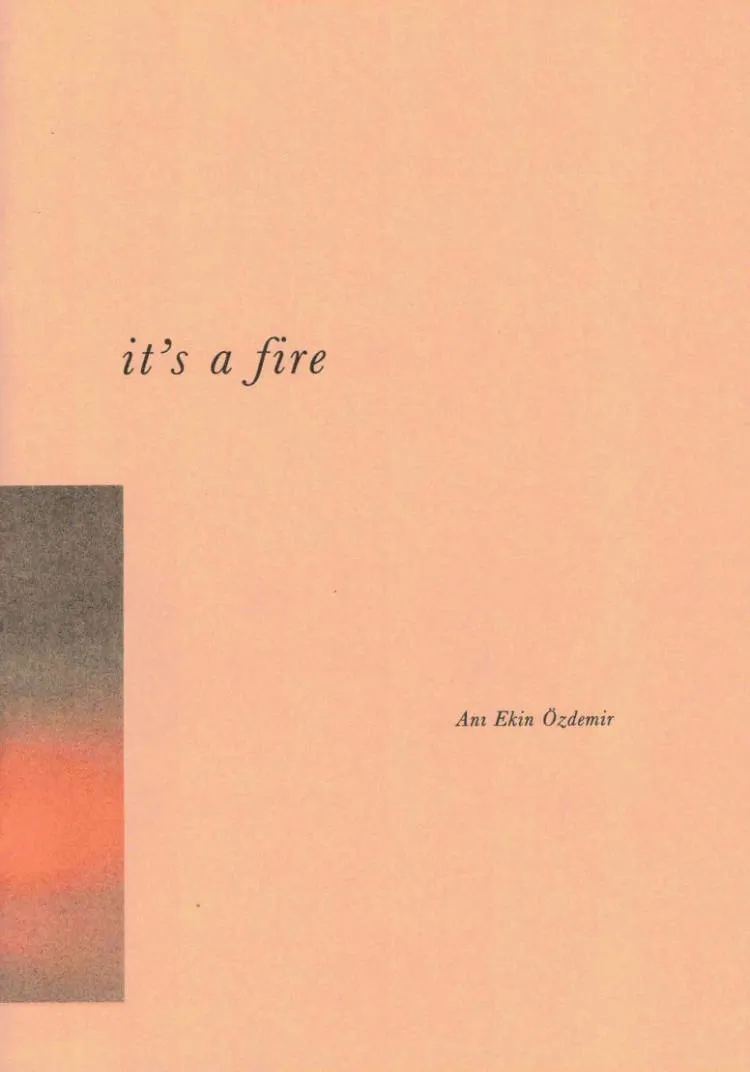
Cover of It's a Fire

Risiko Press

It's a Fire

Anı Ekin Özdemir

Zines €10.00

It's a Fire is a collection of poems that weaves together dreamt and experienced situations, written in movement, with the intensity of senses, weather conditions, and the impossibility of fulfilment and ownership—which also makes it a reflection on desire as a force that disorganizes capitalist productivity, disciplined subjectivity, and neoliberal self-improvement. Along the way, it burns, contaminates, multiplies, and keeps on desiring.

Cover of Eselsohren Dog Ears

Risiko Press

Eselsohren Dog Ears

Pol Matthé

"The impossible takes a little longer. [pen scribbling]"

Presented at Kransen in Borgerhout, 1—3 March 2024, with an exhibition titled Dog Ears and a remote reading by fellow-Stockholmian artist Dave Allen.

Cover of Katalog 2

Risiko Press

Katalog 2

Jan Matthé

Assembled and copied by Jan Matthé at Permeke Library Antwerp, September—October 2022. Edited at Kransen, printed in Borgerhout in an edition of 200, bound by De Wrikker in Berchem. Released on the occasion of Permeke draait door met Risiko Press, Sunday 27 November 2022 at Permeke Library, with readings and performances by Tina Schott, Jóhanna Kristbjörg Sigurðardóttir, Stefanie Alexandra, Sis Matthé, Ria Pacquée, Jan Matthé, Clodagh Kinsella and Roman Hiele. Thanks to Christel Kumpen for the invitation, Allon McKaye for the Saturday and Toni Matthé for the unicorn with a heartshaped tail.

Cover of Twenty Bookmarks

Risiko Press

Twenty Bookmarks

Zines €12.00

Twenty Bookmarks is a result of Production & Workflow class of Graphic Design Department at the Royal Academy of Fine Arts Antwerp, Ba1 Class of 2026.

Cover of Manifest ( ) gathered angry woman loving

Risiko Press

Manifest ( ) gathered angry woman loving

Chiara Di Luca, Emma Burel and 2 more

Zines €7.00

Words gathered from The Carrier Bag Theory of Fiction (Ursula K. Le Guin, 1986), Natural Enemies of Books (MMS, 2020), Non credere di avere dei diritti (Libreria delle donne di Milano, 1987), Dada Cannibalistic Manifesto (Francis Picabia, 1920) and WITCH (Rebecca Tamás, 2019). A first version of this poem/pamphlet was made in the context of See What I Mean, a workshop by Phil Baber at Antwerp’s Royal Academy of Fine Arts, october 2024.

Cover of The Tiniest Muzzle Sings Songs of Freedom

Wave Books

The Tiniest Muzzle Sings Songs of Freedom

Magdalena Zurawski

Poetry €18.00

Taking readers from suburban carports to wintry Russian novels, from summer tomato gardens to the sublime interiors of presleep thoughts, Magdalena Zurawski's poems anchor the complexities of our interconnected world in the singularity of the human experience. Balancing artistic experimentation with earnest expression, achingly real detail with dazzling prismatic abstraction, humor with frustration, light with dark, she offers a book of great human depth that is to be carried around, opened to anywhere, and encountered.

Magdalena Zurawski is the author of the novel The Bruise, which won the Ronald Sukenick Award from FC2 in 2008 and a LAMBDA literary award in 2009, and the collection of poems Companion Animal, which was published by Litmus Press in 2015 and won a Norma Faber First Book Award from the Poetry Society of America. She attended Brown University where she studied with poets Rosmarie and Keith Waldrop, C.D. Wright, and Peter Gizzi. She has lived in Berlin, New York, Philadelphia, San Francisco, and Durham, NC where she ran the Minor American Reading Series. She is currently Assistant Professor of English and Creative Writing at the University of Georgia.

Published April 2019

Cover of I have brought you a severed hand

Divided Publishing

I have brought you a severed hand

Ghayath Almadhoun, Catherine Cobham

Poetry €15.00

Fluid and unselfconscious, Ghayath Almadhoun writes love poems in the shape of nightmares: I have brought you a severed hand is a surreal mix of absurd humour, heteroerotic lust and dead seriousness. Caught between two exiles, the one inherited from his Palestinian father and the one he chose and lives, Almadhoun attempts to explain water and tame hope.

This book never misses the defiant beat of an exile’s haunted footing across wars, seas and memory. Almadhoun turns the genocidal logic of colonialism upside down, emptying out the crumbs of humanity and civilisation. —Don Mee Choi

Almadhoun uses every possible means of silence to make the total devastation palpable. —Alfred Schaffer

Many poets attempt to traverse the gulf between the experience of tragedy and the ability to relay its magnitude to anyone else. But few living have done it with such flourish, such sustained passion and formal precision as Ghayath Almadhoun. —Kaveh Akbar

Ghayath Almadhoun (born 1979, Damascus) is a Syrian-Palestinian poet who moved to Sweden in 2008. He has published five collections of poetry in Arabic, the latest being Adrenalin (Almutawassit, 2017) and I have brought you a severed hand (Almutawassit, 2024). In 2017, Adrenalin was translated into English by Catherine Cobham and published by Action Books. In 2023, Almadhoun curated, edited and translated the poetry anthology Kontinentaldrift: Das Arabische Europa (Verlag Das Wunderhorn and Haus für Poesie), which includes thirty-one Arabic poets living in Europe. The English translation of I have brought you a severed hand is published simultaneously by Divided in the UK and Europe and by Action Books in the USA. Almadhoun currently lives between Berlin and Stockholm. His work has been translated into nearly thirty languages.

Catherine Cobham taught Arabic language and literature at the University of St Andrews, Scotland, for many years and was head of the department of Arabic and Persian from 2011 until 2021. She has translated the work of a number of Arab writers, including poetry by Adonis, Mahmoud Darwish, Ghayath Almadhoun, Tammam Hunaidy and Nouri al-Jarrah, and novels and short stories by Yusuf Idris, Naguib Mahfouz, Hanan al-Shaykh, Fuad al-Takarli and Jamal Saeed. She has written articles in academic journals and co-written with Fabio Caiani The Iraqi Novel: Key Writers, Key Texts (Edinburgh University Press, 2013).

Cover of Essays

Essay Press

Essays

Dorothea Lasky

Essays €18.00

Poetry as both a form and genre has many possibilities to exist within; however, poetry too often is burdened by the imperative to have an argument and a set of imagery and meanings that are preconceived and placed within the poem. In this way, poetry gets conflated with writing a thesis or project, and the poet simply the presenter of perfectly argued language. When poets attempt to bridge the gap between genres and write within the contemporary essay form, they are tasked to construct perfect arguments there as well and avoid the associative and aesthetic logic that makes poems important. The term essay itself was coined by Michel de Montaigne in the 1500s — it comes from the French word essai, which means to test or experiment with what one knows as a learning tool, and is in partial opposition to the terms we use to discuss the essay now

ESSAYS calls on thinkers and writers to move beyond this linear thinking into the realm of what an essay by someone like Montaigne might do. His essays do as they say they will—they test out ideas, they are unafraid to get messy in their execution, they are brave enough to go forward into the uncharted waters. In them, it’s completely beside the point to get back to where they started, let alone where they’d say they would go. They are simply beside the point. It’s true.

ESSAYS, edited by Dorothea Lasky, is a book of essays on the essay, which enact and query these directives. The volume collects essays by poets Ariel Goldberg, Ken Chen, Wayne Koestenbaum, Tracie Morris, Anaïs Duplan, Raquel Salas Rivera, Brandon Shimoda, Cecilia Vicuña, Fred Moten, and Mónica de la Torre.

Cover of Angst

Self-Published

Angst

Benedikt Bock

Poetry €22.00

In 1942, butcher Heinrich Angst started to set up his own business in Zurich. Today, Angst AG operates the municipal abattoir and supplies catering businesses and butchers throughout the canton. Angst is a book documenting an installation with 50 used and framed sausage wrapping papers presented at Fondation Fernet Branca in Saint Louis, France. On the other hand the book is gathering 50 systemically relevant poems surrounding writing, everyday life as a dance with obligation and panic, a society without children, fear as a fundamental quality of life and hopefulness to bury fear together. 

Cover of T (poem)

Materials

T (poem)

Laurel Uziell

Poetry €13.00

T is a long poem in multiple parts and its author's second book. “The two genders are YES and NO, so you stutter or else shut up forever”. 

From the Afterword: "Between 2017-2018 I was involved in a trial with a group of TERFs after a scuffle emerged during a counter protest against a ‘debate’ about sex-based rights in light of proposed reforms to the Gender Recognition Act which would have made trans people’s lives marginally easier. Luckily I wasn’t actually in the dock, but I appeared to give evidence, and for everyone involved it was a humiliating ordeal as we were doxxed, harrassed online and in real life, while the relentless media campaign which ensued took a toll on the entire trans community. The caricaturesque reduction of a complex interrelation of political positions, epistemologies, traumas and personal grievances into two ‘sides’ ultimately worked to further the persecution of trans people, but nevertheless highlighted a social logic on whose terms the so called debate was forced to appear: sex was pitted against gender (or more revealingly ‘gender identity’), objective biology against subjective ‘self-identification’, nature against culture, or perhaps, first nature against second nature."

What does a poet say (what does anyone say), when placed on the stand, how answer the binary logics forced like a cage in the legally-grounded violence which splittingly interrogates solidarity, the splitting invocation of law? In answer, T spreads across the page as if desperately finding a form for speech acts forced into a garrotted tick-box, a witness stand, video evidence, Nature’s originary disguise as history or vice versa, wrapped inside ‘common sense’ as a pronominal shroud, in the policing of body, speech, and every fungible fibre of being. The author writes: “I want the whole text to be a kind of horrific inorganic body with awkward parts, both to replay at the level of form some of the critiques of organicist thinking with reference to nature that the poem tries to articulate, and also, more glibly, to be somewhat like a trans body, awkwardly fitting together with some parts undercutting others”. An extended enquiry into Materialism and its material (fleshed) stakes, driven through the heart and to the heart of things, T sees lyric poem shudder to line-broken essay to fragment of play to citational drop; in tight compression sprawling, a poem whose argument is necessary and necessarily incomplete, poetry can do thinking, this thinking we do outside and within it, sprung trap, open and closing door.