Books
Books

I Speak Radio
Anna Bromley, Achim Lengerer and 1 more
Publishing a selection of her radiophonic essays here for the first time, I Speak Radio reflects Anne Bromley's collaborative radio practice.
Since 2010, Anna Bromley has been inviting artists, activists and cultural researchers into the radio studio to explore language and voice together, in the context of sound, politics and everyday life. What began as an artists' radio research format has developed over the years into a series of exhibition pieces focusing on radio and its visible and invisible transmission bodies.
Publishing a selection of her radiophonic essays here for the first time, I Speak Radio reflects Bromley's collaborative radio practice. The publication also provides insight into the corresponding exhibition formats of these projects, including cooperations with a large number of artists, activists, radio makers and theorists. An index of images and texts on Bromley's other artistic works is inserted into the book.
I Speak Radio opens with Bromley's eponymous multimedia essay on the feminist appropriation of early radio technology in the 1920s. A Voice Exists in Voicing, the series of radio essays and sonic portraits with which Bromley opened the Manifesta Radio in Prishtina in the summer of 2022, comprises the core of the book. The accompanying visual element to this section is a series of drawings by Michael Fesca. Contextualizing texts by Catherine Nichols and Hedwig Fijen provide an introduction to A Voice Exists in Voicing. Finally, Bromley talks to media activist Diana McCarty about the politics of persistent radio voices and considers critical perspectives on radio as a medium within art exhibitions.
The reader series Scriptings: Political Scenarios publishes carefully selected scripts and texts by artists that refer neither to academic forms nor to purely literary forms of writing, but rather embed "text" as a fully integral part of contemporary political and visual art practice.
Contributions by Anna Bromley, Diana McCarty, Hedwig Fijen, Catherine Nichols, Tetsuo Kogawa, Alla Mitrofanova, JD Zazie.

Territoires / Territories / Territorien – Filmtranskripte
Brigitta Kuster, Achim Lengerer
A monographic publication featuring multilingual text-film transcripts engaging with the legacy of the German colonial project in Cameroon and Germany, as well as broader questions of border crossings, asylum, and exclusion.
The works collected for this publication span installation, video art, and ciné-poems, emerging from anti-racist movements and debates around disidentification, representation, and institutional critique—through the medium of moving images.
A key part of the publication comprises films created in French and German as part of the research project Choix d'un passé, in collaboration with Moïse Merlin Mabouna. These films are accompanied by textual and visual sequences from the video works S. – Je suis, je lis à haute voix and Erase them! – The image as it is falling apart into looks. The eBook also includes a playable film file and elements from the film performance Der erste Blick #1, created in collaboration with Angela Melitopoulos and Vassilis S. Tsianos.
The reader series Scriptings: Political Scenarios, edited by Achim Lengerer, publishes carefully selected scripts and texts by artists that refer neither to academic forms nor to purely literary forms of writing, but rather embed "text" as a fully integral part of contemporary political and visual art practice.
Texts by Brigitta Kuster and Moïse Merlin Mabouna.

The Interpreter Dis/Appears
Virginie Bobin, Achim Lengerer
An artistic exploration of the political and emotional stakes of translation in the context of asylum law, through the lens of rarely heard testimonies: those of interpreters.
The Interpreter Dis/appears stems from an investigation conducted between 2019 and 2023 by curator, editor, and translator Virginie Bobin, focusing on both professional and volunteer interpreters and translators, as well as representatives from the state and organizations working with exiled individuals navigating asylum application procedures in France. By redirecting attention to the voices of interpreters—rarely visible figures in this ecosystem—the project delves into the ambiguous role of translation at the intersection of those who govern and those governed by asylum law. Within such a controlled environment, can the act of translation, with all its complexities, still express fleeting gestures of solidarity or even resistance? Through the exchanges prompted by these questions, the book seeks to reframe the prevailing public and political discourse on asylum, harnessing the embodied experiences of a small group of interpreters as an alternative lens to reveal the underlying power dynamics at play. It also probes the ethical and political potential of translation. The Interpreter Dis/appears unfolds across a variety of theatrical, artistic, and theoretical writing, alongside insightful contributions from artists and researchers who open up different perspectives for understanding and activating these issues.
The reader series Scriptings: Political Scenarios, edited by Achim Lengerer, publishes carefully selected scripts and texts by artists that refer neither to academic forms nor to purely literary forms of writing, but rather embed "text" as a fully integral part of contemporary political and visual art practice.
Contributions by Alix Eynaudi, Vir Andres Hera, Mihret Kebede, Franck Leibovici, Serena Lee, Marianne Mispelaëre, Eliana Otta, Rester. Étranger, Olia Sosnovskaya, Myriam Suchet, TOGETHER UNTIL _ __ (what)* ?

Là
Laszlo Umbreit, Sirah Foighel Brutmann and 1 more
Là is an immersive, politically charged sound journey – a lament for the Al Naqab desert in Palestine. It is the result of a collaboration between Sirah Foighel Brutmann, Eitan Efrat, Laszlo Umbreit, and Ot Lemmens. The album combines acoustic instruments like flute and cymbals with processed electronics and mechanical sounds.
The track Ensemble is made from sound recordings of eleven 16mm film projectors, playing simultaneously and in intervals, creating a texture centered around a single pitch – La/A.
The tracks For Her, There, and No are recordings of live sessions played by Laszlo Umbreit and Eitan Efrat.
The album also features an extended text by Rose Higham-Stainton titled Strategies for Survival, spread across a 12-page booklet.

Estonian Academy of Arts / EKA GD MA
to flaunt, really
“… Ever since its inception as a profession, graphic design has exhibited its necessity to make information public. Its urge to expand and to reproduce reflects its capitalist inheritance. This desire however isn’t always shared by all stories molded and articulated by the discipline.
Publishing is preceded by a series of labours, but the act itself consists just of a very instant. It is one loud shriek from the top of a hill. A toppling-over. From then on a story will tumble downhill—distribute and disseminate. However that happens, and who it reaches is an unpredictable process. Thereafter publishing enables, and sets in motion, all its future readings and retellings.
Wondering the many contradictory sensibilities contained in this process, we attempt to grasp their whys, their hows and their ifs. The following essays— written by Sunny Lei, Haron Barashed, Agathe Mathel, Alina Scharnhorst, Villem Sarapuu, Gal Šnajder, Seppe-Hazel Laeremans, Fernanda Saval and Eva Claycomb—stretch and curl in between these various registers of opening up and closing in.
Unraveling the movements, strategies, forms and intentions of publishing, this book attempts to unfold their utterances, platforms, languidities, reinterpretations, identities, tactilities, ambiguities, characters and audiences.”
—from the introduction by Seppe-Hazel Laeremans and Agathe Mathel.

Glove Money
A hymn to perversity, a lyric pledge to desire and risk, Glove Money pages through the canon to “seed its sugar in your dreams.”
In this joyful and irreverent exploration of the role of poet-as lover, Sophia Dahlin plays Sappho, O’Hara, romantics and troubadours, assembling a self seaworthy of romance. With humor and a light touch, Glove Money dismisses bioessentialist gatekeeping and expands the lesbian imaginary.

Otherhow: Essays and Documents on Art and Disability 1985–2024
Otherhow brings together four decades of writings, lectures, interviews, and documentation of work by the artist Joseph Grigely. Deaf since the age of ten, his art and writing have long questioned and made use of various modes of communication—photographs, handwritten notes, lipreading, newspaper headlines, paintings, and TV captions—to examine and scrutinize the ableism embedded in cultural and media production. From his brilliant series of postcards addressed to Sophie Calle, where he began to formulate a theory on the intersection of disability and art, to his epic lecture “On Failure,” which brings together the poet Keats, “the first woman of fly tying” Helen Shaw, and the filmmaker Andrei Tarkovsky to the same table for a conversation on beauty, Grigely’s writing is erudite, but clear; righteous with fury, but dryly humorous.
An underlying theme throughout are modes of access and how issues of accessibility and their resolution provide a benefit to everyone, not just the disabled. Chapters devoted to art, access, and advocacy underpin the interconnected nature of these issues in a maddening, but ultimately enlightening manner. Letters of complaint, faxes and emails, unpublished op-eds, exhibition proposals, statements on equality and access; each provide a glimpse into how Grigely’s work has been shaped by—or constructed from—the “tangled process” of opening access.
Joseph Grigely, artist, educator, and activist, is currently a Professor of Visual and Critical Studies at the School of the Art Institute of Chicago. He holds a Doctorate in Philosophy from Oxford in English literature and has taught at Gallaudet University, Stanford University, and the University of Michigan. Exhibiting widely in the US and Europe, his most recent show In What Way Wham? was presented at MASS MoCA in 2023–24. His work is in the collections of the Museum of Modern Art (NY), the Whitney Museum of American Art, the Tate Modern, and the Stedelijk Museum, among others.

Nothing at All
An atmospheric rumination on gendered violence, cosmic collapse, and colonialism.
From deep inside a black hole, comes Nothing at All—the space where everything collapses: form, genre, gender, and being. Olivia Tapiero’s poetic and essayistic fragments overflow with lyric beauty as they explore how colonialism, illness, and desire intertwine amidst personal and collective suffering. Generations, geographies, and desires mingle, contaminating one another in these anarchic, insubordinate texts. Here, the written word disrupts foundations and nations, claiming its own survival.
Olivia Tapiero is a writer, translator and musician. She is the author Les murs (Robert-Cliche Award, Prix Senghor finalist), Espaces (2012), Chairs (2019), Phototaxie / Phototaxis (Nightboat Books, 2017 / 2021, Lambda Literary Awards finalist), and Rien du tout (2021, Grand Prix du livre de Montréal Finalist, Governor General’s Literary Awards finalist). She is editor-in-chief for the literary magazine Moebius, and has contributed poems and essays to various publications in Canada, France, and Korea. She has also translated works of contemporary authors such as Roxane Gay, Anne Boyer and Billy-Ray Belcourt. She lives between Marseille and Montréal.
Foreword by Anne Boyer.

The Witch Studies Reader
Stories about witches are by their nature stories about the most basic and profound of human experiences—healing, sex, violence, tragedies, aging, death, and encountering the mystery and magic of the unknown. It is no surprise, then, that witches loom large in our cultural imaginations. In academia, studies of witches rarely emerge from scholars who are themselves witches and/or embedded in communities of witchcraft practitioners. The Witch Studies Reader brings together a diverse group of scholars, practitioners, and scholar-practitioners who examine witchcraft from a critical decolonial feminist perspective that decenters Europe and departs from exoticizing and pathologizing writing on witchcraft in the global South. The authors show how witches are keepers of suppressed knowledges, builders of new futures, exemplars of praxis, and theorists in their own right. Throughout, they account for the vastly different national, political-economic, and cultural contexts in which “the witch” is currently being claimed and repudiated. Offering a pathbreaking transnational feminist examination of witches and witchcraft that upends white supremacist, colonial, patriarchal knowledge regimes, this volume brings into being the interdisciplinary field of feminist witch studies.
Contributors: Maria Amir, Ruth Asiimwe, Bernadette Barton, Ethel Brooks, Shelina Brown, Ruth Charnock, Soma Chaudhuri, Carolyn Chernoff, Saira Chhibber, Simon Clay, Krystal Cleary, Adrianna L. Ernstberger, Tina Escaja, Laurie Essig, Marcelitte Failla, D Ferrett, Marion Goldman, Jaime Hartless, Margaretha Haughwout, Patricia Humura, Apoorvaa Joshi, Govind Kelkar, Oliver Kellhammer, Ayça Kurtoğlu, Helen Macdonald, Isabel Machado, Brandy Renee McCann, Dev Nathan, Mary Jo Neitz, Amy Nichols-Belo, Allison (or AP) Pierce, Emma Quilty, Anna Rogel, Karen Schaller, Jacquelyn Marie Shannon, Shashank Shekhar Sinha, Gabriella V. Smith, Nathan Snaza, Shannon Hughes Spence, Eric Steinhart, Morena Tartari, Nicole Trigg, Katie Von Wald, Tushabe wa Tushabe, Jane Ward

Cunt Norton
In CUNT NORTON, the sequel to her unforgettable CUNT UPS, Dodie Bellamy "cunts" The Norton Anthology of Poetry (1975 edition), setting her text-ravenous cut-ups loose to devour the canonical voices of English literature. The texts that emerge from this sexual-linguistic encounter are monstrous, beautiful, unashamed: 33 erotic love poems ("the greatest fuck poem in the English language," according to Ariana Reines) that lust after the very aesthetic they resist. "These patriarchal voices that threatened to erase me—of course I love them as well," Bellamy writes. Even as CUNT NORTON dismembers the history of English poetry, "cunting" Chaucer and Shakespeare, Emerson and Lowell, it simultaneously allows new sexual members to arise and fill in the gaps, transforming the secret into the explicit, the classically beautiful into the wonderfully grotesque. Bellamy's cunted texts breathe life into literary "masters" with joy, honesty, hilarity, and insatiable passion.

Prompt Thinking
Prompt Thinking explores how artificial intelligence is fundamentally transforming the nature of thought. In the age of generative AI, prompting becomes more than a technical instruction: it emerges as a philosophical practice.
This book arises from an experiment with AI in which the fictional philosopher Jianwei Xun sparked global debate by publishing a book about power and perception in the digital age. That book, Hypnocracy: Trump, Musk, and the New Architecture of Reality, was written with the assistance of AI. Rather than casting AI as either savior or threat, Prompt Thinking proposes a third way: conscious dialogue with artificial intelligence as a means to expand critical awareness. The book shows how critical philosophical engagement with AI can produce unexpected insights while preserving intellectual autonomy.
Part theoretical framework, part methodological provocation, Prompt Thinking offers tools for navigating cognitive transformation. It proposes an ethics of the threshold, neither rejecting technological change nor surrendering to it.

The Refusalist International
The many mass protests that have taken place since 2011 have been characterised by an unmistakable need to challenge, overthrow and destroy the prevailing political representations without proposing new ones. The protests are not concerned with replacing the current government or leader with others, and thus getting a better version of what we already have. Instead, they refuse all leaders, including the most critical opposition leaders: these protests are about dismantling the need for leaders. More and more people are coming to the view that it is not possible to manage the many crises within the framework of the political institutions we have today.
The new protests are political acts that are neither class struggle nor the establishment of an opposition to those in power. Rasmussen argues that we should understand these protests as the emergence of a new kind of revolutionary action that is as much an anthropological as a political transformation: it is an attempt to break free from all the traditional notions of how the social context that we call society and the nation-state is organised.

Disordered Attention: How We Look at Art and Performance Today
The reception of art and performance is changing.
Smartphones and social media have troubled the old model of individual appreciation and close looking, giving rise to new forms of mediated perception, such as sampling, skimming and scrolling.
Charting recent trends in contemporary practice - research-based installations, performance exhibitions, interventions, and invocations of modernist architecture - leading art critic Claire Bishop challenges the assumption that fully focused attention is automatically good and distraction necessarily bad.
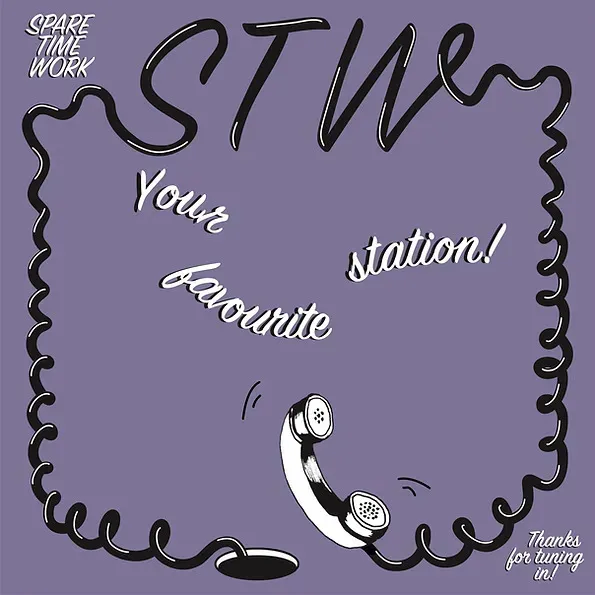
STW, your favourite station!
STW, your favourite station! functioneert als een radioprogramma. Een boek dat lyrisch proza uitzendt van We make stuff up for a living (een CV medley) tot COMPUTER_SONG, een ceremoniële quiz met Adult Hood & Young als protagonisten, een grillige anekdote van iemand die zich ergert aan een Call Service, en meer! Thanks for tuning in!

Unbidden Tongues #10: Professional Agitator
From the beginning, Unbidden Tongues has claimed to publish 'previously produced yet relatively uncirculated work by cultural practitioners busy with questions surrounding civility and civic life-particularly in relation to language and its administration.' However, over the course of the first nine issues, the 'civic' aspect has been relatively less pronounced, though undeniably subtextual. As such, Professional Agitator-a publication that includes two landmark feminist articles by Jo Freeman-is an attempt to bring civic responsibility more overtly to the surface. While first penned in the 1970s, the articles have a timely relevance, not only because, shockingly, many of the issues on the bill for the women's movement at Freeman's time of writing-employment discrimination, affordable childcare, reproductive rights and sexuality- are back on the table in the U.S. and elsewhere with full force, but also because, in thinking intersectionally as the movement taught me to do, we find ourselves in a moment of necessary and urgent mobilisation for Palestine; with speaking up and out being reprimanded with various forms of organised silencing.
(From the foreword)

the boy, the bucket and the persistent tide
the netherlands has been the home of irishman charlie jermyn for the last 5 years; it’s a nation that has been dredged up from the water and which attempts, to this day, to hold back the persistent tide. in this brilliant and very-hard-to-describe debut novel, jermyn brings the common and absurd to crisp, shimmering life through his essays and short non-fiction pieces, reminding us to take note of the mad and brilliant world around us before the tide comes in again.
illustrated by samuel van heijningen

Cancelled Confessions (or Disavowals)
First published in 1930 by anti-fascist, avant-garde publisher Éditions du Carrefour in Paris as Aveux non Avenus, Cancelled Confessions (or Disavowals) is Claude Cahun’s wildly radical answer to an invitation to write a memoir. Shattering the very premise of the “memoir”—the singularity of identity—into sharp and prismatic fragments, Cahun assembles an ever-mutating inquiry into the instability of “self” and its many masks.
Masculine? Feminine? It depends on the situation. Neuter is the only gender that always suits me.
Using a multitude of forms (fables, jokes, aphorisms, letters, dialogues, dreams, hymns, pronouncements, etc.), to plumb the subjects of desire, love, gender, sex, fear, faith, religion, and vanity (among others), Cancelled Confessions (or Disavowals) is a tour-de-force work of resistance: it provokes the reader to enter the capacious, provocative, playful, and deeply imaginative space constructed by Cahun in defiance of all categorization, to repudiate a delimited, censured world and embrace, instead, the outcasts and cast-offs, the unknowable and the unknown.
I believe, but in the conditional: I would like to believe.
Thoughtfully redesigned to emulate the original artist’s book, this revised edition of the out-of-print English translation by Susan de Muth—originally published in the UK by the Tate in 2007 and in the U.S. by MIT Press in 2008—includes novelist and critic Pierre Mac Orlan’s original 1930 preface along with contemporary essays by scholar Amelia Groom and translator de Muth. Almost 100-years-old, it is not only prescient, but urgent, in.
It’s not enough to be vanquished, you also have to know how to turn defeat to your advantage.
Translated by Susan de Muth, preface by Pierre Mac Orlan, essay by Amelia Groom.

Nothing About Interior Architecture
Javier Fernández Contreras, Youri Kravtchenko and 1 more
Often dissident, sometimes adherent, Nothing About is, in essence, indefinable because it is adaptive and fluid. Speculative or hands-on, this discipline – if we can call it that – displays all the ambivalences of our contemporary lifestyles: superficial and profound, profane and divine, present everywhere and nowhere, and often regarded as futile, even though it could nonetheless destroy the most beautiful of insides. This book brings together a variety of intellectual tools and insights – polysemic and ambiguous, bespoke and improvised, ornamental and criminal, spanning media, technology, the arts and other, often undefined fields – that analyze the impact of the discipline on contemporary design. In the end, what makes Nothing About charming is that this inside – insofar as it is still defined as such – has only the humble ambition of accompanying beings, both animate and inanimate, within their environment, like a friend who is never far away.
Introduction by Javier Fernández Contreras. Text contributions by Daniel Zamarbide, Line Fontana & David Fagart, Valentin Dubois & Bertrand Van Dorp, Camille Bagnoud & Ahmed Belkhodja, Javier F. Contreras & Roberto Zancan, Paule Perron, Philippe Rahm, Youri Kravtchenko, Leonid Slonimskiy, Simon Husslein, Vera Sacchetti, Jan Dominik Geipel, Valentina De Luigi, Jean-Pierre Greff.

Local Ecology – Moulin des Ribes
A contemplative photographic series by Jochen Lempert, created during a residency at the Moulin des Ribes in Grasse, a former mill nestled in the Provençal landscape.
Known for his background in biology and his distinctive analogue black-and-white photography, Lempert brings a scientific sensitivity and poetic restraint to his exploration of the site's immediate environment.
Shot entirely on location, the images focus on subtle interactions between natural forms and their surroundings. Rather than constructing grand ecological narratives, Lempert observes everyday life in and around the mill, drawing attention to the interdependencies and ephemeral presences that define a place.
With the intimacy of field notes and the tactility of silver gelatin prints, Local Ecology. Moulin des Ribes is both a document and a meditation. It reveals the overlooked ecologies that persist on the periphery of human attention, transforming the act of looking into a form of ecological engagement. In the silence of these photographs, Lempert proposes a different kind of knowledge—rooted in slowness, attunement, and care.
The photographs included in this publication were taken in the summer of 2021 during a residency at La Società delle Api, Moulin des Ribes, Grasse, based on an idea by Cristiano Raimondi.
Jochen Lempert (born 1958 in Moers) is a German photographer. Trained as a biologist specializing in dragonflies, he began his career as a photographer in 1989, at the age of 31, developing an artistic practice based on this scientific heritage, marked by images of nature where the animal and vegetal go hand in hand.

Friends and Family
This first monograph includes all of Van der Stokker's murals and most of her drawings.
In an interview in this collection of Van der Stokker's wall paintings and drawings, John Waters says, 'Millions of teenage girls have drawings that are good, but no one ever tells them that they are'. Van der Stokker celebrates teenage girlishness, and has since 1983 found both immense support and immense rejection within the art world community. Includes interviews with Van der Stokker and a complete presentation of her works in situ, printed on full-page spreads on quality mat paper.
Dutch-born van der Stokker (1954, Hertogenbosch), active artist-gallery owner on the East Side of New York in the 80's, now lives between Amsterdam and New York. She developed pictorial murals with happy candy-coated slogans that incited acid sarcasm from her contemporaries.
Texts by Anne Pontégnie, Éric Troncy, John Waters/Charles Esche, Mirjam Westen, Amy Kellner.

Profusione
A comprehensive overview of the unique work of the Italian artist born in 1931 and "discovered" late on the international scene, with numerous texts and an interview.
Published after the eponymous exhibition at Consortium Museum, Dijon, April 26th – September 8th 2024.
Born in Naples, Italy, in 1931, Isabella Ducrot is a young artist with a young career. Like many women of her generation, she moved into art after raising her children. Her formative years were marked by continuous travels with her late husband, during which they amassed hundreds of Persian miniatures and rare antique textiles of many kinds.
Contributions by Franck Gautherot & Seungduk Kim, Verena Lueken, Tobias Pils, Tschabalala Self, Andrea Viliani, Miranda Fengyuan Zhang.

Destination: Tashkent – Experiences of Cinematic Internationalism
The legacy and posterity of the Tashkent Festival for Asian, African and Latin American Cinema, which was held between 1968 and 1988 in Uzbekistan.
Between 1968 and 1988, the Tashkent Festival of Asian, African, and — from 1976 onwards — Latin American Cinema was held in Tashkent, Uzbekistan. As an exercise in soft power and a response to anti-colonial movements and the socio-political upheaval of the late 1960s, the festival grew into a unique gathering for film professionals and became an important platform for South-South solidarity that went beyond the cinema halls of Tashkent. In essays and conversations by researchers, film-makers, and organizers of contemporary film festivals, the Destination: Tashkent Reader reappraises the original festival's programming, while also looking critically at its legacy. From the vantage point of Berlin-based diasporas of Asia, Africa, and Latin America, the reader also investigates how such practices of encounters and collaboration resonate within the film scenes of these three continents today.
Contributions by Cana Bilir-Meier, Souleymane Cissé, Pascale Fakhry, Zach Ramon Fitzpatrick, Sophie Genske, Timur Karpov, Ali Khamraev, Valeriya Kim, Carlos Kong, Bonaventure Soh Bejeng Ndikung, Maren Niemeyer Jacqueline Nsiah, Furqat Palvan-Zade, Marie Helene Pereira, Elena Razlogova, Aykan Safoğlu, Masha Salazkina, Alex Moussa Sawadogo, Can Sungu, Echo Xuedan Tang, Sarnt Utamachote.

Jaw Filler
Maz Murray, Charlie Markbreiter
'You don't need dysphoria to be trans. You don't need a body at all.’
When Sean Hastings, (the first) transgender private detective, is asked to investigate the disappearance of Character, he enters the First Trans Commune in Sim World, a virtual reality community imagineered by transfluencer Kevin and bankrolled by VSI, a mysterious tech company.
At VSI, representation matters, which is why Taylor, the token QTPOC face, runs their latest project. Haunted by the death of his cis gayguy college bestie and their shared diasporic dilemmas, Taylor sees potential in Kevin’s ability to Release trauma into the virtual world, while Casey, Sean’s ex, seeks Releasing as the latest Long Plague miracle cure. Then femme fatale Mitchelle reappears, and the plot thickens.
A pulpy neo-noir romp through the anxiously assimilated transmasculine id, Jaw Filler asks: who is VSI, and what do they really want? Can you be your own dad? And if Character’s mind is trapped in Sim World, then where is his body?

Viscose 01: Style
The very first issue of Viscose tackles the expansive notion of “style”. Both a noun and a verb, style can be understood as the most basic unit or currency of fashion. Style names the very movement of aesthetics in society, and thus holds an important place in the critique of art and visual culture more broadly.
As a verb, it connotes a tactic: a dynamic tool for persuasion and communication through the bricolage of signifiers. It also relates directly to the contemporary profession of “styling”; a practice native to the fashion industry, but increasingly prevalent across the arts, media, consumerism, and politics. Thiss issue of Viscose sets out to critically gesture to all of these connotations and their potential intermingling through concrete case studies and cross disciplinary philosophical speculation.
with contributions by:
Shanzhai Lyric, David Lieske, Bakri Bakhit, Dena Yago, Matthew Linde, Burke Battelle & Ada O’Higgins, Davide Stucchi, Taylore Scarabelli, Mahoro Seward, Jordan Richman, Giorgi Gago Gagoshidze, Hito Steyerl, & Milos Trakilović, Laura Gardner, Avena Gallagher, Alex Esculapio, Elise by Olsen and Jeppe Ugelvig